Are We Teaching Spelling All Wrong?

At its core, Beneath the Surface of Words by Sue Scibetta Heglund argues that we’re teaching spelling all wrong by focusing on sound to symbol correspondence. After all, even in the widely cited Hanna and Hanna paper (full text here), only about half of English words can be spelled correctly using phonetics. To focus merely on phonetics still means that a huge number of words have to simply be memorized.

I’ve been using Logic of English Essentials with my older elementary children for the past four years – and that program leans heavily into sound to symbol correspondence. I’ve seen great improvement in spelling from my dyslexic student since beginning the program – but then again, it’s also been four years with lots of growth in lots of areas! One of the hallmarks of the “sound to spell” in Logic of English is overpronouncing sounds that we normally use the schwa for in order to cement the spelling into our heads. The problem is that in order to “say-to-spell”, we need to first know the spelling. I may think “Be-ay-yu-tiful” when I say “beautiful”, but that’s because I already know how its spelling. Same with “cray-on” or “roy-al.”

In addition to the difficulty of the schwa, a sound-to-symbol approach to spelling requires the memorization of lots of words where the sound could be represented by several different phonograms. For instance, the sound /er/ can be represented by ER, IR, UR, or EAR. Logic of English teaches each of these and their frequencies (ER is the most common), but ultimately the student either needs someone or something to prompt them (“Use IR the /er/ of bird” or looking it up in a dictionary or online) or needs to memorize which /er/ is used in each word. There are dozens of other sounds that can be represented by multiple phonograms.

The reality is that English pronunciation and spelling isn’t one-to-one. Depending on the dialect, many sounds go unpronounced or are pronounced in unexpected ways. If children (and adults) are going to learn to spell well, they need something beyond JUST sound to symbol correspondence.

Enter the relatively new discipline of “Structured Word Inquiry”, which Beneath the Surface of Words (BtSoW) describes. BtSoW posits that English is not primarily a phonetic language but a morphonemic language. That is to say, spelling expresses the meaning of words beyond just the sounds of words.

As a result, to learn to spell a word, we can benefit from looking at the meanings of words and of their “morphemes” – the smaller units of words, including stems (what many of us grew up referring to as “root words”), prefixes, and suffixes. We can look at related words that use the same stems. And we can look at the etymology (the history) of the word as it moves from language to language. All these will help us understand both the meanings of the words and the way they are spelled the way they are.

Beneath the Surface of Words gives dozens of detailed examples of words that are hard to spell from a phonemic standpoint but that make sense once one has explored related words and/or etymology of a word. For example, I loved the illustration of a student who had a hard time keeping a list of literary terms straight until she analyzed “personification” and saw “person” in it. (Does that seem “well, duh” to you? That’s probably because you already have an morphophonemic understanding of each of those words – but since “person” is pronounced with the schwa as persun, a child, especially one with a language learning disability like dyslexia, may struggle to make this connection without help.) Another fun example was learning why there’s an “l” in yolk – it traces way back to Old English when the yolk (geolca) literally meant the “yellow” (geolu) part of the egg.

So am I ready to throw away or resell my Logic of English curriculum?

Nope, not at all. I still find great value in the systematic teaching of the phonetics of the English language, including the phonograms and the general rules (BtSoW would call them conventions) of spelling. Furthermore, Logic of English isn’t just spelling (maybe not even primarily spelling?) So I’ll continue using Logic of English with my elementary school students. But I’ll probably be working harder to look at and explore the morphology of the English language as we go through Logic of English together.

And for my rising middle schooler (how the time has flown!)? We’ll be doing Structured Word Inquiry to help her grow in spelling and in vocabulary as she’s encountering more and more complicated words that don’t necessarily easily translate from sound to spelling.


When the Roll is Called on Sunday…

I’ve been typing up the lyric sheets for next year’s hymn study (we learn a new hymn every seven week interval) and one of my children (who shall remain nameless) started complaining about how we never learn TRULY new ones that they’ve never heard before.

Now, Daniel and I have already chosen next year’s hymns – selected from songs that are personally meaningful, theologically rich, and a part of our church’s corporate worship – so I’m not planning on changing anything.

But I was a bit curious as to what said child thought we should be learning. So I started singing one after another, trying to find something that I knew that was unfamiliar to her. Strike after strike until I got to an old song I learned in Sunday school from a then elderly retired missionary couple who likely sang it in Sunday school in the 20s or 30s.

Everybody ought to go to Sunday school,
Sunday School, Sunday School
The mommies and the daddies and the girls and the boy
Everybody ought to go to Sunday school

So let’s get up on Sunday morning and get out to Sunday school
Though the weather be so cloudy or so gray
So today and every Sunday this will always be our prayer
When the roll is called on Sunday I’ll be there

And then into the chorus, sung just like “When the Roll is Called Up Yonder”

When the roll is called on Sunday
When the roll is called on Sunday I’ll be there

I finally found one that was unfamiliar! Curious, I started looking around to see if I could find any recordings of said “hymn”. Alas, none could be found on Spotify – and even Google struck out.

What about you? Have you heard this one before?


Room for Schooling

My mother raised and homeschooled my six siblings and I in an 1100 square foot house (with a basement) on half an acre. So I knew from the get-go that it could be done.

But I also knew that my mother spent a lot of time dreaming of adding on to the house because raising and homeschooling seven children in an 1100 square foot house can be… cramped.

We had file crates to hold our school books, and we generally ate dinner with our crates under our dining room chairs – there wasn’t room for a dedicated space for them so they ended up wherever they could fit.

So when Daniel and I designed our house and had it built in 2015/16, knowing we wanted a whole passel of kids and to homeschool them, we built a 1200 square foot house (with a basement) but had a large space built into the rafters that could be turned into a school room when the time came.

We finished the basement after 3 years in 2019, when we were up to four children and pregnant with another one (the first baby we lost.)

Another 4 years and we were adding our third student to the homeschool (we were up to five kids now, having reintegrated our foster daughter with her family and had a couple more bio kids.) We decided it was time to finish the upper room.

But then God saw fit to give and take away and give and give again. We lost a second baby and God added two more children to the family – one through adoption, one biologically. The process of all that was consuming enough that we put a pause on the school room finishing project.

But now, with a fourth student slated to join our homeschool in July and three preschoolers in the wings (one chomping at the bit to be taught to read), we are at last finishing up our school room – another 500 feet entirely dedicated to school.

Construction began today – to say I’m excited is a bit of an understatement :-P


The Grace of Hard Beginnings

Daniel and I discussed it before we got married, maybe even before we’d officially decided to get married. Both of us wanted a big family (at least by modern standards – Daniel wasn’t nearly as ambitious as I before I became his THE ONE), and we both knew we wanted to build our family biologically AND through adoption. Little did we know how difficult either of those desires would be.

My mom had uncomplicated pregnancies, multiple home births. I expected that would be my story as well. But then I developed severe preeclampsia at 30 weeks with my first baby.

And my first babies were all rough sleepers. And some among our first have had learning disabilities. And all of them are what the psychologists call “strong-willed.”

We had a hard beginning to the starting of our family. A hard enough beginning that many expected us to stop after one or two.

But I had discovered that difficult doesn’t have to be a deal-breaker. God had used and still is using our difficulties around pregnancy and parenting to teach me dependence on Christ and to sanctify me into his image. He used and is using my children to expose sin and to call me to greater righteousness.

And when the time came for us to start parenting children from hard places, we were able to take in stride a lot of the difficulties that throw other foster parents or potential adoptive parents for a loop. Yes, fostering and adopting is still different, but it hasn’t (for us) been significantly harder than parenting our biological children.

I have always considered the difficulty worth it. After all, these are children, persons made in the image of God! Any amount of difficulty can be borne for the privilege of shepherding these precious, priceless people.

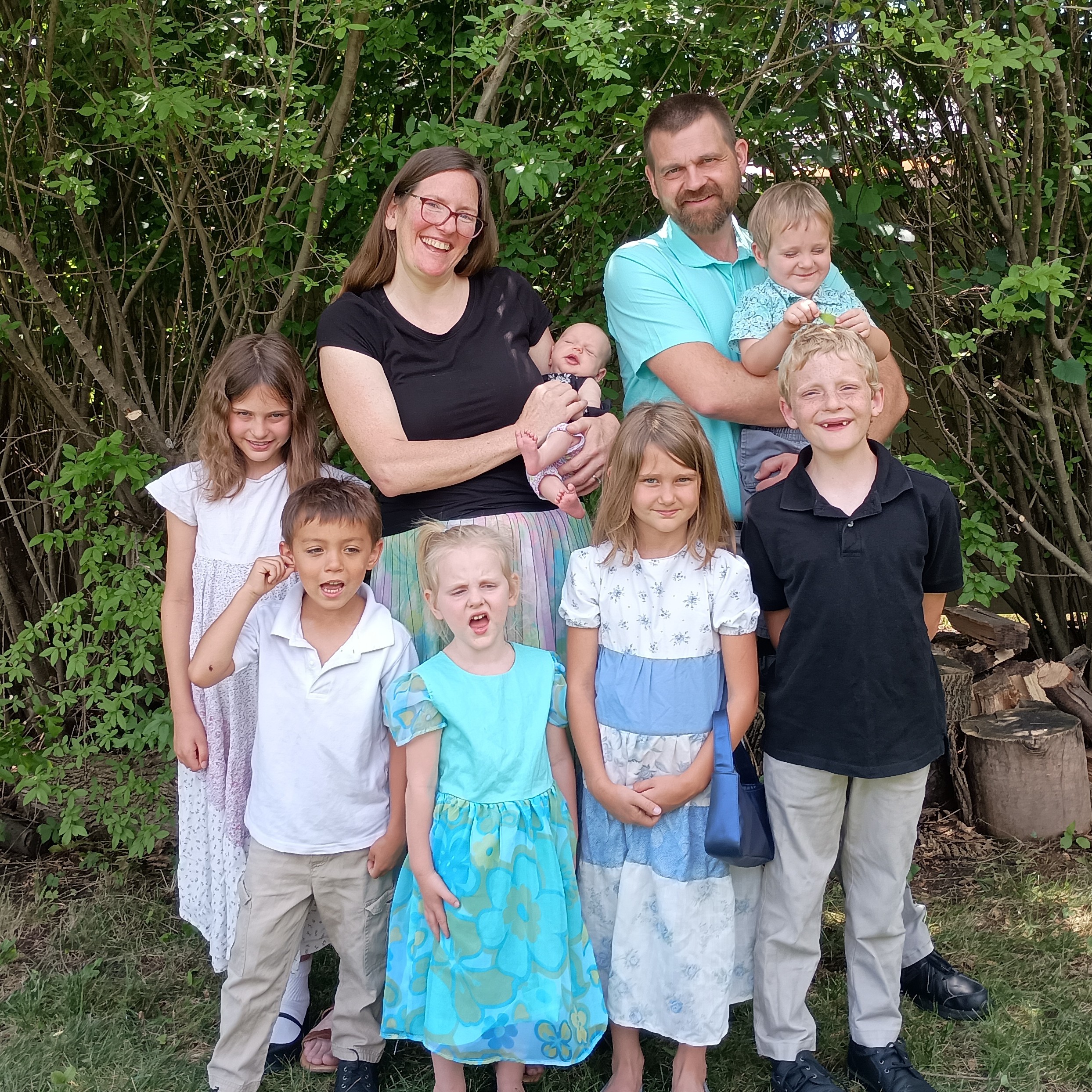
With our seven precious absolutely-worth-it children.

But while I’ve considered it worth it, and have been thankful for the spiritual growth I’ve experienced through the process of pregnancy and parenting, fostering and adopting, I’d not understood the great grace of having a hard beginning.

You see, after eight pregnancies (all hard in their own ways) and parenting nine children (5 biological, 4 foster), I ended up with the elusive (to me) “good baby”. Moriah has been sleeping a five-hour stretch each night since she was 6 weeks old. I’ve never been able to expect a five-hour stretch until at least 9 months.

And now I realize that if I’d have had this easy a time with my first, I’d have quit after the first hard one. After any of the rest of my children. Every other child would have seemed too hard. Fostering would have seemed an impossibility. Adopting? So much for that desire.

But God granted me the grace of hard beginnings, and waited until we already knew we were ready to finish our family before he gave me an easy child.

Praise God for his grace in giving us the privilege of raising these 7 precious children (and the three he allowed us to parent for only a time.) Praise God for his grace in keeping any of our children from being “the one that broke the family.” Praise God for the grace of hard beginnings.


**Of course, Moriah is only four months, so whether she remains “easy” remains to be seen. Certainly, the postpartum preeclampsia I experienced with her and her early difficulties with weight gain were not particularly easy – nonetheless, the overall experience with her thus far has been nothing like the “deep end” God graciously threw us into with our first pregnancy and several of the others, teaching us to cling closely to him as our life preserver.


Many birds with one stone

We’re gearing up to start our school year this next Monday, which means I’m busy finishing up the great school-supply reset. I’ve been going through the house and collecting all the school- and office-related detritus and attempting to sort it all back to where it belongs.

I’ve just been throwing caps onto markers willy-nilly and stuffing them into a can – but today was the day to go through them all and see if they actually write.

Several dozen didn’t. But since the kids were clamoring to paint, I decided to try an experiment. I had the kids sort the spent markers by color and we stuck the tips in water in baby food jars for a half hour. Not-quite-instant watercolors!

We painted at least one page per person before lunch, at which point there was still plenty of “paint” left. So I pulled out the rice that’s been sitting on the kitchen counter for an embarrassing length of time after the girls stuck their unwashed hands in it while making rice bags (so I didn’t want us to eat it!) A cup of rice in a jar plus what was left of the most brilliant paints (blue, orange, black, and brown were standout favorites). Shake, shake, shake and dump onto a dehydrator tray to stick in the dehydrator along with a batch of yogurt.

I still had dye left so I went hunting for more ways to use it up. Here, I have some orzo in the cupboard from a recipe I tried years ago and some macaroni from when the neighbor was cleaning out her pantry. Shake, shake, shake.

Colored orzo in foreground with breastmilk storage shakers in background

Once the rice and pasta were all dry (much more quickly than I expected), I poured them into old two and four ounce breastmilk bottles acrued while we had little ones in the NICU. Now that Moriah’s here and it’s clear I’m not needing to pump, I can get rid of my surplus. I already gave 60 to our preschool program director at church to make rhythm shakers for preschool music – but I’ve still got several dozen and my own preschoolers could use some shakers for school this year.

Because I’m going to be doing preschool with three this year. Reuel and Shiloh are clearly ready for pre-K, but now that Frank is finally starting to talk he’s also demonstrating that he’d really like to join in with school too – at the very least, with the songs and finger plays and rhymes.

So there we have it. I’m not sure exactly how many birds that is, but we got a lot accomplished out of figuring out which markers were still usable today. Painting with the children. Making shakers for preschool. Using up some loose pantry items. Using up some leftover breastmilk storage containers. And, turns out, about a half dozen of the markers revived after soaking (all half dozen were thick tip Crayolas) and were able to return to use.

Hooray for a productive day!


What kind of Clutterbug are you?

Cassandra Aarsen’s The Clutter Connection makes a bold claim: that all people fit into one of four clutter categories based on their preferences around the visibility of their organization system and the degree of organization within their system.

“Butterflies” prefer visual abundance and organizational simplicity. They need big, visible, easy-to-access containers that make it easy to toss something back where it belongs (even if it’ll take some extra time to dig around for the specific battery they need.)

“Bees” prefer visual abundance AND organizational abundance. They like to see their stuff, but they also like to micro-sort it into dozens or hundreds of categories.

“Ladybugs” prefer visual and organizational simplicity. They want things out of sight but have little patience for maintaining detailed systems.

“Crickets”, on the other hand, prefer visual simplicity and organizational abundance. They want things neatly filed out of sight into complex organizational schemes.

Okay, sure, you may be saying. Everyone has different preferences. So what?

Well, if the best organizing system is the one you’ll actually use… then knowing your type and that of the members of your household can be helpful.

And that’s the real strength of this book. Aarsen gives lots of tips for how to help the clutterbugs in your life keep on top of their stuff. Perhaps the most helpful tip for those of us in a huge household is to defer to visual abundance and organizational simplicity. It’s easier for a lover of visual simplicity to hang jackets on a coat rack than to get a lover of visual abundance to open the closet, get out a hanger, and hang up their coat. An abundant organizer can create an “inbox” for broad categories so that the simple organizer can toss items in – the abundant organizer can always micro-organize later.

I took Aarsen’s quiz and discovered that nearly every question slotted me neatly into the “visual abundance, organizational abundance” category. I didn’t pay any attention to which bug that was – which meant I was sure her quiz had gotten me wrong when she started describing the “bee”. It fit me to a T! Silly me for not paying attention to the moniker – I’m a total bee.

As is Daniel. Our kids, on the other hand? At least one is definitely a butterfly – and probably a whole lot more than one. We need to simplify our organizational systems wherever the children interface with them. And we need to have less stuff. Sigh.

All in all, I found Aarsen’s book to be an enjoyable and thought-provoking listen as I’ve been sorting through seemingly endless boxes of loose parts. Whether the insight I’ve gained will be able to help keep those loose parts from finding a place back in a random box? That remains to be seen.


What I do for myself

Eloise Rickman, in her book Extraordinary Parenting, writes of asking mothers what they do for themselves only to meet blank stares. Many mothers don’t do anything for themselves.

I had to stop the audiobook to clarify to Beth-Ellen, who was folding laundry alongside me, that I was not one of those women. I am no martyr. I do things for myself all day long.

I make my bed when I wake up and delight in the beauty of the quilt my mother made us or the one I made myself.

I copy out a passage of Scripture, slowly working my way through a text.

I cuddle with one of my little ones as they slowly wake up.

I peer out the window at the newest visitor to our bird feeder, trying to memorize its features so I can look it up later (if I don’t know its identity) or pointing out its various features to my children if I do know something about it.

I memorize passages of Scripture and sing hymns with my children during our morning worship.

I grub about in one of my many beds of native plants when I step outside to call the kids in or to get the mail or to empty the compost pail.

I read The Story of the World and Hans Christian Anderson during “together time.” I read poems, old and new. I learn the names of the clouds with my children and what weather each type of clouds portends.

I take long baths while reading up on whatever my current pet topic is.

I dream up and research out the next garden bed and then work to implement it.

I plan the next year’s school curriculum and delight in thinking of the next subjects my children and I will deep dive into together.

I sketch ideas for the next Easter or Christmas outfits and then comb through the patterns I have and what free patterns I can find to approximate the vision I have in my head. I dig through my fabric collection and delight in not spending anything, except joyful time sewing, on my kids’ festival clothing.

I make cut-up cakes for my kids’ birthdays, with each opening of the Twizzler bag bringing back fond memories of the cakes my grandma made me.

I do these things for myself day in and day out. Just because I also do them with or for others does not make them any less for me.

Sometimes, my family and I drink deeply together of life-giving water. Other times, I pour out and find myself all the more enriched for having used the things I delight in to serve my family.

Truly, I lead a rich and fulfilling life.


4 Things to Do When You’re Stressed

I had a headache today as I was trying to get a whole lot of Christmas preparations done while simultaneously trying to play a game the kids wanted me to play with them (note to self: trying to multitask when one of the tasks is “play a board game with the kids” is only going to result in frustration.)

Anyway, I was getting frustrated and stressed and overstimulated.

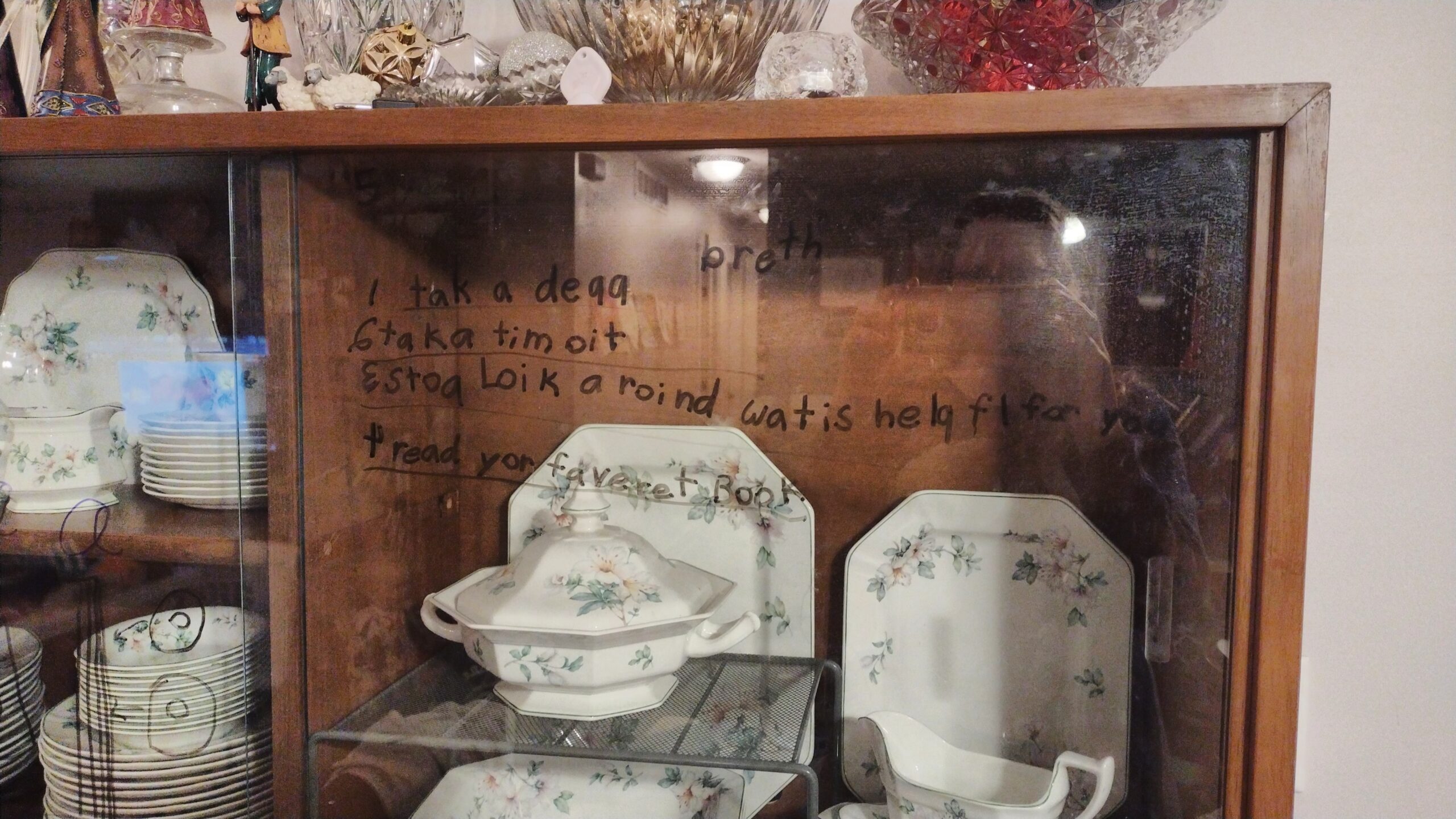
Tirzah Mae's list of things to do when I'm stressed
Tirzah Mae’s list of things to do when I’m stressed

Tirzah Mae got out a dry erase marker and wrote up a nice list of things I can do when I’m stressed :

  1. Take a deep breath
  2. Take a time out
  3. Stop, look around. What is helpful for you?
  4. Read your favorite book

It’s a very nice list, and definitely worth trying next time I’m stressed.


My Girls are Potty Training

ALDI had Cocomelon underpants on their ALDI finds aisle, and I bought some (who am I? I don’t buy branded stuff! But, alas, I am growing soft in my advanced age as I realize my time with little-littles is nearing its end.)

My guess that this might motivate Shiloh to try potty training was absolutely correct. She eagerly put them on and set off to run, run, run to the potty, aided by big sister Beth-Ellen. Beth-Ellen was quick with the hands-on part of training – grabbing Shiloh’s hand and running with her, noticing if it had been been a while since she’d been potty and asking her if she needed to now, and helping Shiloh fold her new underpants and put them away.

Beth-Ellen wanted me to get out the little blue potty and to turn on the Daniel Tiger potty episode, but I declined. Shiloh is proficient with climbing on the big potty seat and using the fold down little hole. And I still don’t watch TV with the kids except in dire circumstances (Shiloh knows Cocomelon from Saturday morning cartoons with papa – not because *I* show the kids shows!)

Tirzah Mae helped in her own way, sitting down with paper and pen to devise a potty-training program complete with an elaborate tracking and rewards chart.

I told Daniel about the girls’ potty training project last night and he just had to laugh (especially about the potty training program!) “They’re *your* daughters!” he said.

Why, yes, yes they are!


Sensory Delights

There was something stinky in the kitchen trash, but kids were already sitting down for breakfast and I wasn’t wearing shoes to take it out, so we opted to diffuse some essential oils to mask the smell.

It being fall (at last!), we decided to try some fall scents – and arrived at a blend that delighted us all day long.

See my diffuser there? I’m no essential oil enthusiast (MLM + uber-questionable health advice = Rebekah’s not a fan) but I’m allergic to a lot of fragrances, so blending my own smells lets me screen out the stuff that gives me sneezes!

I liked it so much, I put it in again today just for the joy of it (no stinky trash needed.)

In case I forget, it was 4 drops cedarwood, 4 drops cinnamon bark, 2 drops cloves, and 10 drops orange.