Book Review: The Little White Horse by Elizabeth Goudge

Elizabeth Goudge’s The Little White Horse is a children’s fantasy book curiously set up in twelve chapters with 3-5 parts each.

In the first chapter, we set the stage and introduce a few of the main characters: newly orphaned thirteen-year-old Maria Merryweather, Maria’s governess (who suffers from indigestion and eats very delicately), Maria’s dog Wiggins (who lives to eat), the enormous Sir Benjamin with whom Maria is now going to live, Sir Benjamin’s enormous not-quite-dog Wrolf, and two individuals whom Maria’s governess is sure are entirely imaginary. Goudge’s descriptions here in chapter one are delightful.

“It was indigestion that had ruined her nose, not overindulgence. She never complained of her indigestion, she just endured it, and it was because she never complained that she was so misunderstood by everyone except Maria. Not that she had ever mentioned her indigestion even to Maria, for she had been brought up by her mother to believe that it is the mark of a True Gentlewoman never to say anything to anybody about herself ever. But Miss Heliotrope’s passion for peppermints was in the course of time traced by the discerning Maria to its proper source.

So distressing was Miss Heliotrope’s nose, set in the surrounding pallor of her thin pale face…

But chapter one also introduces us to Mysteries–Mysteries that compound over the course of the book, one partially resolving to unveil yet another yawning one. What is it about the little white horse that Maria sees when she first arrives, which Sir Benjamin seems to recognize, but which is never seen again? Why has their not been a woman in Sir Benjamin’s house for 20 years, and who keeps the house so clean and prepares Maria’s clothes each morning? Why do the Black Men of the forests of Moonacre wreak such havoc on the inhabitants of the area?

Of course, Maria manages to eventually figure out the mysteries and solve every problem Moonacre has, all the while picking up an entourage of adoring people and animals. And everyone gets married in the end.

This was my first reading of The Little White Horse, and I enjoyed it tremendously. The story was engaging, a light little escape into a fantasy world where I knew everything would turn out all right in the end.

That said, I spent plenty of time suspending disbelief. When every person takes to Maria immediately and starts disclosing deep secrets. When Maria’s stories, invented on the spur of the moment to get her out of difficulty, turn out to be true. When Maria gets married at age 13.

Yes, that’s right. Among the three marriages that occur at the end of the book are 13-year-old Maria’s marriage to her beloved once-presumed-to-be-imaginary-friend who used to visit her in London (for real but while he was dreaming in Moonacre?)

Yeah, plenty of suspension of disbelief. I nodded all the way through Carrie’s review. That said, I still liked it. I just did.

I wouldn’t mind owning a copy. I wouldn’t mind reading it out loud to my children at some point. I would point out that getting married at 13 is not at all the thing.


Rating: 3 stars
Category: Children’s fantasy
Synopsis: A fun, frivolous fantasy in which an orphaned girl sets things aright in Moonacre, her cousin’s ancestral property.
Recommendation: Read, but be prepared to suspend disbelief


I read this as a part of Carrie’s Reading to Know Classics Book Club Check out what other bloggers are saying about this book there.


Planning for a healthy pregnancy (Part 1)

By the time I see a pregnant woman, there’s only a very limited amount we can do.

We can manage nausea and try to have appropriate weight gain. We can make sure she doesn’t get listeriosis. We can treat her anemia. We can try to get her blood sugars back under control. But generally, we’re too far behind to make a significant difference.

If we really wanted as healthy a pregnancy as possible, we’d have needed to start before she got pregnant–not at 20 weeks along.

So, say you’re thinking about having a baby…what are the first steps you should take to plan for a healthy pregnancy?

1. Quit bad habits

If you smoke, you’re currently starving your body’s organs of oxygen. If you get pregnant while you’re smoking, you’ll be starving baby of oxygen. Womb-asphyxiated babies don’t grow as well–they are more likely to be born prematurely and more likely to be born small, both of which increase the risk for a whole slew of problems in infancy and beyond. Stop smoking before you start trying.

If you use illegal drugs, cut it out. Cocaine, meth, and narcotics all increase the risk of low birthweight and preterm birth. Think that’s not so bad? Low birthweight and preterm birth are the single leading cause of infant death. Furthermore, your baby can get addicted to those drugs in utero–and when they start going through withdrawal in the delivery room? You’re going to get your baby taken away.

Think marijuana’s okay? It’s legal in two states, so it’s fine, right? Think again. Marijuana use increases risk of at least two different types of congenital heart disease–and there’s plenty we don’t know about how marijuana affects pregnancy. It’s not worth the risk.

What about alcohol? If you’re drinking under the recommended amount for women (no more than once a day with no more than one drink on any given occasion), you don’t need to worry too much about this one in the preconception period. But if you’re dependent on alcohol or are used to consuming more than one drink at a time, now’s the time to rein this in to within the recommended amount for women. Since you’re going to be quitting drinking entirely once you start trying, it wouldn’t hurt if you were to cut back beyond the recommendations at this point.

I know that a lot of you are breathing a sigh of relief at this point. You’re good to start trying, you might be thinking.

But there’s more.

2. Attain a healthy weight

There are plenty of people who have their personal tiffs with BMI (myself included), but it does have some value. When we look at BMI as a predictor of pregnancy outcome, we do see an increased risk with both high and low BMIs. The risk of miscarriage is more than doubled in women with BMIs over 30, while women who have BMIs between 25 and 30 are at only slightly increased risk of having a miscarriage. Obesity (defined as a BMI above 30) also increases risk of having an infant born with a neural tube defect. Furthermore, obesity is frequently associated with a host of metabolic and cardiovascular abberations that can cause complications during pregnancy (predisposition to diabetes and hypertension among them). On the other hand, having too low a BMI has problems of its own. Women whose prepregnancy BMIs were below 20 have an increased risk of delivering a baby prematurely (which I’ve already mentioned leads to a whole host of other complications).

The good news is that you can do something about these risks. By attaining a healthy weight prior to pregnancy, you can improve your chances of having a healthy, uncomplicated pregnancy and delivery.

So, check out your BMI. If you’re under 20, start working on gaining weight. If you’re over 30, start working on losing weight.

I know, that last bit isn’t as easy as it sounds. If readers are interested, I’m willing to go into a bit more depth on the best approaches for losing or gaining weight prepregnancy–but this information isn’t dramatically different than normal healthy weight gain/weight loss strategies, so I was thinking to focus more specifically on the items that are more specific to pregnancy in this particular series.


And I’m now up to over 600 words with a bazilliondy things left to mention, so we’ve got ourselves a series :-)


Nightstand (March 2014)

Thanks to getting my final two wisdom teeth out last Thursday, I’ve had opportunity to get caught up on some reading this past weekend. I have not had much time to blog about said reading. So this is all I’ve got for the month!

This month, I read:

  • Laura Ingalls Wilder: A Biography by William Anderson
    A very nice biography of Laura Ingalls Wilder, written at a reading level similar to that of the Little House books. See my full review here.
  • Laura Ingalls Wilder Country by William Anderson
    A nice little book with photographs of the actual places where Laura lived and some of the actual items described in the Little House books.
  • June by Lori Copeland
    Completing a series I began long ago–this one struck me as not very well written at all. Still, I like Christian romances sometimes-especially when I’m recovering from oral surgery :-)
  • Discover your Inner Economist by Tyler Cowen
    A nice look at the economics of everyday life. This is less sensational and more informative than the well-known Freakanomics, which belongs to the same genre. If you’re interested in economics and human behavior, this is an excellent book on the topic.
  • The Little White Horse by Elizabeth Goudge
    I read this for the first time with this month’s Reading to Know Classics Book Club–and enjoyed it a good deal. It required serious suspension of disbelief and was certainly an off-the-cuff fantasy as opposed to a well-reasoned one, but it was fun and I liked it. I’ll review it in more depth later.
  • The Black Moth by Georgette Heyer
    I expected this one to be a Regency, but it turned out to be set a century or so before. Nevertheless, it was a highly enjoyable romp that involved an affair of honor, a highwayman, a kidnapping, a love triangle, and a long-lost heir. It took me a while to get interested in the characters, since I met at least a half dozen before I could figure out which direction the tale was taking–but I’m glad I stuck it out.
  • Program Your Baby’s Health by Barbara Luke and Tamara Eberlein
    Not a terrible prenatal program, but not a great one either. It was written to 2004 and the research on healthy pregnancy has advanced quite a bit since that time. The biggest flaw with this particular program was the advice to restrict physical activity during pregnancy–advice that showed up in nearly every chapter. This one was the most readable of the several books I’ve looked at on prenatal programming, but I can’t really recommend it due to its out-of-date recommendations.
  • Empires of Mesopotamia by Don Nardo
    A very nice little book detailing the various empires of Mesopotamia from Sumer to the Second Babylonian Empire. I was impressed by how well-written and laid out this was, but a little surprised that it had been filed in the adult non-fiction section of the library. I’d say it’s perfect for a late-elementary or early-Middle School introduction to Mesopotamia.
  • Ancient Persia by Don Nardo
    A look at the empire immediately following the Second Babylonian Empire, by the same author as Empires of Mesopotamia. Certain parts echoed the previous book heavily–although this was written at an even lower reading level (early-elementary, I’d say) and filed in the children’s section at my local library
  • The 1920s edited by John F. Wukovits
    I grabbed this title to give me a bit more context on Calvin Coolidge (my husband’s favorite president) and found this to be a perfect introduction to the ’20s. The book is a series of chapter-long excerpts from other biographies and histories of the era–which meant it was easy to read in segments, and gave tastes of a number of authors’ styles (making me kinda want to read some of the books from which the excerpts were drawn.)
  • Williamsburg: a picture book to remember her by
    A book of photographs of Colonial Williamsburg. I wanted to get a taste of what to expect when we travel to Williamsburg this fall with Daniel’s family–and I’m getting really excited to see all those historic buildings and the craftsmen and craftswomen within!

Still in Progress:

  • One Thousand Gifts by Ann Voskamp
  • To-Do List by Sasha Cagen

Don’t forget to drop by 5 Minutes 4 Books to see what others are reading this month!

What's on Your Nightstand?


Thankful Thursday: Little Things

Thankful Thursday banner

There are plenty of big things that I could thank God for, but sometimes it’s the little things that stick out the most.

This week I’m thankful…

…for compliments
I wore a springy green tiered skirt and a teal shirt today, topped off with a blue and green beaded belt and some blue dangly earrings. I worried a bit that my outfit would be a bit too informal for work–but lost my worries when several of my coworkers complimented my outfit. How nice!

…for humbling moments
At lunch, I shed my white ballet flats and curled up on the couch to write my grocery list. When I was done, I slipped my shoes back on and got in the car for work. As I was walking in the door, I looked down and realized that I hadn’t slipped the white ballet flats on–I’d slipped just ONE white ballet flat on. The other was a hot pink ballet flat from yesterday. Of course, there was too little time to return home–and since Thursday is grocery shopping day, I got plenty of weird looks as I went to my three different grocery stores to fill my list.

Two Different Shoes

…for bloody butchers
I started some tomato and pepper seeds several weeks ago and have been faithfully watering and lighting them since–but hadn’t seen anything until a few days ago, when three little hybrid tomato seedlings sprouted. A little was better than nothing, but I’d hoped for more (I planted 6 seeds each of four different types). Then today, I looked at lunch to find two little seedlings popping out. The heirloom “Bloody Butcher” tomatoes had sprouted. This evening, I looked again and saw another two sprouts. Yay!

Seeds Sprouting

…for Facebook conversations
I posted my excitement regarding my bloody butchers on Facebook, and got responses from my sister-in-law, a cousin, my mother, and an aunt. The ensuing conversation was a delight. I’m so thankful I have opportunity to connect with family this way.

…for an expected package arriving unexpectedly
The UPS man arrived during my lunch, dropping off two packages for Daniel Garcia. I didn’t know Daniel had bought anything recently, so I texted him to ask him about the two packages that appeared to be books. (I didn’t open the packages like I normally would because it IS my birthday tomorrow, and I wouldn’t want to ruin a planned surprise). Daniel figured he knew what one of them would be, but not the other. When we got home this evening, we opened them both to find that one was…the copy of Megan McCardle’s The Up Side of Down that I’d won from Carrie’s giveaway. The publisher apparently doesn’t go for the formal and dropped the “Mrs.” before the “Daniel Garcia” in my address :-P

The Up Side of Down

…for repurposed curry
Once upon a time, I had a chicken curry recipe that had much more “sauce” than we could use with the meat. I got the brilliant idea of turning the sauce into a soup and my newest recipe-creation-craze began. This Tuesday, I made coconut crusted chicken (a kinda Indian curry) for Happy Food – and, for ease of preparation, used boneless skinless chicken breasts instead of the whole chicken parts I’d used the last time I made it. The boneless skinless breasts had apparently been injected with significantly more saline than the whole chicken had, because I ended up with flavorful crusty meat on top–and six or seven cups worth of sauce (it’s supposed to be a dry fried-chicken type recipe!) I decided I’d repurpose this one–and did so by simply adding fresh basil and zucchini and pouring it over rice. Voila – from Indian curry to Thai fusion in twenty minutes.

…for this man
Daniel
It’s hard to believe that we’ve now been married a year. A year out and we’re still newlyweds. I asked him if he’d be up for a walk tonight – he said he was. We walked to the liquor store down the street (can’t buy alcohol in grocery stores in Wichita) to get a wine for the stew recipe I’ve been wanting to try. Then we walked to the Braums a little further ’round the block to get milk and buttermilk. We held hands and talked and enjoyed the lovely weather. I am a most blessed woman.

Looking at what I’ve written so far, I realize I’ve only mentioned today’s thankfulnesses-actually only a segment of today’s thankfulness. I haven’t mentioned a conversation about midwifery, reading a devotional before bed, getting a good deal on vitamins. I haven’t mentioned the good evaluation at work or the prospect of Pizza Hut pizza and my favorite wine for my birthday tomorrow. I haven’t mentioned time to read and fascinating conversations sparked by books. I haven’t rejoiced in the research I’ve been able to complete or the breakthroughs some clients have had.

Yet I have so much to be thankful for. Maybe I should start writing a thousand gifts list, like Ann Voskamp (still working on reading it, will give opinions when done.) Maybe I should start recording ten thousand.

“The sun comes up, it’s a new day dawning
It’s time to sing Your song again
Whatever may pass, and whatever lies before me
Let me be singing when the evening comes

Bless the Lord, O my soul
O my soul, worship His holy name
Sing like never before, O my soul
I’ll worship Your holy name

You’re rich in love, and You’re slow to anger
Your name is great, and Your heart is kind
For all Your goodness I will keep on singing
Ten thousand reasons for my heart to find

Bless the Lord, O my soul
O my soul, worship His holy name
Sing like never before, O my soul
I’ll worship Your holy name

And on that day when my strength is failing
The end draws near and my time has come
Still my soul will sing Your praise unending
Ten thousand years and then forevermore”

~Matt Redman “Ten Thousand Reasons”


The Prairie, Revisited

Someday, I’m going to be a pioneer. I’ll travel in a covered wagon, settle on an empty prairie, build a log cabin with timber cut from the creek bed. I’ll cut notches in the logs and carefully set notch upon notch, climbing the corners of the cabin to build it higher and higher.

It’s been a dream of mine since my earliest days, those days when I first read Little House on the Prairie.

But while I’ve been able to accomplish some of the childhood dreams elicited by books, I have not accomplished this particular one-and likely never will.

The closest I’ll get will be building Lincoln log houses with children.

And that’s okay.

I was struck, rereading Little House on the Prairie for the first time in several years, with how much of the book is focused on the mechanics of building a home from scratch–but also much I missed of the rest of the book.

I never caught, on my early readings, just how tenuous the Ingalls’ resettlement was. Pa heard a rumor that Indian territory would be opening for settlement, so he uprooted his family and moved in. Despite there being plenty of non-Indian land around, Pa settled within an Indian reservation–knowing that it was an Indian reservation. He considered it to be just a matter of time before the Indians would be resettled. That’s what happens when white men move forward, he assumed; the Indians move on to make place for them. And of course the US government would back up the white settlers who were squatting on Indian land. Of course.

It’s astonishing to think. How can someone (who isn’t desperate) know that the land they’re living on belongs to someone else but yet still choose to build upon it in hopes that they’ll come out on top in the end?

In some ways, Pa seems so advanced in his views of Indians. He didn’t hate them or fear them, he tended towards the “noble savage” viewpoint (which I definitely had as a child, at least in part obtained from the Little House books). Yet his attitude in settlement was almost like many would treat wild animals. Yes, suburban sprawl will impact the native animal population, but people are more important than animals and the animals will move to other places and adapt.

It’s challenging, revisiting the prairie through these new eyes.

My view of Little House on the Prairie has also changed now that I am married and have moved from being near my family to be with my husband. In the months leading up to our marriage, Daniel and I talked of various directions our life could take-of different educational and professional routes Daniel could take, of different places we might end up living. I blithely told Daniel that I would follow him anywhere.

And it’s true. I will follow him anywhere.

But, having moved once to follow him, my determination to follow him anywhere has much more fear attached.

The move to Wichita has not been easy for me. I battled a depression over this past year that was more severe than any I have battled before. I am now finally, one year out, starting to find my balance. The thought of uprooting again terrifies me.

I can’t help but think of Caroline Ingalls as I read Little House on the Prairie. I imagine how hard it must have been for her, leaving her family and “civilization”, spending months without anyone to talk to but her husband and their children, just starting to establish a home when news comes that you must move again.

I wonder if she felt more sorrow or more relief when it became clear that they must not stay, that they would need to backtrack, that they would return to Wisconsin. Was she sorrowful because of the year lost, the work done and left for others to enjoy? Or was she elated to be returning back to her family, to the little house they once loved? And what was she thinking when Pa’s wanderlust struck again later (when they left for the banks of Plum Creek)?

It’s interesting, revisiting old places and seeing them through older, more mature eyes.

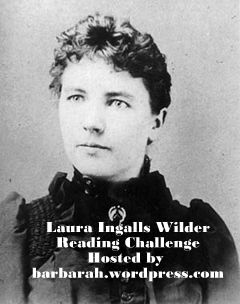
I wondered at the beginning of the Laura Ingalls Wilder Reading Challenge if I wouldn’t try to make something from Little House on the Prairie, like I did with Little House in the Big Woods a couple years ago. I didn’t. The closest I got was creating some log cabin quilt blocks for a quilt for a soon expected nephew and building log cabins with Lincoln logs with the kids of some friends from church.

I don’t regret that I didn’t do more–this year’s challenge was thought provoking enough that I didn’t need the extra activities.

I read this title as a part of Barbara H’s Laura Ingalls Wilder Reading Challenge and the Reading to Know Classics Book Club. You can check out what other people have been reading at Barbara’s challenge wrap up post and the RTK wrap-up post.


Book Review: Laura Ingalls Wilder by William Anderson

I’ve read my fair share of Laura Ingalls Wilder biographies for children–most (if not all) of them fitting into the glossy paged photograph-laden category. Each biography has a tendency to veer one of two directions: either it focuses almost entirely on the information Laura shared in her Little House books (thereby adding nothing for the avid reader) or it focuses almost entirely on the ways reality deviated from the Little House books (thereby destroying a young reader’s trust in the essential historicity of Wilder’s novels.)

Laura Ingalls Wilder: A biography by William Anderson is as different from those biographies as a book can be. It is not a glossy picture book with minimal text. It is not simply a retelling of Laura’s Little House books. Neither is it a critical look at how Laura changed her story.

Instead, it’s an honest to goodness biography written at a reading level (and in a style) similar to Laura’s “Little House” books. Anderson explicitly mentions some things that are different from the books (for instance, that Laura was actually much younger than described in Little House on the Prairie when her family settled in Indian territory); but he mostly writes Laura’s story as it occurred, letting the Wilder fan take notes of where stories were slightly altered or moved to a different context in the Little House books.

I loved it.

I think this book would have been very accessible to me in the throughs of my first Little House obsession (age 6-8), and would have added to my understanding of pioneer life (and Laura’s life in particular) without dissuading me from love for the Little House series.

It is a book of substance not of fluff, written simply but not condescendingly. I recommend it highly.


Having said all that, I think it is important that I clarify. This book is written for an elementary to middle school audience, so it doesn’t go into great detail about certain things. Those who are interested in a more in-depth discussion of Pa’s squatting on an Indian reservation or of other harsh components of pioneer life will be disappointed. Don’t expect an adult biography. But, for what it is, a children’s biography of a beloved author, this is a very good book.

I read this title as a part of Barbara H’s Laura Ingalls Wilder Reading Challenge. You can check out what other people have been reading at her wrap up post.


Rating: 4 stars
Category: Children’s biography
Synopsis: A biography of Laura Ingalls Wilder from birth to death; written for an elementary to middle grade audience.
Recommendation: Definitely recommended for the target audience (although older folks can enjoy it too).