God of Judgment, God of Grace

“In the Old Testament, God reveals himself as a God of Judgment. In the New Testament, God reveals himself as a God of Grace.”

If I had a dollar for every time I’d heard a well-intentioned Christian say something to that effect…

But wait.

I’m pretty sure I’ve said something to that effect.

The problem is, it’s wrong.

Or, at least, it’s incomplete.

God does indeed reveal himself as a God of Grace in the New Testament. But that doesn’t mean He fails to reveal himself as a God of Judgment.

God does indeed reveal himself as a God of Judgment in the Old Testament. But that doesn’t mean He fails to reveal himself as a God of Grace.

I’ve been thrilled to be teaching the Old Testament to three-year-olds in Sunday School this year. It’s great. I love the Old Testament. I love teaching the Old Testament.

And what’s struck me about the Old Testament this time around is that I haven’t yet seen an example of God’s judgment without His Mercy.

When Adam and Eve ate the poisonous fruit, God’s judgment on them meant death and banishment from the garden. Yet in God’s mercy, He promised a Savior and the ultimate destruction of their enemy the snake.

When Cain killed Abel, God’s judgment on Cain meant an end to his livelihood and a lifetime of wandering. Yet in God’s mercy, He set a mark on Cain to protect him from his greatest fear – that whoever found him would kill him.

When the people were so wicked that God could stand it no longer, God’s judgment on the world meant a flood that destroyed all people but eight. Yet in God’s mercy, He preserved eight – and promised to never again destroy the earth in that way (despite man’s evil continuing to provoke His anger.)

When humanity set themselves against God and sought to build a tower to display their own glory, God’s judgment meant confusing their language and their plans. Yet their punishment was God’s mercy, giving them a second opportunity to be obedient – to fill the earth and subdue it.

When Sodom and Gomorrah committed great atrocities before God, God’s judgment meant raining down fire and brimstone on them. Yet in God’s mercy, He let Abraham haggle with him over the fate of the city, promising to save the cities if even ten righteous men could be found. But even when ten righteous could not be found, God’s mercy saved the family of the one righteous man.

The New Testament really only requires one proof text – but it’s the proof text around which every other text hangs. God’s mercy meant pardoning sinful rebels. But his judgment meant pronouncing a death sentence on His Son.

God’s grace meant imputing His Son’s righteousness to wretches. His judgment meant nailing His Son to the cross for the wretches’ sin.

If you think that the Old Testament tells only of God’s judgment, read again.

If you think that the New Testament tells only of God’s grace, read again.

For wherever God reveals Himself, He reveals Himself as the Judge and the Justifier – the awful and the merciful.

“But now the righteousness of God has been manifested apart from the law, although the Law and the Prophets bear witness to it— the righteousness of God through faith in Jesus Christ for all who believe. For there is no distinction: for all have sinned and fall short of the glory of God, and are justified by his grace as a gift, through the redemption that is in Christ Jesus, whom God put forward as a propitiation by his blood, to be received by faith. This was to show God’s righteousness, because in his divine forbearance he had passed over former sins. It was to show his righteousness at the present time, so that he might be just and the justifier of the one who has faith in Jesus.
~Romans 3:22-26 (ESV)


Book Review: The Child in the Family by Maria Montessori

Over the years, I’ve read my share of books about homeschooling, looking forward to the day when I’d be doing history timelines with my elementary students, science experiments with my middle schoolers, and higher maths with my high schoolers. But, then… what do you know? I don’t have any of those. I have a baby. And before she’ll be a high schooler or a middle schooler or even an elementary schooler – she’ll be a preschooler.

Which is why I resolved to pick up something on early childhood education on one of my recent library trips.

And who better than Maria Montessori, right? She’s a universally recognized early childhood educator.

I started with The Child in the Family because we’ll be training our children in our family (not in a school setting) – and because I guessed that this would be about very early childhood, even infancy. And… I was right!

The Child in the Family is highly theoretical.

Montessori begins by stating that children are the last repressed class of humans – practically slaves to their parents, who exercise god-like power over them. She argues that while adults tend to think of children as blank slates, ready to be made after their parents’ image, children are in fact living spirits ready to begin to make their physical selves in their own likeness.

Montessori’s method, then, is all about giving children the freedom to raise themselves, to learn as they desire, to mold themselves as they like.

Montessori’s child is some sort of idealized angel, innately aware of both morality and of his own dignity. When the child sees injustice, he bristles. When his dignity is wounded, his spirit is crushed. As such, adults should tread lightly, recognizing their great potential for injuring this otherwise perfect being.

Does this sound melodramatic? I thought so too.

Montessori seems fully aware of one half of the human condition: Imago Dei. But imago Dei is only one half of the equation. Original sin means the child is not only a spiritual being made in God’s image, but also spiritually dead, bent toward evil.

Montessori’s only-half-right-theory means that her practice is only-partially-helpful. In this volume, Montessori mentions a few practical ways by which a parent or other adult can avoid offending the child. The first is to be patient with a child’s curiosity (a child isn’t being dirty or naughty when he picks up a fallen leaf from the sidewalk). The second is to, for lack of a better phrase, allow the child to be a grown-up. Montessori encourages the use of real miniature glasses and plates and silverware, rather than having unbreakable “child-friendly” dishes. She encourages the use of child-sized furniture that the child can move around (and discourages the use of rubber caps to keep the movement of said furniture from making noise.) She encourages the use of child-sized cleaning equipment so a child can sweep her own floor and dust her own furniture.

In general, I’m okay with those practices. I don’t think I’m anywhere near as dogmatic on the child-sized-but-real stuff – but certainly Tirzah Mae has no interest in using a plastic baby spoon, eschewing it in favor of real flatware (child-sized flatware for her is on it’s way, since she can’t exactly fit the real flatware in her mouth!)

The second to last chapter speaks of the Montessori teacher and how she uses “various stimuli to awaken a sense of security in the child.” She is all about making her educational material attractive to the child so that the child will initiate learning activity. Once the child has initiated the activity, she is careful not to interrupt either with praise or correction (I really appreciate this idea – I often see moms completely disrupt their child’s purposeful play by inserting themselves into the play.) Unfortunately, that is the extent of the discussion of Montessori’s pedagogical methods in this book. I certainly hope she elaborates more in other books – since this proposed role for the teacher seems much more interesting to me than the silly theories about a child’s innate goodness promoted by this particular book.


Rating: 2 stars
Category: Early Childhood Education
Synopsis: Montessori propounds her theory that children are innately good and should be allowed freedom to mold themselves as they like.
Recommendation: Lots of ridiculous theory, very little of practical use. Skip it.


Vacation (Part 2): Thai and Travel and Porch Swings

September 6: Day 2

Sunday morning, Daniel dropped me off at church early to prepare the “opening” activity centers for the three year old Sunday School. We were learning about Noah, so I had a sticky wall rainbow and, by now, I can’t remember what else. Oh, but it’s coming back – pairs of animals to match and blocks to build an ark with.

Daniel went back home to take care of our guests and to get Tirzah Mae ready for the service.

After church, we went out to the land, where we inspected the then-current state of construction – at that point, the walls had been poured but the forms not yet removed. Timothy and I tramped around the perimeter so Tim could see our land more fully.

Our family at the hole

Our family in front of “the hole”

From there, we went out for Thai at Chiang Mai Thai (Oh my, so much going out to eat this vacation already!) As is our custom, we served Tirzah Mae from our own plates – in this case Green and Yellow curries. The older woman who served us kept exclaiming about “The baby!” “Eating Thai curry!” After expressing her astonishment to us, I heard her in the kitchen, expressing her astonishment there as well :-)

Once home, Daniel and Joanna and Tim watched the very bloody The Untouchables, about the attempt to put away Chicago mob-boss Al Capone. I squawked around like a chicken with my head cut off, doing endless loads of laundry and attempting to get us packed for our trip to Lincoln.

When the movie was done, we “scared up” breakfast for dinner – caramel apple oven French toast I’d prepared earlier, as well as bacon and sausage and kiwi and whatever else I could find in the fridge that needed to be used up.

Then, all four of us adults got busy getting the packing done and the house cleaned up so we could leave for Lincoln at a decent hour the next day!

September 7: Day 3

After the usual scurry of last minute preparations for a trip, we took off – Daniel and I and Tirzah Mae in our gold Trailblazer, Tim and Joanna and their baby-on-the-inside in their blue Trailblazer (one of the fun parts of having a large family is occasionally accidentally matching!)

Tim and Joanna on the world's largest porch swing

Tim and Joanna on the World’s Largest Porch Swing

We stopped at the world’s largest porch swing in Hebron, NE where we took pictures and then took Tirzah Mae over to the playground. Tirzah Mae enjoyed her first swing ride (that is, she enjoyed a swing for the first time, not that she rode one for the first time.) She also went down a slide for the first time.

Aunt Joanna helps Tirzah Mae get acquainted with the swing

Aunt Joanna helps Tirzah Mae get acquainted with the swing

Once we were done in Hebron, we wished Tim and Joanna good-bye and headed on toward my parents’ home in Lincoln.


Grace to Know Your Limits

This week was our first week back to fall Bible studies, having been gone for the first two weeks since they officially began.

I was leaving Tirzah Mae in the nursery, which meant doing all those things that must be done for other people to take care of her – stuff diapers so the nursery workers don’t have to figure out prefolds, fill a sippy cup with water and a dish with precut grapes since the nursery workers can’t breastfeed her, put her in clean clothing so I don’t look like the worst mom in the world…

It hadn’t been a terrible night – wakings at midnight and 4, but ones where I’d quickly fallen back asleep after feeding and settling Tirzah Mae.

When I got home from Bible study and had my list of usual morning tasks still to complete, I decided I’d forgo my afternoon nap.

Eat lunch. Switch laundry, hang laundry, fold laundry and put it away. My eyes started feeling heavy, my temples started to throb. But I still had to rinse diapers, give the toilet a quick scrub, and get the mail before I could start on my afternoon tasks.

“Grace to know your limits,” I thought – and began composing the blog post in my head (and then on the back of an envelope.)

Now I must learn the wisdom to work within my limits.

(Which is why I must now stop writing and get to taking that nap!)


Read Aloud Thursday (September 2015)

Tirzah Mae and I continue to read board books – I’ve gotten another dozen or so by Sandra Boynton out of the library (since we’ve enjoyed several of hers in the past) and I picked up a couple of new-to-me authors from the library on my last visit as well. But we’ve also branched out, rather accidentally (on my part), into regular picture books.

I’ve generally been inclined to think that regular picture books are outside of our abilities, mostly because Tirzah Mae is majorly into oral exploration and because it’s hard enough to keep her from ripping board books. But when Alice gave some recommendations on our last Read Aloud Thursday post, I dutifully requested them from my library, not realizing until I picked them up that they’re normal picture books!

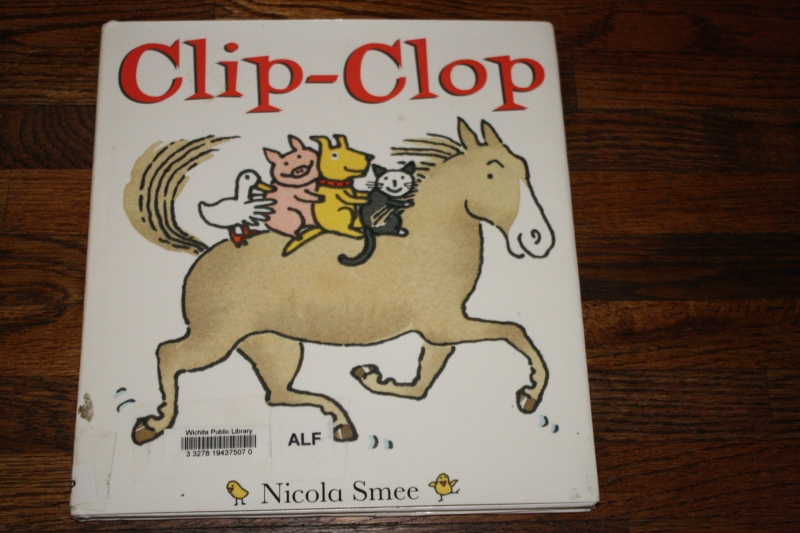
I tried (unsuccessfully) to read one to Tirzah Mae as we both laid on the floor. And then we went on vacation, taking the board books and leaving the picture books. But when we got back and I was casting about for things to do at the kitchen table while Tirzah Mae kept on eating second breakfast (I’m thinking she must be going through a growth spurt – she can steadily eat for an hour, consuming maybe two cups of food over that period.) Anyway, I was looking for things to do when I noticed Clip-Clop by Nicola Smee on the bookshelf. I got it out and read it and… what do you know? It worked wonderfully.

This Month’s Favorite Regular Picture Book:
Clip-Clop by Nicola Smee

Clip-Clop

A cat asks a horse for a ride, which the horse gladly gives – then a dog asks for a ride. Before long, there are four different animals on horse’s back, begging Mr. Horse to go faster and faster. When Mr. Horse finally stops, the animals fly off into a haystack. Mr. Horse is a little worried, but the four voices crying out “Again!” reassure him. It’s a delightful tale with wonderful rhythm. We’ve read it now three or four times, laughing and thoroughly enjoying it each time.

This Month’s Favorite Board Book:
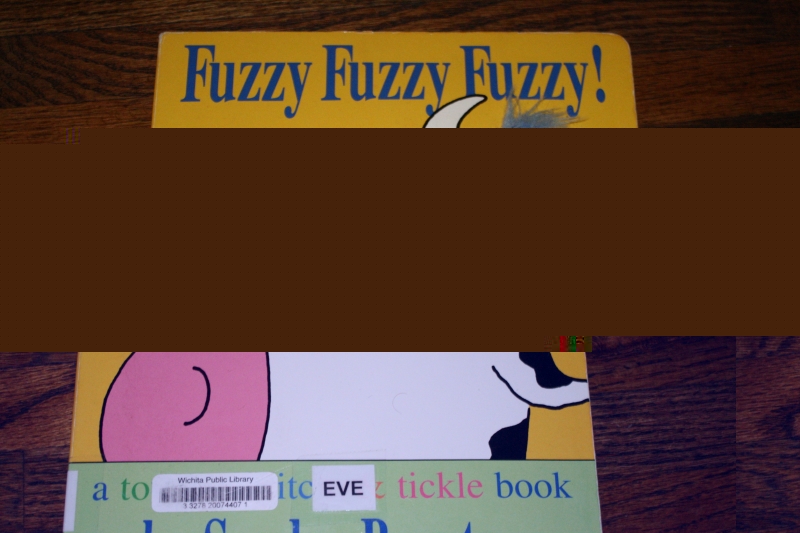
Fuzzy, fuzzy, fuzzy by Sandra Boynton

Fuzzy, Fuzzy, Fuzzy!

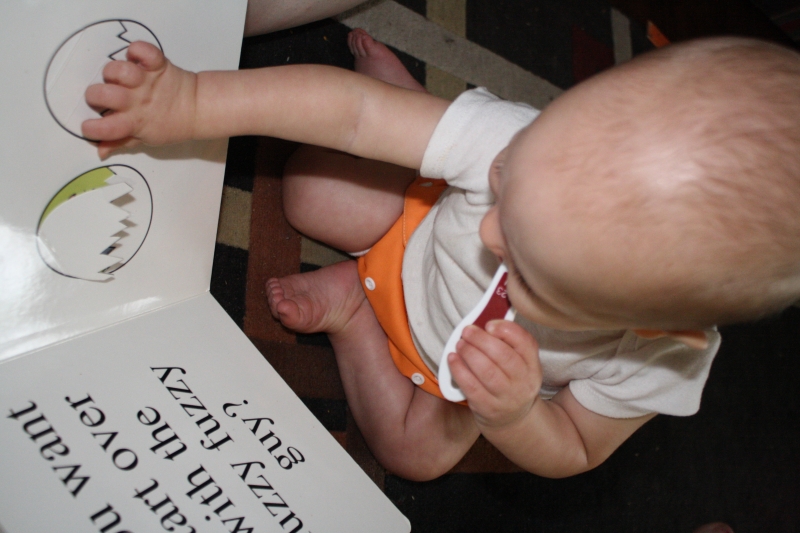
A touch-and-feel book with simple language, this one captivated Tirzah Mae and she won’t let it go. There’s a “fuzzy, fuzzy, fuzzy” cow’s nose, a “rough, rough, rough” dog’s paw, and an “incredibly soft” duck’s belly. Tirzah Mae delighted in touching the different textures. But what she liked most of all were the lift-the-flap eggs at the end. The book asks “Do you want to start over with the fuzzy fuzzy guy?” Depending on which flap you lift, the little chicks inside answer either “Yes” or “No”. Tirzah Mae thinks these are hilarious. So much so, that all we need to do to send her into paroxysms of laughter is to say “Yes” and then “No” in the voices we generally do when we’re reading. So, so funny. She likes this so much we’re buying it for her (I think I’m going to call it a birthday gift.)

Tirzah Mae lifts the flaps

This Month’s Favorite New Author:
Leo Lionni

Leo Lionni’s What?, Where?, and When? feature torn-paper mice illustrations demonstrating different words. In Where?, the copy asks “Can you guess where the mice are?” before showing them “Up high” in a tree, “Popping out” of a shoe, etc. When? asks “When does it snow?”, leaving reader or listener to respond “in the winter”. What? asks readers to guess what the things on the pages are. Readers once again have to supply the noun, while the text of the book supplies little comments like “Do you see what I see?” as the mice peek out from behind a giant set of eyeglasses. Even if I weren’t planning on reading every book in my library, I’d still be picking up whatever else I can by the author on my next library trip.

Check out what other families are reading aloud at Read Aloud Thursday at Hope is the Word.


Breaks, Intentional and otherwise

I don’t plan blogging breaks – but only because I’m not that intentional about blogging. I rather expect that I’ll post daily (except on Sundays), but I (generally) don’t stress if I don’t. Usually, that means I end up posting 3-5 days a week.

And then I started doing I-don’t-know-what at the beginning of this month. (Probably trying to get my list of books read since starting my “read every book” challenge organized and counted for this post.) I was busy and just didn’t blog. Then my brother and his wife and their baby-on-the-inside came to visit over Labor Day weekend. Then we went north for a week-and-a-half-long vacation.

I didn’t intend for that to equal a blogging break. I’d have access to a computer, as well as my tablet (with a keyboard). I’d probably even have time, since we weren’t there over a holiday – meaning that our families were still generally working during the day.

But blogging barely crossed my mind.

Which means I have plenty to report, right?

Of course right.


September 5: Day 1
I spent the morning writing up the aforementioned challenge progress report. Then, when Timothy and Joanna texted that they were about an hour away from Hutchinson, we took off for Hutchinson’s Cosmosphere.

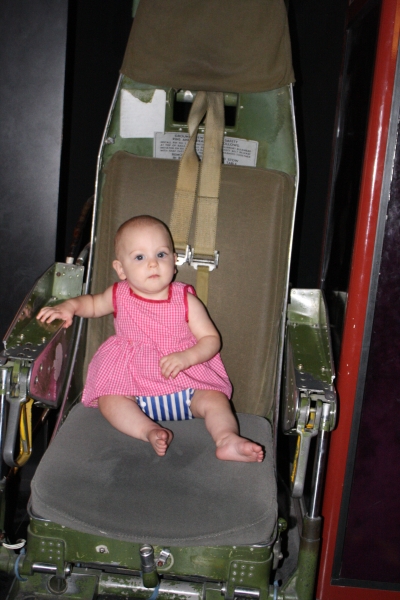
Tirzah Mae in the Ejection Seat

Tirzah Mae sits in a spacecraft ejection seat

If you ever find yourself in southeastern Kansas, you really should check out the Cosmosphere. The first time we went (with my parents sometime last year, I think?), we bought tickets for the whole shebang: the museum, the “digital dome” theatre playing some documentary, “Dr. Goddard’s lab”, the planetarium. We spent a fair bit of time exploring the “upstairs” portion of the museum – with all sorts of facts about the planets. When we went downstairs for the “Hall of Space museum”, I was already tired, but I took a fair bit of time reading everything in the first gallery, a display all about the Nazi V1 and V2 rockets – precursors to modern space flight. I had no idea how large the museum was.

This time, we knew better than to waste our time on documentaries and planetarium shows we could see just about anywhere. We were prepared to plunk down our cash for tickets to the Hall of Space museum – and nothing else. As it was, my brother asked for the military discount (a couple dollars off ticket price), was asked if he was active military (which he is), and was handed free tickets to the Hall of Space for us all.

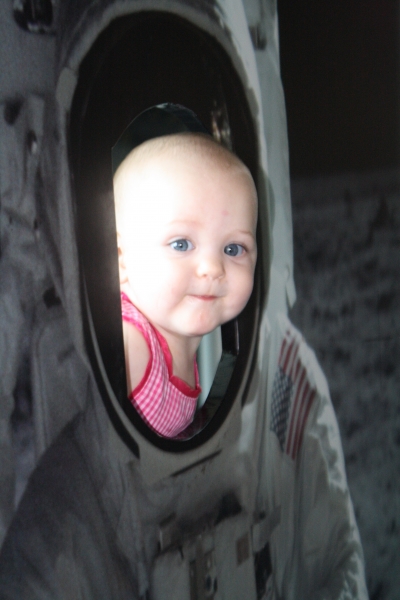
A bright-eyed Tirzah Mae looks out from her space suit

A bright-eyed Tirzah Mae looks out from her space suit

Anyway…we toured the Hall of Space, reading about and seeing artifacts from the entire history of the Space Age – from the aforementioned V1 and V2 rockets of World War II through the Cold War space race and the Apollo missions up to today. This time, I had more energy (not having wasted it on the upstairs stuff!), but I still wore out by the end of the museum. There is SO much to see and to learn.

Once we were done, we were all worn out – so we ordered Mediterranean in (from Le Monde – a delicious place).

And that was our first day of vacation :-)


Nightstand (September 2015)

Since the first day of September was a Tuesday, the fourth Tuesday of the month is the earliest it can ever be – which means the September Nightstand completely snuck up on me. (Does anyone else feel that way when the Nightstand isn’t on the last Tuesday of the month?)

And since I haven’t had a lot of books that needed to go back to the library over the past three weeks, I’ve been enjoying a leisurely reading schedule that has me partway through a couple dozen books but only finished with a few. Which means you should be able to browse a nice short list this month :-)

Fiction read this month:

  • Whirlwind by Cathy Marie Hake
    A rather typical Christian romance in which a widower ends up thrown into a marriage of convenience with his son’s new nanny. A little underdeveloped mystery, some likewise underdeveloped romantic tension. I still enjoyed it. Also, this was my library’s last book by Hake, so I’ve closed her out in my quest to Read Every Book at my local library.
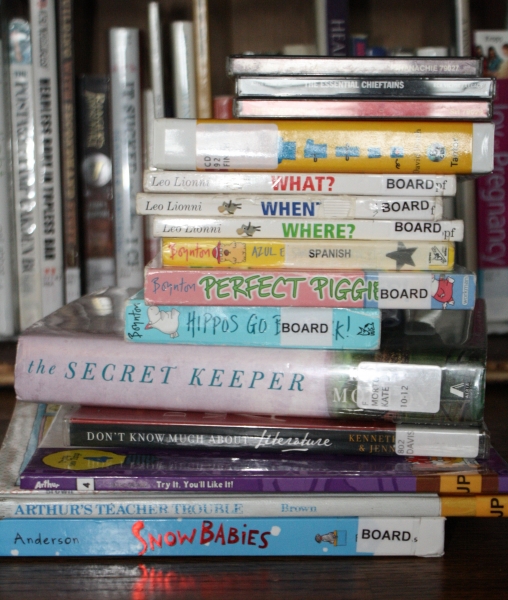
  • The Secret Keeper by Kate Morton
    My in-real-life book club’s September pick, this was a long but intensely interesting look at the intertwined lives of three women. It wasn’t a mystery exactly, but it was something like that. I highly recommend it. Read my full review.
  • 3 “Arthur” picture books by Marc Brown
    Maybe I need to pick up the pace so I can just get done with these. Ugh.
  • A dozen or so read aloud board or picture books
    I’ll be discussing our favorites from among these this Thursday for Read Aloud Thursday.

Library books returned September 2015

Nonfiction read this month:

  • Don’t Know Much About Literature by Kenneth C. Davis & Jenny Davis
    This Q&A book made me feel that I do indeed not know much about literature. Either I hadn’t read anything from the author (sadly, way too common an occurrence) or the questions were about the author’s life instead of his works. I did ace the quiz on C.S. Lewis, though. So there’s something. Also, this closes out the “802” section in my library. Go me!
  • The Journal of Best Practice by David Finch
    David Finch’s marriage was on the rocks with little expectation of resolution when his wife made a discovery that changed their lives: David has Aspergers. The Aspergers diagnosis (which was confirmed by a doctor) gave Finch the impetus to try to work on his marriage, to try to work on himself. Daniel and I listened to The Journal of Best Practices (read by the author) while we drove on our recent vacation – and we generally enjoyed it, although we felt that the author blames his Aspergers for rather a lot. Many of the problems in the Finch’s marriage were exacerbated by Aspergers, sure; but they’re the same things many marriages suffer from – lack of communication, failure to see a spouse’s perspective, poor division of labor, etc. Finch makes statements about “neurotypicals” that make me wonder what tree he fell out of (and if his editors also think that’s actually how normal people are) – believe it or not, not being on the autism spectrum doesn’t make one intuitively socially aware or incapable of overthinking something. Nevertheless, this book was interesting to listen to and gave us plenty to talk about. We were disappointed, however, with how often the author drops the F-bomb. (Side note: Why is such deplorable language considered acceptable writing? I wish I could trust that I can listen to a nonfiction book in my car with my daughter present, but I’m realizing I’m going to have to do a lot more screening of our trip reads in the future.)
  • The New Kitchen Science by Howard Hillman
    Back in the day, I taught a lab called “Scientific Principles of Food Preparation” – and I loved it so much I’ve dreamt of making a series of posts with videos showing the amazing science that goes on under our noses every day in the kitchen (although, oh my, the work it’d take to turn that dream into a reality!) So I was excited to read this book. Unfortunately, Hillman starts his Q&A format book with a chapter on kitchen *equipment* – definitely the most boring of kitchen science. It got more interesting as the book went on, but I still felt like the book could have been laid out differently to better engage the reader and more logically explain the science. (Also, it could have included a LOT more experiments!)
  • The Modern Christmas in America by William Waits
    An adaptation of the author’s doctoral dissertation in sociology, this was a rather dry treatment of the evolution of gift-giving in America from the 1880s through the post-WW2 period. The author took a novel approach to studying this by exploring popular literature: magazines and their advertisements. I enjoyed the many advertisements reproduced in the book, but thought the author’s blatant socialism (in the chapter on charity) and his theories on “decontamination from the marketplace” were rather off-putting.

Don’t forget to drop by 5 Minutes 4 Books to see what others are reading this month!

What's on Your Nightstand?


Book Review: The Secret Keeper by Kate Morton

16-year-old Laurel is sitting in her treehouse, pouting, while the rest of her family enjoys the baby’s birthday party. She’s just about decided to join the family party when she sees her mother greet a visitor (a man Laurel has never seen before) by plunging a knife into his chest.

In the very next chapter, Laurel is a grown woman and her mother Dorothy is celebrating her 90th birthday, her last birthday. Laurel goes through a family photo album, telling her hospitalized and unresponsive mother the familiar story of her own life, starting just before she’d met their father. As Laurel nears the end of the album, an old photo falls out, one Laurel has never seen before. It’s their mother and another woman, victory rolls in their hair. Laurel asks her sister about the picture and her sister explains how she’d found the photo in a book belonging to their mother: a copy of Peter Pan, the play. The book was inscribed “For Dorothy. A true friend is a light in the dark. Vivien.”

It’s funny, Laurel thought, she’d never considered her mother’s life before the album began – her life before she’d met and married their father. But this photo, and the inscription in the book, touched something deep inside of Laurel. She began looking into the story of her mother’s past.

From there, The Secret Keeper follows the lives of three women: Laurel, her mother Dorothy, and Dorothy’s friend Vivian. The narrative jumps back and forth from woman to woman and from 1940’s England to modern day (2011) England. And it’s absolutely fascinating.

This was the September pick for my in-real-life bookclub, and I knew from the other readers that there would be a twist at the end. Despite this, I spent the majority of the book with no clue as to even what I might be trying to solve. Was I trying to solve the mystery of the man’s death? Of Vivien and Dorothy’s relationship? Of… well, I didn’t know. It was disconcerting, reading a book that kept me guessing all the way to the end – guessing not only about the solution to the mystery but about what the mystery was exactly.

It drew me in like few books have lately. It wasn’t simply an escape – it kept me thinking too much. Yet it wasn’t dense and literary (in such a way that I felt exhausted afterward from the hard work of interpretation.) It was an engaging story, a thought-provoking read, a mental and emotional workout that I only recognized by the runner’s high, not by any perspiration in the process. (For the record, I have never experienced a runner’s high from running, nor have I ever run without noticing myself perspiring. Actually, I’ve pretty much never run. So maybe my metaphor should have been something more like an enjoyable night of dancing that I only recognized as a workout from the pleasantly sore muscles in the morning – but it’s not what I came up with first, and I don’t have the energy just now to figure out how to transform that one to fit the sentence. Yep, I’m that lazy.)

It took me a few chapters to get into this novel, but once I was in, I was in all the way. I enjoyed every twist and turn. And the twist at the end? It’s more like two dozen twists, absolutely paradigm-shifting twists. Twists that make me want to sit right back down and read the book over again to see how the author crafted the story so exquisitely that everything fits in this completely altered worldview.

Yeah. It was GOOD.

You should read it.


Rating: 5 stars
Category: General Fiction
Synopsis: A woman seeks to learn about her mother’s life before marriage and family – and finds out more than she could have ever imagined.
Recommendation: An excellent book. Highly recommended.


9 years ago today

On this day in history, 9 years ago, I started a massive project: to read every book in my local branch library.

I’ve moved cities twice, gotten married (just once, thank you), and had a child in the intervening 9 years.

What started at a branch library now continues at Wichita’s Central Library.

I’m gonna read every book in my local library. Or die trying. Probably the latter.

Meanwhile, it’s been tremendous fun.

TOTALS as of Sept 5, 2015 (9 years or 3287 days)

Category Items Complete Categories Closed Items/day
Juvenile Picture 1335 433 0.41
Juvenile, Board Books 54 15 0.02
Juvenile, First Readers 64 3 0.02
Juvenile, Chapter 92 7 0.03
Juvenile Fiction 308 205 0.09
Juvenile Nonfiction 179 1 0.05
Teen Fiction 40 4 0.01
Teen Nonfiction 5 0 0.00
Adult Fiction 443 70 0.13
Adult Nonfiction 756 34 0.23
Audio CD 549 0 0.17
Juvenile DVD 48 0 0.01
Adult Fiction DVD 90 0 0.03
Adult Nonfiction DVD 34 0 0.01
Periodicals 66 0 0.02
Total 4063 items
1.24 items per day

Interestingly, the last time I made an update was exactly 4.5 years ago – which gives a nice opportunity to see how my reading habits have changed over the past 4.5 years.

Some major differences –
Juvenile: I have decreased my reading of juvenile books in general (from 1203 books to 829 books) – although I had not read any board books until we were expecting Tirzah Mae and my intake of juvenile nonfiction was increased in this past 4.5 years.
Adult: My “adult” reading has basically halved, with the proportion of nonfiction to fiction increasing.
Media: I have listened to about 100 more audio CDs in this past 4.5 years than in the 4.5 years before that. My DVD consumption has decreased dramatically (because I haven’t been recording when Daniel and I watch something on Netflix – while I *did* record things I watched with my sister on Netflix). I have also essentially stopped reading magazines.

Of course, the real question is how many books I read in a certain time frame – and I haven’t answered that one yet. Since my last data point is 4.5 years ago, I’m going to have to answer for the entire past 4.5 years – but it looks like I have read 566 books in the past 4.5 years (excluding children’s picture books, first readers, and beginner chapter books.) That equals out to 125.8 books per year or 10.5 books per month or 1/3 of a book per day.