Nightstand (February 2017)

Between a quick weekend trip north to pick up some beef (a 513 lb half!), a teething infant, a toddler who is no longer napping, and beginning our foster-care class, I haven’t had a lot of time for reading this month. But I’ve sneaked in a little here and there :-)

Books for Loving:

  • The Epistles of St. Ignatius
    I appreciated reading through these epistles and learning a little more about Ignatius, a second century Christian bishop. While I had some points of disagreement with Ignatius, his arguments against the docetists and for the Incarnation encouraged me to give praise to the Incarnate God. I wrote a little of what I learned about Ignatius in this blog post.

Books for Growing:

  • Mindless Eating by Brian Wansink
    What can be better than a book subtitled “why we eat more than we think”? The subtitle is a delicious wordplay. We eat more food than we think we eat. We eat mindlessly and therefore spend more physical time eating than we spend thinking about what (or why or how) we’re eating. Wansink’s book talks about the psychology of eating, about our unconscious behaviors related to eating and how to tweak those behaviors. Highly recommended.

Books for Knowing:

  • Getting to Know the Church Fathers by Brian Litfin
    I’ve actually only read half of this so far – I’ll finish the other half next month while studying the church under Constantine (and thereabouts). So far, though, it’s been an excellent introduction into some of the noteworthy people of the first few centuries of the church. Litfin gives a mini-biography of each father (and one mother), reflects on their life and teaching from an evangelical perspective, and then shares an excerpt from that father’s writings. As someone who has virtually no knowledge of these individuals, I’ve found this to be very helpful in my study of church history.

Books for Seeing:

  • The Pearl by John Steinbeck
    It’s only five chapters long (I think), and I’ve only read one of those chapters. Sigh. But I’m looking forward to finishing it up next month.

Books for Enjoying:

  • The Emperor of Nihon-Ja by John Flanagan
    Ever since I finished the ninth book in the Ranger’s Apprentice series, I’ve been checking my local library to see if the final book of the series was available. Finally, after months of weekly peeks at the bookshelf, I checked the computer – and discovered that my branch doesn’t own a copy! Silly me. I requested this from another branch and greatly enjoyed it.

While I haven’t read much as far as grown-up reading goes, I’ve been doing lots of reading aloud to the children. And in celebration of Laura Ingalls Wilder’s 150th birthday this month, Tirzah Mae and I read a whole slew of the “My First Little House” picture book adaptations (which I plan to write about Thursday when I wrap up my participation in Barbara’s Laura Ingalls Wilder Reading Challenge.

Don’t forget to drop by 5 Minutes 4 Books to see what others are reading this month!

What's on Your Nightstand?


I’m so glad

Surely every family has their own special phrases, words that can be heard as the warp threads upon which the fabric of our lives are woven.

One of our special phrases is “I’m so glad.”

I’m so glad I’m married to you.

Whispered words as we linger ten more seconds in bed before rising to meet the demands of one or the other of our offspring. Words accompanied by a handsqueeze as we drive together to church. Words spoken in broken voices after a particularly emotional conversation (read: when one of us has hurt the other.)

I’m so glad God made me your mama.

Words said during sweet moments of snuggling. Repeated during bathtime or diaper changes. Reminders to myself as much as to them when my exasperation seems to know no bounds.

I’m so glad

An exclamation when I’m feeling glad. A reminder when I’m not. A reassurance to myself and to them. God has made us a family. And we are glad He has.

What are your family’s special phrases?


Getting to Know Ignatius

Ignatius was an early church father who was bishop of Antioch of Syria. We know of him from a collection of letters he wrote to various churches (and to Polycarp, the bishop of Smyrna) while enroute to Rome, where he expected to be martyred as a witness to Christ.

Ignatius’s letters follow a relatively predictable arc: Ignatius greets the church and writes them some encouragement before settling upon his primary message: the church must be unified in order that she can combat heresy.

For Ignatius, unity means complete submission to the bishop. Ignatius is a strong proponent of the monoepiscopacy, that is, of a single strong bishop as leader of the church in a specific area. Ignatius regards the bishop as analogous to Christ, the presbyters (also called elders) as analogous to the apostles, and the deacons as analogous to angels and the servants of the presbyters. Given this understanding of church governance, Ignatius’ insistence on unity with the bishop makes sense (even if it does grate on these Protestant ears!) However, it is important to note that Ignatius does not urge unity and submission to the bishop for its own sake. Ignatius’ primary goal is that the church remain free from apostasy and heresy – and he sees unity under a selected bishop as a way of attaining that. In his letter to the Ephesian church, Ignatius writes that the one who separates himself from “the bishop and the whole church” is “a wolf in sheep’s clothing, while he presents a mild outward appearance.”

Regarding the relationship of the church to the bishop, Ignatius writes:

“For your justly-renowned presbytery (church), being worthy of God, is fitted as exactly to the bishop as the strings are to the harp. Thus, being joined together in concord and harmonious love, of which Jesus Christ is the Captain and Guardian, do ye, man by man, become but one choir; so that, agreeing together in concord, and obtaining a perfect unity with God, ye may indeed be one in harmonious feeling with God the Father, and His beloved Son Jesus Christ our Lord.”

~Ignatius to the Ephesians

Ignatius was particularly concerned with two dueling heresies: the heresy of the Judaizers and the heresy of the Gnostics. The Judaizers insisted that Christian believers follow the Old Testament laws and become Jews in order to have salvation in Christ. The Gnostics argued that Jesus did not truly come in the flesh but only in the appearance of the flesh (called “docetism”).

Most of Ignatius’ arguments against docetism are propositional: “Now He suffered all these things for us; and He suffered them really, and not in appearance only…” (Ignatius to the Smyrnians) But some of Ignatius’ writings sing with praise for the salvation Jesus wrought through His humanity:

“Being incorporeal, He was in the body; being impassible, He was in a passible body; being immortal, He was in a mortal body; being life, He became subject to corruption, that He might free our souls from death and corruption, and heal them, and might restore them to health, when they were diseased with ungodliness and wicked lusts.”

~Ignatius to the Ephesians

(I had to look up “impassible” – and discovered that it means incapable of suffering pain. While Ignatius does not make this clear, it seems theologically correct that Jesus was physically impassible prior to his incarnation – but he was not incapable of suffering anguish in an emotional or “soulish” sense.)

In another letter, Ignatius speaks of the heretics thus:

“For they speak of Christ, not that they may preach Christ, but that they may reject Christ; and they speak of the law, not that they may establish the law, but that they may proclaim things contrary to it.”

~Ignatius to the Trallians

At other times, Ignatius channels the apostle Paul, proclaiming that if Christ only suffered in appearance, then Ignatius’ sufferings, imprisonment, and impending martyrdom are worthless (see 2 Corinthians 15).

In his letter to the Ephesians, Ignatius gave a test by which to distinguish false teachers. False teachers, Ignatius says, speak of their own accord and for their own glory, while God speaks as the Trinity (the Son does not speak of his own accord but what he hears from the Father, etc.) and for the glory of the Trinity (the Holy Spirit glorifies Christ, etc.)

While most of Ignatius’ letters to the churches focus on combating heresy and encouraging unity under the bishop, his letter to the Romans sharply departs from the norm. The letter to the Roman’s is almost entirely focused on one goal and one goal alone: the Roman church is not to seek to prevent Ignatius’ impending martyrdom, either through prayer or through legal means. Ignatius desires to be martyred as a testimony and wishes no one to stand in his way.

Another departure is Ignatius’ letter to a fellow bishop, Polycarp. This letter consists primarily of instructions to Polycarp and to Polycarp’s flock, with little to no discussion of pure doctrine. The letter to Polycarp is about orthopraxy rather than orthodoxy.

I’ve enjoyed reading Ignatius’ letters as part of my study of church history. As I alluded to above, I do not find myself in agreement with Polycarp’s monoepiscopacy – I believe the Scriptural pattern describes a plurality of elders who share responsibility for the body and to whom the pastor is accountable, rather than a single leader who bears responsibility and to whom the elders are accountable. On the other hand, reading Ignatius’ defenses of Christ’s humanity (in particular) has encouraged me to reflect upon the Incarnation and to better worship the Incarnate God.

Ignatius at a Glance
Date: ~35-108
Location: Antioch
Key theological points:

  • Arguments against Judaizers
  • Arguments against docetism
  • Defense of the monoepiscopacy

Key writings: Letters to a number of churches and to Polycarp

Resources:

  • Litfin, Bryan. Getting to Know the Church Fathers. Chapter 1: Ignatius of Antioch
  • Schaff, Philip. Ante-Nicene Fathers. Volume 1 (available at the Christian Classics Ethereal Library)

Books of Action Rhymes

Maybe some people grew up knowing dozens of little hand plays – they learned them in preschool or at library story time or whatever.

I am not one of those people.

Furthermore, since my preemies aren’t supposed to spend time with other kids until they’re older, I can’t take my toddler to story time (lest my infant be exposed to kids). So I am stuck with books to learn those action rhymes – which is fine with me. Books are my preferred way of learning anyway.

I’ve checked out a few books of action rhymes, mostly as they come up in my reading of the “nursery rhyme” section – juvenile nonfiction Dewey Decimal 398.8, and am attempting to learn a few to share with Tirzah Mae.

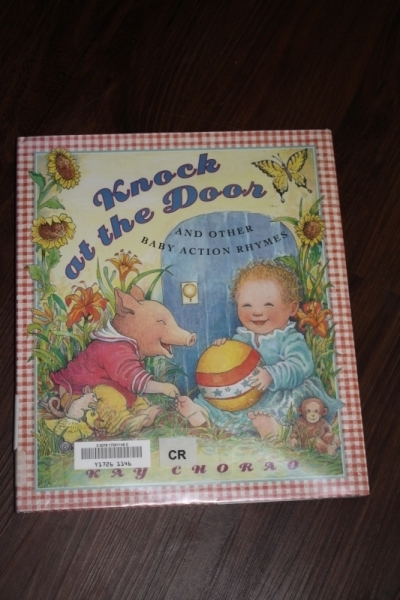
Knock at the Door by Kay Chorao

Knock at the Door

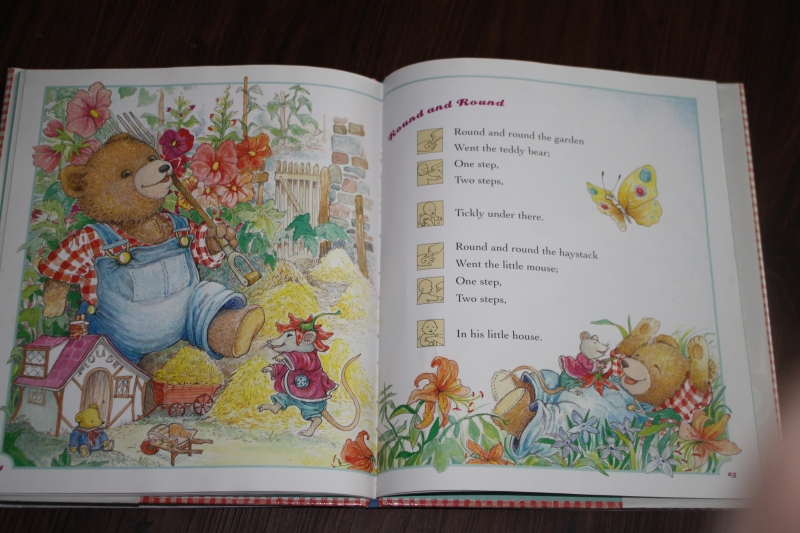
A collection of 20 finger-plays conveniently organized with one or two per double-page spread. Each line of the finger-play is preceded by a small box illustrating the appropriate action. The illustrations are generally clear (or at least I was able to do something with them – whether or not it is correct is another story.) Best of all, the book also includes large illustrations of each rhyme – which means it’ll keep a child’s interest even if mama chooses not to do the finger-play (Guilty as charged – I’m working on it.)

Inside 'Knock at the Door'

Clap Your Hands: Finger Rhymes selected by Sarah Hayes, illustrated by Toni Goffe
A little over 20 finger-rhymes accompanied by illustrations of children performing the finger rhymes. Some of the illustrations make the actions perfectly clear, while others are decidedly less so. There are multiple rhymes to a page, making this less of a favorite for me than Chorao’s Knock at the Door.

Marc Brown’s Playtime Rhymes
Twenty finger plays and other action rhymes accompanied by small-box illustrations of each action and large illustrations depicting the content of the rhyme. While I detest Brown’s Arthur books, his illustrations in these classic rhymes are just fine. Some of these rhymes are more involved than others – but that’s okay. Each rhyme has its own double-page spread, which makes it easy to open up and just do one rhyme (not that I ever want to limit us to just one rhyme. *sarcasm*)

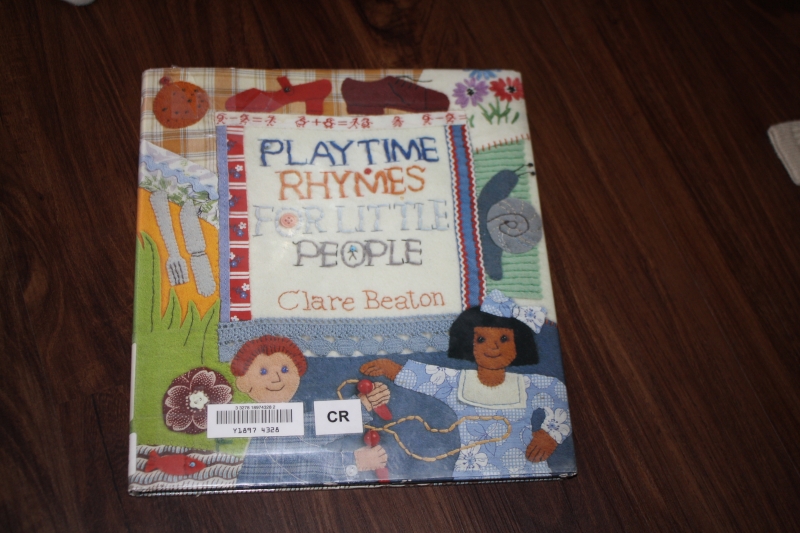
Playtime Rhymes for Little People by Clare Beaton

Playtime Rhymes for Little People

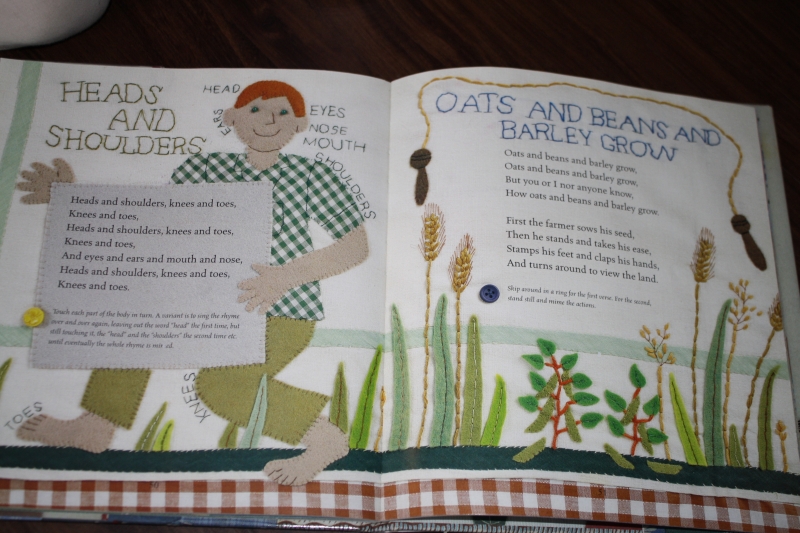
About 40 rhymes including familiar action rhymes (“Incy Wincy Spider” and “Head and Shoulders”) and unfamiliar ones, familiar songs (“The Wheels on the Bus” and “Here we Go round the mulberry bush”) and less familiar ones, and a range of “counting out” songs for selecting who’s “it” during playtime. Unlike several of the other collections I read, this does NOT include figures for how to “act out” the rhyme. Instead, instructions are given in italicized print at the bottom of the page. But, as with other Beaton titles, to focus on the text misses the highest point: Beaton’s lovely applique and embroidery illustrations. Oh how I long to make a collection of pieces in her style for our nursery! (But, time.)

Inside 'Playtime Rhymes for Little People'

Of the four collections reviewed here, I recommend either Knock at the Door or Marc Brown’s Playtime Rhymes for the mom seeking to learn new finger plays – and Playtime Rhymes for Little People for people who are interested in beautiful fabric art :-)


Reading Laura

This is February, which means it’s time to read Laura Ingalls Wilder along with Barbara H’s Laura Ingalls Wilder Reading Challenge.

But this February is no ordinary February.

Tomorrow, February 7th, Laura Ingalls Wilder will turn 150 years old!

And this month, I am introducing my daughter to Laura Ingalls Wilder for the very first time.

Tirzah Mae is two, which means she’s not quite ready to sit down for a full chapter of Laura with only minimal illustrations… but she’s at just the right stage for the “My First Little House books”, abridged from Little House in the Big Woods, Little House on the Prairie, and Farmer Boy and illustrated in the style of Garth Williams.

I intended to read one a day, but we read the first one and Tirzah Mae was hooked. She kept bringing me another and then another and another. Maybe it’s time to try the chapter books after all!

At any rate, the Little House books are the first books I remember binge reading and re-reading – and I’m delighted to be introducing my daughter to my own childhood friends!

Thanks, Barbara, for hosting this challenge – I intend to finish the rest of the “My First Little House Books” that my library offers and to write up my (and Tirzah Mae’s) thoughts at the end of the month.