Missed Opportunities, or I’ve Always Wanted to Fly

Once we’d geared up, we had a short wait. Then, it was time to get in the plane for our trip up.

On our way to the plane

Joanna would jump second, we discovered as her instructor directed her towards the back-right corner of the little plane. Her instructor entered after her and took his seat on the floor facing her, back to the the pilot’s chair.

Then my instructor sat with his back against a box, bent knees parallel with the other instructor’s, but coming from the opposite direction. The two men draped their arms over their touching knees, settling in for what was for them a comfortable routine.

My post was alongside the pilot, back against the front of the plane, with instruments and our pilot’s lap to my right, the airplane’s door to my left, and my instructors knees directly in front of my own.

There weren’t many non-awkward places to look, not a lot to observe from my floor-bound vantage point. So I focused on my friend in the opposite corner, merely five feet away.

Joanna must have felt a bit awkward too, sitting face to face with the man she’d soon be strapped to. Or perhaps she was enjoying a Zen moment prior to a terrifying jump–at any rate, she closed her eyes.

On our way to the plane

My instructor saw her and turned back to me, gesturing with his head. Did I see her there? I grinned and nodded. Yes, I saw.

Now he gestured at his co-instructor, tapped on the pilot’s arm, and enlisted the help of the other men. “It’s her birthday!” He shouted, his voice a nearly indiscernible sound above the engine.

“You’ve got to help me,” he told the young pilot–and then launched into an off-key rendition of “Happy Birthday.”

Could Joanna hear us singing over the usual noise? Yes, she was blushing now as my instructor sang loudly: “Happy birthday, dear whatever-your-name-is” and we all sang together: “Happy Birthday to You!”

We sunk back into our silence. The flight seemed much longer than I’d expected. But we were finally reaching altitude.

The pilot’s hand touched my shoulder and I thought for sure I’d done the forbidden–messed with his controls somehow. I scrunched further into the corner–but when I looked up, I saw that he was looking at me.

“Wanna steer?” he mouthed, gesturing back and forth with his hands in a steering motion.

I looked at him askance. “Are you serious?”

“Sure, It’s nothin’.” He jogged the yoke towards me and we turned accordingly.

I was facing backwards on the floor. I couldn’t see. There was no way I could steer the aircraft. Even if it was “nothin’.” I was more than a little terrified. What was going on here?

I shook my head no and turned aside. Why I was I afraid to take his daring offer? I’d always wanted to fly.

Later, I learned that he was in his late 20s and that he listened to Moody Bible Radio.

He could have loved Jesus. He could have been flirting.

I could have just missed an opportunity.

I’ve always wanted to fly.


On Choosing a Bible (Part 1)

A dozen and a quarter years ago, I was beginning my teen years and was in need of a good, hefty Bible to make me feel like a good, proper Christian.

An NIV Life Application Bible fit the bill–weighing in at approximately fifty billion pounds, it was my constant companion and sure proof of my spirituality.

Then, in my senior year of high school, I grew disillusioned with what I felt was the childish tone of the NIV. It just so happened that the Bible program I was in had me purchasing a number of different Bibles, so I found myself with a NASB Life Application Study Bible, a (second) NIV Life Application Study Bible, and a NKJV Thompson Chain Reference Study Bible.

The NKJV became my companion, probably for the sake of the non-applicable study notes.

Imagine, a study Bible that actually was about studying the Bible? (Do I sense some bitterness towards the–count them–three identical, expensive, and utterly useless Life Application Study Bibles?)

When I needed a smaller Bible for my trip to Sweden less than a year later, I chose a leather-bound NKJV.

A bit of a word-study nerd, I’d come to love the formal equivalence and old-fashioned syntax of the New King James. I was an NKJV girl, I proudly declared.


We had our little family squabbles over translations.

Half of us were squarely in the formal equivalence camp, favoring the translations that anal-retentive geeks everywhere adore. The other half didn’t really enter into the Bible translation conversation.

NASB vs. NKJV

That was our big argument.

Abridged or unabridged.

Until Dad (up to that point a true NASB lover) turned tails and suddenly started using the TNIV.

We were all aghast.

Not only was he going for a dynamic equivalence instead of a formal equivalence, he was choosing the infamous gender-neutral Bible.

Why would he do such a thing?


I contemplated getting another Bible off and on for about a year.

My Bible was getting a bit bedraggled. It had been dropped in the bathtub several times, dropped in the toilet once (was that TMI?), and squished into my shoulder bag more times than could be counted.

I started reading up on textual criticism and the pros and cons of the NU text versus the Majority Text. I became sold on the NU Text even as I appreciated how the additions made in the Majority text have (by the grace of God) little impact on things of doctrinal importance.

I started reading Reformed bloggers and started attending a solidly NASB church.

But spending money on a new Bible when I already had five or ten at home seemed wasteful–especially if I was purchasing a translation I already owned.

I held off. No new Bible for this girl.

That is, no new Bible until the second to last day of July, when I sat at my parent’s kitchen table, puzzling over the “so then” in James 1:19–

“So then, my beloved brethren, let every man be swift to hear, slow to speak, slow to wrath;” (NKJV)

The “so then” clearly indicated that this command was related back to what the author (James) had just said. But I couldn’t find any reasonable connection between the previous statement and the current command.

I read it over and over and over again.

I set down my Bible and paced a bit, took a bathroom break, got some cereal. I picked the Bible up again and re-read some more.

I got frustrated. James was just the most confusing book. I’d been struggling all week to figure out its theme.

My dad’s statement that James is like a New Testament Proverbs helped me quite a bit in interpreting the book altogether–but with that “so then” in there, there had to be a connection. Dad’s “Proverbs” trick couldn’t get me out of this one.

That’s when I saw the footnote: “NU Text reads Know This.”

There wasn’t a connection. There wasn’t supposed to be a connection. The “so then” doesn’t exist. That was a Majority-text addition not included in the best (NU-text) manuscripts.

I was getting a new Bible.


Lest you be completely confused by this post, have no fear. I intend this to be a lead in to several articles about choosing a Bible. My intent is to explain some of the jargon (and jokes) I’ve used in this article, hopefully in a way that will help you to understand some of the thought process that goes into wisely selecting a Bible translation (and a study Bible).


WiW: A Mother’s Ambitions

The Week in Words

In my time of privation from library books–a full week (how could I bear it?)–I took to my own bookshelves to find a title I had not read for some time.

I arrived at Louisa May Alcott’s Little Women, which I have not read for at least ten years.

I found myself impressed as never before by Marmee’s wise counsels and dear dreams for her daughters.

In one conversation, Meg asks her mother if she has “plans” for her daughters, as one worldly woman had gossiped at a party Meg had attended. (The worldly Mrs. Moffat assuming that Mrs. March intended her daughters to marry money–and was thus ingratiating her family to the rich next door neighbor Mr. Laurence.)

“Mother, do you have ‘plans’, as Mrs. Moffat said?” asked Meg bashfully.

“Yes, my dear, I have a great many; all mothers do, but mine differ somewhat from Mrs. Moffat’s, I suspect. I will tell you some of them, for the time has come when a word may set this romantic little head and heart of your right, on a very serious subject…so listen to my ‘plans’, and help me carry them out, if they are good.”

Jo went and sat on one arm of the chair, looking as if she thought they were about to join in some very solemn affair. Holding a hand of each, and watching the two young faces wistfully, Mrs. March said, in her serious yet cheery way:

“I want my daughters to be beautiful, accomplished, and good; to be admired, loved, and respected; to have a happy youth, to be well and wisely married, and to lead useful, pleasant lives, with as little care and sorrow to try them as God sees fit to send. To be loved and chosen by a good man is the best and sweetest thing which can happen to a woman; and I sincerely hope my girls may know this beautiful experience. It is natural to think of it, Meg; right to hope and wait for it, and wise to prepare for it; so that, when the happy time comes, you may feel ready for the duties and worthy of the joy. My dear girls, I am ambitious for you, but not to have you make a dash in the world–marry rich men merely because they are rich, or have splendid houses,which are not homes because love is wanting. Money is a needful and precious thing–and, when well used, a noble thing–but I never want you to think it is the first or only prize to strive for. I’d rather see you poor men’s wives, if you were happy, beloved, contented, than queens on thrones, without self-respect and peace.”

“Poor girls don’t stand any chance, Belle says, unless they put themselves forward,” sighed Meg.

“Then we’ll be old maids,” said Jo stoutly.

“Right, Jo; better be happy old maids than unhappy wives, or unmaidenly girls, running about to find husbands,” said Mrs. March decidedly. “Don’t be troubled, Meg; poverty seldom daunts a sincere lover. Some of the best and most honored women I know were poor girls, but so loveworthy that they were not allowed to be old maids. Leave these things to time; make this home happy, so that you may be fit for homes of your own, if they are offered to you, and contented here if they are not…

~Louisa May Alcott, from Little Women

Later, when Meg is being pursued by poor young man, Jo (desperate to keep her sister from leaving to marry) asks her mother if she wouldn’t rather Meg marry a rich man. Marmee replies:

“Money is a good and useful thing, Jo; and I hope my girls will never feel the need of it too bitterly, nor be tempted by too much….I’m not ambitious for a splendid fortune, a fashionable position, or a great name for my girls. If rank and money come with love and virtue, also, I should accept them gratefully, and enjoy your good fortune; but I know, by experience, how much genuine happiness can be had in a plain little house, where the daily bread is earned, and some privations give sweetness to the few pleasures. I am content to see Meg begin humbly, for, if I am not mistaken, she will be rich in the possession of a good man’s heart, and that is better than a fortune.”

Mrs. March desires that her daughters enjoy marriage. She desires that they not lack or experience undue hardship. But her greatest ambitions for her daughters is that they be virtuous, respected, and content.

How often my ambitions lie along the lines of Mrs. Moffat’s worldly ambitions rather than Marmee’s virtuous ones–but when I read of Marmee’s ambitions for her daughters, I cannot help but be ambitious for those same things.

Don’t forget to take a look at Barbara H’s meme “The Week in Words”, where bloggers collect quotes they’ve read throughout the week.


Snapshot: Geared up

I knew I was in for some fun when we got to the part of the release form that stated something to the effect of “I certify that, apart from the conditions listed below, I am free from any medical condition…”

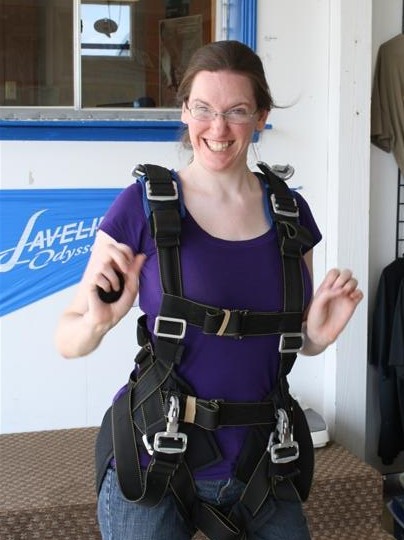
Geared up for skydiving

My list of medical conditions isn’t that long–but every condition means skydiving is not an ideal sport for me. I listed the group: hypotension, vertigo, exercise-induced bronchospasm.

I’d been drinking Powerade (with plenty of sodium to manage the hypotension). I had my meclizine along (to manage the vertigo). I had my inhaler (to manage the bronchospasm.) The only one I was really worried about was the hypotension. It’d really stink to black out while in free-fall, thus missing the experience I’d paid so much to have.

My friends started to worry for me. “Will they still let you skydive?” they wondered.

I told them there was no doubt. We’d all be jumping tandem–which meant the instructor tied to our backs would be doing the work. If I were to have a medical event mid-jump, the only problem would be that I wouldn’t be able to enjoy my jump.

I really wanted to enjoy my jump.

Sure enough, the instructor looked over my list, asked if I used an inhaler, and never said another word.

I loaded the Powerade, took my Meclizine, and entirely forgot about the inhaler (but really, jumping from an airplane is not exactly aerobic exercise!)

Then, when my time came, I geared up for the jump!

Joanna and I geared up to go


A Rotten NewEgg

You’ve been graciously putting up with my erratic posting (and even more erratic commenting) since my computer’s been out of commission.

I’ve been trying to graciously put up with the dozens of hours I’ve had to put in to try to get my new build running.

Two motherboards and two months from when I first ordered the components for my new computer, I still don’t have a computer and have finally ruled out every other possibility and concluded that the second motherboard is defective.

Yes, that’s right. The motherboard NewEgg sent me to replace the first one (which, if you’ll remember, had an exposed circuit that glowed and smoked) is defective.

Not knowing how exactly to explain what is wrong with the motherboard (except to say that I’ve ruled everything else out), I decided to chat with a NewEgg representative online to help me figure out how to get another replacement.

The rep had bad news. I couldn’t get a replacement because it has been two months since I ordered my first motherboard.

If I had wanted a replacement on the second motherboard, I should have asked for it within 30 days of my original order.

Never mind that my replacement motherboard arrived exactly 31 days after I’d ordered the original one.

Nope, I should have known that the second was going to be defective. I should have put in my request for a replacement before I’d even received the second board.

Then, the representative (who I’m sure was simply following the script she had been given) kept apologizing “for the inconvenience this may have caused you.”

May have caused you?

Excuse me. There is no “may have” about it. This has been a major inconvenience.

I have been without a computer of my own for a month. I have spent dozens of hours trying every trick I (and my computer support friends/relatives) could come up with. I have purchased multiple additional components that I had not originally intended to purchase (so that I could rule out my legacy optical or hard drives, cables, or internet connection as causes of the problem.) I have spent money to ship them the first defective motherboard they sent me–only to have them ship me a second defective motherboard.

No “may have”. This has been an inconvenience.

They say I have no recourse but to call the manufacturer. Then they once again “apologize for the inconvenience this may have caused you”?

It’s insulting. Don’t pretend you’re not at fault. Don’t pretend you did everything you could to save me from inconvenience.

Apologize for the inconvenience you HAVE caused.

Oh, and remember how I said they told me my only recourse was to call the manufacturer?

My representative kindly gave me the number to call.

Unfortunately, NewEgg wasn’t so kind as to let me continue to see our chat conversation once my rep had “hung up”. As soon as my rep logged off, the chat screen (and with it the phone number for the manufacturer) disappeared, to be replaced by a customer service evaluation form.

Then, to add insult to injury, the evaluation form limited me to 500 characters with which to evaluate the service I’d received.

I’d have liked to have been able to comment. I’d have liked to have given them some feedback on how their policy of only issuing returns within 30 days of the original order date (regardless of whether the recipient had received said item within 30 days of the original order date). I’d have liked to have given them some feedback on how their customer service script weasels out of taking any responsibility for the trouble they’ve caused (and in fact shows little sympathy for the trouble that has occurred regardless of their role in its causation.) I’d have liked to have given them some feedback on how their chat window immediately jumps to the feedback form when the customer service rep logs off, leaving the customer without vital information to fix their problem. I’d have liked to have given them some feedback so they could fix their clearly broken return and customer service process.

But they didn’t give me room. Apparently they’re not interested in my feedback–or my business.


Nightstand (July 2011)

Thanks to an airplane jump and a visit from state surveyors to another of my buildings (not the one they visited last month in time for the Nightstand!), I don’t have pictures or my last week worth of reading. I have only what I’d already written prior to the excitement of this past week. Nevertheless, I do have a bit of reading I can share.

Read and reviewed in brief:

C.S. Lewis: Writer, Dreamer, and Mentor by Lionel Adey
C.S. Lewis is, like, one of my favorite authors (the Valley girl accent is absolutely appropriate, since I’m often a bit of a fan-girl where he’s concerned.) And I’m participating in Carrie’s Chronicles of Narnia Reading Challenge. So I really wanted to get through this book. I forced myself to read way past when my sister told me I should give up–and finally skipped through to the chapter about Narnia. This book was shelved with the biographies, but that’s not what it is. It’s…something else. It’s a literary critic reviewing what all sorts of other literary critics have said in criticism of C.S. Lewis as a literary critic and as literature-creator. Dull as dust.

I Was a Teenage Fairy by Francesca Lia Block
If I were to try to describe Block’s writing, I’d have to stay that she’s a stereotypical YA author–except that she does it extremely well. Her books are full of edgy and inappropriate material; they’re almost devoid of adult-adults; and they try to be artistic. Except that Block succeeds where other authors fail. This particular book is about a girl-model who had been molested as a child, and about her fairy, who convinced her to keep living (or something like that.) I wish I could recommend Block’s writing, because it really is something to behold–but the sex, drugs, homosexuality, pseudo-bestiality, etc. make me loathe to recommend anything she’s written.

The Next-Door Dogs by Colby Rodowsky
Sara Barker is terrified of dogs. She has been since she was very little and had a bad experience with her aunt’s dog. She’s mostly kept her fear a secret from her friends, but when a nice next-door neighbor moves in–along with two dogs–Sara is forced to confront her fear (or have her friends confront her for her fear.)

Reviewed elsewhere on bekahcubed:

To be reviewed (Maybe):

The Fool’s Progress by Edward Abbey
Eyewitness Books: Photography by Alan Buckingham
The Holocaust Ghettos by Linda Jacobs Altman
Hotel on the Corner of Bitter and Sweet by Jamie Ford
The Horse and His Boy by C.S. Lewis
Thrive by Dan Buettner
Food, Inc by Peter Pringle

Read but not Reviewed (even in short):

  • 1001 Horrible Facts by Anne Rooney
  • Bones and the Birthday Mystery by David A. Adler
  • The Camp-Out Mystery created by Gertrude Chandler Warner
  • The Greatest Invention in the History of Mankind is Beer… by Dave Barry
  • The Yellow Feather Mystery by Franklin W. Dixon

Additionally, I read somewhere around 30 children’s picture books.

Don’t forget to drop by 5 Minutes 4 Books to see what others are reading this month!

What's on Your Nightstand?


I’m Alive

I realized, on my way home from work, what my silence (especially on this Nightstand day!) might seem like to my long-time readers.

Last you knew, I was jumping out of an airplane. Then I don’t participate in the carnival I’ve faithfully participated in for almost two years.

Clearly, I died.

Except that I didn’t.

I went, I jumped, I lived. (I loved it!)

State surveyors showed up in one of my “away” facilities yesterday–and I needed to be up bright and early to meet them this morning.

Ten hour workdays are fun when you’ve got an hour and a half travel time on either end.

Even more fun when you’ve got to try to be there by 7 am.

Long day today, long day tomorrow.

I’ll share jump stories and photos when the madness stops.

For now, I’m just thankful to be alive–and reminding myself of James 1:2-5

“My brethren, count it all joy when you fall into various trials, knowing that the testing of your faith produces patience. But let patience have its perfect work, that you may be perfect and complete, lacking nothing. If any of you lacks wisdom, let him ask of God, who gives to all liberally and without reproach, and it will be given to him.”


What You Meant

*Spoiler alert: If you haven’t read A Horse and His Boy, this post gives away almost EVERYTHING.*

A fellow heard the prophecy regarding how the baby Cor would one day save Archenland. Desiring the downfall of Archenland, he purposed in his heart to thwart the prophesied end.

His purposes seemed to be accomplished when Cor, now known as Shasta, grew up doing menial labor in the house of an uneducated Calormene fisherman, completely unaware of Archenland and unconcerned with its fate.

But what the fellow meant for evil, Aslan meant for good. His evil action only set the stage for Aslan’s great plan–the prophesied deliverance.

A Tarkaan saw the boy working hard in the fisherman’s tent. Desiring a slave with whom he could do whatever he wished, he purposed in his heart to buy the teenaged Shasta.

His purposes seemed to be accomplished when the fisherman begins to barter, selling away his “son” for a few crescents.

But what the Tarkaan meant for evil, Aslan meant for good. The Tarkaan’s evil intentions only gave the impetus for Shasta to begin his flight.

A stepmother sees her step-daughter and hates her. Desiring to have away with her, she purposed in her heart to marry the girl off.

Her purposes seem to be accomplished when the engagement goes through and the girl leaves her home.

But what the stepmother meant for evil, Aslan meant for good. The stepmother’s evil intentions only made a way for Aravis and Shasta to meet, and to become traveling companions.

Dozens of characters, each with their own purposes. The pleasure-seeking Lasaraleen. The lust-driven Rabadash. The conquest-happy Tisroc. The favor-currying Vizier. Even Shasta and Aravis have their own selfish motivations.

Evil actors seem to drive the story to its deadly end.

But all the evil actors, however much evil they meant, had no power against the purposes of the main Actor.

Each actor is a free agent, acting according to the intents of his own heart–and it seems that every actor’s intents are evil. Even the “good” choices were often made with poor intentions: pride, self-preservation, shame. Every bad choice is fully the actor’s responsibility. He clearly chose, of the evil in his own heart, to act as he did.

Yet every evil perpetuated out of the evil in man’s heart was turned into good by the sovereign hand of Aslan.

Conversely, any good that any actor did was not out of the good in his own heart (as though he had good in his heart out of which to act), but was generally the result of the direct hand of Aslan–the Lion at their heels, driving them wherever He willed, compelling them to ride faster than they thought themselves capable of riding.

As such, no actor deserves glory for his good actions; each actor only deserves punishment for his evil.

Yet Aslan, in His mercy, withheld just punishment from many who did evil–and justly received glory for every good deed.

“But as for you, you meant evil against me; but God meant it for good, in order to bring it about as it is this day, to save many people alive.”
~Genesis 50:20


Chronicles of Narnia Reading Challenge
This post is yet another collection of notes from my reading of The Horse and His Boy for Carrie’s Chronicles of Narnia Reading Challenge.


WiW: A quest for Joy

The Week in Words

There’s a pang in my heart, a rumbling in my gut, a nagging in my mind.

Something in my soul says this can’t be all there is.

Somewhere deep inside, I have an insatiable, unquenchable thirst.

I’m not sure exactly what it signifies–but one thing is sure.

THIS will not satisfy.


Is this what Lewis spoke of when he talks of his quest for Joy?

“Even when he first experienced Joy as a child, Lewis recognized that the feeling was not mere nostalgia or love of nature. It was a desire, then, for what? Trying to answer that became a kind of personal grail quest for Jack, a quest he would recount first in his highly autobiographical allegory, The Pilgrim’s Regress, and again in his memoir, Surprised by Joy. Both books are organized around the search for Joy, trying and setting aside many false objects of “Sweet Desire,” until one finally comes to rest in humble recognition of the true Object one has been seeking since childhood.”
~David Downing in The Most Reluctant Convert

I can identify with Lewis’s grail, his quest to capture the elusive Joy.

I think we all can.

What was Solomon’s story but a search for Joy? Spending every resource at his disposal, seeking a Joy that none of his resources could give.

Money. Fame. Women. Wisdom. Work.

The same things I try to find meaning and purpose, Joy, in.

“Solomon had the resources to do whatever he wanted, which is exactly what he did. He gorged himself on pleasure and filled himself with wine. He poured himself into great architectural projects and bought hordes of slaves…He had money, sex, power, fame, a big house, and entertainment. He was a test case for human happiness.

If the things of the world could satisfy, then Solomon should have been the happiest man to have ever lived. And yet, after standing at the pinnacle of life and surveying all that he had accomplished and accumulated, he came to one conclusion: ‘All is vanity.’

In reality, we’re not that different from Solomon. We have our vision of what would make us happy, of what would finally give us satisfaction. And so we pursue our dreams…

And you know what? Sometimes dreams come true. We get married, have children, land the new job, buy the new house. But we’re not cured of our madness. One dream replaces another, and the circle of discontentment starts all over.”

~Stephen Altrogge in The Greener Grass Conspiracy

Joy, the elusive fulfillment of my inner longing.

The flavor I taste in a thousand things, but can only satiate in One.

“You will show me the path of life;
In Your presence is fullness of Joy;
At Your right hand are pleasures forevermore.”
~Psalm 16:11

Don’t forget to take a look at Barbara H’s meme “The Week in Words”, where bloggers collect quotes they’ve read throughout the week.