Thankful Thursday: A Day with Joanna

Today I’m thankful…

…that I was able to spend the afternoon (and some of the morning) with Joanna, quilting
…that both of us managed to get a great deal done on our respective quilts
…that we had some wonderful conversation on books, jobs, friendship, dating, eHarmony, marriage, childbearing (of course, we WOULD discuss this topic!), and life in general
…that I am not an Asian elephant, who has a twenty-five month gestation period
…that I do not have foot long fingernails like the woman in the Guinness Book of World Records
…that I’m one of those “readers” with an insatiable curiosity for life–and a desire to try everything
…that at least ONE person thinks I have a sense of humor :-P
…that if there’s a guy out there who can fit my absolutely ridiculous standards, God knows it and has him ready (for just the right time)
…that if there’s no guy out there who can fit my absolutely ridiculous standards, God knows it and has me ready (to make the most of my singleness)
…that God knows what He’s doing with me, even if I don’t know what He’s doing with me
…that I have a great friend who’s traveling with me along this unknown path


B3,RD: How safe are artificial sweeteners?

I know some of you have been wigging out waiting for this–so I’ll put you out of your misery.

Artificial sweeteners? Safe or the devil’s spawn? It’s a great question that’s racing through the minds of nutrition conscious people everywhere. Dietitians are divided in their thoughts. There’s the “I can’t live without my Diet Pepsi” crowd (many of my nutrition professors in our “Pepsi” school fit into this group), and there’s the “artificial sweeteners are going to be the end of Western civilization as we know it” crowd (although this crowd tends to not mind the end of Western civilization in other contexts).

Because this issue is such a divisive one–and one with so many different opinions–I’m going to give you the facts and my general recommendations, and then let you decide for yourself.

FDA Regulation of Food Additives

First of all, it’s important to be aware of how additives to our food supply (such as artificial sweeteners) are regulated. According to the rules of the 1958 amendment to the Food, Drugs, and Cosmetics Act of 1938, no chemical additive can be used in food if it has been “found to induce cancer in man…or in animals.” This means that, at least as far as cancer is concerned, we’re home free. If additives have been found to cause cancer in humans or in lab animals AT ANY LEVELS of exposure, they may not be used in the American food supply.

Once the additive has been determined to not cause cancer or other genetic changes, experiments are done to determine what levels of the additive are safe. Researchers find the highest “dose” that causes no observable health effects and then decrease that 100 times to determine the “Allowable Daily Intake” or “ADI”.

See the below table nabbed from the Mayo Clinic for more information on the ADIs.

Artificial sweetener ADI* Estimated ADI equivalent** OK for cooking?
Aspartame (NutraSweet, Equal) 50 milligrams (mg) per kilogram (kg) 18 to 19 cans of diet cola No
Saccharin (Sweet’N Low, SugarTwin) 5 mg per kg 9 to 12 packets of sweetener Yes
Acesulfame K (Sunett, Sweet One) 15 mg per kg 30 to 32 cans of diet lemon-lime soda*** Yes
Sucralose (Splenda) 5 mg per kg 6 cans of diet cola*** Yes

*FDA-established acceptable daily intake (ADI) limit per kilogram (2.2 pounds) of body weight.
**Product-consumption equivalent for a person weighing 150 pounds (68 kilograms).
***These products usually contain more than one type of sweetener.

You can see that the ADI limit for a 150 lb individual ranges from 6 to 30 cans of diet soda per day (for the rest of your life). Since ADIs are established at 100x LESS than the highest exposure at which no observable health effects can be noted–the actual “danger level” is somewhere around 600 to 3000 cans worth of diet soda per day. I think it’s safe to say that none of us consume that much artificial sweetener.

So, based on FDA regulations, artificial sweeteners are safe for use at the levels in which they are present in the food system.

The National Cancer Institute on Artificial Sweeteners

According to the National Cancer Institute’s fact sheet on artificial sweeteners, “there is no clear evidence that the artificial sweeteners available commercially in the United States are associated with cancer risk in humans.”

A few studies suggest correlations between artificial sweeteners and cancer risk, but these studies are generally poorly designed. It is unclear whether the vague results of these studies have any applicability. For example, a study suggested that national brain cancer rates rose as a result of the introduction of aspartame. However, the trend in rising rates began 8 years prior to the introduction of aspartame and occurred in a population unlikely to consume aspartame.

The American Dietetic Association (ADA) on Artificial Sweeteners

According to the ADA Evidence Analysis Library (which compiles and evaluates all of the best research on nutritional topics), “Limited research in humans, from peer reviewed journals, supports the safety of non-nutritive sweeteners for the general population. Considering the lack of high quality studies, continuing post-market surveillance of the safety of non-nutritive sweeteners is prudent.”

The phraseology is a bit bulky (that’s what happens when committees write a recommendation), but the gist is as such: “We don’t have a lot of good research in humans, but what we do have says that non-nutritive sweeteners are safe for the general population. However, since there isn’t a lot of good research available, we should continue watching for evidence one way or the other.”

How’s that for equivocation?

My opinion on the safety of artificial sweeteners

My opinion falls somewhere between the FDA’s “of course they’re safe”, the National Cancer Institute’s “all the studies that say they aren’t are flawed,” and ADA’s “we can’t really tell.”

I think that it is safe to believe that artificial sweeteners are unlikely to cause cancer. Because of the restrictions of the 1958 Delaney Clause, the FDA is required to conduct a great deal of research on the carcinogenic properties of potential food additives prior to approving them. The National Cancer Institute concurs that the artificial sweeteners that have been approved by FDA are unlikely to cause cancer.

However, only a limited body of research exists in other non-cancer areas of health. There are big blank holes in the research.

We do know, based on other chemicals, that most substances have dose-dependent responses. Even the best of things, when consumed in excess, can be toxic. Much of the nation was startled to learn of water intoxication in 2002 when Cassandra Killpack died after being force-fed excess quantities of water by her adoptive parents. Even water, the chemical most essential for life, is toxic in large quantities. On the other hand, in low doses, many potential toxic chemicals have little effect.

It makes sense that we should control the DOSES of artificial sweeteners that we consume. If you are close to or above the FDA ADIs, you might consider backing off on the artificial sweeteners.

Also, since children have lower body weights, they are more susceptible to overdosing on anything–so it makes sense to watch children’s intake more carefully. Pregnant and lactating mothers may want to watch their intake more carefully as well, as we do not know what effect any artificial sweeteners might have on rapidly growing babies.

So, my general recommendation, is that artificial sweeteners are likely to be safe when consumed in moderation. As a quick rule of thumb, I would say that if you are consuming more than three servings of foods made with artificial sweeteners (half the ADI for Splenda for a 150 lb individual), you might want to back off. But if you’re consuming less than three servings of artificial sweeteners in a day, the benefit of consuming fewer calories is probably greater than the risk of some unknown health issue.

Your B3,RD challenge for today (although today is nearing its end–sorry folks, this one took longer than I expected) is to calculate up approximately how much artificial sweetener you consume in an average day. Do you top my recommendations? How about the FDA’s?



A Weekend in Review

The Daughter’s of the King ladies retreat was this last weekend, and it was fantastic.

The weekend was themed on Beth Moore’s Get out of that Pit. We watched some of Beth’s videos, heard from the book, heard teaching from the book, had small group times discussing the concepts found within, and had some personal time with God.

I’d already read the book, but the retreat was still pretty powerful. Especially the personal time with God. We had several questions to think through and pray through–but the great part was when God started talking. He told me what my pit is: self-PITy. He said, “You’re so busy longing for something different, something else, that you aren’t seeing what I’ve already given you. And, paradoxically, this has kept you from attaining your deepest desires. Wallowing in self-pity over how things HAVEN’T turned out as you expected is keeping you from enjoying the abundant life I have for you now and from anticipating the abundant life I have for your future.

Yikes! But it’s so true. Knowing is half of the battle. Now, I’m daily practicing the steps Moore discussed for getting out of the pit: Cry out, Confess, Consent. And by God’s grace, I’m on my way out of the pit.

Apart from the wonderful time with God, I had a fantastic time with my girls. We swam Friday night–and stood in the shallow end of the pool singing all our favorite kiddie songs: “He’s a Peach of a Savior”, “I’m in the Lord’s Army”, and “The Hippo Song.” We cracked ourselves up with each different version–and decided that we were having so much fun that we NEEDED to share it with others. So we sang for everyone at our break Saturday morning.

On Saturday, we made leaf door hangers–one for each of us and some extras for the Thanksgiving baskets we’ll give out last month. I painted quite a few. I took pictures of quite a few really good ones–but somewhere between the ride home and Sunday morning, I lost my camera. So, I don’t have any pictures for now. (Hopefully I’ll find the camera soon.)

After we returned Saturday night, we had cheesecake at my Mom and Dad’s house for Mary’s birthday. I found a trivia question book that I’d given the family for Christmas years ago. At first I just threw the questions out to a couple of people, but by the end of the night, there were a dozen of us draped around the living room, trying to figure out which of the listed first ladies didn’t have “Smith” as their maiden name.

Sunday morning, I slept in–and then worked in the church nursery during the service. That’s when I really missed my camera. I only had three little kiddos in the nursery, but boy were they CUTE!

We closed the weekend with the movie “New in Town” (which I thoroughly enjoyed.)


What’s on MY Nightstand?

It’s time for taking inventory of our stash of soon-to-be-read’s with 5 Minutes for Books’ monthly meme “What’s on Your Nightstand?”

What's on Your Nightstand?

Not surprisingly, my nightstand is full, packed with a wide variety of library (and a few privately owned!) books.

Adult Fiction

  • Barren Corn by Georgette Heyer
  • The Carousel Painter by Judith Miller
  • The Fellowship of the Ring by J.R.R. Tolkien
  • When Calls the Heart by Janette Oke

Young Adult/Children’s Fiction

  • Fairest by Gail Carson Levine
  • Mystery in the Sand by Gertrude Chandler Warner
  • Mystery of the Flying Express by Franklin W. Dixon

Nonfiction

  • Catastrophe by Dick Morris and Eileen McGann
  • Life is Tough but God is Faithful by Sheila Walsh
  • Guinness World Records 2010
  • One Thing by Sam Storms
  • Dave Barry Slept Here by Dave Barry
  • I Married Adventure by Luci Swindoll

I also have a whole stack of children’s picture books by Verna Aardema. I’ve been in the process of reading every book in my local library for a little over 3 years now–but I’ve been doing it rather haphazardly. Carrie’s system of reading through the picture book section of her library struck my fancy, so I’ve started at the beginning–and the beginning is Aardema. I’ve only read two of her books thus far, but it appears that she generally retells African folk-tales. The pronunciation can be a bit tricky, but both stories I’ve read seem okay. Not great enough that I’d recommend them, but not bad enough that I’d recommend avoiding them. Just neutral.

Check out what other women are reading at 5 Minutes 4 Books


B3,RD: On Alternative Sweeteners

You see them everywhere in dizzying arrays. Little pink or blue or yellow pouches. The grocery store shelf containing alternative sweeteners is growing larger every year. And diet products are forever announcing that they’re “now made with [insert name of alternative sweetener here]!”

It’s hard for anyone to keep track of all the many sweeteners that are available–which is why I’m going to focus today’s B3,RD post on simply understanding what’s available.

Alternative sweeteners are non-sugar substances that can be used in place of sugar to provide sweetness with fewer calories. They do this one of two ways. Some alternative sweeteners are indigestible or only partly digestible and are passed through the digestive system with only minimal calorie absorption; while others contain the same number of calories per gram as sugar, but are so much sweeter than sugar that much less of them can be used (thereby allowing them to contribute fewer calories to the food item).

The main characters in the first group (that are only partly digestible) are sugar alcohols. These contain somewhere between 1.5 and 3 calories per gram; less than sugar’s 4 calories per gram. Sugar alcohols are often used in hard candy or chewing gum because they do not promote cavities like regular sugar does. In fact, they do the exact opposite and inhibit cavity development. Sugar alcohols include sorbitol, xylitol, isomalt, mannitol, maltilol, and lactilol. Because these products are only partially digested, they can create unpleasant gastrointestinal effects (such as diarrhea and gas) if consumed in large quantities.

In the second group (those alternative sweeteners that are much sweeter than sugar), we have a whole smattering of artificial and “natural” sweeteners. Below is a quick chart with pertinent information about these “non-nutritive sweeteners”.

Common name
(Brand Names)
Times sweeter than sugar Heat stable? Approved by FDA
Acesulfame-K
(Sunnette, Sweet One, Swiss Sweet)
200x Yes 1988
Aspartame
(Nutrasweet, Equal, Natrataste)
160-200x No 1996
Neotame 800-13000x No 2002
Saccharin
(Sweet’n’Low, Sugar Twin)
200-700x Yes 2000
Stevia
(Truvia, PureVia)
300x Yes 2008
Sucralose
(Splenda)
600x Yes 1999

Some of these non-nutritive sweeteners (especially saccharin) have a bitter aftertaste that can be quite unpleasant.

Modest evidence supports the notion that consuming foods made with non-nutritive sweeteners instead of higher calorie foods made with sugars can help individuals cut calories. While some people claim that non-nutritive sweeteners induce people to eat more than they normally would (thus consuming more calories overall), the evidence appears to contradict this statement. Replacing caloric foods and/or beverages with ones made with alternative sweeteners does not cause increases in intake, but rather promotes modest decreases in caloric intake.

SO…if preventing obesity and obesity-related complications is your main health concern, replacing a sugar-loaded snack with a lower-calorie one made with artificial sweeteners is probably a good idea.

Today’s B3,RD challenge only applies if you are generally a consumer of regular soda or sugared gum: Purchase a sugar-free variety of your favorite soda or gum and taste test it to see how you like it. If you like the alternatively-sweetened version, you can save some calories by switching over.

Stay tuned for more information on the safety of artificial sweeteners tomorrow!


How HFCS affects farmers

Davene asked me a great question about this morning’s B3,RD post:

How about the way the HFCS industry affects farmers? I don’t know much about it – something about HFCS affecting the price of corn, and that affecting the price of feed for dairy and beef farms. Just thought I’d pick your brain. :)

I’d like to clarify that I am not an expert in farming or agricultural economics, but I do have some interest in the subject. So, please read judiciously (as you always should, but especially when the speaker/writer is not an expert in the field.)

The United States’ federal government subsidizes corn, making HFCS a less expensive option than sugar for many food processors, which is why many food processors switched from using sugar to using HFCS in the ’70s and ’80s.

Since a majority of American domestic corn use is for animal feeds, anything that increases the demand for corn (without also increasing supply for corn) would increase the price of corn–and thereby, the cost of meat. However, despite the ubiquitous-ness of HFCS in the American diet, HFCS remains a small player in overall demand for corn.

According to an article published in the February 2008 edition of “Amber Waves” (a USDA publication), total demand for HFCS reached a peak in 1999 and has since begun to decline.

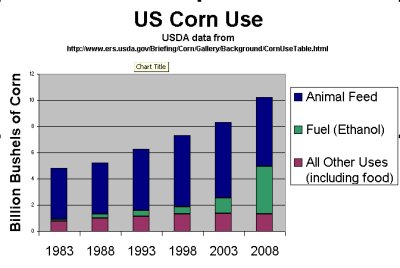
The below graph, using data from the USDA on US domestic corn use, further supports my assertion that HFCS is unlikely to be a key player in raising the prices of feed, and therefore meat.

US Domestic Corn Use

This graph indicates that total domestic corn use in the United States has doubled in the past 25 years. Twenty-five years ago (in 1983), almost 81% of all corn used in the United States was used for animal feeds. In 2008, animal feed made up only 51% of all corn used in the United States.

What made the difference? Probably not HFCS. In fact, in the 25 years since 1983, total corn used for food, as seed, or for other industrial purposes (apart from fuel) decreased from 16% to 13% of total corn usage.

In the last 25 years, corn use for feed has multiplied 1.3 times. Corn use for food, seed, and industrial purposes has multiplied 1.7 times. Corn use for fuel (as ethanol), on the other hand, has multiplied 23 times.

Demand for ethanol has increased significantly in the last 5-10 years. According to a USDA briefing on corn, “strong demand for ethanol production has resulted in higher corn prices.” This has then led to the higher meat and dairy prices you may have noted in the last few years.

So, in answer to Davene’s question (and perhaps yours), HFCS is unlikely to be a cause of concern to our farmers–or a cause for higher meat or dairy prices.

(Ethanol, on the other hand–well, that’s opening a whole new can of worms. I personally have my doubts about how environmentally friendly ethanol is–but beyond that, I think it’s foolish to use FOOD to fuel our cars. Wouldn’t it be a lot smarter to use something humans can’t use otherwise?)


B3,RD: Demystifying HFCS

You’ve probably heard warnings about high-fructose corn syrup (HFCS). You’ve heard that HFCS is responsible for the obesity epidemic. You’ve heard that you should go for products made with regular sugar instead.

Perhaps someone has cited studies that link high fructose diets with heart disease. They’ve talked about how fructose doesn’t act the same way as glucose in the body.

They’re right–except that they’re wrong.

High fructose diets are linked with heart disease. And fructose does act differently than glucose. But High Fructose Corn Syrup is not the problem.

There are two types of HFCS: a syrup that is 42% fructose (HFCS-42), and a syrup that is 55% fructose (HFCS-55). HFCS-42 is used in baked goods and non-carbonated drinks, whereas HFCS-55 is used primarily in carbonated drinks.

Table sugar, on the other hand, is 50% fructose. So, depending on which “version” of HFCS you’re talking about, HFCS either has slightly more or slightly less fructose than “regular sugar”.

So a high fructose DIET might cause problems–but high fructose CORN SYRUP is not the culprit (since high fructose corn syrup and sugar contain very similar proportions of fructose.)

Increased sugar intake is the problem, regardless of its source. Americans are consuming more calories than ever, and more and more of those calories are coming from sugar (either HFCS or table sugar). This is contributing to an overall increase in fructose consumption–and an overall increase in calorie consumption.

So, if you want to do what’s best for your health, don’t worry about choosing BETWEEN regular sugar or HFCS. Instead, work on cutting down sugar intake altogether (regardless of the source).

Today’s B3,RD challenge is to avoid the anti-HFCS hype and instead work on choosing a lower-sugar version of your favorite snack or soft-drink (or just eat/drink less of the high-sugar version.)


Happy Pictures

Emily Joy has started hosting a weekly themed photo challenge on her site–and I’m pleased to join in this week.

Emily Joy Photo Challenge

This week’s them is “happiness”–and I can’t think of a happier picture than this one of my cousin and his fiancee dancing.

Joe and Dana dancing

We had a talent show at our family Kolach days celebration–and Joe and Dana did some country swing (musicless) for us.

Dancing with the one you love. Moving to the music that only the two of you know. Present with your family. Happiness.

Check out the rest of the entries at Emily Joy’s photography site.

Update: This photo won first place in Emily’s contest! Thank you so much, Emily.
Emily Joy Photography First Place Winner


B3,RD: THE Nutrition Professionals

Three years ago, when I started my venture to read every book in Eiseley library, I used Pearl Buck’s rules to give myself an out. If, after reading 50 pages of a book, I was not interested in continuing on, I had permission to stop.

After three years and over 1400 books, I am using that rule for the very first time. Because I absolutely cannot stand Oz Garcia’s The Healthy High-Tech Body.

The Healthy High-Tech Body

Garcia’s biography in the back of the book states that he is “one of the best-known nutritionists and health authorities in America.” Problem is, he’s an absolute quack. Sure, he can throw around chemical names like no other and give incomprehensible explanations for why we should follow his recommendations–but the real science behind his recommendations is tenuous at best.

I know this because I’ve devoted the last six years of my life to learning the science of food, nutrition, and health behavior change. But what’s the average consumer to think? If you can’t trust “one of the best-known nutritionists and health authorities in America”, who can you trust?

That’s where the Registered Dietitian comes in. You see, anyone can call themselves a nutritionist–even someone with marginal education and no credentials (for instance, Oz Garcia.)

The designation Registered Dietitian (RD), on the other hand, carries distinct educational and professional requirements. RDs are required to complete a core curriculum in nutrition, food science, and health behavior change from an accredited university. RDs are required to undergo at least 900 hours of supervised practice. RDs are required to pass a Registration Exam and complete at least 75 hours of continuing professional education every five years in order to attain and maintain their credentials. Additionally, RDs are bound by a Professional Code, which, among other things, insists that they provide evidence-based nutrition services.

You wouldn’t go to your next door neighbor–or even Oprah–to get your broken arm set. Your next door neighbor is nice enough–and Oprah is popular enough–but neither have the credentials to set your broken arm. You’ll go to someone who does have the credentials: an MD (Medical Doctor), a PA (Physician Assistant), or a NP (Nurse Practitioner).

Likewise, no matter how nice or how popular a “nutritionist” might be–they don’t have the credentials unless they’ve got an RD behind their name.

So next time you’re looking at an article or a book, or evaluating something someone is saying on the television or online, look for the RD behind the name. Because RDs are THE food and nutrition professionals.

Today’s B3,RD challenge is to think critically about the nutrition information you see and hear today. Ask yourself whether the speaker has the credentials–an RD behind their name.

A search for Garcia’s education and credentials produced only the most tenuous results.

Mr. Garcia is occasionally ascribed a Ph.D, but I have been unable to find any explanation for this designation. He has certainly never listed where he attained his doctorate or what his doctorate is in.