
 bekahcubed
Meeting the Greats
This last weekend, Daniel and I and Tirzah Mae took a trip into Missouri to see Daniel’s grandparents – Tirzah Mae’s great-grandparents.
We had a sweet time visiting with Daniel’s grandparents, who were enchanted by our little Tirzah Mae.
While we were there, I took the opportunity to take some photos (of course!)
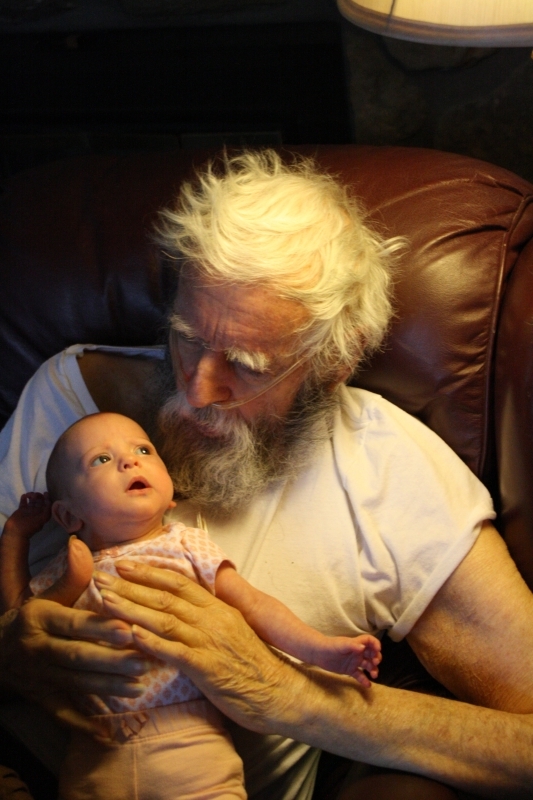
Jack was delighted to hold his littlest great-granddaughter.
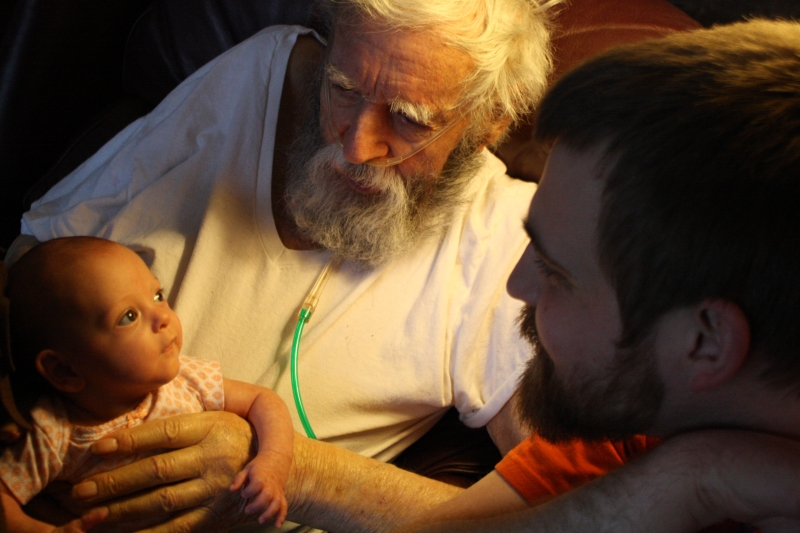
Grandpa’s live-in caregiver and Daniel’s cousin really wanted him to shave his beard. Daniel and I thought it was fun (and I think Jack’s inclined to agree with us!).
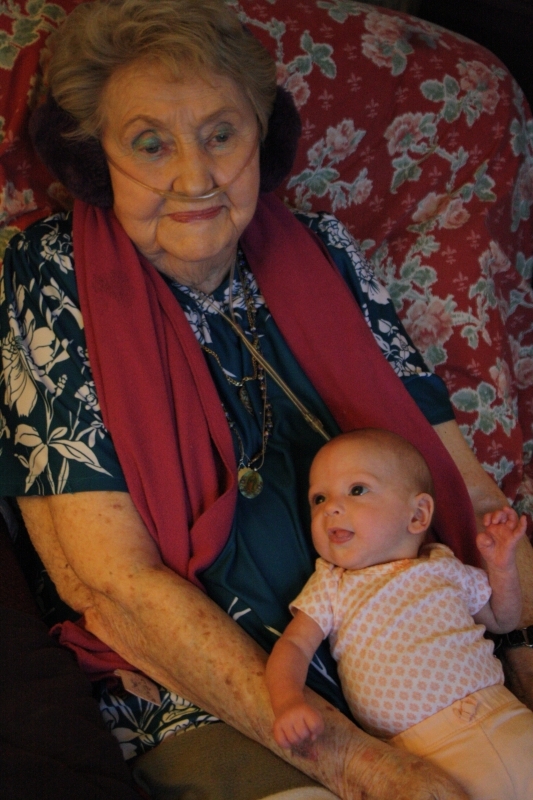
Tirzah Mae sits with her great-grandma Garcia – who told me again and again how glad she was that I was “nursing.” “They really discouraged it in my day, dear – It just wasn’t done.”
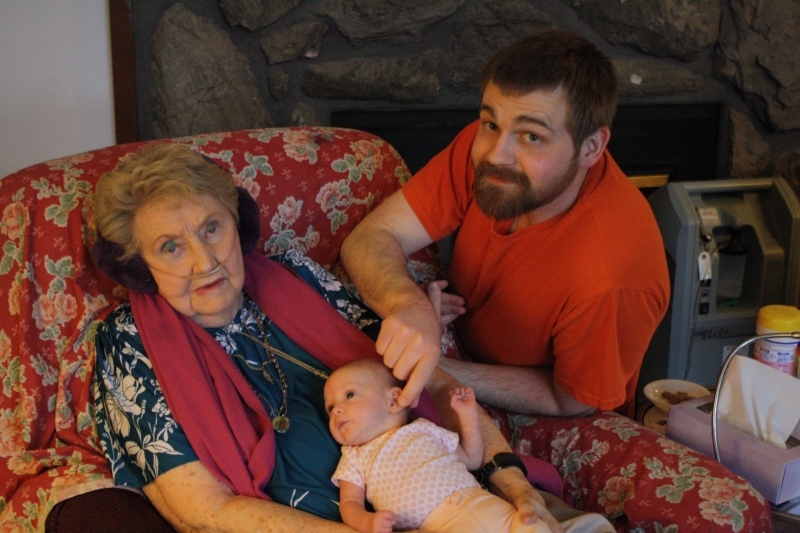
Another three generation shot – Irene and Daniel are looking at the camera, but none of us could convince Tirzah Mae to follow suit.
Family is clamoring for more photos, so I’ve jumped out of order (skipping November and December photos) to give them a more recent photo album. If you already have a password, follow the link to the January album and enter the password to see the album. If you don’t already have a password, e-mail me at b3master@.menterz.com to get it.
L.M. Montgomery Reading Challenge Conclusion
I’m glad I set low expectations for this year’s L.M. Montgomery Reading challenge – because, having set them low, I was able to meet them (sort of).
I wrote that I intended to reread one of the Anne books – which I did. I reread Anne of Green Gables for probably the couple dozenth time. Yet despite multiple re-readings, Anne continues to enchant. Anne of Green Gables is a story of anecdotes, with no overarching plot – but I was struck, this time around with how many threads resolve by the end of the volume. Marilla’s crispness softens, Rachel Lynde admits that she was wrong about the foolishness of adopting an orphan, and Anne and Gilbert resolve their longstanding feud. But one of the biggest changes that occurs is Anne’s transformation from being a burden to be passed on to another each time someone dies to being a burden-lifter who passes on other opportunities in order to bear Marilla’s burden once Matthew is dead.
I also stated initially that I would possibly make another Anne outfit for my American girl doll. My hope was that I could complete the brown voile with puffed sleeves that Mrs. Lynde made at Matthew’s behest. I paid close attention to the garment’s styling, looked up fashions from the gay nineties to come up with what the dress might have looked like, and thought through how I wuld modify my doll dress pattern to accomplish that look. Then, one afternoon last week, I went down to my craft room to begin – and could not find the brown fabric I’d designated for the dress years ago. It wasn’t on my fabric shelf (either among the other browns or in any other section of the shelf), so I began searching. I searched first on my table, piled high with projects in progress. I found a pair of Daniel’s slacks and a couple of my skirts to be mended – and since they required black thread and my machine was currently threaded with that, I finished them on the spot. I was just nearing the end of the pile when Tirzah Mae sounded the alarm from upstairs – and my search (and the outfit) had to be put on hold. So no Anne outfit has been made. Maybe next year.
My final goal was that I “may or may not find and read a book about Lucy Maud from my local library” – I did find a book, Looking for Anne of Green Gables, and read and reviewed it.
So, overall, while it might not have been a substantial year compared to many, I was able to complete most of my relatively modest goals.
Check out what everyone else read and said at Carrie’s conclusion post.
Book Review: Looking for Anne of Green Gables by Irene Gammel
L.M. Montgomery states that the character for Anne of Green Gables “flashed into my fancy already christened, even to the all important ‘e’.” Irene Gammel, a professsor of comparative literature, disputes that statement, suggesting that “Anne” (and the events of Anne’s life) is the product of Montgomery’s reading, life events, and inner life.
Gammel has meticulously picked through Montgomery’s journals (both the published and the unpublished) for clues about Anne – and has gone a step further to read through the books and periodicals Montgomery would have read prior to writing Anne of Green Gables. The result is a fascinating, if somewhat speculative book Looking for Anne of Green Gables.
Prior to reading this book, I was not terribly familiar with the life of Lucy Maud Montgomery (“Maud” to those who knew her) apart from the various biographical sketches Carrie has offered at Reading to Know.
- Reviews of Maud’s selected journals: Volume 1, Volume 2, and Volume 3
- Review of Maud: the Life of L.M. Montgomery by Harry Bruce
- Review of Maud’s autobiographical The Alpine Path
- Review of Maud’s theology
- Article on Montgomery’s suicide
So I knew bits and pieces but hadn’t really put them together into any clear understanding of her life events and how they fit together. This book helped me put some of those pieces together – although it’s important to note that this is not a biography proper, but literary criticism of a sort.
Gammel looks at various events in Maud’s life, relationships she’d formed, and news stories from her neighborhood that may have influenced the writing of Anne. Specifically, she looks at how Maud might have (or, when possible, actually did as evidenced by journal entries) interpreted those events and used them to color Anne. For example, Gammel suggests that the theme of Anne finding a family (and Marilla coming to love Anne) reflects Maud’s fantasy of a loving family (she did not feel that she was loved by her elderly grandparents, who raised her.) Likewise, the perfect bosom friendship of Anne and Diana reflects the type of friendship Maud dreamed of and attempted to enter into with half a dozen girls who always disappointed Maud when the character of their friendships changed over time. So Gammel suggests that many of the events and themes of Anne of Green Gables represent unfulfilled longings of Maud’s.
Gammel also looks at how the periodicals Maud would have been reading might have influenced her writing. For example, Gammel notes an advice column that gives the “cure” for croup that Anne uses (The column suggests that mothers who administer this cure can save their child’s life before the doctor has time to arrive.) In another example, red-haired orphan “Ann’s” show up in several stories or poems.
When I wrote a little blurb on this book on my Nightstand post recently, Barbara H. (who read and reviewed this book in 2011 commented:
“I also didn’t like that she seemed to feel she had to try to find inspiration for much that LMM wrote – as if LMM couldn’t have just made some things up out of her imagination.
I agree and disagree with Barbara. I felt that Gammel was more heavy-handed than necessary in suggesting that this scenario or that story was THE story behind various incidents in Anne of Green Gables; but I found it interesting and fairly likely that those scenarios and stories would have influenced Maud’s writing, even unconsciously. As a fellow voracious reader (although not a particularly successful writer of fiction – I’ve dabbled but never completed anything), I can certainly identify with sort-of “absorbing” the contents of what I read and having them come out in the most unlikely places. Often, I’ll say something or write something and someone will ask me where I got that from. Sometimes I’m conscious that I’m quoting something or paraphrasing something, sometimes I’m not. Sometimes I’m aware of what work I’m quoting or paraphrasing or drawing from, sometimes not. But frequently, when someone asks me for sources, if I search hard enough, I realize that the germ of many of the “original” ideas that pop into my head are not original after all but a continuation of what Mortimer Adler calls “the great conversation” (at least, I think that’s where I got that thought :-P).
I did have a few complaints with this book, in addition to the aforementioned heavy-handedness, and they happen to be the same complaints Barbara H. made (really, you should probably read her review). Maud had a number of close female friends, and Gammel frequently implies that these were erotic in nature (it seems the vogue thing these days to rewrite artists of days past as homosexuals, and while some of them might be, I am reminded when I read such conjectures of C.S. Lewis’s statements regarding platonic male friendship being the deepest love and think maybe there’s something about same-sex friendships of the past that our current sex-crazed society just doesn’t get.) Furthermore, Gammel frequently associates nature with paganism and assumes that Montgomery’s insertion of nature into the Anne books is a sort of rebellion against the Sunday-school literature Montgomery often wrote for. While this may be (again, it’s possible that was Montgomery’s intent), I think it just as likely that Maud simply enjoyed nature and created her heroine to enjoy it as well.
Overall, though, I found this a fascinating book speculating on the origins of the character “Anne of Green Gables”.
Rating: 3 stars
Category: Literary analysis/biography
Synopsis: Gammel explores the events and stories that may have influenced Lucy Maud Montgomery’s character “Anne of Green Gables”.
Recommendation: If you really enjoy Anne of Green Gables and don’t get too upset at glimpses behind the curtain (How’s that for another literary reference?), you’ll probably enjoy this book. If conjecture or the idea that an author might not be quite as original as you originally supposed bothers you, no need to get yourself worked up by reading this book.
I read this as part of the 2015 Lucy Maud Montgomery Reading Challenge. Follow the link to check out who else is reading – and what they’re reading.
Book Review: The Night Circus by Erin Morgenstern
When was the last time you read a book straight through cover to cover?
The last time I did was January 28, right after Tirzah Mae got her two month shots.
The book was Erin Morgenstern’s The Night Circus.
The circus arrives unexpectedly, massive black and white tents surrounded by a black wrought iron fence in what yesterday was only a field. The placard at the gate announces that it is open at night only.
Once the circus-goer pays admission, he passes through the gates into a circus like none he’s ever seen before. Everything inside is in black and white, bright light and total darkness. The grounds dazzle every sense as the circus-goer follows interwoven circles through dozens of tents. Each tent contains its own entertainment. Some are typical fair, if more spectacular than usual – contortionists and fire dancers and cat trainers. But some of the Night Circus’s amusements are completely novel – a garden made of ice, an enchanted wishing tree, a labrynth of rooms each more mind-boggling than the last.
What the circus-goer doesn’t know is that this ephemeral entertainment, popping into and then disappearing from one site after another, is not the main attraction. The Night Circus is a venue, a stage, a stadium in which a high stakes game between two great magicians is played out.
The game started many years ago, when a student magician innovated a new philosophy of magic, a new technique for wizardry. His master challenged him that a new philosophy or a new technique is only worthwhile if it can be taught. Each magician would choose a student, would train that student in his own magic – then, when the time was right, the two students would be pit against one another to see whose magic would prevail.
It’s been years since the last match, but now at last, Prospero has found a student he feels sure will prevail against anyone Alexander could train. He invites Alexander to a show, invites him to the game, offers as his contestant his six-year-old daughter Celia. Alexander accepts, begins training his own apprentice. And when Alexander decides that the time is right, he contacts a man in London to create an acceptable venue for the competition – and he sends a two-word message to Prospero: “Your move.”
The Night Circus is undoubtedly one of the most unique and most interesting fantasies I’ve ever read. While the story is set in familiar late-nineteenth-and-early-twentieth-century England and America, the setting is at the same time completely novel, thanks to the spectacular Night Circus and the magical premise of the story. The characters are mysterious, elusive, and absolutely fascinating. The plot is engaging and the story well-told.
That said, I doubt The Night Circus would be a hit with everyone. The story includes magic, yes, but also astrology and fortune-telling – all givens in the world of The Night Circus. A sex scene about three-quarters through rather disappointed this reader (it wasn’t terribly explicit, but enough so to make me uncomfortable.) And a jarring f-word in the first couple chapters almost made me put the book down (that was thankfully uncharacteristic for the novel – and I rather wonder why it made it past the editors, it was so out of place for the novel’s Victorian, albeit steampunk, setting.)
So I recommend this novel with serious caveats.
Rating: 3 to 4 stars
Category: Steampunk (but it transcends the genre)
Synopsis: A circus provides the setting for two magicians to pit their young students against one another in a mind-boggling sensory display of wizardry.
Recommendation: Masterfully written, fascinating premise and setting – but certain “dirty” elements make me hesitant to recommend this to all readers.
Thankful Thursday: Normalcy

Life is starting to settle into comfortable patterns, signalling a return to some manner of normalcy. I don’t have big, earth-shattering things to give thanks for – but I am thankful for the ebb and flow of life, for seasons that come and go, for finding rhythms in each new season.
This week I’m thankful…
…for an afternoon off
Once a week, Daniel comes home early so I can go grocery shopping without Tirzah Mae. I breastfeed her, load up my books to return to the library, and head out on errands. While shopping itself is not my favorite tasks (except that I love cooking and love to be frugal, I’d probably hate shopping), I love the brief (or not so brief) visit I can make to the library before I shop. Those afternoons off, and especially the quiet of a book-filled library, do wonders for my soul.
…for connections
It’s taken a long while to get connected at our church. We love the preaching, the worship from the Word – but relationships have been difficult to establish. We still don’t have bosom friends there – but we are starting to develop friendships. Sunday reminded me of that as I had one conversation after another with acquaintances who are becoming friends.
…for turkey dinners
We were just bringing Tirzah Mae home at Thanksgiving, and neither of our families do turkey for Christmas – which means Daniel and I haven’t had a turkey dinner yet this fall/winter. But turkey’s were on super-sale following both of those holidays and I picked up a couple for our freezer. I cooked one on Monday and we’ve been eating from it ever since. Yum, yum.
…for a wonderful, beautiful, very-good day
Did you read about my Tuesday? A blessing from on high, that day was.
…for breastfeeding during shots
Tirzah Mae had her 2 month shots yesterday – a total of 3 pokes. When I first mentioned breastfeeding during administration to the doctor, he was pretty uncertain – he thought there’d need to be two people there to hold her and didn’t think everyone would fit around my breast. But when the nurse came in and it was just her, I asked again. “Sure,” she said, “doesn’t make any difference to me.” But it did make a difference for Tirzah Mae and I to be able to cuddle and breastfeed to comfort her before, during, and after those shots.
This newborn season has been a long one, filled with ups and downs – and I am so thankful that God has brought us through this long, hard newborn period. And now, as we enter the season of infant proper, I am thankful for the normalcy He’s wrought – and acknowledge His goodness whether the normalcy continues or a new challenge throws us off-kilter.
“For everything there is a season, and a time for every matter under heaven:
a time to be born, and a time to die;
a time to plant, and a time to pluck up what is planted;
a time to kill, and a time to heal;
a time to break down, and a time to build up;
a time to weep, and a time to laugh;
a time to mourn, and a time to dance;
a time to cast away stones, and a time to gather stones together;
a time to embrace, and a time to refrain from embracing;
a time to seek, and a time to lose;
a time to keep, and a time to cast away;
a time to tear, and a time to sew;
a time to keep silence, and a time to speak;
a time to love, and a time to hate;
a time for war, and a time for peace.
…
He has made everything beautiful in its time.”
~Ecclesiastes 3:1-8, 11
Tirzah Mae and her Mother’s Wonderful, Beautiful, Very Good Day
6 am-My husband brings me breakfast in bed while I breastfeed Tirzah Mae.
7 am-I take a chance and take a bath while Tirzah Mae is sleeping in bed. She stays asleep.
8 am-Tirzah Mae wakes up and I go to pick her up with my shower cap on. Tirzah Mae stares at my forehead, a frown furrowing her own. I take off the shower cap and as Tirzah Mae sees my hair she breaks into a wide, truly social smile – her first. I change her and set her in the swing while I rinse her dirty diaper. I return to find her gurgling at and reaching for the mobile above her – another first. We breastfeed and leave for Tuesday connection. Tirzah Mae makes no complaint when I load her into the carseat – she’s too busy looking around, as if seeing the world through new eyes.
9 am-We arrive at Tuesday Connection (our church’s primary Women’s Bible study) almost on time. There is delicious food. There is good discussion. There are several enjoyable conversations. Tirzah Mae stays alert on my lap during small group time, sleeps in the wrap during large group time.
noon-We breastfeed and Tirzah Mae falls asleep in my lap, affording me the opportunity to get something done on the computer. I open a new document and open my Bible to Exodus and lose myself in the word for the next couple of hours, breaking only periodically to reposition Tirzah Mae when she wakes for a second and third and fourth course.
2 pm-A sunny 70 degrees, the afternoon is too beautiful to stay inside. Tirzah and I set out, with her in the wrap and a song in my heart. We walk along the river for a couple miles. Tirzah Mae sleeps and I pray.
3 pm-I realize I’m thirsty as we approach the Douglas street bridge. The library is just a couple blocks down, I figure I’ll grab a drink before our return trip. Tirzah Mae gets hungry so we settle ourselves in the seldom-used lounge by the board room to breastfeed. We strike up a conversation with the switchboard operator, who used to work in a hospital nursery and doesn’t stop asking questions about Tirzah Mae. I’m glad for the conversation.
4 pm-We head home, Tirzah Mae now facing outward in the Moby. She watches the cars go by and explores the shadows on the ground. We start supper and sit down to breastfeed again.
5 pm-We breastfeed and Tirzah Mae allows me a free hand, giving me opportunity to read Nightstand posts and to peck out comments with one hand.
6 pm-My beloved, Tirzah Mae’s papa arrives home and we sit beside each other, eating dinner and discussing our days.
Tirzah Mae and her mother had a wonderful, beautiful, very good day yesterday.
Nightstand (January 2015)
One of the nice things about breastfeeding is that it enforces sit down times throughout the day. It generally leaves with just one free hand – which means breastfeeding time is reading time (but not usually blogging time.) It’s nice that, even though I feel dreadfully behind around the house, I still get my reading in :-)
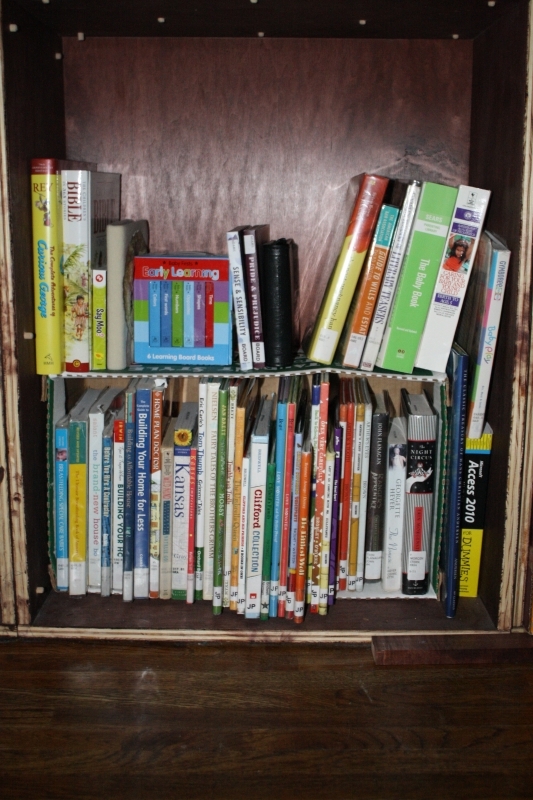
- The Icebound Land by John Flanagan
Book 3 in the Ranger’s Apprentice Series – I’m continuing to really enjoy these, although I wonder if they’re going to start getting weightier. I noticed one “damn” in this one and drug addiction plays a significant role in the plot – I’m hoping I haven’t led Davene astray in encouraging her son Josiah to read this series. - On a Whim by Robin Jones Gunn
The second “Katie Weldon” book. She’s now officially dating Rick Doyle – and is working at acting normal around his roommate Eli. This is what I’ve come to expect from Gunn – a relatively realistic view of college life at a Christian college with strong Christian iron-sharpens-iron friendships. - Deceived by Irene Hannon
A woman hires a private investigator to track down the boy she saw at a mall who looks like (and talks like) her dead son. Christian romantic crime-drama a la Dee Henderson. I enjoyed it quite a bit. - Anne of Green Gables by L.M. Montgomery
I always love returning to Avonlea – and Carrie’s L.M. Montgomery reading challenge gives me a chance to do so each year! - 17 children’s picture books author BOU to BRIDWELL
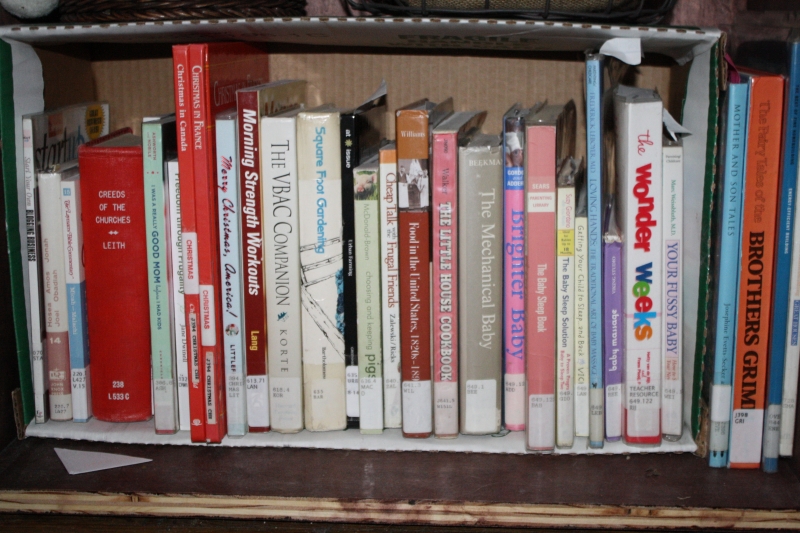
Books about houses:
- Sears, Roebuck Home Builder’s Catalog: The Complete Illustrated 1910 Edition
An old-style dreambook. - House Styles at a Glance by Maurie Van Buren
What are the primary characteristics of a Queen Anne style house? How about a Tudor or a craftsman bungalow? House Styles at a Glance can help you out, with illustrations for each type of house that point out key characteristics. This was a fascinating book.
Books about preemies:
- The Preemie Primer by Jennifer Gunter
An OB-GYN and mother of premature triplets, one of whom died shortly after birth, Jennifer Gunter describes the complications associated with prematurity comprehensively, taking a system by system approach (lungs, heart, brain, etc.) She also shares her own heartbreaking story of difficulties. This is a good overall review of both the hospital and post-hospital experience of having a preemie, slanted towards ongoing complications (since the author’s children experienced ongoing difficulties past age 3, when most preemies are considered to have caught up to their peers with no further “correction” needed.) I found certain parts of this book difficult as the author is clearly not pro-life and discusses selective reduction (aka abortion of one or more babies in a multiple pregnancy) and avoiding heroic measures from that standpoint (for the record, I have some definite opinions about avoiding heroic measures when there is nothing to be gained by doing so – but I come at it from a decidedly pro-life stance.) - The Preemie Parents’ Companion by Susan L. Madden
Written by the mother of a preemie, this book gives a good overview of the hospitalization period, but it’s strongest point is describing what’s normal for a preemie once he comes home. Parents are often told to treat their child like a normal newborn once they leave the hospital (after being educated to correct for gestational age) – but preemies aren’t exactly normal newborns. Madden carefully describes the unique characteristics of preemies during the first couple years of life while they’re still “catching up” to their peers.
Other books:
- Lookimg for Anne of Green Gables by Irene Gammel
An exploration of the autobiographical and literary influences that led to Lucy Maud Montgomery’s Anne. Part biography, part comparative literature, this was a well-researched but still relatively speculative book. I enjoyed most of it, although Gammel’s fascination with human sexuality and speculation regarding Maud and her compatriots sexuality was less than pleasurable. I read this as part of Carrie’s L.M. Montgomery reading challenge. - The Food Police by Jayson Lusk
Lusk, an agricultural economist, makes a case for keeping the government out of food – contrary to the wishes of the modern “food police”. Lusk discusses the economics of organic foods, agribusiness, fat taxes, and the “local food” movement. I greatly enjoyed this book – and while I have some differences with Lusk regarding what is desirable in terms of human behavior, I agree with him regarding what is desirable in terms of food policy. My biggest disappointment with this book is that, instead of taking the measured tone of a scholar, Lusk takes the more strident tone of a pundit, thus likely reducing the appeal of his message to the nonconverts.
On the docket for next month:
- Heart of Darkness by Joseph Conrad
For the Reading to Know Classics Bookclub. - Farmer Boy by Laura Ingalls Wilder
For Barbara’s Laura Ingalls Wilder Reading Challenge. - Books about babies
- Books about building a home
- Children’s picture books author BRI – ?
Don’t forget to drop by 5 Minutes 4 Books to see what others are reading this month!

Ditching the Shield
Disclaimer: This post contains a frank discussion of some of the difficulties of breastfeeding a preemie. I try not to be vulgar, but I do discuss the mechanics of breastfeeding openly. If you’d rather not read, feel free to skip this post.
After two half-hearted attempts to get my nipple situated in Tirzah Mae’s tiny red mouth, the nurse told me to wait right there.
As if I could do anything else. The swaddled miniature in my arms was hooked to half a dozen monitors, keeping her – and me – tightly bound to our recliner.
I tried again, squeezing breast tissue between thumb and forefinger to make a “nipple sandwich”. But Tirzah Mae was looking away – and my attempt to draw her close caused my sandwich to fall apart.
The nurse returned, deftly separating the cardboard insert from the back of a blister pack.
“Here.” She handed me a clear silicone nipple with small holes on the end. “Your nipples are too big for her to latch onto.”
I thought about protesting. We’d barely tried to latch Tirzah Mae on – and nipple shields, I knew, were not without risks. But they’d drilled home the NICU truth – we couldn’t waste calories doing unnecessary things, even things like latching her on at the breast.
So that was that.
A week later, a different nurse asked me how breastfeeding was going as she weighed Tirzah Mae before a breastfeeding session.
I explained that we were using a shield, but that it was going okay with that.
I heard myself in her voice, urging me to try to latch on without the shield.
I nodded halfheartedly, just like my clients do when I make the same suggestion.
“You don’t understand,” I thought. “I only get to breastfeed once a day and that for only thirty minutes. I can’t waste our precious time trying to get her latched.”
And the frustration at NICU policies caught up to me – scheduled feedings that were spaced too far apart for my infant daughter who was clearly hungry, crying and eating her fists after just two and a half hours, being able to breastfeed only once a day, having breastfeeding timed and with before and after weights constantly measuring our performance. Hot tears rolled down my cheeks and I was thankful for the dimmed lights that hid my anger.
Once we had Tirzah Mae home, Daniel asked me occasionally how it was going – practicing without the shield.
I loved him for internalizing my antipathy towards the shield – and hated him for rushing me.
Practicing wasn’t easy. Tirzah Mae would become angry that milk wasn’t already flowing. I became impatient with her anger. I was tired, drained from long nights with little sleep and days where nothing got done.
It was so much effort to go without the crutch.
I cursed the nurse who gave it to us, who got us hooked on its subtle evil. I blamed her, crying stormily, as I fumbled with the shield with sleep-numbed hands. As it fell off – once, twice, five times.
Tirzah Mae grew angry with the wait and Daniel woke up to her wail. I blamed the nurse when Daniel complained of being unfocused at work the next day.
But we kept practicing, first once a week then more and more frequently.
We’re almost done with it, Tirzah Mae and I.
I never take it when we go out. I never use it when we’re breastfeeding around the house. It stays in the basket beside the bed, only to be used if Tirzah Mae’s too frustrated to latch after a few tries at night.
We’re on our way to losing the shield.
Good riddance, I say.
A Much-Needed Holiday
Many people might describe my personality as driven – and, when I think of it, that’s probably a rather apt description.
Driven recalls to mind an animal with a man behind it, cracking a whip or wielding a cane. So long as the animal keeps moving and moving as fast as the driver desires, he is comfortable enough. But should the animal slow or stop? He feels the whip upon his back.
That’s me.
I am the driven and the driver, weary and wanting rest but beating myself up when I slow or stop.
Adding a newborn to the mix adds a layer of fatigue I never imagined was possible. The driver insists that I get something done – that the house be cleaned, the dinner prepared, the blog post written. The daughter insists that I hold her rather than sleep.
So is it any surprise that I emerged from bed yesterday after a highly productive but exhausting Saturday followed by an utterly sleepless (okay, I got four or five thirty minute stretches) night and announced to my husband that I wanted a break.
“I just want to take a day off and read all my library books,” I told him.
Which got me thinking. Could I read all my library books in a day?
Obviously, I wouldn’t be able to literally read them all completely in a day – but could I even read a chapter of each?
I asked my husband for permission to take a 24-hour holiday – and at 1:30 pm yesterday I began my holiday.
I breastfed Tirzah Mae and made dinner – and I read, and read, and read.
By 1:30 pm today, I had read one chapter each of 41 books (40 nonfiction and 1 fiction), leaving just 4 nonfiction and 3 fiction books unread (also 24 children’s picture books that I didn’t even try to read).
I feel great.
It was a much-needed holiday (and I didn’t feel the whip crack even once.)