Nightstand (March 2016)

A number of my blogging acquaintances are switching their end-of-the-month reading logs to the actual end of the month rather than participating in 5 Minutes for Books’ Nightstand Blog Hop on the last Tuesday of the month. I am not one of them. I enjoy the Nightstand community and don’t have any problem having my log be on a semi-arbitrary date.

What I have been having a problem with is getting my Nightstands posted, though!

I have half-completed Nightstand posts for the past 5 (FIVE!) months sitting in my drafts folder.

Which is why this month, I decided to post my Nightstand, however late it may be!

So here’s what I’ve read in the past month…

Books for Loving:

  • Concise Theology by J.I. Packer
    An excellent book with 2-4 page summaries of a variety of theological topics. I can see using this as a jumping-off point for a high school theology class (or something like that.) I especially appreciated reading this when I decided to add application – spending a brief amount of time framing a prayer of response after each section.

Books for Growing:

  • Sink Reflections by Marla Cilley
    I’ve read this book by the “Flylady” before, but it’s always useful when I’m setting up a new household and in need of some motivation to get my routines in place. I don’t follow Flylady to a tee and I find her annoying whenever she starts getting philosophical – but the idea of setting up routines to keep your household running is a good one.
  • The Accidental Housewife by Julie Edelman
    A completely worthless home how-to manual. Basically, Edelman advises you buy lots of disposable junk for cleaning, turn on music and dance while you clean, and drink lots of wine throughout.
  • On Becoming Toddlerwise by Gary Ezzo andRobert Bucknam
    I know plenty of folk who swear by the Babywise/Growing Kids God’s Way approach – but while I didn’t find anything overtly objectionable in this particular volume, the thought of trying to follow their routine with my toddler (the whole day divided into 15 minute segments of activities) sounds exhausting. I am a woman of routine, but our household routines are arranged according to the time it takes to clean up after meals and exercise and fold a load of laundry and clean the bathroom. In other words, Tirzah Mae’s routines fit into the household routines rather than trying to run a household in between arbitrarily set 15-minute cycles.

Books for Knowing:

  • Beast in the Garden by David Baron
    Baron tells the story of the mountain lion, once only a threat to cattle, and the process by which mountain lions in Boulder, Colorado became habituated to humans, culminating in some highly unusual human deaths. A fascinating look at how humans and animals interact (and how we can’t just “return to the wilderness”). I had a hard time putting this one down.
  • When to Rob a Bank by Steven D. Levitt and Stephen J. Dubner
    A collection of blog posts from the ever-popular Freakonomics authors. I enjoyed the randomness of this collection, as well as the smaller-than-a-usual-chapter articles, which allowed me to read them in bite-sized chunks. I did NOT enjoy the many articles about gambling (which I consider to be both boring and unwise).
  • Born in the USA by Marsden Wagner
    Wagner documents the deplorably woman (and baby) unfriendly practices of American maternity care and gives suggestions for how to fix it. Marsden deftly describes how obstetric care in the US pays only lip-service to evidence, choosing to experiment on pregnant women and their children in the absence of evidence (and even in the presence of evidence AGAINST certain practices such as Cytotec inductions). Marsden’s solutions were intriguing, but I had some definite quibbles: I don’t believe nationalized health care is the answer and I don’t think litigation is the answer. It was interesting to compare Marsden’s view of litigation with the Theresa Morris’s in Cut it Out!. While I agreed strongly with Marsden’s emphasis on the midwife model of care as a solution for the current system, I was disappointed that he did not also mention how primary care doctors are increasingly opting out of providing obstetric care (in part due to litigation, in part due to the scheduling demands of obstetric care.) I think that, especially in rural areas, this is a huge barrier to low-risk women receiving good prenatal and obstetric care.

Books for Seeing:

  • I made the mistake of trying to read Homer’s The Odyssey at the beginning of the year, while I was still in my first trimester exhaustion AND moving. Yeah. No.
  • Which is why I’m trying again with Mary Shelley’s Frankenstein. I’m about halfway through.

Books for Enjoying:

  • The Dinner Diaries by Betsy Block
    As a memoir, this fits with my generally enjoyable reading. Except that this was a memoir about feeding a family and Betsy Block did it ALL wrong. I wrote up the two main things she did wrong (and some alternate advice) in my full review.
  • The Yummy Mummy Manifesto by Anna Johnson
    Basically about staying hip even though you’ve become a mother. Occasionally interesting but generally kinda annoying (What if I’ve always dreamed of being able to wear twinsets and khakis without someone accusing me of dressing for a different stage of life? Don’t tell me that now mom’s aren’t supposed to dress like that.)

Don’t forget to drop by 5 Minutes 4 Books to see what others are reading this month!

What's on Your Nightstand?


Book Review: The Dinner Diaries by Betsy Block

Feeding a family. Raising healthy eaters. Topics I’m passionate about. Even while I was still working on my degree, I knew that helping mothers feed their families and raise healthy eaters was what I wanted to do as a career. I made that the focus of my graduate work. After a stint in long term care, I moved to WIC, where I was able to live my dream (at least as far as career goes.)

Subtitled “Raising Whole Wheat Kids in a White Bread World”, Betsy Block’s book should be right up my alley, right?

Wrong.

I should have known from the blurb on the back cover:

“A harried mother of two, Betsy Block is in pursuit of the perfect family meal: local, toxin-free, humane, and healthful.”

But the book was in a Dewey Decimal category I was trying to close and I figured “how bad can it be?”

Pretty bad.

Betsy Block’s The Dinner Diaries is basically a manual on how NOT to feed a family or raise healthy eaters. In order to save you the work of reading it, allow me to summarize the main points.

Tip 1: Start with all the wrong priorities

It’s no mistake that “healthful” is last on the list of Block’s priorities a la the back of the book. In reality, her definition of “healthful” is suspect enough that you might as well knock it off the list. Block is all about the local (which has very little impact on health), toxin-free (the American food supply, with the exception of methyl-mercury containing fish, is actually one of the safest in the world), and humane/sustainable (an ideological issue but not a health one.) Her couple of concessions to actually health practices include trying to eat less sugar and (at the very end of the book) attempting to eat more whole grains.

If you’d rather actually have some success at feeding a family or raising healthy eaters, I recommend starting with priorities that will actually help you achieve health. Try: increasing fruit and vegetable intake (no, it doesn’t have to be fresh – frozen or canned are fine), increasing variety (of protein sources, vegetables, starches, you name it – variety is good), sitting down together as a family to eat (even for snacks), having sweets around less frequently and subbing fruit instead, or experimenting with forms of cooking other than frying. I can give you more suggestions if you’d like, but those are some of the biggies.

Tip 2: Lecture your children about food

There’s nothing like a good guilt trip to help kids form a healthy attitude toward food, amiright?

Okay, no.

But Block seems to think it’s a great idea. She lectures about all those wrong priorities, lectures when kids won’t eat something, lectures when kids do eat something. She sets up learning opportunities for herself (like going to see a pig that she’s later going to eat) and leaves the children behind lest it be too tense for them – not that she won’t lecture them about it when she gets home. When her daughter asks to help cook, Betsy asks if that means her daughter will eat what they prepare. When her daughter says “probably not”, Betsy declines the offer of help.

If you’d like your children to actually develop a healthy attitude toward food, start by modeling healthy attitudes towards food yourself (by the way, Block’s obsessive interest in “perfect” food isn’t healthy.) Eat in moderation. Eat a variety. Don’t obsess over food (either in a “I must have sweets now” or in a “my diet must be absolutely healthy all the time” way).

If you’d like your children to develop a healthy attitude toward food, involve them in selecting and preparing food. Preschoolers will love searching for a red vegetable at the supermarket. Kids can learn to cook early on. Gardening or going to a farm to see how food is made is a great activity for kids. BUT…not as a way to coerce your kids into eating something. That’s Betsy’s mistake. She read that when kids cook with their families, they’re more likely to eat what they make – so she thought she could coerce her daughter into eating by letting her help cook. Letting your child cook isn’t a one-time magic bullet to healthy eating. Instead, it’s a process by which children develop positive associations with food, take ownership of food (in a healthy way), and learn skills that will help them eat well when they decide that they’re willing to try eating asparagus.

If you’d like your children to develop a healthy attitude toward food, move the conversation from nutrition to habits. Dina Rose’s excellent website It’s not about nutrition is a great resource for changing the way families talk about food. The gist of Rose’s message is to start talking about proportion, variety, and moderation (Check out this article for more info.) Changing the conversation makes a real difference, both in helping kids eat healthfully, but also in helping them think healthfully about food.

In the very first chapter of Betsy Block’s book, she writes of a nutritionist who refused to work with her because of her emphasis on organic foods. Block was shocked that organic foods were controversial. Except that to call the “health benefits” of organic controversial is putting it mildly. Despite many attempts to prove otherwise, there is no compelling evidence that organic foods are more nutrient-rich or more safe than conventionally grown ones. It’s fine for people to eat organic, but they’re fooling themselves if they think that organic = healthy. Block’s choice to focus on secondary issues instead of primary ones meant that her memoir is a recounting of an exercise in frustration, accomplishing next to nothing in terms of changing her children’s habits and attitudes regarding food.

The nutritionist who ended up working with Block (although we only hear about her in the first chapter) did a good job of trying to get Block to focus on some actually beneficial eating practices (unfortunately, she did not address the task of how to communicate with children about food) – but it was all for naught. Block would not be dissuaded from her ill-informed search for dietary perfection and from her agenda of changing her children’s eating patterns by coersion. I think the first nutritionist made a wise choice.

Please, people, don’t be Betsy.


Rating: 1 star
Category: Food memoir
Synopsis: Betsy Block tries to make over her family mealtimes.
Recommendation: Ugh. No.


Thankful Thursday: Generosity

Thankful Thursday banner

This week I’m thankful…

…for help hanging a mirror
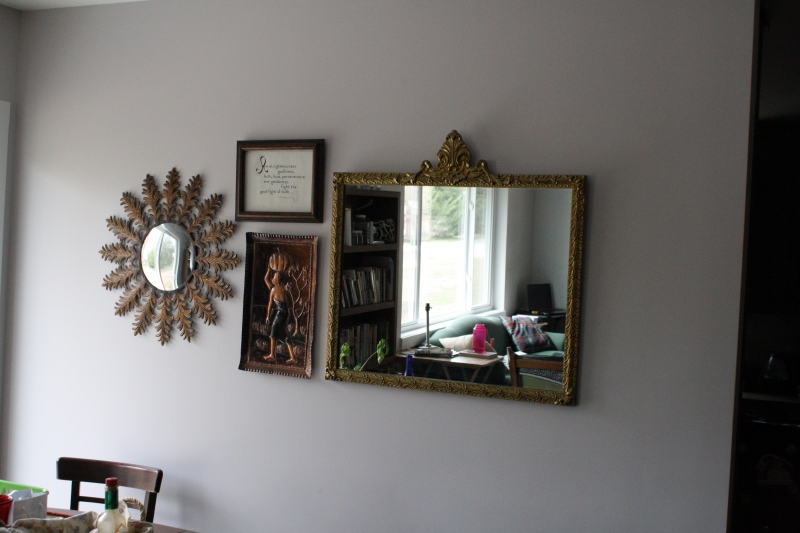
Daniel arrived home Friday evening to find the house a mess and his wife frustrated. I’d dragged all the wallhangings out and laid them out on the floor to arrange them before hanging them on the wall. But when the time came to hang the big mirror that’s the centerpiece of the dining room arrangement, I couldn’t find the stud-finder (and that mirror DEFINITELY needs to be hung on something more sturdy than drywall!) I emptied all our toolboxes on every available surface in the kitchen and only found the studfinder (in the back of my car) after several hours of searching. Daniel was gracious to help me carry all the pictures and whatnot back downstairs and help me put away the rest of the tools – and to help me hang that pesky mirror right then and there.

Mirror wall in dining room

…for a birthday burger
We enjoy Red Robin, and belong to their loyalty club (or whatever it’s called – we get promotional emails and they give a free burger during our birthday months.) After the frustrating mirror incident (during which dinner was NOT made), we went out for my birthday burger. It was just the break I needed – and I enjoyed a delicious mushroomy burger (Daniel’s not the biggest fan of mushrooms, so when I make mushroom dishes at home, it’s usually pretty subtle.)

…for kitchen projects completed
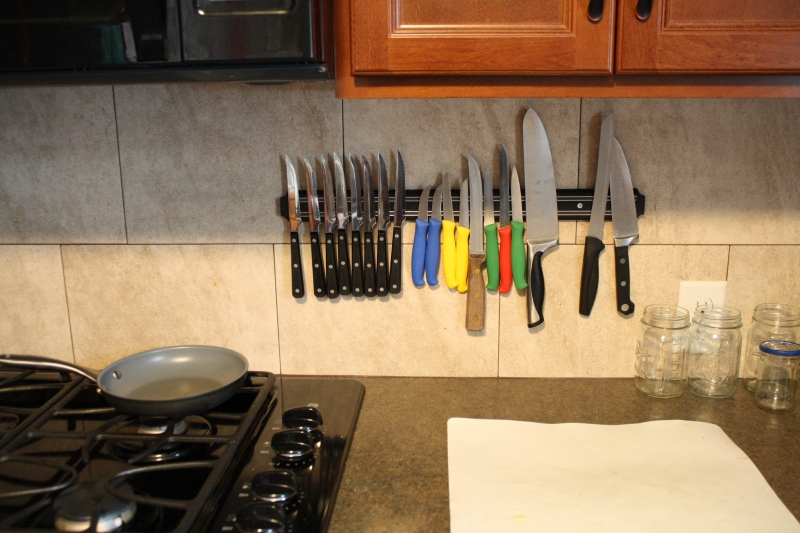
My husband could have done all sorts of things with his Saturday morning. He could have slept in or watched television or read a book or worked on his personal projects. Instead, he woke up early, took off to the Home Improvement store and set to work installing my magnetic knife rack in the kitchen. And, since the drill was out, he hung my swinging towel rack while he was at it too. With those two tasks complete, my kitchen is complete. It feels nice, awfully nice.

Knife rack all suited up

…for a birthday windchime
I already wrote about this, but the windchime has been delighting me all week – whether it’s catching a glimpse of it out the window or hearing its music on a windy day.

…for a generous loan
A friend who had a baby the summer before Tirzah Mae offered to loan me some of her maternity clothes. Tirzah Mae and I went over Tuesday for a playdate/clothing try-on session – and I walked out with almost 2 dozen articles of maternity wear! I’m probably set for most of the remainder of this pregnancy.

…for the generosity of God in Christ
These gifts of patience and time and food and help and objects and clothing are all wonderfully nice. But nothing can compare to the generosity of God, who gave HIMSELF. Even if my house remained a mess, the studfinder remained missing, my husband hadn’t provided help, the burger hadn’t been free, the kitchen hadn’t been completed, the windchime not given, the loan of clothing not made – the gift of Christ is beyond what my heart can bear.

What? All this and Christ beside?

“For you know the grace of our Lord Jesus Christ, that though he was rich, yet for your sake he became poor, so that you by his poverty might become rich.”
~2 Corinthians 8:9 (ESV)


Book Review: Mothering Your Nursing Toddler by Norma Jane Bumgarner

“How long do you intend to nurse?”

If my experience is typical, it’s a question many a nursing mother has heard many a time.

And my answer has always been… difficult to give.

Because I didn’t have any hard and firm answer. I intended to keep nursing until we stopped.

I did know that would not be until Tirzah Mae was at least 12 months old, since cow’s milk is not recommended until age 1 due to a high sodium and protein content that can tax an infant’s kidneys (and because I had no desire whatsoever to provide formula, that nasty-smelling, clothes-staining stuff.) But after a year? Who knew.

Generally, my questioners would follow up with the question they really wanted answered: “But you aren’t going to still nurse when she’s old enough to [lift your shirt, walk up to you, ask to nurse in English]?”

And I… didn’t really know what to say exactly.

My observation has been that most mothers I’ve talked to who have nursed for truly extended periods of times (past their child’s third birthday, for example) have often delayed practices that I consider healthy (for instance, waiting to give their nursing child solid food and water until long after six months) or prolonged practices that I consider less than ideal (such as frequent nighttime nursing.) Since I intended to introduce solid foods at six months and water to go along with solids – and felt that an infant or toddler should, at some point, learn to sleep through the night without waking to nurse, I imagined weaning would occur sometime before my child’s third birthday.

When Tirzah Mae turned one, I had an easy excuse for continuing to nurse beyond the American Academy of Pediatrics’ minimum recommendation of one year – Tirzah Mae was born early, so it was really only like she was ten months old. But I also knew it would be worthwhile to read up on this “nursing a toddler” thing – and I knew just the book.

La Leche League’s Mothering Your Nursing Toddler by Norma Jane Bumgarner is THE book on the topic – and my library happens to have it.

This book’s greatest strength is in encouraging mothers of nursing toddlers through countless stories that can assure them they are not alone – a very useful thing for those mothers who often DO feel alone as they nurse their baby-who-is-no-longer-a-baby.

On the other hand, Mothering Your Nursing Toddler seems to assume that nursing for a very extended period of time is both beneficial and desirable in almost all cases. While I don’t think that nursing for a very extended period of time is harmful, I don’t know that it is necessarily to be encouraged by default. But, since that is the position Bumgarner takes, she encourages those practices that I’ve observed in prolonged nursers – suggesting that following the practices I recommend is actually parent-led weaning.

And if that’s so, I started weaning at six months, when Tirzah Mae started eating solid foods and drinking small quantities of water to go along with it. We continued weaning when Tirzah Mae turned one and I started giving her small amounts of whole cow’s milk with a couple of meals or snacks a day. If I didn’t feel like nursing when she was grabbing for the breast, I offered her cow’s milk or water in a cup first. If she was satisfied with that, we didn’t nurse. If she refused the water or milk, we’d nurse despite my not feeling like it. Sometime around a year, I stopped automatically feeding her when she woke up at night. I cuddled her close and rocked her and put her back in bed without nursing unless she made clear that she would only be pleased if I nursed her.

Now, she’s nursing a couple of times a day, usually before naptime and bedtime – although we occasionally nurse more, depending on her state of mind and my own.

I have no plans for stopping anytime soon (although I also don’t begrudge the days when Tirzah Mae falls asleep before we’ve nursed and ends up not nursing at all.)

I feel no need to pump on days that Tirzah Mae chooses not to nurse. Before I read this book, I would have assumed that was a part of child-directed weaning. She doesn’t nurse, so my body doesn’t make as much milk, so weaning commences. But I don’t think Bumgarner would agree. She seems to think it quite unlikely that a child would self-wean before age 2 and would therefore encourage pumping to keep supply up.

So…what DO I think about this book? Just like this entire topic, it’s hard to say. I suppose it could be very encouraging to the mother who feels like her child could benefit from extended breastfeeding – and I would recommend it to that woman. The woman who is pretty sure she doesn’t want to nurse past a year is unlikely to benefit from this book (if anything, she’s likely to feel overwhelmed by the suggestion that she should keep nursing until three, four, or beyond.) It’s tougher for me to say whether I’d recommend this book for a woman who is uncertain about continuing to nurse.

I think there are definite benefits to continuing to nurse as long as both you and your child want to. I do NOT think that means that your nursing relationship has to be on your child’s terms (as Bumgarner generally seems to recommend). It’s appropriate that, as your child no longer relies on your breastmilk for the primary source of his nutrition (usually around a year of age), you as the mother would take a more active role in determining when and where you breastfeed your child.


Rating: ?
Category: Breastfeeding
Synopsis: All about breastfeeding a child at age 1, 2, and older
Recommendation: I’m not sure.


Happy birthday to me

I generally take a nap on Sunday afternoons while Daniel is home to take charge of Tirzah Mae.

This week was no exception. After completing a range of household tasks, I took myself off to bed.

I napped a bit, glad for the sleep and woke up to Tirzah Mae awakening from her own nap. I got her up, changed her diaper, fed her afternoon tea.

Daniel was nowhere to be found.

We went to investigate and found him in the garage, clearly hiding something.

Daniel’s work took him rather late into the afternoon, later than our usual dinner time – so, after a quick consultation with him (having warned him that I was going to open the garage door), Tirzah Mae and I started into dinner on our own.

About midway through our meal, Daniel came into the house, instructing me to close my eyes.

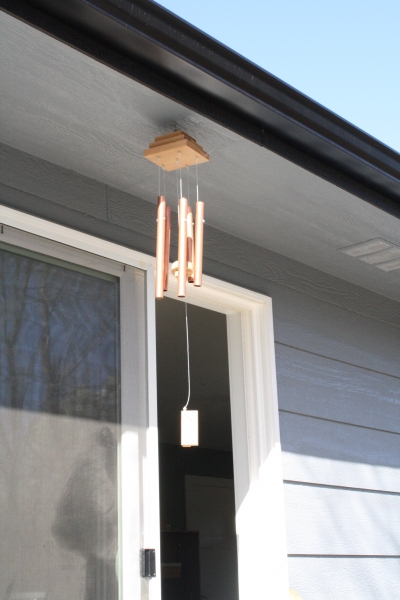
When I opened them, he was holding this windchime!

My birthday windchimes

Happy birthday to me!

(I’ve always wanted a windchime, but am not much of a shopper so it’s an item that’s perpetually been on the “buy some day” list. Except not anymore, ’cause Daniel made me one for my birthday!)


Skirt-Wearing in Pregnancy

Dressing for pregnancy is hard.

There’s trying to figure out how to adjust to a figure that’s changing on a weekly (no, make that daily) basis. There’s trying to avoid spending too much money on clothing you’ll wear for five months or less. There’s guessing what size you’ll be at what season, and figuring out how to layer to make that outfit you bought for when it’s hot and you’re huge work for now (when it’s chilly and you’re not quite huge yet.) There’s trying to strike just the right balance between comfort and style.

It’s hard.

One thing I’ve found, as a mostly-skirt-wearing-woman, is that skirts are an absolute lifesaver.

My pre-pregnancy pants stopped fitting somewhere around the end of the first trimester – and while I wore them for a little while with zipper unzipped and a belly band covering, it wasn’t long before I needed maternity pants.

Skirts, on the other hand, don’t have that pesky crotch that forces the waistline to a specific place. You can wear them high over the belly (if they’re flowing) or low under the belly (if they’re more fitted or if you find it more comfortable that way.

Wearing a skirt over my bump

Wearing a skirt over my bump

In addition to being easy to wear, skirts are wonderful for a variety of weather. If it’s cold outside, you can always throw a pair of tights, leggings, or pants underneath. If it’s warm, you can go bare-legged and enjoy the breeze.

One extra benefit – if you’re a leaker, you don’t necessarily have to resort to pads around the house. If you leak a little, you can just change your underpants without having to worry about changing your “over”pants as well. (TMI? Maybe. But this is pregnancy we’re talking about here – plenty of potentially embarrassing material to cover.)

Wearing a skirt over my bump, part 2

Check out how high that waist is!

I’ve had to retire a few skirts so far this pregnancy due to length issues (I generally prefer to wear a waisted skirt high over the bump and an elastic-waist skirt low; if the skirt is waisted and short, it gets a little TOO short once it’s over the bump) – but I’ve still got almost a dozen skirts that I’m still wearing, and expect to continue wearing for at least another month or two.

BONUS: My sister-in-law was giving away a strapless maxi-dress and I grabbed it on a whim, thinking it might make a good pregnancy skirt. I’ve been wearing the elasticized part (that’s supposed to go over the breasts) over my bump and and letting the skirt (which is supposed to start just below the breasts) hang just below my bump. It gives me the security of coverage while still letting me have a maxi-skirt. This tip probably only works for tall gals like myself, but I’ve found it to be wonderful.

Maxi dress turned maxi skirt

Maxi-dress turned maxi-skirt

Did you wear skirts during your pregnancy? What are your best tips for overcoming the clothing hurdles of pregnancy?


A Bookish Meme

A little over a month ago, Barbara H tagged me in a bookish meme. And now that I’m back to blogging (easing my way back in, apparently :-P), I figured it’s high time I answered Barbara’s questions!

Do you remember the first book you read or really liked?
I don’t remember the first book I read, but I do remember the first book (er…series) I was completely obsessed with. I LOVED the Little House books and read them dozens of times when I was maybe 7 or 8. I remember my older sister and I lying on the floor in our room, reading the Little House books in the thin crack of light that came in from the hall after our bedtime.

How did your love for reading come about (grew up in a reading family, a certain book captivated you, etc.)?
I suppose it’s because I grew up in a reading family. My mom was a voracious novel reader and, although I don’t know if I ever saw my dad just sitting and reading a book that wasn’t the Bible, he was all about information and was always looking up soemthing in an encyclopedia or dictionary. I was maybe four or five when my grandma bought us three different sets of Encyclopedias: a Children’s Encyclopedia, the Compton’s Encyclopedia, and the Encyclopedia Brittanica. We loved those – for reference, sure, but also for reading (the “cows” article and the “American Indians” article in the Compton’s Encyclopedia are wrinkled and stained from much love from a pre-adolescent Rebekah.)

What is your favorite genre to read?
Right now, it appears to be nonfiction of the practical sort: how to make curtains, how to raise a reader, how to have a baby, etc. But I’m not sure that’s really a genre. I’ve historically been pretty eclectic, but have fallen into something of a rut over the past couple of years – one that I’m aiming to get out of with my reading resolutions.

What genre do you avoid reading?
I’ve often said that I avoid reading “genre fiction” – science fiction and fantasy, romances, westerns, mysteries. But that’s not quite accurate. I love C.S. Lewis’s Chronicles of Narnia and J.R.R. Tolkien’s Lord of the Rings, both fantasy series. I read Georgette Heyer’s Regency romances rather often, and Christian romances not infrequently. I have recently very much enjoyed reading a couple of Agatha Christie mysteries. So maybe westerns are really the only genre I really and truly avoid?

What is your favorite movie based on a book?
The A&E miniseries of Pride and Prejudice. I love the book – and the movie’s reliance on dialogue from the book. I love the period costumes and dancing. I love Elizabeth as played by Jennifer Ehle and Mr. Darcy as played by Collin Firth. Really, I love it.

What’s your least favorite movie based on a book?
Pride and Prejudice with Kiera Knightley. Skipping entire plot lines while spending five minutes of precious screen time on a lovesick Elizabeth mooning on a swing? Ugh!

What is your favorite time and place to read?
I don’t know that I have a favorite, unless maybe in bed before a nap on a Sunday afternoon. I do most of my regular reading while marching in place to music between sets of weights in my living room.

Are you in any “real life” book clubs or discussion groups?
My church has a monthly book club that I participate in. We read mostly fiction, but the occasional nonfiction item as well. Since I don’t read a whole lot of fiction, the club helps me to broaden my horizons.

How many bookcases do you have?
I have five full-sized bookcases and three half-sized ones. I only have two of the full-sized and one of the half-sized currently set up and full, since we’ve decided we’re going to do things right and brace our bookshelves before we fill them here at Prairie Elms (and we haven’t done so with the basement ones yet.) Of course, that’s not counting the shelves full of library books in our entertainment center.

What is a favorite quote about books or from a book?
It’s a bit hard to pick favorites… but a quote that I come back to frequently is from C.S. Lewis’s Mere Christianity:

“If I find in myself a desire which no experience in the world can satisfy, the most logical explanation is that I was made for another world.”

Thanks, Barbara, for tagging me in this – it’s so fun to talk books!


Happy/Sad. Good/Bad.

Happy. A little boy wore a gleaming smile to match the word.

Across the page, the same little boy had giant tears rolling down his face to illustrate “sad”.

I turned the page to continue reading to Tirzah Mae, but then stopped short – for the next two words were “good” and “bad”.

After a bit of quick thinking, I told Tirzah Mae that the words were “kind” and “naughty”.

I won’t be buying that particular book for Tirzah Mae, nor will I be checking it out of the library again for her or her siblings.

Good and bad are such loaded words.

In one sense, the illustrations were apt – showing good or bad behaviors. But the rest of the book was describing opposites that modify not behaviors but the child. While each page included only one word, a parent could have “read” the sentence “The child is [insert word].”

“The child is happy.”

“The child is sad.”

“The child is alert.”

“The child is sleepy.”

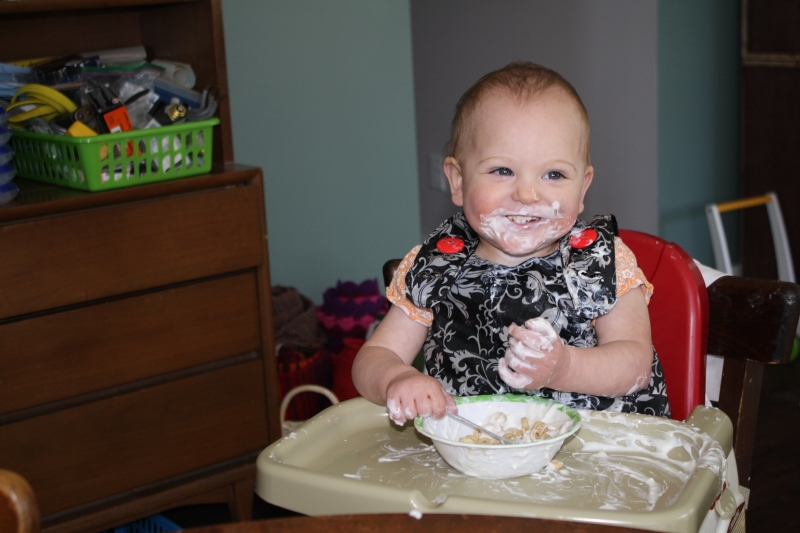
Tirzah Mae is MESSY.

“Tirzah Mae is messy.”

But when it came to “good” and “bad”?

“The child is good.”

“The child is bad.”

It doesn’t fit my theology.

There is a sense in which every child is good. There is a sense in which every child is bad. But neither have to do with the child’s behavior.

Every child is good in the way that God declared Adam and Eve “very good” after creating them. Every child is created by God and, in some small or large way, reflects God’s image. In that, he is good.

Yet every child is bad, in that every child is born sinful. “No part of [him] is untouched by sin, and therefore no action of [his] is as good as it should be, and consequently nothing in [him] or about [him] ever appears meritorious in God’s eyes.” (J.I. Packer’s definition of total depravity from Concise Theology.) In that, every child is bad.

To suggest that a child is “good” because he engages in kind behavior and that he is “bad” when he engages in unkind behavior undermines both the innate “goodness” and the innate “badness” of a child.

I would not want a child of mine to think that she is only valuable in my eyes when she engages in kind behavior. She is valuable because she is a human, created in the image of God.

I would not want a child of mine to think that she is only bad when she engages in naughty behavior – and to think that by changing her behavior she can change her innate badness.

No, I want my daughter (and our unborn baby and every child who enters our family after that) to know that she is precious because God made her. I want my daughter (and our unborn baby and every child who enters our family after that) to know that she is born a sinner and acts sinfully because it’s who she is.

I pray daily that my daughter would recognize that there is nothing she can do to make herself “good”. Every day, I pray that she would recognize her inability to save herself from her sinfulness. Every day, I pray that she would fall upon the mercy of Christ to make her good.

And I want the words I use to help her to recognize her need for a Savior – not to encourage her to cling to works righteousness.

Am I too picky about words? Are there any common phrases that get your guff?


Thankful Thursday:

Thankful Thursday banner

The days and weeks and months continue to be busy – but good.

This week I’m thankful…

…for safe travels
Daniel’s Grandpa died a couple weeks ago and his funeral and burial were on Thursday and Friday of last week. Then my sister-in-law had a baby shower in Lincoln on Saturday – which meant we did a whole lot of traveling over the course of three days (something around a thousand miles.) In all our travels, our vehicle worked, we stayed well, and Tirzah Mae didn’t even complain too loudly about being stuck in her car seat!

…for precious last memories
By the time I met Daniel, his grandpa was already frail and housebound. Grandpa’s memory was failing and he repeated himself frequently. I can tell funny little anecdotes of the times we’ve visited, but the funny is tinged with quite a lot of sadness. But it just so happens that we visited Jack just one week before he died. No one had any idea how soon Jack would leave us – but I’m so glad we had that last visit. One day, I can tell Jack’s great-grandchildren about the last time Daniel and I visited him before he died. Jack asked the old familiar questions about jobs and families – but the overarching theme of his conversation was thankfulness. He was thankful for his wife and all the hard work she did bringing children into the world and raising them. He was thankful for his children, that God had given him five. “Are you going to have more?” he asked me, forgetting that I’d already told him we were expecting. “They’re worth a million bucks” he said. Precious memories I can pass on to our children.

…for ending and beginning with Betsy
Sure, we’ll probably do a thing or two more before we actually sell her, but we’ve got enough done with Betsy (our old house) that we’re ready to put her on the market. It’s a tremendous relief to me.

…for providential timing
Tirzah Mae rarely sits in her booster seat unless I’m sitting beside her eating – but it just so happens that she was still sitting in her chair from dinner (or already in her chair before second breakfast) when I dropped a glass bowl and a ceramic bowl on the floor (on two separate occasions). Since she was in her chair, I could clean up the shattered remnants of the bowls without worrying about her safety.

…for the one after whom all families are named
I’m moving along to memorize a second of Paul’s prayers for the Ephesians – this one in Ephesians 3. Paul writes

“For this reason, I bow my knees before the Father from whom every family in heaven and on earth is named…”
~Ephesians 3:14-15 (ESV)

It’s encouraging to remember that God is the author of every family. May our small family reflect Him more and more.


Goodbye to Betsy

Yesterday Tirzah Mae and I drove back to the old house (affectionately named Betsy) for what we’re hoping is one of the last times.

We cleaned the kitchen and bathroom – and gave our realtor keys to the front door.

Tirzah Mae and Mama post-cleaning
Tirzah Mae and her Mama post-cleaning

Lord willing, Betsy will be on the market by the end of the week.

Lord willing, she’ll be sold soon.

She served us well – Daniel for eight years, me for three, Tirzah Mae for one.

She was our newlywed home, the first home either Daniel or I had owned, the home where we started building our family.

And now, as we prepare to expand our family, as we celebrate three years of marriage, as we enjoy the home we built together, we’re ready to hand Betsy over to others.

Will she be home to a single person just starting out (as she was for Daniel)? Or will it be a young couple who moves in? Maybe it’ll be a family (although it’d have to be a small one – she’s just a little house)?

I don’t know what the future holds for Betsy, but I’m glad she was a part of our past – and I wish whoever comes next as much joy in her as we had.