Nightstand (November 2014)

Last month, I sat in a hospital room typing up my Nightstand post, trying to hold off my baby’s delivery as long as possible. This month, I eagerly await news that I can return to a postpartum hospital room, room in with my daughter and BRING HER HOME.

It’s been an eventful month, full of traveling back and forth from home to hospital and pumping endless gallons of breastmilk (nope, not exaggerating, you should see my deep freeze). It has not been a particularly reading-rich month, since I’ve been rather busy with Tirzah Mae. But, there are still books on my Nightstand – can a fish live without water?

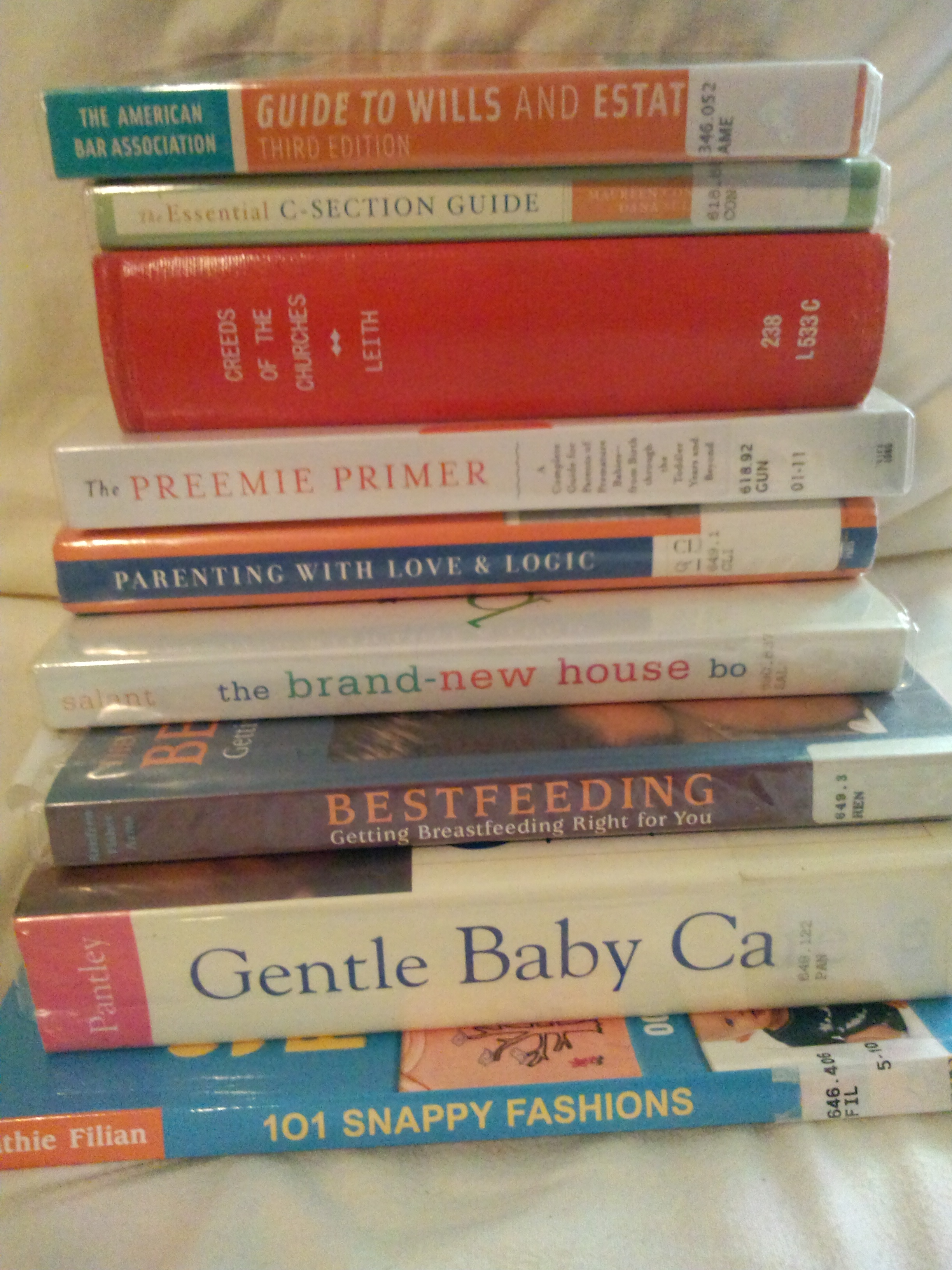
Book pile

This month, I read:

  • The Essential C-Section Guide by Maureen Connolly and Dana Sullivan
    Since about 30% of American births take place via c-section, the authors attempt to fill a gap in prenatal education, teaching women what to expect before and after a c-section. Reading this, I was a) frustrated that the c-section rate is as high as it is (much of it due to repeat c-sections without other indications) and b) thankful that I didn’t have a c-section – except that, oh wait, I did. The authors seem to go out of their way to try to present a c-section as a normal and appropriate birthing experience (though they stop just short of encouraging the completely elective c-sections that are normative in some South American countries). Meanwhile, the typical side effects/after effects of a c-section that the authors describe are so truly horrific that this reader is convinced (if she wasn’t already) that VBAC is the way to go (I was blessed to NOT experience anything particularly awful after my section – but why risk those side effects if you can avoid them entirely?) I really want to review this book more fully, but don’t know if I will, since, well – I am recovering from my c-section and taking care of my preemie, which doesn’t exactly leave a lot of room for other things.
  • 1628 Country Shortcuts from 1628 Country People by editors of Country and Country Woman magazines
    “Who knew” type tips from before Pinterest.
  • Christmas in Williamsburg by Taylor Biggs Lewis, Jr. and Joanne B. Young
    Lots of pictures of Colonial Williamsburg dressed up for Christmas. A fun review from our trip.
  • Preemies by Dana Wechsler Linden, Emma Trenti Paroli, and Mia Wechsler Doron M.D.
    A great comprehensive look at the questions and concerns parents have while their preemies are in the Neonatal Intensive Care Unit. Read my full review.
  • Christmas Customs around the World by Herbert H. Wernecke
    Many of the customs described in this little book, published in 1959, are depicted elsewhere with equal or greater artistry – the real strength of this particular volume compared to others is the missionary vignettes shared throughout. While I can’t find the passage that gave me the impression, it seems that the author was involved with some Presbyterian missions agency, and he shares a variety of missionary’s depictions of how their community (often a mission school or orphanage) celebrates Christmas in Africa or Asia.

image

On the docket for next month:

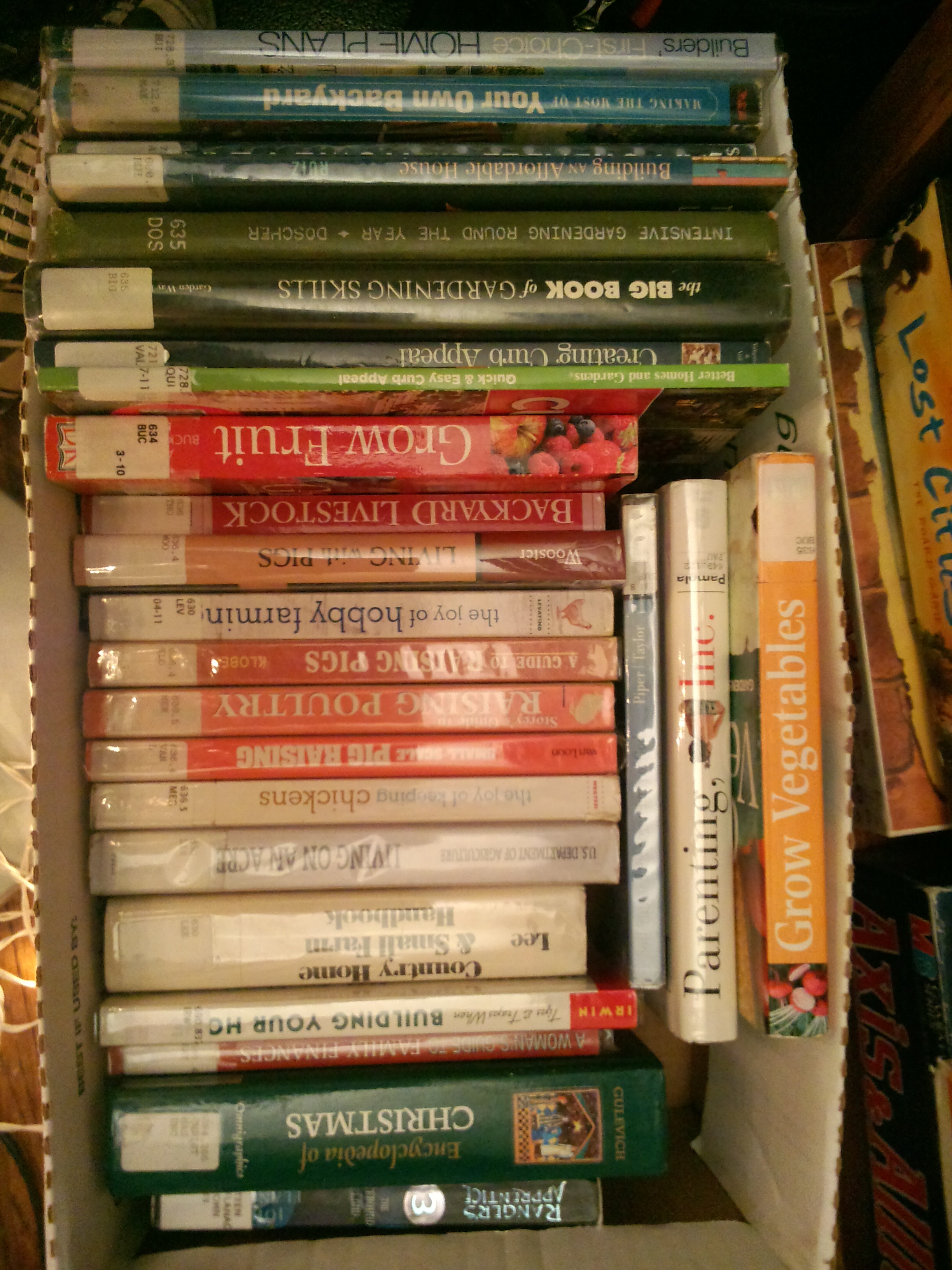
  • Books about preemies/childcare
    ‘Cause we have a daughter who needs to be cared for
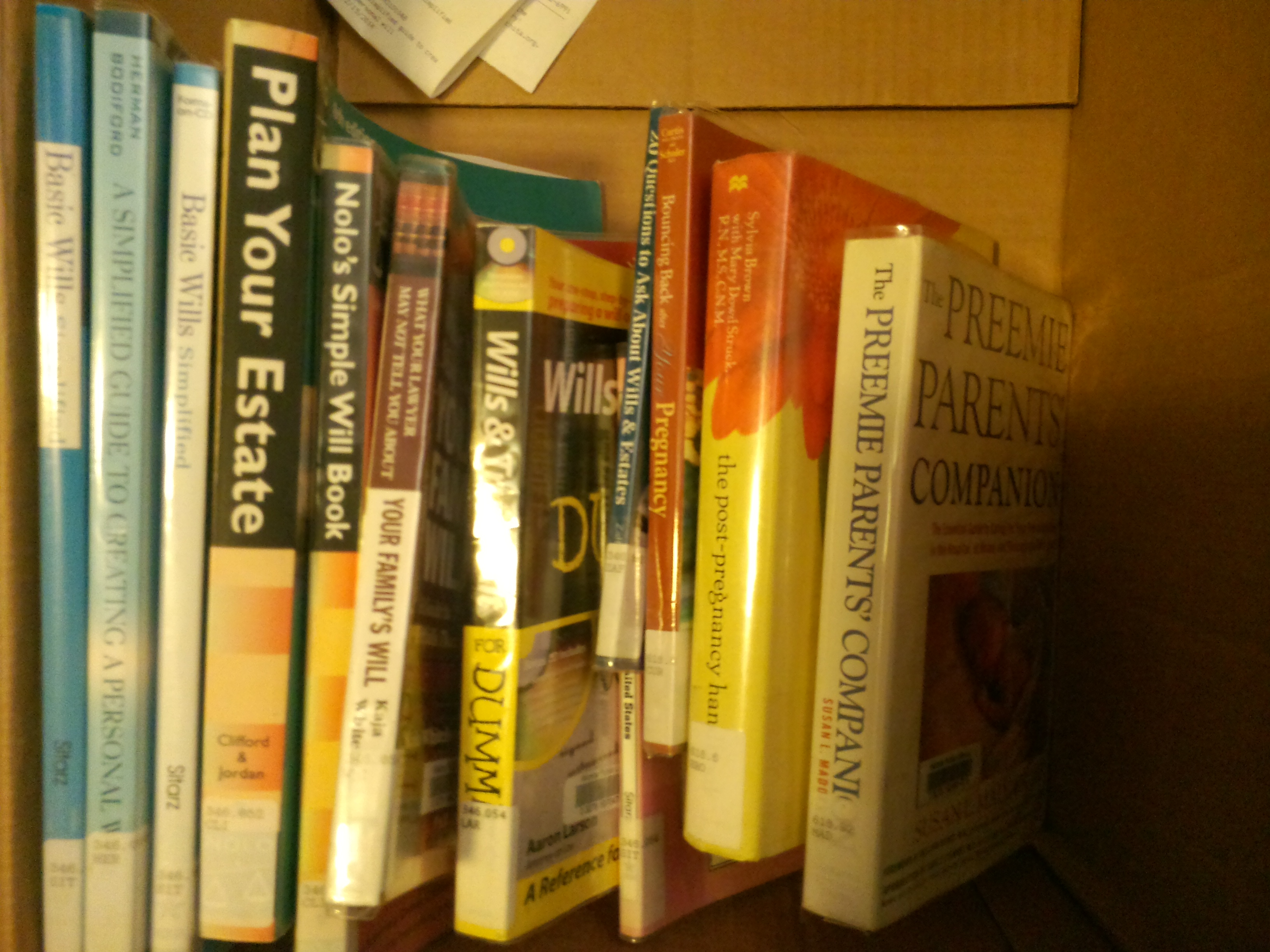
  • Books about estate planning
    ‘Cause we have a daughter who needs to be cared for
  • Books about postpartum body stuff
    ‘Cause there are special rules for recovering from a c-section and I didn’t study up in advance because I didn’t expect to need it.
  • Books about building houses
    ‘Cause we’ll need to be thinking about the process of putting a house on our land.
  • Books about gardening/homesteading
    ‘Cause I’m dreaming of what else we can put on our land.

image

Don’t forget to drop by 5 Minutes 4 Books to see what others are reading this month!

What's on Your Nightstand?


Grace for Today

All my worst fears came true in Tirzah Mae’s birth.

Is it odd that I never really feared for our baby’s safety? There were days when I was distracted or particularly active and didn’t notice movement so I worried – but, in general, I was at peace.

What I really feared was risking out of home birth, having to deliver in a hospital. When I started retaining water, I feared pre-eclampsia. Most of all, I feared a c-section.

All my worst fears came true in Tirzah Mae’s birth.

And God’s grace was there for each circumstance as it arose.

God’s grace was not there for the fear and anxiety leading up to delivery.

I worried and fretted and stressed over the potential of pre-eclampsia, of risking out of home birth, of having a hospital birth, of a c-section. In all that, grace was absent.

God gave His command long ago when He told the people not to worry about tomorrow.

Worrying about tomoorrow is fruitless- tomorrow will have worries, sure, but God’s grace is available for today’s trials.

Despite my weeks of increasing dread, when the time came, God’s grace and peace was there.

When the urine test at the midwife’s office showed 3+ protein, I went into the waiting room and told my husband and grieved for less than 5 minutes over the loss of a homebirth. God’s grace was there.

When the OB checked my blood pressure and my protein and sent me to the hospital, I settled in for a long hospitalization with a calm every nurse remarked upon. God’s grace was there.

When the perinatalogist said that my platelets were droping and we needed to induce at 32 weeks, God’s grace was there.

When 12 hours of magnesium and cervidil left me exhausted and feeling a foreigner in my own skin, I calmly discussed with my husband and God’s grace was there as I asked the doctor for what had been my worst fear – a c-section.

I learned that God gives grace, not for the worries of tomorrow He commanded us to cast on Him, but for the actual events He gives us in today.

The hymn proclaims

“Strength for today
and bright hope for tomorrow
Blessings all mine
With ten thousand beside.”

And the hymn is absolutely right. God gives the strength and grace for every today – but gives only the hope that allows us to cast every tomorrow’s anxieties upon Him.

May I, may we ever bask in today’s grace – and ever cast tomorrow’s anxieties on Him whose grace is sufficient when tomorrow becomes today.


Lactose intolerance in babies

It happens in my office all the time. A mother declares that her infant is lactose intolerant: “Everyone in my family is”.

The professional in me keeps a neutral facial expression while I internally groan. And since the doctor has marked that the infant should receive Similac Sensitive for Fussiness and Gas, helpfully providing an additional diagnosis of “lactose intolerance”, I issue the infant checks for the lactose-free formula.

I groan because lactose intolerance in babies is incredibly rare. Babies’ guts make the lactase enzyme so they can break down the lactose found in their mother’s milk (all mammals’ milk includes lactose). It is only as children grow older and less dependent on mothers’ milk that their bodies stop producing the enzyme to process it.

The few exceptions are 1) primary lactase deficiency, which rarely ever occurs, 2) secondary lactase deficiency, where a gastrointestinal illness temporarily wipes out the body’s ability to make lactase, and 3) prematurity, where an infant is born before her gut lining has started to produce lactase.

Which brings me to my biggest groan.

Tirzah Mae had only ever received my breastmilk, slowly increasing feedings as the IV nutrition was decreased. Most of what she got was via the feeding tube, but she’d started taking it by bottle in the last few days – and we’d started practicing breastfeeding once a day as well.

As I prepared myself for our breastfeeding practice, I noticed that Tirzah Mae had spit up – and I mentioned it to the nurse, who observed that the spit up was bright yellow (my color discrimination has been poor since I delivered, so I didn’t notice anything odd about it under the dim lights.) When the nurse checked the residuals left in Tirzah Mae’s stomach, they were green. Feedings were put on hold and breastfeeding practice suspended.

That evening, the nurse practitioner came in to discuss the situation. She explained the plan: to start again with smaller feedings and work our way up again – and asked me how much dairy I consumed.

She explained how preemies sometimes don’t yet have the ability to process lactose and requested that I reduce my intake of dairy down to maybe one serving a day – and maybe I could try lactose-free milk instead of regular.

I put on my patient face, inquiring about what she thinks might help, while inwardly groaning.

You see, despite the opinions of plenty of doctors and nurses, lactose intake by a woman actually has no impact on the amount of lactose present in her milk.

In a lactose-tolerant woman, any lactose she eats is broken down into its component sugars in her gut, from which the component sugars are absorbed into her blood stream. Then, independently, her breasts take sugars from her blood stream and synthesize them into lactose for her breastmilk.

In a lactose-intolerant woman, any lactose she eats passes through her gut into her colon unabsorbed – and bacteria in her gut ferment it, producing the typical symptoms of lactose intolerance (gas, diarrhea, abdominal cramping, etc.) Then, independently, the mother’s breasts take sugars from her blood stream and synthesize them into lactose for her breastmilk.

It’s simple science, really. But doctors and nurses didn’t spend their educations studying the science of digestion and absorption and metabolism like dietitians do.

So they give silly, unscientific advice related to diet and mothers swear by it because they see improvement when the prematurity (or the GI illness) that caused the problem in the first place resolves (sort of like thinking the antibiotic cured your child’s cold when it resolves in 7-10 days)**.

I choose not to argue and dutifully consume just one serving of dairy daily (actually, I only ever consumed one serving of lactose-containing dairy daily – since my former pattern was one cup of milk, one cup of yogurt, and one serving of hard cheese daily). I label my breastmilk “low dairy” and dream of the day when I can go back to eating whatever I want to without being dishonest. (Since the only reason I’m not eating the dairy now is so I wouldn’t be dishonest in writing “low dairy” on my breastmilk – I already know the restriction isn’t affecting her at all.)

**Caveat: Some women who are told that their infant has lactose intolerance and who reduce dairy as a result discover that this truly is helpful (and symptoms resume when milk is reintroduced). This is generally a case of mistaken identity. While lactose in mom’s intake and lactose in breastmilk are not related, the more cow’s milk a mother consumes, the more cow’s milk proteins will end up in her milk – and some babies do have sensitivities to cow’s milk proteins, which would resolve when mom reduces dairy intake.**


Thankful Thursday: Myself Again

Thankful Thursday banner

I’m not generally a vain person – and I didn’t dread the weight gain that would come with pregnancy. I correct women all the time when they disparage themselves in my office. “You’re not fat,” I tell them, “You’re pregnant.”

And despite the wound to my pride when my weight gain surpassed the goal curve somewhere around 20 weeks, I felt fine with my pregnant body – until I didn’t.

I’m not sure at what point the swelling went from being just a part of pregnancy to I-no-longer-am-at-home-in-my-own-body, but by the time we were hospitalized, I was there.

Now, as the swelling goes down and my blood pressure finally decreases too, I am thankful to be myself again.

This week I’m thankful…

…for normal shoes
I never wear tennis shoes, preferring to pair ballet flats or loafers with my skirts or slacks. But when my feet started swelling around 22 weeks, I requested (and was granted) permission to wear tennis shoes at work. Before long, my feet has swollen to the point that I couldn’t have worn my other shoes even if I wanted to – my feet widened to the point that there was sock peeking out on either side of the tongue of my tennies. Now, I’m thankful that my feet are returning to normal, which means that I can return to my normal footwear.

…for the ability to breathe
Not too long into our hospitalization, I started to have difficulty breathing. The X-ray showed a spot of fluid on my lungs but (thankfully) no widespread pulmonary edema. The residents began me on a regimen of incentive spirometry, where I tried to blow 1750 mL of air into a little device to fully empty my lungs – and then allow them to fully reinflate. It felt magnificent after delivery to be able to breathe again without laboring. I’m so thankful that I can breathe.

…for my face looking back in the mirror
We didn’t weigh me that last day before delivery, so I don’t know how much I gained ultimately in my 32 week pregnancy. Weights from earlier in the week showed at least 50 lbs of gain – but I know I gained quite a bit more even in that last day. How do I know? Because my face went from being thin (at the beginning of pregnancy) to being rounded (when I entered the hospital) to being look-who-we-just-carved-out-of-the-recliner-she’s-been-sitting-in-for-ten-years (at delivery). That last day, I gained so much additional fluid, that I could barely see through slit-like eyes and couldn’t recognize the face I saw in the mirror. I’m so grateful that I can now look in the mirror and see my own face looking back at me.

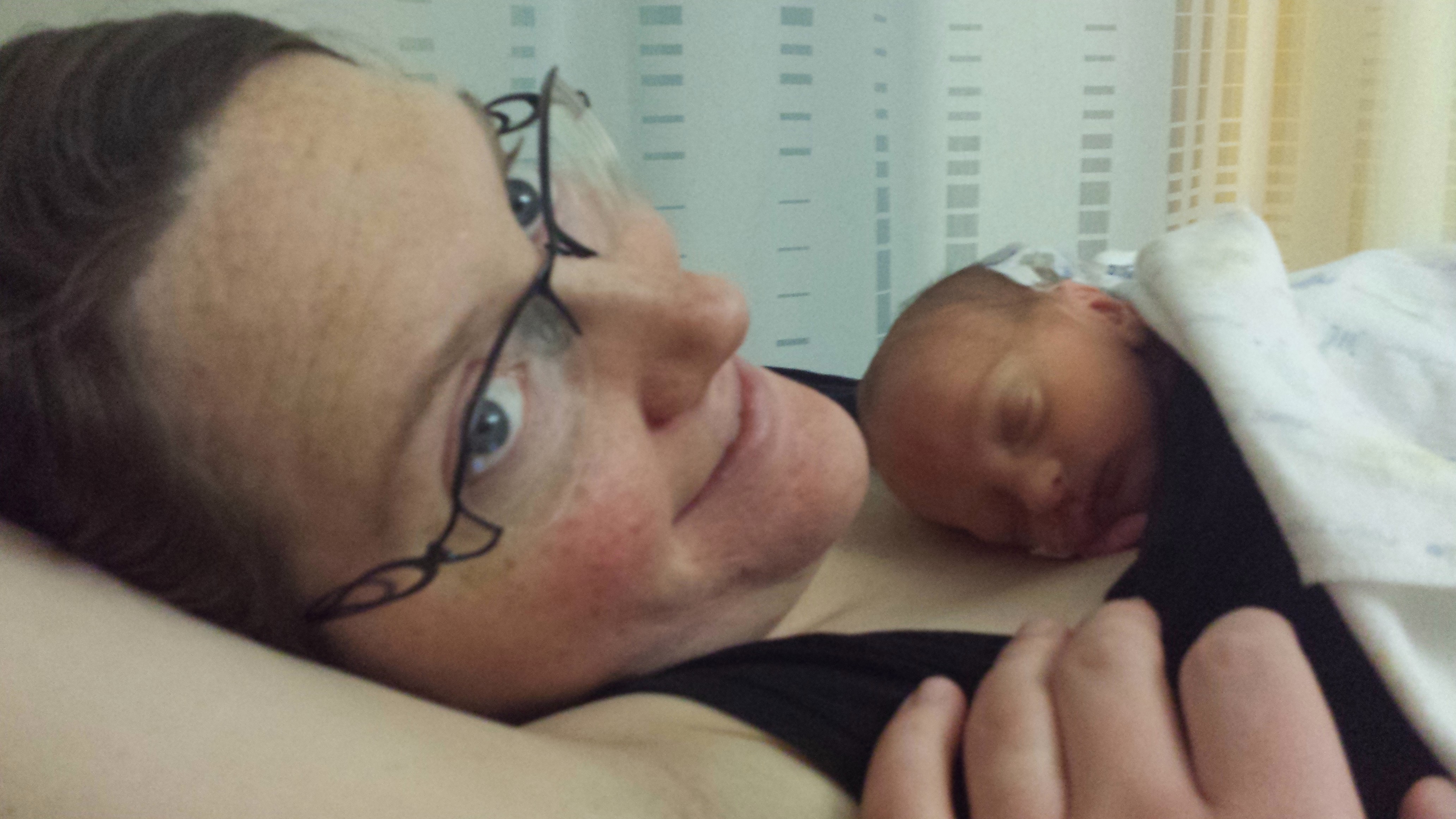
Tirzah Mae and I two hours after her birth

Me and Tirzah Mae two hours after her birth – note my swollen face

…for limbs that move at my will
I didn’t experience any terrible side effects (except for a single emesis) from my first course of intravenous magnesium, but my second dose, once we began induction, was awful. I shook uncontrollably almost constantly and couldn’t really move myself willingly at all. While I hated the Foley catheter during the first course, I took refuge in it during the second – since there was no way I could have controlled my own body enough to walk into the bathroom, or even keep myself seated on the commode. Having not had any control of my body for 12 hours during the induction, I am so thankful to again be able to move my own limbs when and only when I want to.

It’s harder for me to be thankful that my belly is almost flat, able to fit into many of my old clothes. But the conversation I overheard in the operating room makes me thankful even for that.

I could hear an audible gasp, I’m not sure who from – and then Daniel asked “Is that the waters breaking?” The doctor replied, “No, I haven’t gotten to her uterus yet – that’s ascites.”

I don’t know if the doctor explained ascites or not – but I knew what it was and was (and am) grateful that we delivered when we did. Ascites is a buildup of fluid in the abdominal cavity, generally because the liver has stopped functioning. While my liver function tests were still normal at the point we began induction, my liver had clearly shut down in the twelve hours between the start of induction and Tirzah Mae’s birth. My womb would have quickly become a toxic environment for her.

So I’m thankful. Thankful that the fluid in my belly is gone – and even though it’s bittersweet that my baby’s gone too, I’m so thankful that she is safe in the NICU rather than being poisoned by my body no longer working.

God has been good, so very good.

“Whom have I in heaven but you?
And there is nothing on earth that I desire besides you.
My flesh and my heart may fail,
but God is the strength of my heart and my portion forever.”
~Psalm 73:25-26 (ESV)


Book Review: Preemies by Dana Wechsler Linden, Emma Treti Paroli, and Mia Wachsler Doron

The books to return were already in the car and were already overdue when we had our visit to the midwife, so I had no choice but to return them to the library. I briefly contemplated just driving through the bookdrop – I had officially just been put on bedrest.

But I’d just been put on bedrest. I’d need some reading material. Specifically I wanted something on pre-eclampsia.

I returned the books, seated myself at the computer catalog, and only rose when I had Dewey Decimal numbers for all my books.

There were no books on preeclampsia, but one on preemies showed up under that search, so I figured I might as well see what that book had to say about preeclampsia.

Thus, I returned home with Linden, Paroli, and Doron’s Preemies. I didn’t start reading it right off, but when we were admitted to the hospital immediately after our OB appointment the next day, I requested that Daniel bring the book with him when he returned to the hospital.

Preemies turned out to be a really fantastic, comprehensive look at the struggles of premature babies and their parents. The chapters are arranged chronologically, from “In the Womb” to “The First Day” all the way to “From Preemie to Preschool (and Beyond)”. Each chapter begins with Parents’ Stories, then The Doctor’s Perspective, then Questions and Answers. Finally, the authors include a small section on special issues facing preemie multiples during that stage.

I read this book from cover to cover (except for the final chapter on losing a baby – I’m almost certain that chapter would have had me distraught) and found it to be a valuable resource for understanding what was happening with our Tirzah Mae (and thankfully, many complications that weren’t happening).

Of course, most mothers of preemies don’t have advance warning like I did – eight days of hospitalized bedrest during which I could read and prepare myself for the inevitable premature birth of our baby (even as we tried to keep her in the womb as long as possible.) Also, most mothers of preemies are presumably not quite as voracious readers as I am. But Preemies takes that into account, offering a comprehensive table of contents that includes each question to be addressed in the Q&A section of each chapter – thus allowing parents of preemies to easily find answers to their specific question without having to read through all 572 pages of this tome.

This book’s strong point is definitely the descriptions of the medical procedures and processes that take place in the Neonatal Intensive Care Unit (NICU) – It is not as good at detailing what happens or what to do after your infant comes home from the NICU. That said, I would still highly recommend this as a resource for parents of preemies in the NICU.


Rating: 4 stars
Category: Medical/Parenting
Synopsis: A comprehensive look at the various challenges faced by preemies and their parents, particularly during a stay in the Neonatal Intensive Care Unit.
Recommendation: Well-written, comprehensive, understandable descriptions of common medical procedures and complications. Recommended for parents of preemies currently in the NICU.


Protector and Sustainer

“How old is she?”

It’s the natural question mothers of infants field every day.

It’s the question mothers of preemies just don’t quite know how to answer.

Tirzah Mae is 2 weeks and 3 days old – if you’re dating from when she left my womb.

But she’s just 34 weeks and 4 days old – if you’re counting gestational age. Which means she should still be in my womb – should still have another six weeks in my womb.

For me, this is the hardest part of being the mother of a preemie.

Tirzah Mae and Mama

Tirzah Mae should still be in my womb. I should be protecting her, sustaining her, giving her oxygen and nutrition and warmth. Instead, she lies in an isolette away from me. My body couldn’t protect her, couldn’t sustain her, couldn’t give her what she needed. My body failed her.

I know there wasn’t anything I did to cause the severe pre-eclampsia, wasn’t anything I could have done to have held it off longer than we did. We already managed to keep her in the womb 8 days longer than when we first acknowledged the problem as severe. I, the midwife, the doctors did all we could. My body just shut down that last day and she had to be delivered.

But that doesn’t stop the profound sense of loss and helplessness. I lost two months of pregnancy – Tirzah Mae lost two months of my protection. Now being told my belly’s so small and I look so good for a woman who’s just had a baby takes on a new sting. Now should be a time of glorying in my baby bump, not of rapidly returning to my prepregnancy state. As my little girl thrashes about on her isolette when a new nurse doesn’t know to swaddle her, I try to soothe with my voice from a distance while I scrub in the requisite 3 minutes. She should still be in my womb, nestled tightly to keep her from worrying at her limbs being all stretched out. She should be hearing my voice, my heartbeat, my bowel sounds and breathing all the time, calming her. Instead, she settles for a voice across the room, echoing oddly inside her isolette, telling her that it’s okay, mama’s here.

People have told me, from early pregnancy, that parenting is an exercise in trusting God. I acknowledged that, even as I researched all the right things to do to prepare for conception, to reduce risk of pregnancy complications, to set my child up for the best of health. I had it researched, had the plan worked up, and scrupulously followed the plan – and I had complications nonetheless.

Sweet Tirzah Mae

In the earliest days after Tirzah Mae’s birth, when I was struggling most with the sense that I had failed her, the chorus to an old hymn resounded in my head:

“He hideth my soul in the cleft of the rock
That shadows a dry thirsty land.
He hideth my life in the depths of His love
And covers me there with His hand”

I looked at the Scripture the hymn points to – Exodus 33 – where Moses requests to see God’s glory and God declares that no man can see Him and live. But God arranges a way – He hides Moses in the cleft of a rock; He covers Moses with His hand; He makes His glory pass by. Moses sees God’s backside and LIVES, hidden by God’s own hand.

And God opened my eyes to His character, to how this story foreshadows the cross. Our biggest danger, Tirzah Mae’s biggest danger is not the harsh world outside her mother’s womb. Her biggest danger is to be consumed by the wrath of God. Yet God made a way to protect her – God offers to protect her in the cleft of a rock while He pours out His wrath on His right hand, His only Son.

If God is willing to go to such lengths to hide me, to hide my Tirzah Mae from His wrath – how can He not guard and sustain her in the little dangers of life as a preemie?

As I mourn my inability to protect Tirzah Mae, God reminds me that He is her protector.

And as I mourn my inability to sustain Tirzah Mae, He takes me again and again to the Scriptures that assert that He is the sustainer of all life.

“In Him we live and move and have our being.”
~Acts 17:28

“For by him all things were created, in heaven and on earth, visible and invisible, whether thrones or dominions or rulers or authorities—all things were created through him and for him. And he is before all things, and in him all things hold together.”
~Colossians 1:16

The truth of God’s character comforts my heart and I raise my Tirzah Mae up to God. As much as I love her, He loves her more. As much as I am limited in my ability to protect and sustain her, He is limitless. He is her protector and sustainer. As much as I can be an agent by which He guards her, I shall be – but ultimately, I must surrender her to Him again and again.


Our newest addition

We had hoped to keep Baby Garcia in the womb as long as possible – but really only had educated guesses as to how long that may be.

Turns out, that was 32 weeks.

On Thursday the 30th, my platelets dropped, causing our consulting physician to recommend induction. Even before we began that process, my blood pressure started to rise again (and wasn’t responding well to drugs) and my swelling had increased dramatically.

I had lots of side effects of the induction drug and/or the magnesium sulfate I was back on to prevent seizures – and by the time the day was done, I was physically and mentally exhausted. I couldn’t stand on my own feet between dizziness from the magnesium and swelling in my feet. I couldn’t grasp a spoon to feed myself ice chips since my hands were so swollen. I couldn’t see thanks to an unrecognizably swollen face, along with the characteristic “visual disturbances” associated with pre-eclampsia. And my oxygen saturations were dropping.

By midnight, I realized that I would not have the physical or emotional strength to attempt a vaginal delivery (at least another 12-24 hours on Pitocin) with the restrictions my condition placed on me. I requested a Caesarean section.

At 3:32 Friday morning, Tirzah Mae Eloise Garcia was born at 32 weeks 1 day of gestation. She was 17.5 inches long and weighed 3 lbs, 5 oz. She was born with her umbilical cord tightly wrapped around her neck twice.

In retrospect, Tirzah Mae’s cord plus my own health status could easily have necessitated an emergency c-section had we proceeded with an oxytocin-induced vaginal delivery, and I could have then needed general anesthesia so Daniel couldn’t be there and potentially would have ended up with an incision that would make VBAC less likely.

As it is, God in His mercy gave us an uncomplicated c-section with ample chance for VBAC and beautiful, healthy baby born at 32 weeks, 1 day.

IMG_20141101_194717740

We’re still in the hospital – I will probably be here just one more day but we’re still working on getting my blood pressure under control. Tirzah Mae will be here longer, not because she isn’t doing well, but simply because she still has weeks of maturing to do before she’s ready to face the outside world on her own. For now, she’s breathing under her own power and starting to get tiny feedings of her mama’s breast milk. We treasure every moment we get to spend with our precious Tirzah Mae.

Thank you all for loving us and praying for us – and please continue to pray for us as we continue this joyful and challenging journey as parents of a preemie.


Nightstand (October 2014)

Hospitalized bedrest for severe pre-eclampsia has understandably disrupted my usual routines – and the monthly Nightstand is no different. It’s not that I’m not reading plenty while on bedrest – that is, in fact, just about all I’m doing regularly – but logging what I’ve read and taking pictures of my piles has decreased significantly in priority.

Currently Reading:

  • The Bible: ESV
    There is no consolation in times of trouble like the continued reminder of the faithfulness of God throughout the ages – and no better way to be reminded than through His own record of His doings.
  • Great Hymn of the Faith
    For me, hymns are one of the best ways to remind my mind of truth even as it (my mind) wants to go crazy with speculations. I had Daniel bring the hymnal to the hospital room and I’ve been working my way through it two or three hymns at a time, singing each one I know – and delighting in the truth from Hymn 1 “O Worship the KIng” (“In thee do we trust, nor find thee to fail / Thy mercies how tender, how firm to the End / Our maker, defender, redeemer, and friend”) to Hymn 87 “Joy to the World” (“He rules the world with truth and grace / and makes the nations prove / the glories of his righteousness / and wonders of His love”).
  • How I know God Answers Prayer by Rosalind GoForth
    Reading along with the Reading to Know bookclub – I’m not sure whether I’ll get it finished and a post written about it, but it has been another encouraging reminder of the faithfulness of God, and one that helped me to focus on God during the couple of weeks leading up to our hospitalization, when I started to realize something was going wrong and started to panic with worst-case scenarios.
  • Preemies by by Dana Wechsler Linda, Emma Trenti Paroli, and Mia Wehsler Doron
    I picked this up from the library right after our visit to the midwife gave me serious indication that we would likely NOT be having the normal, natural, term home birth I expected. So far, this has been a nice intro to what we might expect from a NICU stay.
  • Keeping Bees and Making Honey by Alison Benjamin and Brian McCallum
    Since we just bought a piece of land outside of town, I’m inspired to dream big about all sorts of homesteading possibilities previously less feasible because of our location in the center of town.

This month, I read:

  • The Burning Bridge by John Flanagan
    I enjoyed this second title in “The Ranger’s Apprentice” as much as the first. It continues to be an entertaining and clean YA fantasy series – and one that I don’t hesitate to recommend.
  • The Foundling by Georgette Heyer
    Heyer never ceases to amuse – and this particular title is one of her stronger ones. The young Duke has been molleycoddled and managed from birth by his guardian and a set of loyal staff. He’d love to be his own man, but is quite too compassionate to his loving jailors to defy their imprisonment. But when his young cousin gets into female troubles, the duke sees a perfect opportunity to “slip the noose” and settle the affair. While his faithful family and servants search for him frantically – and wild rumours fly about London, the duke manages to acquire two young wards, a false identity, a kidnapping, and more than a couple scrapes with the law.
  • Parenting, Inc. by Pamela Paul
    A look at how the parenting industry preys on parent’s desire to be perfect (and to raise perfect children) to sell them all sorts of unnecessary items and services. I have the book beside my bed waiting for me to review it fully, but I’m not sure whether I’ll get around to getting that done. For now, I can say that I devoured this book in a short period of time and very much appreciated the author’s perspective.
  • Painless Childbirth by Giuditta Tornetta
    The author, having experienced a painless childbirth, attempts to walk the reader through the months of pregnancy to allow her a painless childbirth as well. But I’m willing to have some pain in childbirth to avoid the pain of having to walk through Tornetta’s tortured “spiritual” journey, her exploration of the chakras, her practice of hypnosis, and her pseudo-psychology. I read three chapters, skimmed the rest, and praise God that I don’t have to summon the strength for childbearing from within myself – instead I can rest and rejoice in the eternal, all-powerful God of the Universe who gives strength for childbirth, whether painful or pain-free.
  • Under the Tree by Susan Waggoner
    A nostalgic full-color look at children’s toys from the 1930s to the 1970s. While I didn’t personally receive many of these (although some have stood the test of time and were still being given in my childhood), I remember these toys and games fondly from trips to grandparents’ houses and time spent playing across the street at our pastor’s house (with the toys his older children left behind!)
  • The Baby Name Wizard by Laura Wattenberg
    A fun baby naming book that gives charts of popularity over the past century.
  • Christmas in Ireland
    Christmas in Switzerland
    Christmas in Today’s Germany by World Book

    I do so love Christmas – and learning how different countries “do” Christmas is always enjoyable.

Don’t forget to drop by 5 Minutes 4 Books to see what others are reading this month!

What's on Your Nightstand?


Life goes on…for everyone except me

The oddest part of being on hospitalized bedrest is the realization that life goes on…for everyone except me.

People get up and go to work and come home and make dinner and watch the World Series and update Facebook with the goings on of their day.

I lie in bed and try to occupy the time between every-four-hour vitals and daily nonstress tests and couple time a week sonograms. I call the nurse to let her know how much I voided. I call room service for a meal and sit up in bed for one hour afterwards to avoid heartburn before lowering the head of the bed to keep my blood pressure lower.

My day is wrapped around baby’s health and my own.

Baby’s still kicking. Biophysical profile is good. Heart rate is great. No contractions. Baby’s doing fine.

My health is harder to assess and more tenuous. Is this headache a sign of disease progression or is it my normal morning sinus headache prolonged because I’m not getting up to clear my head? I’m struggling to breathe – how far do I press the residents to do something about it when my O2 saturations are staying okay? I’m retaining tons of fluid – the doctors haven’t recommended anything but the nurse suggested restricting my fluids a bit to try to stave off some of it. Should I follow her advice? My blood pressure fluctuates, never quite high enough to need an oral antihypertensive – but high enough to make me worry.

People ask me what they can do to help and I have no idea what to tell them. I know what I’d be doing at home if everything were fine and I was getting prepared for my expected home delivery – but my life is on hold now and I have no idea how to carry on.

Do I need preemie clothing? Will I need to be prepared to take baby home right after we deliver? Or will there be weeks in the NICU before that happens? How important is it that my dishes be done, that the nursery be prepared, that the freezer has meals in it? I don’t know.

I can only think for the present day, because everything could change in an instant.

And I open Facebook and see all the kids in their new Halloween costumes and pregnant mommas wearing clever little mom and baby costumes – and I am baffled that life goes on…for everyone except me.


Quick update from the hospital

I saw our backup OB yesterday due to the blood pressure / protein spilling issues and my blood pressure had spiked to the point that he admitted me to consult with a maternal fetal specialist at one of our local hospitals. I’m currently getting at least 24 hours of observation as well as IV magnesium to reduce risk of seizures and steroid shots to help mature baby’s lungs for a sooner entry into the outside world. Right now, we don’t know when that might be, but this particular specialist (versus his counterpart in the hospital down the street) tends to like to keep babies in the womb if at all possible – which is very encouraging to me. We’ll have a better idea of what treatment will look like and whether I’ll be hospitalized for the duration of the pregnancy tomorrow after labs are complete. Either way, we’ll likely be spending quite a bit of time in the hospital in the next several weeks, whether in treatment for me or in the NICU with baby.

Good news is baby is healthy – growth is right on track, amniotic sac has just the right amount of fluid, heartbeat and fetal movements are great.

God has also been gracious to give me supernatural peace about this rather enormous departure from our planned home birth. The nurses and doctors have mentioned how remarkably calm I have been regarding the change – and how well I’ve tolerated the procedures so far (the IV and shot of steroids and the Foley catheter). I have to admit that’s not my strength at all – God has been gracious to grant peace and rest. (That said, I’ll be pleased as punch when the 24 hour sample is up and they hopefully let me start peeing on my own power again.)

Thank you all for praying and for continuing to pray. I know that God answers prayer according to the wisdom of His providence – and that He accomplishes all things for His glory and His people’s ultimate joy. I am currently resting in that sweet assurance – and praying that I would continue to rest in God’s good sovereignty.