
Righteousness in the Balance

Notes on Ergun Mehmet Caner and Emir Fethi Caner’s
Unveiling Islam
Chapter 9: Salvation (Mathematical Righteousness)

“Then those whose balance [of good deeds] is heavy,–they will be successful. But those whose balance is light, will be those who have lost their souls; in Hell will they abide.”
surah 23:102-103 (as quoted in Caner & Caner p. 149)

In Islam, righteousness is measured as on a balance. The righteous man is the one whose good deeds outweigh his bad deeds when the time of judgment comes.

One might think that this is a kinder, more merciful idea of righteousness than Christianity’s conception of righteousness. Christianity declares that in order to be righteous, one must be completely without sin. There is no leniency towards bad deeds, no way for bad deeds to be “made up.” What’s more, Christianity affirms the doctrine of original sin–saying that even the tiniest baby who has of yet done nothing good or bad is sinful. According to Christianity, we are all born stained–and even the smallest blot excludes one from heaven.

Original sin is a harsh doctrine. The absolute holiness of God is a harsh doctrine. That God cannot tolerate sin is a harsh doctrine. One cannot believe in the absolute depravity of man and the absolute holiness of God without hating his flesh. One cannot believe in the Christian doctrine of righteousness without being forced to depend upon Christ for his righteousness.

Christianity posits that man is helpless, stained, unable to attain to righteousness of himself. Islam, on the other hand, suggests that man can achieve righteousness. All he need do is make sure that his good deeds outweigh the bad.

Which is where the difficulty comes in. If we could all keep a scale in our house where we could collect together our good deeds and our bad and weigh them out, then perhaps this conception of righteousness could give hope. We could clearly see that the balance is tipping in the wrong direction and do some speedy acts of righteousness to even the scale.

But we do not have a scale by which to judge our righteousness. Only Allah holds that scale. How are we to know the weight of our actions? I cannot begin to comprehend the consequences of my actions in the here and now–how am I to understand their consequence in the hereafter? How much heavier is murder than lying? Is giving to charity heavier than doing street cleanup in a disadvantaged neighborhood? I know not the density of my actions.

Under Islam, my only hope is to be eternally striving–striving against bad deeds and towards good deeds. But this striving neither eases the conscience nor gives assurance for eternity. It simply begets more striving.

Compare this to Christianity, where the scale is plainly set forth. Even our smallest sins are infinitely weighty. Even our most spectacular good works are infinitesimally light. There is no way for us to balance the scale.

If this were the only information we were given about righteousness, we would have reason to despair. Better to believe in Islam, where at least there is some chance of attaining to righteousness.

But this is not the end story in Christianity. For Christianity says that man is utterly fallen and utterly incapable of lifting himself up–but Christianity also says that God has provided a way for man to be righteous.

This week, we celebrate the Passover. This week, we celebrate the Lord’s Supper. This week, we celebrate Good Friday. We celebrate the spotless lamb Jesus Christ, absolutely righteous, without blemish. We celebrate the exchange that took place on the cross: our sins placed on Jesus, His righteousness imparted to us. We celebrate God’s righteous wrath poured out on Christ; His favor bestowed on us.

Christianity teaches man to despair of attaining righteousness by good works–but it offers a far better righteousness, a righteousness attained by surrender, by the work of God Himself.

If it were not for Christ, Islam’s conception of righteousness as a giant set of scales would be a far more merciful righteousness. As it is, the reality of the cross of Christ, purchasing righteousness for those with no hope of ever earning, makes the God of the Bible’s implacable holiness infinitely more merciful than Allah’s scales.

To achieve Allah’s righteousness, man must work tirelessly, without any assurance of reward. To achieve Christ’s righteousness, man must recognize the worthlessness of his own works and receive the righteousness that has been bought for him, with eternal assurance.

When I weigh Christ’s righteousness vs. Allah’s in the scale, there can be no doubt in my mind. Christ’s righteousness is far better.

Addendum (May 10, 2010): Ergun Caner’s testimony as a converted Muslim has been challenged by several bloggers who claim that he has grossly exaggerated the extent of his Muslim upbringing. Readers of this book ought to be aware that the Caners may or may not have the experiential knowledge of Islam that they claim to have, and should therefore be careful to test the statements found in this book against other reliable sources.

Women under Islam

Notes on Ergun Mehmet Caner and Emir Fethi Caner’s
Unveiling Islam
Chapter 8: Women (Love, Marriage, and Property)

I spoke earlier of how little I’ve discovered that I know of Islam.

This chapter speaks of the little I know first hand.

When Laura Bush and others started talking about freedom from Islamic oppression for women, I cheered. I was glad someone was finally talking about the elephant in Islam’s living room. Unfortunately, I fear that the Western world has failed to take seriously the threat that Islam poses to women.

We excuse the lack of education for many Islamic women, saying that it’s simply a cultural thing. We excuse the forced “modesty” by saying that perhaps the women prefer their burqas. And perhaps that is so–but this is only the tiniest hint of how Islam treats its women.

According to the Qur’an, women are inferior to men. No ifs, ands, or buts. Women are inferior. Women are the property of their husbands, and are a sexual object for their husband’s pleasure. While men can divorce their wives for any reason simply by declaring that he is divorcing her, women cannot divorce their husbands even those husbands are unfaithful or physically abusive. In fact, Islam not only excuses unfaithfulness and abusiveness, but explicitly encourages both polygamy and wife-beating.

Westerners deliberately close their eyes to this reality of Islamic faith, disbelieving that any modern religion could actually countenance such cruelty. This ignorance is naive and dangerous.

Truly, there are Islamic families (particularly in the US) who practice neither polygamy nor wife-beating. Perhaps there are some Muslim men who respect their wives as equals rather than as inferiors. But this is the exception rather than the rule–and is in opposition to what Islam actually teaches about the position of women in society and in the home.

The experience of a woman I know is far closer to the reality for Muslim women, even here in America. An American woman, she married a Muslim man and obtained US citizenship for him. He divorced her legally, and she lived on governmental assistance. Yet he still claimed marital rights–insisting upon conjugal visits, demanding that she not interact with other men, and taking money and work from her.

He beat her when they were married-and he still beat her after their divorce. She has had broken bones, deep wounds, even brain damage at his hand. Once he beat her badly and tied her to a chair and left her there.

I have seen the bruises. I have heard the stories. I have feared for my mother’s safety as she associated with this woman. But I have also seen the indoctrinated woman insist upon not pressing charges, do everything she could to waylay justice–because under Islam, her “husband” had every right to treat her as he did.

The Western world MUST awaken to see the threat Islam poses to women. We cannot allow ourselves to be blinded by pleas for tolerance and cultural sensitivity. Tolerance does not excuse the beating of women. Cultural sensitivity does not allow for the keeping of sex slaves. Islam not only excuses but promotes these. To “tolerate” Islam is to endorse the wholesale victimization of women. As such, no Christian man or woman is allowed the luxury of “tolerance”.

“All that is necessary for evil to triumph is for good men to do nothing.” (attributed to Edmund Burke)

Addendum (May 10, 2010): Ergun Caner’s testimony as a converted Muslim has been challenged by several bloggers who claim that he has grossly exaggerated the extent of his Muslim upbringing. Readers of this book ought to be aware that the Caners may or may not have the experiential knowledge of Islam that they claim to have, and should therefore be careful to test the statements found in this book against other reliable sources.


Schwab’s 10 Commandments of Success

Charles M. Schwab (1862-1939) was an American industrialist, a steel magnate in charge of Bethlehem Steel. While Schwab was not always a successful individual in his personal life (he was notorious for gambling, partying, and extramarital affairs), he was certainly successful in business. Perhaps if he had carried his 10 commandments of success over into his personal life, he would have avoided much in his later life.

I read Schwab’s 10 Commandments of Success in Charles Panati’s Words to Live By: The Origins of Conventional Wisdom and Commonsense Advice and thought them remarkably sound.

  1. Work Hard. Hard work is the best investment a man can make.
  2. Study Hard. Knowledge enables a man to work more intelligently and effectively.

    I’ve heard the phrase “Don’t work hard, work smart” a bazillion times. But I think I like Schwab’s variation better. Do work hard–but study hard too. Only when we marry brain work and brawn work can we accomplish great things.

  3. Have Initiative. Ruts often deepen into graves.

    This stopped me in my tracks. Have initiative. I’ve heard “Take initiative”, I’ve heard “Demonstrate initiative”, but “Have initiative”? I like it. Take seems to me an external thing that one is grasping for. Demonstrate seems to be an attempt to conjure up something from within. Have, on the other hand, indicates possession. I possess initiative. It is something internal.

  4. Love Your Work. Then you will find pleasure in mastering it.
  5. Be exact. Slipshod methods bring slipshod results.
  6. Have the Spirit of Conquest. Thus you can successfully battle and overcome difficulties.
  7. Cultivate personality. Personality is to the man what perfume is to the flower.

    This was another stop-me-in-my-tracks statement. Cultivate personality. How often do we act as though our personalities are fixed? “I am what I am and there’s nothing you can do about it.” We excuse our bad habits and bad manners, saying that it’s just the way we are. But while our personalities may be innate, that does not mean that they cannot be trained, cultivated. Cultivate your personality by hoeing down the weeds, training the vines to grow along a trellis or support, and watering the most pleasant portions.

  8. Help and share with others. The real test of business greatness lies in giving opportunity to others.
  9. Be Democratic. Unless you feel right towards your fellow men you can never be a successful leader of men.

    Feel right? You mean I have a choice about how I feel towards others? How often do I complain about those under my leadership, putting them down for not following well? But perhaps if I respected them more, expected more of them, I might be more successful as a leader. It’s something to think about.

  10. In All Things Do Your Best. The man who has done his best has done everything. The man who has done less than his best has done nothing.

    I can’t do more than my best–but anything less than my best isn’t worth doing. Someone once said, “If it’s worth doing, it’s worth doing well.” Oh that I would place that kind of priority on doing my best work–always.


Relearning the 5 Pillars

Notes on Ergun Mehmet Caner and Emir Fethi Caner’s
Unveiling Islam
Chapter 7: Fundamentals (The Five Pillars)

This is the Islam I learned in high school: the five pillars, the essentials.

  1. The creed
  2. Prayer
  3. Almsgiving
  4. Ramadan
  5. Pilgrimage

This chapter might have been a review–but it only reinforced how little I actually know about Islam. I know so little, even about the five pillars–the part I thought I knew.

For instance, did you know that Islam requires ritual ablutions prior to prayer? Did you know that petitions in prayer are frowned upon? There is no sense in Islam that Allah will stay his hand or act based on the requests of his servants. Prayer is not communication with Allah, but simply an act of ritual obedience.

Did you know that Ramadan celebrates the “giving” of the Qur’an?

Did you know that the pilgrimage means more than just traveling to Mecca? It includes a great deal of ritual, including encircling the city several times, walking several miles outside the city to a certain spot, throwing a certain amount of stones in a certain way, etc.

I didn’t. This was definitely an enlightening chapter.

Addendum (May 10, 2010): Ergun Caner’s testimony as a converted Muslim has been challenged by several bloggers who claim that he has grossly exaggerated the extent of his Muslim upbringing. Readers of this book ought to be aware that the Caners may or may not have the experiential knowledge of Islam that they claim to have, and should therefore be careful to test the statements found in this book against other reliable sources.


Allah’s Nature

Notes on Ergun Mehmet Caner and Emir Fethi Caner’s
Unveiling Islam
Chapter 6: Allah (Names of Terror, Names of Glory)

Allah (Islam’s “god”) and Jehovah (the God of Judaism and Christianity) are not the same. While they share some similarities, their differences are marked.

The Qur’an makes clear that Allah is the one and the only–but that he is NOT triune. Christianity, on the other hand, affirms one God, who is triune–three persons, one God.

According to Islam, Allah is absolutely sovereign and is the source of both good and evil. The Christian God is absolutely sovereign–but is not the source of evil.

Allah is a distant god, with no desire for a personal relationship with humanity. The God of the Bible is a personal God who pursues intimacy with humans–even to the point that He took on humanity in order to have a relationship with humans.

Allah is certainly a judge of the world–and so is the God of the Bible. But the God of the Bible is not only the judge, but the atoner of the world. Allah makes no atonement.

Allah is a god of hatred, desiring to conquer and destroy all infidels. The God of the Bible is the God of love, desiring that no one should perish but that all should come to knowledge of the truth.

While some might say that Allah is the Judeo-Christian God, they couldn’t be more mistaken. Allah is a distant, hateful, unholy god. The God of the Bible is a personal, loving, holy God. And ultimately, the difference between the Muslim God and the God of the Bible can be summed up in two words: Jesus Christ.

The Bible affirms that Jesus Christ is the God Himself, the Son of God, the Promised Messiah, the Atoner of the World, and the only way to God. Islam denies all these things. Islam does not expect a Messiah. Islam does not allow for atonement. Islam denies Christ as God and as the only way to God.

The Caners make it clear that there is no such thing as a “Messianic Muslim”. Christ is the fulfillment of Judaism–which Messianic Jews affirm–but He is NOT the fulfillment of Islam. Islam is and always has been a religion that rejects and explicitly denies Jesus as Christ. One cannot be a Christian and remain a Muslim. The two worship different gods–and the God of Christianity makes it plain that He will not share His glory.

Addendum (May 10, 2010): Ergun Caner’s testimony as a converted Muslim has been challenged by several bloggers who claim that he has grossly exaggerated the extent of his Muslim upbringing. Readers of this book ought to be aware that the Caners may or may not have the experiential knowledge of Islam that they claim to have, and should therefore be careful to test the statements found in this book against other reliable sources.


Islamic Holy Books

Notes on Ergun Mehmet Caner and Emir Fethi Caner’s
Unveiling Islam
Chapters 4 and 5: The Qur’an (Mother of Books)
and Sunnah and Hadith (The Other Books)

According to Muslims, the Qur’an is the exact, dictated revelation of Allah to Muhammad. As such, Muslims look down upon translations as being inferior–whereas the Arabic original is sacred.

The illiterate Muhammad “wrote” down the dictated “revelation” of Allah using a variety of scribes–one of whom left the Islamic faith saying that this “revelation”, far from being inspired dictation, was open to imaginative editing by the scribes. The rest of the Qur’an was kept as oral tradition until the death of several individuals with knowledge of the holy words. Then scribes set to work transcribing the oral recitations of Muhammad’s intimates.

The Islamic “canon” was determined by relatively arbitrary means. One imam gathered together all copies of the Qur’an–then a highly variable document containing the written oral tradition of different individuals–and chose one that was written in the dialect he preferred. Having chosen the one document, he burned all others and commissioned scribes to copy the chosen document to be carried throughout the Islamic world.

According to the Qur’an, the Bible is a revelation from Allah but is flawed and unfulfilled. The Qur’an regularly contradicts Scripture, for instance, saying that the Trinity includes Mary, that blood is unimportant, and that Jesus was not crucified.

Within the Qur’an, there are many contradictions–and even more odd teachings and doctrines. For example, the Qur’an is of two minds as to whether there is an unforgivable sin and what that sin consists of. On one occasion, the Qur’an states that Christians can be found in heaven, while another Surah (verse) declares that all Christians are destined for hell.

While the Qur’an is known to be the holy book of Islam, few are aware that the Sunnah and the Hadith (Sayings and Examples) are the foundation of most Islamic custom and law. It is here, in the Sunnah and Hadith, that the dietary laws, the marriage laws, the laws of cleanliness and modesty and fasting are found.

These writing contain a great deal that is adhered to today–but also contain strange superstitions (for instance, that genetic traits are passed on to offspring depending on whether the man or the woman reaches orgasm first during intercourse) and unusual prescriptives (such as drinking camel urine as medicine).

Addendum (May 10, 2010): Ergun Caner’s testimony as a converted Muslim has been challenged by several bloggers who claim that he has grossly exaggerated the extent of his Muslim upbringing. Readers of this book ought to be aware that the Caners may or may not have the experiential knowledge of Islam that they claim to have, and should therefore be careful to test the statements found in this book against other reliable sources.


A Short History of Islam

Notes on Ergun Mehmet Caner and Emir Fethi Caner’s
Unveiling Islam
Chapter 3: The Story of Islam (A Trail of Blood)

Chapter 3 gives a brief overview of Islamic history, starting with the “four horsemen of Muhammad”, the four imams under whose leadership Islam violently took over the Arabian peninsula (from AD 632-661). Next there was an age of aggressive expansion during which Islam’s military forces extended the rule of Allah across North Africa, east to China, and as far north as France (AD 661-1095). After Muslims attacked a group of pilgrims to Jerusalem, the Crusades began an era of Christian/Muslim conflict which strengthened Islam and weakened Christianity (1095-1291). After this point, Islam moved to defend themselves against Genghis Khan and the Mongolians. This was successful not because of military might but because Mongolian leaders were converted and enforced the new religion top down (1298-1515). It was then that Islam shifted from its largely offensive, conquest-driven role in the world to a more defensive position as the Turkish empire.

But the Caner brothers make clear that this defensive position is a sidenote, an anomaly in Islamic history. The goal of Islam is, and always has been, to conquer the world at the edge of a sword. Current Islamofascism is not a radical sect of Islam–but a return to what has always been Islam’s goal.

“War is not a sidebar of history for Islam; it is the Muslim duty to bring world peace via the sword….It is the duty of the believer in Jesus Christ to persuade Muslims compassionately, wait for them patiently, and pray for them earnestly.”
-Caner and Caner, Unveiling Islam, p 78

Lord, give us the grace to do so.

Addendum (May 10, 2010): Ergun Caner’s testimony as a converted Muslim has been challenged by several bloggers who claim that he has grossly exaggerated the extent of his Muslim upbringing. Readers of this book ought to be aware that the Caners may or may not have the experiential knowledge of Islam that they claim to have, and should therefore be careful to test the statements found in this book against other reliable sources.


My Life, Currently

I’m trying to think of something interesting to post. Something non-bookie. An anecdote or a piece of silliness.

I’ve got nothing.

Today I’m taking 18 books to the library. That’ll put me down to 36 books checked out–assuming I don’t check out any more.

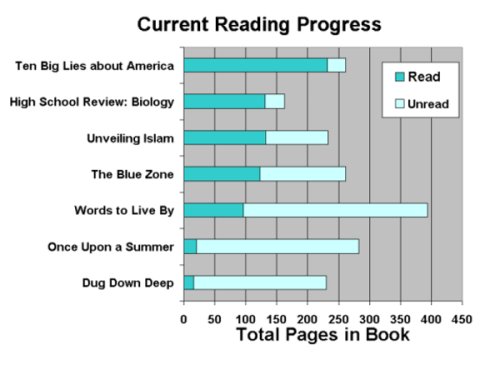
I am currently in the middle of seven books.

Reading Progress

Apart from that, I’m…uh, reading the Bible. And, uh, reading (and creating study materials for) Wardlaw’s Perspectives in Nutrition. And, well, reading Health Promotion Practice and Research.

Exciting, I know.

At some point, my life may not be so reading heavy. But now is not that time.

Sorry.


Prophet of Peace

Notes on Ergun Mehmet Caner and Emir Fethi Caner’s
Unveiling Islam
Chapter 2: Muhammad (The Militant Messenger)

Islam encourages trust in the Koran and emulation of Muhammad’s life. Yet Muhammad himself was unsure at first whether his “revelation” was from God or a demon–his wife convinced him that it was of god. While proclaiming that the Qur’an is the exact words of Allah as received by himself, Muhammad changed the wording of the “revelation” at the suggestion of his scribe. Beyond this, Muhammad condoned and lived a violent life, took on many brides (11 in all, one of whom was only nine years old when their “marriage” was consummated), and was capricious in his judgments.

“Clearly Jesus was a far superior prophet of peace and mercy. Muhammad was ruthless in war, not considering ethical ramifications when he was caught up in the height of savagery. The only life Jesus Christ voluntarily gave up was His own. His character offers continuous, unassailable compassion.”
Caner and Caner, Unveiling Islam, page 52

The history of Islam’s founder belies the common notion that Islam is a religion of peace. Muhammad was far from peaceful, rarely merciful, and plainly immoral (even by modern standards). This stands in sharp contrast to Jesus the Christ, who staged no revolts, murdered no one, and judged no one (except by the truth of His character according to John 3:17-19). He did nothing wrong. Even His worst enemies were incapable of bringing false accusation against Him (Matthew 26:59-60). As the Caner brothers so insightfully point out, “The only life Jesus Christ voluntarily gave up was His own.” He, and He alone, is a true prophet of peace.

Addendum (May 10, 2010): Ergun Caner’s testimony as a converted Muslim has been challenged by several bloggers who claim that he has grossly exaggerated the extent of his Muslim upbringing. Readers of this book ought to be aware that the Caners may or may not have the experiential knowledge of Islam that they claim to have, and should therefore be careful to test the statements found in this book against other reliable sources.


Always Room for One More

Reading My Library

I grew up in an 1100 square foot (+ unfinished basement) home with my parents and 6 siblings.

We barely managed to fit the dining room table into the dining room–and barely managed to fit ourselves around the table.

But despite all this, we regularly had family, friends, and neighbors over to play or be babysat–and to enjoy dinner with us.

I remember aunts or friends asking Mom if she was really sure that she wanted to babysit their kids. Mom would reply “What’s one or two more?”

I loved that attitude–and still love it–“What’s one or two more?”

No matter how squished we were in the first place, one or two or three more was still plenty do-a-ble.

Always Room for One More
Always Room for One More by Sorche Nic Leodhas is a children’s story I can definitely identify with. Based on an old Scottish song, the tale tells the story of “Lachie MacLachlan and his good wife, and his bairns to the number of ten.” They live in a little house, but Lachie declares that there’s “always room for one more.”

He invites in a tailor, a sailor, a Piper, a shepherd, soldiers, and more. The whole house is full with dancing and singing, and always with room for one more–until the poor little house simply bursts. Literally.

Poor little house. Poor Lachie MacLachlan. Poor Missus MacLachlan and ten MacLachlan bairns.

Except maybe not.

The many dozens of people to whom they’ve shown hospitality pitch together to rebuild their house–a new house, twice as big as the old–where there’s “always room for one more.”

I’m not precisely sure why this story is filed in my local library as jP Alger (indicating author name Alger.) The text is copyrighted by a Leclaire G. Alger–but I see no indication of who this Alger is or why he or she’s got the copyright. At any rate, it’s filed under A, so I’ve read it along with my books by author “A”.

The back of the book states that the story is an old Scottish popular song that has been handed down at least four generations in the author Sorche Nic Leodhas’s family. Leodhas has half-translated the work into words that can be understood by American readers–but has left in enough Scottish phrases to make the tale’s roots clear.

This was a delightful tale that I enjoyed very much. I definitely recommend that you look it up.