Tirzah Mae generally does an excellent job of only writing with her markers on paper.
With one exception.
She loves to draw on herself.
Like a week ago, when she put on some eye “makeup”.


Tirzah Mae generally does an excellent job of only writing with her markers on paper.
With one exception.
She loves to draw on herself.
Like a week ago, when she put on some eye “makeup”.
After listening to R.C. Sproul, Jr’s audio series Training Up Children”, I am quite sure of what Dr. Sproul Jr’s answer to that question is. I am also quite certain that I disagree.
First, Dr. Sproul’s position.
Dr. Sproul began in Deuteronomy 6:6-9 (an excellent place to start when discussing a parent’s responsibility toward their children, by the way.)
“And these words that I command you today shall be on your hearts. You shall teach them diligently to your children, and shall talk of them when you sit in your house, and when you walk by the way, and when you lie down, and when you rise. You shall bind them as a sign on your hand, and they shall be as frontlets between your eyes. You shall write them on the doorposts of your house and on your gates.”
~Deuteronomy 6:6-9 (ESV – Emphasis mine)
Dr. Sproul (quite rightly) extrapolates from verse 7 (bold above) that parents should speak of God to their children throughout the course of their lives, not just during a time of formal devotions or family worship. From here, he takes a giant leap to say that parents must homeschool their children in order to be with them at all times.
This, I believe, is an inappropriate conclusion to draw from this passage.
This passage clearly speaks to the important role God intends His word to play in the lives of his people. God expects that His word be not merely external to His people but internal (“shall be on your hearts”.) God expects that parents will diligently teach His word to their children, not merely as formal instruction but as part of the everyday-ness of life. God expects that His word be always before His people (bind on hands, between eyes, on doorposts and gates.)
What this passage does not speak to is whether parents and children should always be together.
As a thought experiment, let’s explore whether one can be obedient to Deuteronomy 6:7 while sending their children to a “state school” (Sproul’s term). We’ll start with the various contexts in which parents ought to talk to their children about God’s word.
“When you sit in your house.” Do parents of children in a state school sit with their children? It depends. Do they eat meals with their children? Do they sit in the living room together after supper? Do they sit together in a car? They may or may not, but there is nothing inherent in sending your children to school that precludes parents sitting with their children.
“When you walk by the way.” Do parents of children in school drive their children about? Do they walk or ride bicycles about? They may or may not, but there is nothing inherent in sending your children to school that precludes parents from traveling with their children.
“When you lie down and when you rise up.” Do parents of children in school put their children to bed (or send them to bed, depending on their age)? Do they wake their children up or see them when they wake up? They may or may not, but there is nothing inherent in sending your children to school that precludes parents from being with their children during bedtime or wakening.
Interestingly, although a majority of Israelites of the day would have engaged in some sort of agricultural activity, God does not say that parents ought to talk to their children about God’s law while milking the cows or tending the sheep or collecting manna. Nor does he say that craftspeople ought to talk to their children while sewing, weaving, or throwing pots, despite the reality that many crafts were done as a family. Instead, this passage refers to everyday activities that parents and children are likely to share regardless of profession or position or socioeconomic class. And even if parents and children don’t do them together, every person on the face of the planet sits down, moves around, goes to sleep, and wakes up. And every person on the face of the earth does these things regularly.
What this passage has to say about parents’ obligation to train their children in God’s word is simply this: Parents ought to diligently and regularly speak to their children about God’s word in the course of everyday life.
Dr. Sproul thinks that Deuteronomy 6 insists that parents be with their children all day every day homeschooling them. He allows that there will be some delegation – for example, his son was going on a trip to the zoo with Dr. Sproul Jr’s mother and sister while Dr. Sproul was giving one presentation – but he denies that sending one’s children to school is an acceptable form of delegation. I have two problems with this. First, as I argued above, I believe that Dr. Sproul twists this passage to imply a necessity of parents and children being together at all times. Second, if Dr. Sproul’s interpretation of this passage’s implications is indeed true and parents must be with their children at all times speaking to them about the word of God, then I see no reason why “delegating” to the children’s grandmother and aunt is an acceptable exception.
This is not to say that there are not significant advantages to homeschooling. This is not to say that some parents may discover that homeschooling is the best way for them to diligently teach their children the word of God. But homeschooling is not necessary.
Let us not put burdens on the believer that God does not.
Must Christians homeschool their children?
No, they need not.
To brighten your day, a picture of my little ones in their Christmas jammies.

The desire to learn everything and to do everything. I suspect it’s quite common among homeschool-graduates-turned-homeschool-mothers. But even if it’s not as common as I think, I know at least for one person who has it.
In her case, it tends to cause a great deal of trouble.
Because it’s just not possible to do everything. There aren’t enough hours in a day, weeks in a year, or years in a lifetime.
So when she tries to do everything, she ends up frustrated and angry. Angry that she can’t do it all. Angry that other people seem to be able to do everything they want to be doing. Frustrated that even her mere two dozen major goals for the year haven’t been accomplished. Frustrated that only the hundred or so things on her to-do list don’t get accomplished each day. Frustrated that her children are taking her away from doing everything. Frustrated that her home is taking her away from doing everything. Frustrated that people e-mail or call on the phone or tag her on Facebook – keeping her from doing everything. And then she gets frustrated and angry because she knows she shouldn’t feel this way.
She knows she can’t actually learn everything. She knows she can’t actually do everything. She knows that caring for her children, caring for people, caring for her home is the important work she ought to be doing. But she struggles at the end of each day, feeling like she should have done more. No matter what the accomplishments of the day are, she should have done more.
She should have blogged, among other things. She is a blogger after all. She loves to write, she wants to write, she wants to grow as a writer. She’s not at all ready to abandon the blog, the title, the task. But the days are busy and the nights too short. The ideas for posts are there, but never time in front of the computer to turn them into a reality. So she posts once a month, maybe even less. Yet every day, she feels this is one of those things she ought to be doing, wants to be doing. She wants to do everything.
She needs permission. Permission to not do everything.
And so, while I have never intentionally done so before, I am taking a hiatus from bekahcubed (the blog). bekahcubed (the woman) needs permission to not do everything. bekahcubed (the woman) needs permission to not write, to not feel guilty.
I need to give her that permission.
bekahcubed (the blog) will be dormant for the remainder of the year. Should bekahcubed (the woman) feel the urge to write, she will do so (as she has opportunity) and will store up her writings to be shared after the new year. Then, perhaps, she will have achieved the elusive balance, or lowered her standards, or blah. blah. blah. At any rate, she’ll evaluate at that point to see what role blogging should be playing in her future.
For now, blogging is one of those things she needs permission not to do. And I’m giving her that permission.
So there.
The section was scheduled for 3:30 pm. Preparations began.
But first, I needed to get into a hospital gown.
So far, I had refused a hospital gown every time, opting to wear my own robe (for admission and overnights) or my own honest-to-goodness clothes (for days). Wearing my own clothes made me feel human, made me feel autonomous, made me feel myself.
Now, though, I was preparing for what was, for me, the least human, least autonomous, least ME procedure.
I was preparing for a repeat c-section.
And the nurse was waiting for me to change into a hospital gown.

I briefly considered whether it was worth it to fight.
My carefully crafted birth plan, intended for my VBAC attempt, was worthless at this point.
I had worked so hard to be reasonable in my birth plan. I gave my wishes, yes, accepting that there were circumstances under which those wouldn’t be possible or reasonable. Even as I wrote of the interventions I didn’t want, I could think of at least one scenario in which I would accept each one. My biggest request was that I be involved in every step of the process. I wasn’t going to give blanket consent to anything. I wanted to give my own consent every time a line was placed, a medication given, a monitor hooked on.
And now I’d just given consent to the one thing I’d worked so hard to avoid. A repeat c-section. With that, I’d given consent to be hooked to a machine, to be laid flat on my back, to be anesthetized. All those things I’d hoped to avoid this time around? I’d just given consent to go ahead with them.
They were necessary.
The hospital gown was not.
I decided to hold my ground.
I was going to wear my own robe.
My nurse pushed back. “I don’t want to ruin your beautiful robe,” she said. “It’s not going to make it out of the c-section in any condition to wear it again.”
“That’s fine.” I insisted. “I bought this robe for 99 cents at a used store ten years ago. It’s served me well. I don’t care if it’s ruined.”
After a couple more almost identical back and forths, she relented. I would keep my robe on.
They wheeled me into the operating room and the first thing I heard was another nurse calling out, “Somebody get this woman a gown.”
She was peeved, it seemed, that no one had bothered to properly prepare me for surgery.
But my nurse stood firm. “She doesn’t want to wear a gown. She’s quite adamant on that point.”
The anesthetist gave a sigh. “I need to access her back,” she told my nurse. “I need a sterile field to place the spinal.”
I chose to ignore how the anesthetist had been acting as if I weren’t there, weren’t my own person.
I was my own person. That was exactly what the robe represented to me at that point.
I spoke directly to the anesthetist. “Cut it.”
“But, but, your beautiful robe.”
“CUT IT.” I didn’t shout, but I was firm.
I was wearing this robe to surgery, one way or another. The robe was of no import – being able to wear it was of the highest import.

My nurse found some scissors, lifted the back of my robe. “I’m trying to cut as straight and as careful as I can. Maybe you can sew it back up after you’re done.”
I appreciated the effort, but it really wasn’t important. I’d already said that I didn’t care whether the robe was ruined. I really didn’t. The important thing was that somehow, in this birth that was so far from what I wanted, I remain me. The robe let me do that.
I’m sure it’s difficult, on the other side of the operating table, to understand why patients make what seem like such unreasonable demands.
How difficult is it to put on a hospital gown? Not at all. Why can’t she just do as she’s told, follow procedures? Doesn’t she understand how difficult it is to work around a robe that doesn’t have access to the back?
No, I didn’t understand, until you told my nurse, how valuable access to my back is for you.
But please, try to understand my side.
For you, this is just another day at work, albeit one in which you’re dealing with a difficult patient. For me, this is a day when something I’ve been working for for the past 20 months slips from my hands. This is a day when my life is in danger, my baby’s life in danger. When I’m forced to deliver my baby six weeks early via surgery.
For you, the robe is a nuisance. For me, the robe is the last thing that keeps me myself.
I’m so thankful for my nurse. Even though she didn’t understand why it was important, once she understood THAT it was important, she advocated for me.
She may never know (but I do) what a difference a robe makes.
We all know by now that the only thing better than sustained tummy time is frequent tummy time. But who has time and energy for that?
It’s enough work to feed (breastfeeding and pumping and bottle warming, oh my!) and diaper (change, rinse, wash, no-time-to-fold, and repeat) and clothe (spit-up, blow-outs, and big-sister-drool) your baby without having to remember to put baby on the floor on his tummy multiple times a day (supervised – don’t forget that tummy time should ALWAYS be supervised [Sarcasm alert].)
But you can’t do tummy time when baby is hungry (read: half of the day) because then by the time you get around to feeding he’ll be too frustrated to latch well. And you can’t do tummy time right after feeding (read: the other half of the day) because then he’ll spit up everything you just fed him (anyone else need to keep their babies upright practically until the next feeding to avoid the dreaded mouth-nose-gasping-for-air-and-crying-like-he’s-dying-whenever-he-does-get-a-breath-spit-up?)
Getting frequent tummy time in is almost impossible.
Or is it?
Our solution is to turn unavoidable “can’t be on mama” time into tummy time.
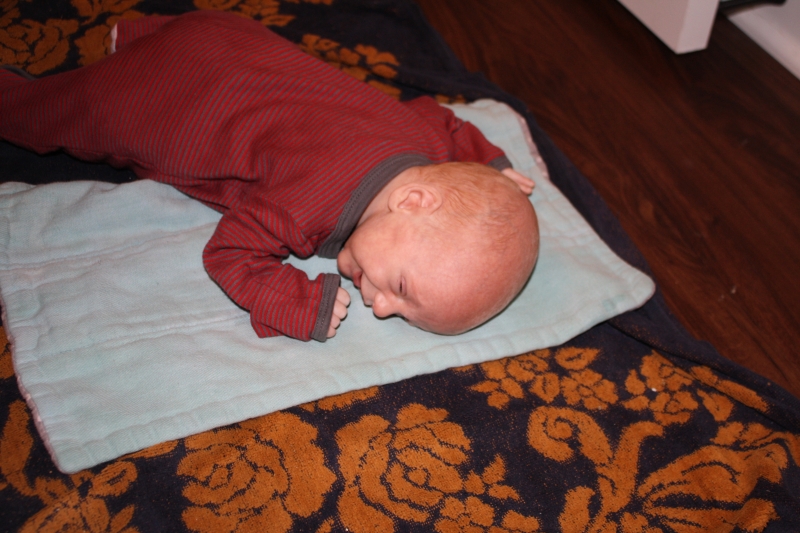
I use a washable throw rug in our bathroom (actually, it’s two vintage bath towels sewn together to double thickness). After diapering, when I’m rinsing those cloth diapers, I lay Louis on the rug with a clean burp rag under his head.
Voila.
At least 4 or 5 (if not 8 or 9) little tummy times every day.
A little over five years ago, I jumped out of an airplane.
It’s never been something I particularly wanted to do – adrenaline is not my thing. But a couple of friends (who didn’t know each other but both knew me) wanted to go – and one of them had scheduled a dive. So I signed up too – and brought my other friend along.

I was nervous leading up to it, but I wasn’t scared. We’d be diving tandem – hooked to an instructor who would do all the hard work. We could just relax and enjoy the ride. Which is exactly what I did.
A little over a month ago, I had a repeat c-section.
It’s never been something I particularly wanted to do – in fact, I did everything in my power to avoid it. I exercised faithfully, I ate like an angel, I took a baby aspirin. When Louis wasn’t in position, I contorted myself into funny positions in an effort to get him head down. When that didn’t work, I had our maternal-fetal specialist do an external version – trying to manually reposition Louis using his hands on the outside of my belly. When that didn’t work, I had no choice.
We scheduled a c-section for 3:30.
I wasn’t particularly nervous, or particularly scared. I’d done this before and made it already.
But then the spinal anesthesia took effect and the anesthesiologist asked me to wiggle my toes and lift my legs.
I couldn’t.
It was exactly what was supposed to happen. I wasn’t supposed to be in control of my lower body. If I were, I would be able to feel as they cut into my abdomen and lifted my baby out. I knew that.
But that didn’t keep me from freaking out.
I had lost control.
As I told my skydiving story, I wrote of the one fearful moment – the moment when my instructor loosened the straps between us so I wasn’t in direct contact with his body.
“He told me he would be loosening the connections that held us. I’d drop a bit lower, so inches would separate our bodies.
Now, here, I felt a glimmer of fear. I knew it would be safe, I knew I’d still be attached. But it wouldn’t be the same. Once he’d lowered me, I wouldn’t be able to feel his presence. Would I be able to make it without that sure sensory feedback reminding me that I was safe?
I would choose to trust, I told myself–and so I did.”
I had the same choice to make when my legs no longer followed my commands.
I wasn’t in control, didn’t have the sensory feedback telling me that my body was there, that my baby was there. I had to choose to trust that God was there and that my body still obeyed His commands.
I repeated the affirmation over and over in my head as I willfully relaxed the muscles I could feel:
“I and my baby are fearfully and wonderfully made.
God sees us and knows us.”
I’d chosen my relaxation phrases carefully, wanting to fix my mind on unchanging truth rather than fickle probabilities.
No “I trust my body” or “My body knows how to birth” for me. I knew that my body could fail. I knew that, while most bodies know how to birth, not all do.
I had determined beforehand to fix my trust in God instead of in my body.
But when I couldn’t control my legs?
I had to determine it all again.
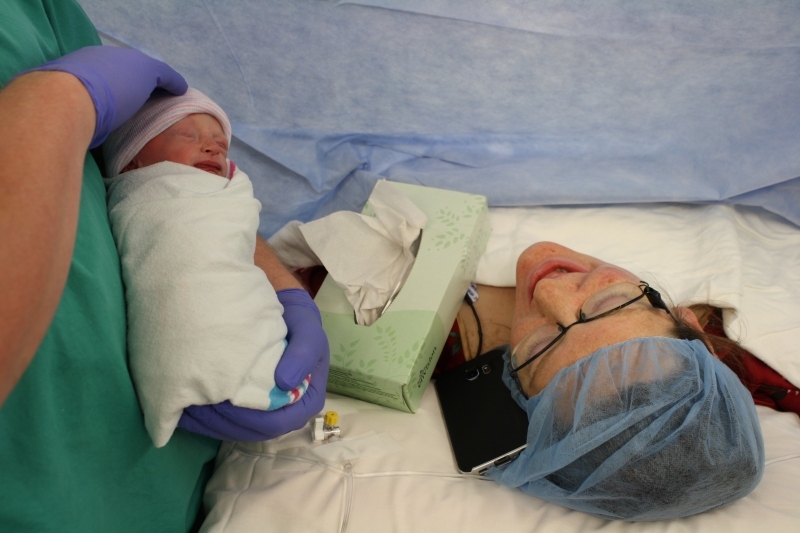
My relaxation music, playing from the phone beside my ear, reminded me of the truth:
“Be still my soul, the Lord is at thy side
With patience bear the cross of grief or pain
Leave to thy God to order and provide
Through every change He faithful will remain
Be still my soul, thy best, thy heav’nly Friend
Through thorny ways, leads to a joyful end.”
I chose to trust when I lost control – and God was more than capable to guide and sustain.
I know y’all are just dying to revisit my skydiving story now – so I’ll make it easy for you. Part 1: Geared Up, Part 2: Missed Opportunities, or I’ve always wanted to fly, Part 3: The Jump, and Part 4: Safely Falling.
Even though I’m not into routine ultrasounds in pregnancy, we’ve ended up with plenty of ultrasounds for both our children (let’s just say that there hasn’t been anything routine about how my pregnancies have progressed!)
With each of the ultrasounds, I’ve been careful to inform the ultrasound tech that we aren’t interested in knowing baby’s sex, so could they please keep it to themselves.
I didn’t think to tell our maternal-fetal specialist when he rolled in the ultrasound to check where baby was lying to determine our course of action the day my condition declined such that delivery was indicated.

Doctor W moved the wand across my belly, confirming that baby was still lying in the transverse position he’d so favored all throughout the pregnancy.
Doctor W explained what I already knew. We couldn’t deliver a transverse baby vaginally. I listened patiently as he explained the different ways a baby might be lying and the relative risks of vaginal delivery with frank breech, footling breech, transverse (the most dangerous is transverse with belly down, since the umbilical cord would almost certainly be delivered first and then be compressed as the rest of baby tried to make his way out.)
And once Doctor W was done explaining, I said my piece. I still wanted that VBAC. I wanted to try everything we could. Yes, I wanted the external version we’d discussed.
Doctor W’s hands moved across my abdomen. He pushed and prodded. He pulled out the wand to see what he’d done. He pushed a little more. He grabbed the wand again.
He’d succeeded at getting baby head down.
He narrated what we were seeing on the ultrasound screen – “There’s the head”. Down in my pelvis.
Just a bit above the head. “And there are his little boy parts. And there are his feet down with his head.”

I looked at Daniel as we acknowledged what we’d just learned.
“Louis,” I said his name in my head, acknowledging our son.
A while later, my nurse was working on her charting and Daniel was off doing something, collecting Tirzah Mae perhaps.
“Do you have any sense of whether the baby’s a boy or a girl?” the nurse asked.
“Well, it doesn’t really matter whether I had a sense or not – Doctor W told us,” I replied.
“Ah shoot,” she said. “I’d hoped you hadn’t noticed.”
I assured her that it was fine, really
And it was.
But now I know, if I really want to wait until delivery to find out, best to let my doctor know in advance too!
“Training your child to help around the house will make the job harder now; but it’ll pay off down the road.”
It’s such common advice, it’s become something of a parenting axiom.
The implication is that lazy parents avoid doing the hard work of parenting – that is, training their children in the way they should go – and end up with more pain and work in the future when their children haven’t been trained to do x or y (or to have z or a character traits).
The axiom tells parents to do the hard work of including their children in housework now so that they can offload some of the housework to their children later. Or, less cynically, parents should do the hard work of including their children in housework now so that their children can be responsible for themselves as they grow into adulthood.

The training task of parenthood is often hard – which is why people find it necessary to remind parents to do the hard work now that will pay off down the road.
But I contend that, at least for toddlers, involving your children in housework does NOT make the job harder now. Involving your toddler in housework can pay off in the here and now – not just down the road.
Now, you are probably thinking “Have you seen how much longer it takes to [insert chore here] when my toddler ‘helps’?”
Yes, I get what you’re saying. My toddler tends to smear food around the chairs when she wipes them, which means I have to re-wipe them. My toddler drops the dustpan before she’s emptied it, which means I have to re-sweep a section of the floor. My toddler puts things in the wrong places when she’s picking up, which means I have to re-sort everything multiple times.
Doing a task with my toddler takes 1.5 to 2 times longer than doing a task myself.
But have YOU seen how much extra work my toddler can create when I let her play independently (not right next to me) while I’m cleaning up?
While I’m saving five minutes by cleaning up after lunch without her help, she’s creating ten minutes worth of work in the living room, bathroom, and bedroom.
The reality is, involving your child in your work right now will have benefits both in the future and in the present.
So, if you want to be a really lazy parent, involve your child in housework now.
I was prepared with all sorts of questions for my midwife – questions about preparing my home for our planned home birth. I’ve never gotten this far in pregnancy before.
But the first step at the midwife’s office, before I even talk to the midwife, is to take my blood pressure and weight and temperature in the bathroom – and to pee in a cup. I dipped my urine, counted to sixty, and checked the dipstick.
A bright green strip at the bottom of the stick told me what I hadn’t at all expected to see. I was spilling protein again, majorly.
I had preeclampsia, again.
My questions about home birth went out the window. I knew that was no longer an option.
We had our visit. The midwife confirmed high blood pressure and protein in the urine. She called our OB and we arranged for another hospitalization.
We went home to pack our bags and then on to the hospital.
With Tirzah Mae, we entered the hospital at 30 weeks, 6 days, already with severe preeclampsia (defined by very high blood pressures and/or a range of other abnormal lab values.) We didn’t even fill out paperwork before I was receiving IV magnesium to prevent seizures. I had a shot of steroids to help mature Tirzah Mae’s lungs. The first 24 hours of our hospitalization was intense, with monitors going off all over, with lines into my veins and around my belly and all over everywhere. Tirzah Mae was born eight days later, at 32 weeks, 1 day.
With this baby, we entered the hospital yesterday, at 33 weeks, 4 days. I had preeclampsia – have preeclampsia – but without severe features at this point. I’ve gotten a shot of steroids, but no magnesium. I’ve been on monitors here and there – but have also spent hours on end just lying in bed or sitting typing or reading.
We just finished talking with the maternal-fetal specialist after lunch.
We are on hospitalized bed rest until this baby is born. At the very latest, we will go to 37 weeks (considered full term) – July 10. More likely, I will develop severe features that necessitate immediate delivery. Until then, we wait.
As we wait, we pray. If you will, please pray with us:
But most of all, pray that God would be seen as glorious. For He truly is glorious and worthy of praise.