Countdown

Reading the mommy blogs and the Facebook posts from pregnant women, you can get the impression that there’s a certain universality of experience for all mothers. Sure, there are often-bitter differences: medicated or unmedicated childbirth, vaginal or cesarean, breastfeeding or formula feeding, cloth diapers or disposable, cosleeping or cry-it-out. The list goes on and on. But all mothers can agree: the time will come when you feel SO PREGNANT you just CAN’T WAIT for this baby to be BORN ALREADY!

And surely this is a common experience for many mothers. Pregnancy can be uncomfortable, as can other people’s comments on your pregnancy. The restrictions (warranted or unwarranted) on pregnant women can feel stifling. Many women are eager to sleep on their stomachs, to reach their toes, to eat yummy soft cheeses, and to experience relief from the ubiquitous lower-back-ache.

But some of us, we mothers of preemies who persist in getting pregnant, have a different experience.

I think I can understand how normal women feel, how impatient they become with the waiting, the comments, the ungainliness of a heavily pregnant frame. But I can’t imagine ever feeling so pregnant, so eager for my pregnancy to end.

Instead, I tease about inducing at 44 weeks, about making up for lost womb-time.

I have two countdowns on my telephone: the one, a preset in the “pregnancy mode” for my period tracker, tells me how many days there are until my EDD (expected due date); the other, of my own creation, tells me how many days I have until I’m more pregnant than I’ve ever been before.

34 weeks and 3 days.

That’s the most of pregnancy I’ve experienced. And I’ve always spent the last few weeks of pregnancy in bed or severely limited, willing just one more week, one more day, sometimes even one more hour before the doctor comes in to tell me that it’s time.

It’s not time, my heart screams, even as my head nods and my voice tells him I’m ready to start the induction (or, in Louis’s case, to try to turn him so we can start an induction instead of another section).

As my due date tells me I’m nearing the last third of my pregnancy, my personal countdown reminds me that any day now my blood pressure could start rising, I could start putting on water weight in earnest, I could start spilling protein in my urine. Any day now, I could go on bed rest.

The road map is impressed on my mind: If things progressed like they did with Tirzah Mae… If things progressed like they did with Louis… But the differences between my pregnancies with Tirzah Mae and Louis also remind me that progressing differently doesn’t mean IT isn’t going to happen. I still could be preeclamptic.

Now, as the numbers on my countdowns slip lower and lower, I whisper my wishes to the Father who knows all things and who ordains all things for his glory: Lord, if it’s your will… let this pregnancy go to term.

-7 days

-14 days

-21 days

-28 days

-35 days

-40 days

I don’t want this pregnancy to end.


Catching breath

What can be more instinctive, more natural than breathing?

The deep inhale, the cleansing exhale. Oxygen to our lungs, carbon dioxide released. In and out. Over and over.

Automatic, unlabored breath.

We don’t think of it until something goes wrong, until we’re laboring to climb stairs or in a sprint to catch a youngster who insists on running out into the street. Don’t notice it until allergies plug the nostrils that usually carry the life-giving air in, the poisonous carbon dioxide out.

But then, all we can think is of our need to catch our breath.

This is how I feel about my routines, the air I breathe day in and day out.

I am a creature of habit, a lover of the routine. I delight in days that flow effortlessly from habit to habit, like breath flowing effortlessly through my airway to my lungs and back.

But when the exhaustion of first trimester met the exhaustion of a mother who hasn’t slept through the night for nine months and then a bout of food poisoning (for myself and the not-yet-sleeping infant) took me out, I was left heaving like a woman who’s just run up twenty flights of stairs with a panda on her back.

I desperately needed to catch my breath.

But no matter how hard I tried, it seemed impossible. I couldn’t figure out how to establish a reasonable morning routine, much less a full day one.

I’d set my standards low. I wasn’t worrying about exercise or ambitious projects. I just wanted to see the living room floor once a day, do the dishes after meals, and not have three loads of clean laundry waiting to be folded at any given time.

I knew from past experience that morning was the best time to get things done – before I’d lost my energy and motivation.

But no sooner did I have the dishes cleared from the breakfast table and already the children were clamoring, the mess was driving me nuts, and I was already ready to snap someone’s head off (usually my daughter’s, hers being the nearest.)

I needed to catch my breath.

In desperation, I turned to Google, searching “preschool routines” or “toddler rhythms” or something of the like. And more often than not, I ended up with a suggested morning schedule for a preschool classroom. Those were not particularly helpful, given that I was trying to get my OWN tasks done. What I wanted was something to tell me how to set up my own rhythms around life with a toddler.

And then I stumbled upon Rudolf Steiner’s Waldorf method and the novel idea of routines as an interplay of breathing in (internally focused activity) and breathing out (external activity).

I was intrigued, especially by the idea that the teacher (in a Waldorf school) should aim to be accessible and attentive for breathing-in activities and should be present and busy at her own work for breathing-out activities. I decided to give it a try. I reorganized my morning routines to alternate between breathing-in activities, in which I focused on the children, and breathing-out activities, in which I focused on the home or on my own pursuits.

And, just like that, our household slipped into automatic, unlabored breath. So many of the frustrations and irritations I’d been struggling with in the mornings? They were gone. The children could play peacefully among themselves while I cleaned up from breakfast and did just a few quick cleaning tasks because they had just been breathing in my conscious presence at breakfast (rather than vying for the attention I was giving my phone). They let me exercise in peace because I’d first filled their lungs with presence while we did our action songs and finger rhymes together.

Is it perfect? No. I still have plenty of times where I’m struggling to catch my breath, when the frustration and the irritation sets in. But now, instead of attempting to sprint all day long and only catch my breath in the evening, I’ve established rhythms that allow me to breathe throughout the day.

And what a difference it has made, catching breath.


Yellowstone Highlights: Waterfalls

“Moose Falls. Louis Falls. Tirzah Mae Falls.”

Ask Tirzah Mae what her favorite part of our trip to Yellowstone was and you’ll be sure to hear about the waterfalls.

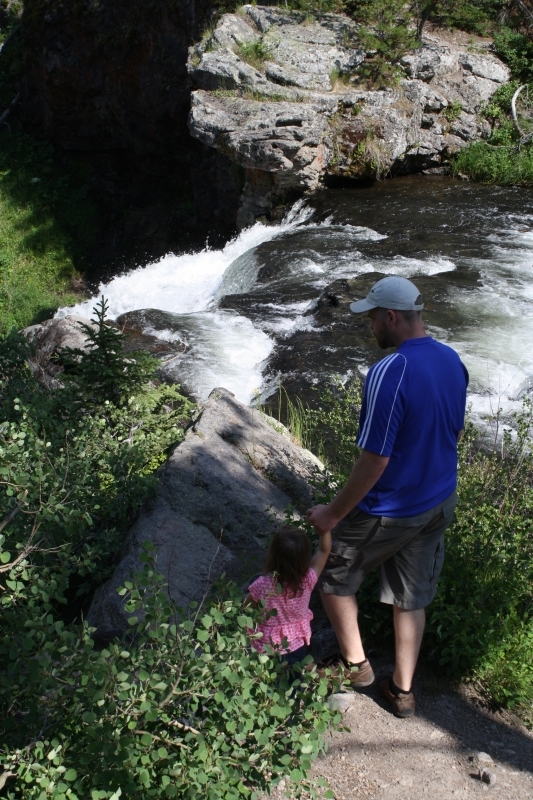
Daniel and Tirzah Mae at the brink of Moose Falls

Daniel and Tirzah Mae at the brink of Moose Falls

Ask her mother what HER favorite part of the trip is? She might have to (somewhat sheepishly) answer with the waterfalls too.

Why the sheepishness? Because in all my planning for the trip, in all my preparations, I didn’t pay the waterfalls much mind except to note where they were and what kind of hikes there were around them. I was busier thinking of geysers and the Grand Canyon of the Yellowstone and wapiti and going on hikes.

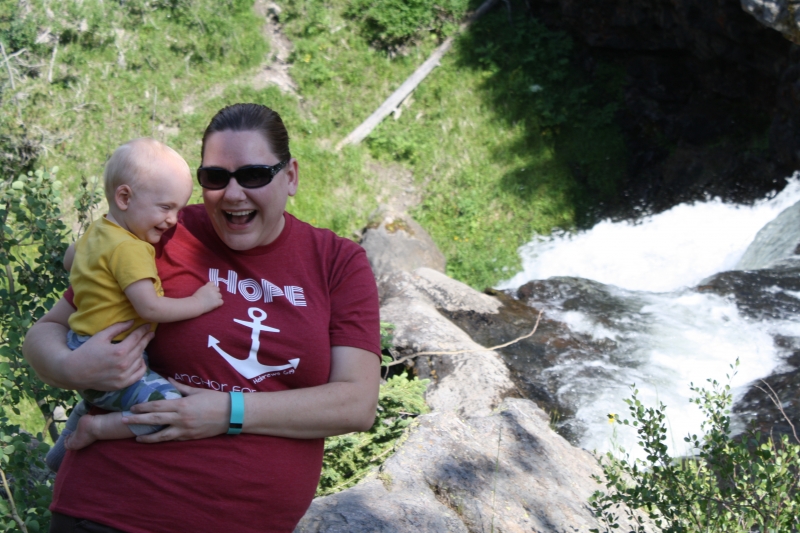
Louis and his aunt Anna at the brink of Moose Falls

Louis and his aunt Anna at the brink of Moose Falls

But on our very first day in the park, as we were driving through from the South Entrance on our way to our lodgings in West Yellowstone, I pulled out the guidebook I’d made for the trip and suggested the we stop at Moose Falls just a mile inside the park. And so we did.

We took a quick scramble down the short trail, past the sign proclaiming that the falls were not for swimming, and to the brink (that’s where the “fall” starts) of the falls. Moose Falls is a 30 foot waterfall on Crawfish Creek, nothing particularly spectacular and certainly not record breaking. But between the sight of the water foaming and the sound of it whooshing and the feel of the spray on our faces, it was amazing. Even more amazing was the wonder on my children’s faces as they took in the whole experience.

Tirzah Mae and I with Moose Falls again

Tirzah Mae and I at Moose Falls

“Whoa,” Louis kept pointing and exclaiming. And “whoa” was right.

I followed along behind as the rest of our intrepid party (we’d met up with my parents and my older sister on I-80 in Wyoming and were caravaning our way
to our lodgings from there) clambered down the rocks toward the base of the falls, where a couple was defying the written directions and swimming in the pool at the bottom.

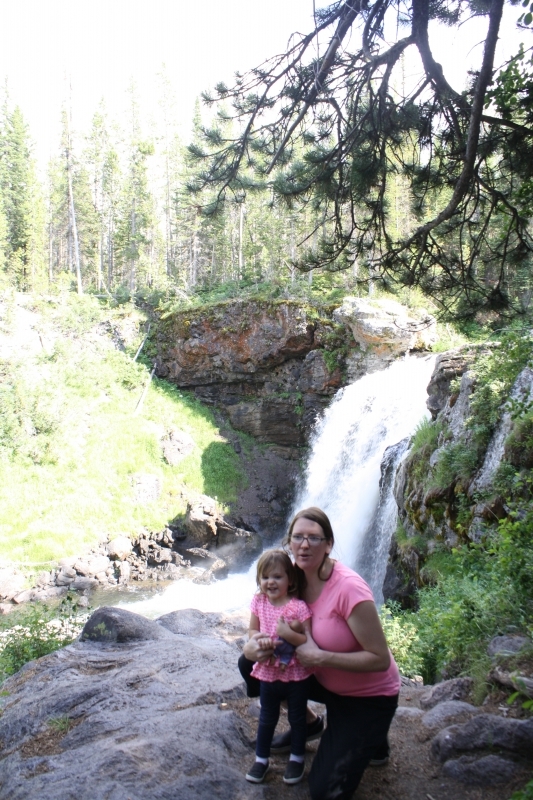
Tirzah Mae and I near the base of Moose Falls

Tirzah Mae and I at the base of Moose Falls

Tirzah Mae wanted desperately to join them, and would suggest swimming every time we saw water for the next few weeks.


Having had such a positive experience with Moose Falls, we decided to also stop at Lewis Falls (named after Meriwether Lewis of Lewis and Clark) a bit further north along the road. This waterfall is visible from the road, which meant it was packed full of people, but we made our stop like all the rest, pulling into a pullout and crossing the road to see the falls.

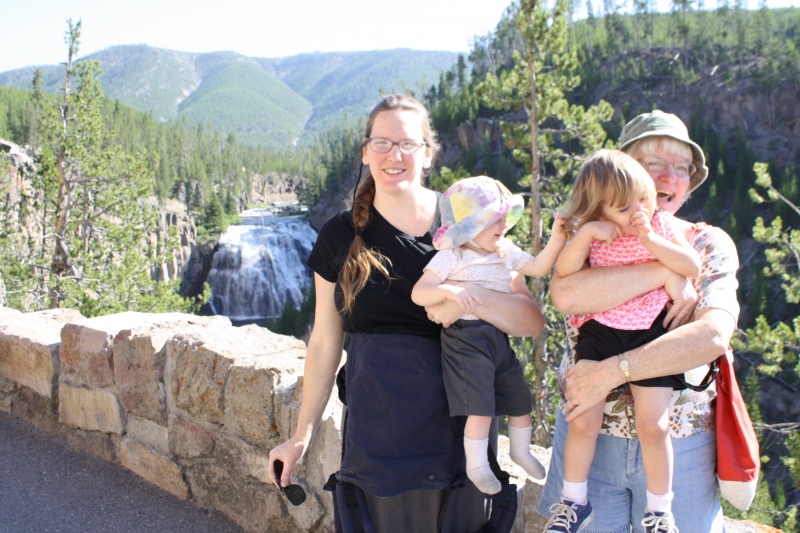
My mom, the kids, and I at Gibbons Falls

My mom, the kids, and I at Gibbon Falls

Tirzah Mae enthused and Louis whoaed as I explained that the loud whooshing was made by the water tumbling through the rocks.

Tirzah Mae loved that the waterfall was named Louis Falls (after her brother, of course) and began requesting to see Tirzah Mae Falls next.

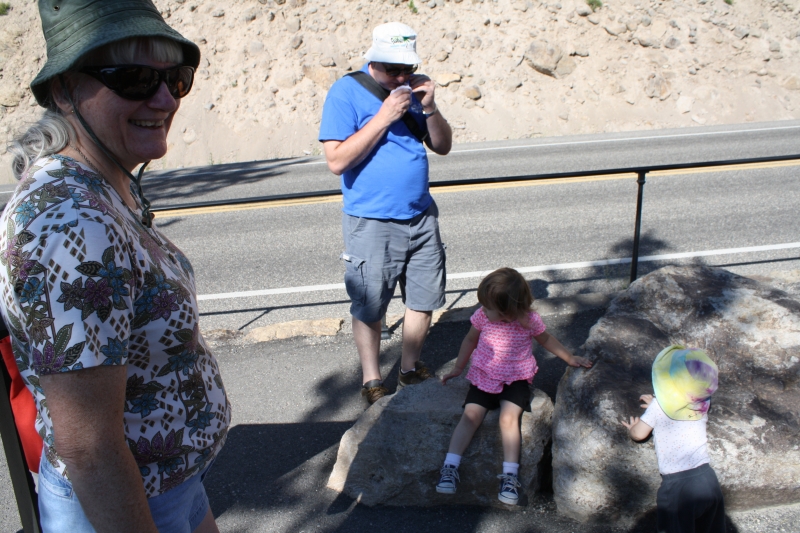
Tirzah Mae and Louis climbing rocks as Grandma and Grandpa look on

Tirzah Mae and Louis climbing rocks as Grandma and Grandpa look on

Our opportunity came three days later, when my parents joined us for an excursion before meeting the rest of our party at the Grand Canyon of the Yellowstone. Gibbon Falls, an 84 foot waterfall, was duly renamed “Tirzah Mae Falls” and we walked from the parking area along the wide guarded path alongside the road to get a better look at the falls. Tirzah Mae was thrilled to have her own waterfall – but the real highlight of “Tirzah Mae Falls” for her was the boulders here and there along the paved path. She observed other children climbing them and walking along the top and then jumping off – and decided she wanted to do the same. Unlike with the swimming episode, there were no signs prohibiting boulder climbing, so we were happy to oblige.

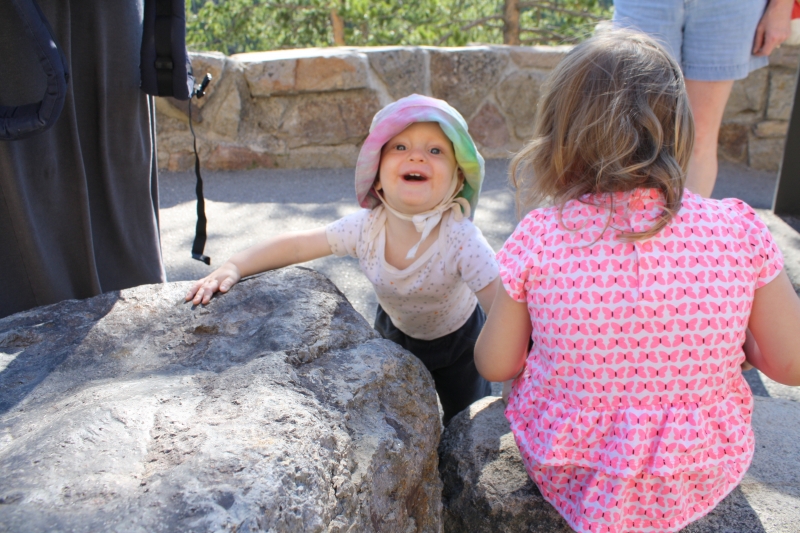
A look of utter joy directed at his papa

Louis’s look of utter joy directed at his papa

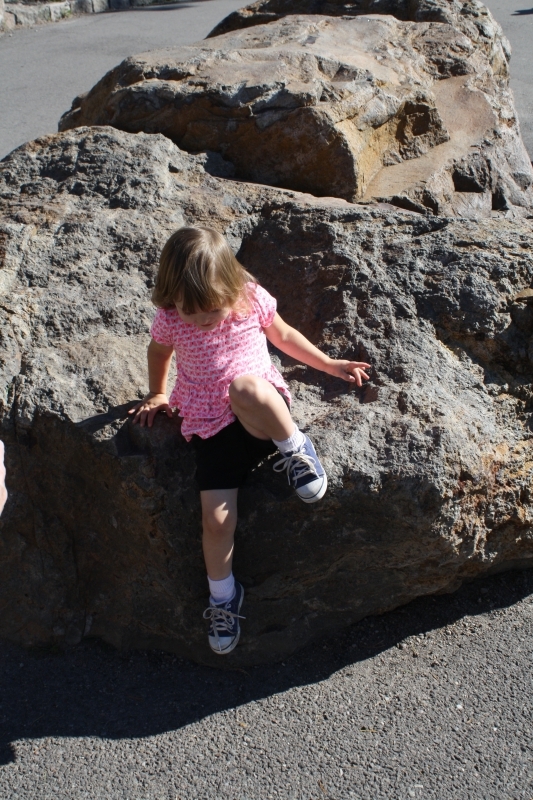
Tirzah Mae climbed the boulders (with help) and walked along the top of them (with help) – and, once safe on pavement, she jumped too. Despite her audible desire to jump off the rocks themselves, she never actually worked up the courage to do so.

Tirzah Mae gets down from a boulder at Gibbons Falls

Tirzah Mae gets down from a boulder at Gibbon Falls

Reading Report: 11 years

September 5, 2017 marks 11 years from when I started my epic project to read every book in my local branch library.

Every so often, I take stock of where I’m at and report on progress. This year’s progress reveals… that I have young children. :-)

TOTALS as of Sept 5, 2016 (10 years or 3653 days)

Category Items Complete Categories Closed Items/day
Juvenile Picture 1492 443 0.37
Juvenile, Board Books 147 46 0.04
Juvenile, First Readers 66 3 0.02
Juvenile, Chapter 92 7 0.02
Juvenile Fiction 314 25 0.08
Juvenile Nonfiction 261 1 0.06
Teen Fiction 48 4 0.01
Teen Nonfiction 5 0 0.00
Adult Fiction 465 71 0.12
Adult Nonfiction 919 42 0.23
Audio CD 695 25 0.17
Juvenile DVD 49 0 0.01
Adult Fiction DVD 99 7 0.02
Adult Nonfiction DVD 42 1 0.01
Periodicals 89 0 0.02
Total 4421 items
1.21 items per day

I’m far enough along that the overall averages don’t change much from year to year – until I get comparing this year’s averages with my overall averages.

Last year’s reading (and the annual average completed)

Category Categories Completed Items Completed Annual Average Items Completed
Juvenile Picture 1 98 135.6
Juvenile, Board Books 1 22 13.4
Juvenile, First Readers 0 1 6.0
Juvenile, Chapter 0 0 8.4
Juvenile Fiction 0 4 28.5
Juvenile Nonfiction 0 48 23.7
Teen Fiction 0 5 4.4
Teen Nonfiction 0 0 0.5
Adult Fiction 1 11 42.3
Adult Nonfiction 1 80 83.5
Audio CD -39 56 63.2
Juvenile DVD 0 1 4.5
Adult Fiction DVD 7 6 9.0
Adult Nonfiction DVD 1 7 3.8
Periodicals 0 23 8.1
Total -27 362 434.8

Notes:

  • A combination of not focusing on closing out categories and reorganizing what I consider a category in audio cds has resulted in a net negative gain in categories completed this year.
  • My reading this year is actually quite similar to last year’s – and I think I’ve settled myself into the reality that this is the new normal for life with young children.

I just started tracking it last year, but a look at how many days it takes me to get through a library item continues to fascinate me.

Category Time to Read (2015-2016) Time to Read (2016-2017) Notes
Audio CDs 4 days 6.5 days I’ve worked hard to consolidate errands to minimize drive time –
maybe that’s why I’m listening to less?
Adult Nonfiction 4.4 days 4.5 days I still read a lot of nonfiction.
Board Books 5.2 days 16.6 days I’m much more likely to select new picture books to read with Tirzah Mae – and to choose board books I already know and trust to read to Louis.
Picture Books 6.2 days 3.72 days As Tirzah Mae’s reading has transitioned mostly away from board books and to picture books, my picture book reading has increased.
Adult Fiction 33.3 days 33.2 days Essentially the same as last year

So concludes my report on the last eleven years’ reading :-)


What we did over summer break

As students stream back to school this fall, they’re getting busy writing the ubiquitous “what we did over summer break” essays.

And as the Garcias ease back into something of a routine (I’m hoping!), I too will be writing what we did over summer break.

It wasn’t intentional, this summer blogging break – but it wasn’t unintentional either.

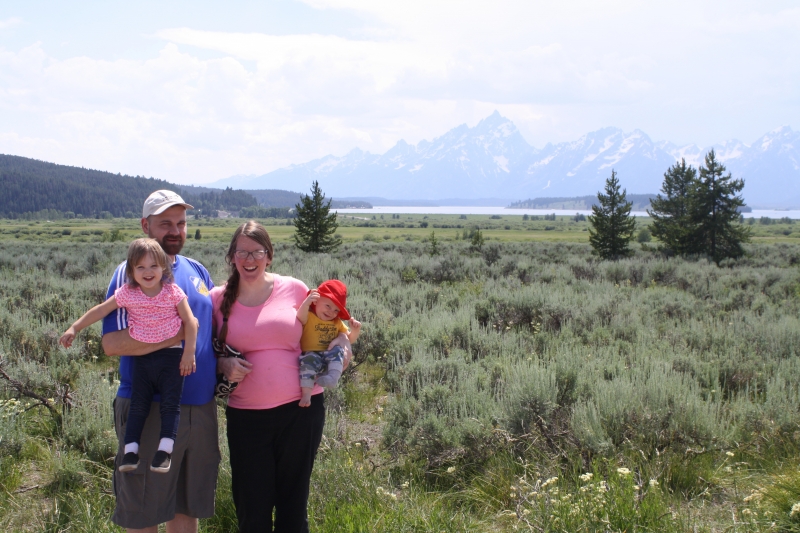
With the Tetons in the background

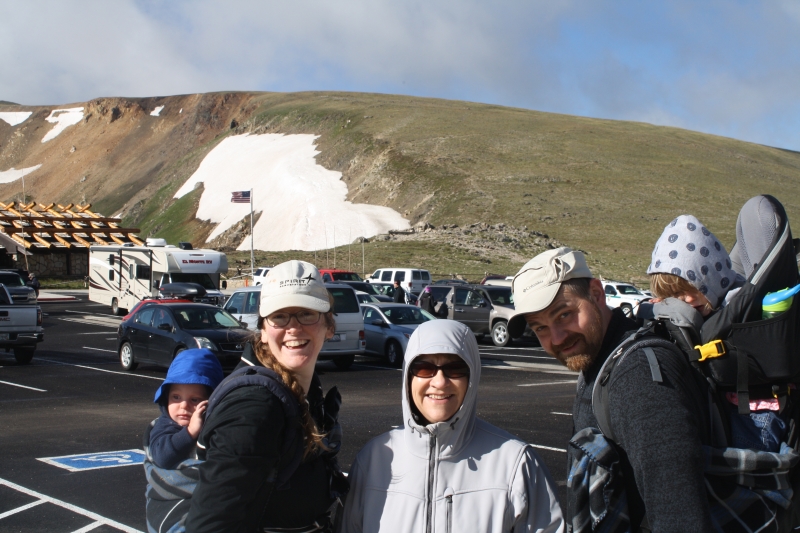
We were busy this summer. We spent a week in Yellowstone National Park with my family at the beginning of July. We spent a week in Colorado with Daniel’s family at the beginning of August. And I jumped right into teaching Sunday School a couple days after we got back from Colorado. In the in-between-time, we packed and did home improvements and took a first aid/CPR class for foster care and cleaned and tried (fruitlessly, it seems) to keep up with the yard and garden. And I gestated. I’m still gestating – and hoping to be for several more months.

Reading it now, I can’t decide whether to be overwhelmed by what we’ve accomplished this summer or whether to feel like it isn’t that much now that I’ve got it on paper.

At the beginning of the Alpine Trail with Daniel's mom

But in the moment it felt like a lot. Flitting and flying, planning and packing and catching up from being gone.

There was barely enough time to process one trip before we left on the next – and I really want to process those trips and preserve those memories.

Which is why I plan a protracted narrative/photo essay here on bekahcubed, detailing just exactly what we did over our summer break.


Nightstand (June 2017)

This month turned out to be a good month for reading, probably because I was exhausted enough that I let everything go to seed while I read (I did stop to change diapers and to heat up leftovers for the kids for lunch). I’m expecting that, as my energy returns (we’re definitely in the second trimester now, so any day now?), my reading will decrease but maybe my house will get a bit cleaner and my husband will be able to relax when he comes home from work instead of having to pitch in to clean the house, make dinner, etc. etc. Fingers crossed.

Fiction Read:

  • The Secret Warning by Franklin W. Dixon
    I picked up the 17th volume of the “Hardy Boys” series after a long break from the series (I read #11 in 2013). Fast-paced, formulaic, and a blast straight from my childhood :-)
  • The Tournament at Gorlan and
    The Battle of Hackham Heath by John Flanagan

    I thought about resisting the siren call of Flanagan’s prequel series to “The Ranger’s Apprentice” – and then succumbed. I was not disappointed with the first two books of this series.
  • The Masqueraders by Georgette Heyer
    Unlike many of Heyer’s novels, this book is not set in the Regency period. Rather, it is set around the time of the Jacobite rebellions in the 18th century. A brother and sister pair travel to London, intending to lie low as they await their father’s arrival. All three had participated in one of the recent rebellions (at the behest of the rather flamboyant father), and the young people are eager for respectability and to escape notice. To this end, they each masquerade as the opposite sex, the son being rather excepionally short and the daughter rather exceptionally tall. But their goal of respectability and escaping notice is rather quickly thrown to the side as they get embroiled in London society and each their own little love affair. An enjoyable read, although not my favorite Heyer title.
  • Regency Buck by Georgette Heyer
    Orphaned young people head off to London to live, intending to set up a place for themselves despite their elderly guardian’s apparent distaste for the scheme (he’d told them by letter to stay put in the country.) But they’re in for a shock when they discover that their guardian is actually quite a bit younger than expected. As is often the case with Georgette Heyer’s novels, I enjoyed this romp through Regency high society.
  • Harry Potter and the Sorcerer’s Stone
    Harry Potter and the Chamber of Secrets
    Harry Potter and the Prisoner of Azkaban
    Harry Potter and the Goblet of Fire
    Harry Potter and the Order of the Phoenix
    Harry Potter and the Half Blood Prince
    Harry Potter and the Deathly Hallows by J.K. Rowling

    I came down with a case of what I’m guessing was food poisoning that left me horizontal for several days, long enough to run out of library novels to read – so I started reading from my own collection. And, just like when I first read these books, I could barely put them down. This time, reading as a mother, I am absolutely baffled as to when I will think it’s appropriate to let my children read these (mostly given the moral ambiguity throughout – I may change my mind later but I’m less worried about the “tense scenes”.) I’d love to hear thoughts from moms who are ahead of me in the process :-)

Nonfiction Read:

  • Prenatal Tests: The Facts by Lachlan De Crespigny and Frank A. Chervenak
    This was the most difficult book I’ve read in a long time. de Crespigny and Chervenak take a highly clinical tone as they describe the various prenatal tests offered women. They discuss what each procedure is like, what the procedure tests for, risks and benefits of one test over another, and who is generally offered each test. That’s tough reading because of the tone, but what really makes this book difficult is the basic assumption behind the whole thing. The same calculus is offered on every page, for every test: what test should be done and when in order to ensure that you can kill the baby you don’t want without harming the baby should you decide you do want him. It’s tragic. I cried. A lot. I cry just thinking about it now.
  • The Complete Organic Pregnancy by Deirdre Dolan and Alexandra Zissu
    Are you terrified by potential toxins lurking everywhere? Are you convinced that pregnancy means you should quit absolutely everything and move to an organic cotton yurt in the middle of an organic pasture where you spend your day drinking filtered water and doing yoga (but not on one of those yucky plastic yoga mats)? Then this is the book for you. It’s a primer in just how dangerous absolutely everything on the face of the earth is. Really, it’s safer to just not get pregnant than to try to deal with all the potential dangers lurking in your office chair, your water bottle, your cosmetics, your local park, everywhere, really. (In case you haven’t yet figured it out, I think this particular book is worthless. Also, while I don’t necessarily think “natural” birth is for everyone – I’ve ended up with two c-sections with spinals despite hoping for a natural birth – I do find it interesting that a book that tells women to avoid absolutely everything during pregnancy due to the potential for minute amounts of chemicals to leach into the mother’s body and then make it to the baby suddenly switches gears when asked about, say, narcotic painkillers during delivery – we wouldn’t DREAM of telling you what to do, that’s a personal decision!)
  • The Ghost Map by Steven Johnson
    A history of the London cholera outbreak of 1854 – and how a moonlighting epidemiologist and a curious curate tracked down the source of the spread: the Broad Street pump. Daniel and I listened to this in the car and enjoyed the history of the epidemic and of the two main characters. What we didn’t enjoy were the lengthy, repetitive monologues about the wonders of cities and the metropolitan world. We’re guessing that we might not have minded so much if we were reading silently, since we could have skimmed through the monotony of those passages. We also wished that the author could have chosen some word other than “sh*t” to indicate human excrement. Have mercy on us audiobook listeners who happen to listen with our children in tow! Thankfully, while the word appears several dozen times, it’s pretty much confined to the first chapter – so, if you plan on listening to this one, listen alone for that section!
  • Parkinson’s Disease and the Family by Nutan Sharma and Elaine Richman
    This “Harvard University Press Family Health Guide” is a general introduction to the pathophysiology of Parkinson’s disease, how disease progression is assessed, various treatments for Parkinson’s and issues affected individuals and their families experience. At just over 200 pages, this is not too long for the less-avid reader. As a health professional, I am ill-equipped to evaluate the readability of this book for a general audience; but I found it to be understandable and informative (as well as generally free of the “woo” that way too many “health” books for a general audience are prone to.) Recommended.
  • Stokes Bird Gardening Book: The Complete Guide to Creating a Bird-Friendly Habitat in Your Backyard by Donald and Lillian Stokes
    Helpful ideas for creating a bird garden. Based on the information from this book, I feel that I have a good idea of how to move forward in creating a bird-friendly habitat in our yard. My one complaint was that little information was given about areas of the country, growing zones, etc.

Don’t forget to drop by 5 Minutes 4 Books to see what others are reading this month!

What's on Your Nightstand?


Priceless

Tirzah Mae peeled the barcode off her new water bottle and affixed it to her shirt.

I noticed it on our way out of the grocery store and began to tease her.

“We need to find a scanner so we can see how much you cost.”

“Are you a bargain or are you pricey?”

I contemplated adding the numbers I knew, the ones I’ve quoted to others.

Half a million dollars.

That was the sticker price for her first twenty-nine days outside the womb. (Neither we nor our insurance company paid the sticker price.)

I thought back to my question: “Are you a bargain or are you pricey?” Yes.

I didn’t quote that number to my daughter, couldn’t quote that number.

Instead my daughter listened and watched, a bit baffled as her mother choked out the words: “You’re neither. You’re priceless. Because you’re made in the image of God.”

So she is. And so are you.

Am overwhelming truth.


Reading Report (April and May)

I haven’t been keeping my Nightstand posts up-to-date (or more, haven’t been posting them when it’s time), but I want to end April and May on a clean slate so that maybe I can pick things up again for June (hope springs eternal!)

So here’s [a little of] what I’ve read in April and May:

Gardening Books:

  • Starting from Seed by the Brooklyn Botanic Garden
    This book focuses on the environmental impact of monocultures and sees starting from seed as a way of maintaining genetic diversity in the garden (and in our world.) As such, it spends a lot of time talking about how to obtain heirloom seeds, how to protect against unwanted hybridization, and how to collect your own seeds.
  • Seeds: The Ultimate Guide to Growing Successfully From Seed by Jekka McVicar
    The subtitle should be “the ultimate guide to successfully starting seeds”. This book has instructions for starting virtually any seed you can imagine for your garden or yard – but it doesn’t have much information on how to go about transplanting those seeds into their final locations, which I think is kinda important.
  • The Backyard Orchardist by Stella Otto
    A readable, if somewhat dated (published in 1993), introduction to growing fruit trees. The general growing and pruning instructions are applicable, but there are TONS more varieties and rootstocks available now than there were then.
  • The Gardener’s Peony by Martin Page
    Until I read this book, I had no idea that peonies were a collector’s item, something people get excited about like they do about roses or orchids. But there are hundreds of different cultivars of peonies and people do indeed go crazy over them. This book gives something of the history of peonies and has what seems like endless pages describing the history of various cultivars and their characteristics. In the last chapters, Page gives some advice on raising peonies and on selecting cultivars (which was really what I was looking for.) I think this is probably more a reference work for the serious gardener and enthusiast, not necessarily for a dabbler like me – but it was fun to go down the rabbit hole for a little while :-)

Relationship Books (Marriage, Parenting, etc):

  • Everyday Creative Play by Lisa R. Church
    Lots of the activities seem either seem “duh” obvious or overly didactic. But sometimes a reminder of those “duh” activities is worthwhile, so it wasn’t time completely wasted.
  • 150+ Screen-Free Activities For Kids by Asia Citro
    Lots of sensory activities – doughs and clays and oobleks and the like. Tirzah Mae had fun with whipped shampoo (colored baby shampoo whipped just like whipped cream or egg whites.) I’ll be checking this book out again sometime when I’m not in my first trimester of pregnancy and therefore have a little more energy for making sensory activities (for now, the kids are making do with playdough, baths, the sandbox, and the garden :-P)
  • Show Them Jesus by Jack Klumpenhower
    A fantastic book about sharing the gospel with children. Klumpenhower writes as a Bible teacher, but gives plenty of suggestions for parents and others who work with children. I reviewed this book here.
  • Success as a Foster Parent by the National Foster Parent Association with Rachel Greene Baldino
    I’ve finished this at last and consider it to be a great introduction to the process for someone who’s interested in fostering but who wants to learn a little about it before they start juggling schedules to actually get certified.
  • Your Time-Starved Marriage by Les and Leslie Parrott
    A short, quick read about making time to invest in your marriage. I think if I’d read this six months ago, it would have been helpful; but we’d already started implementing many of the suggestions they made by the time I got around to reading this. I would recommend this, though, for couples who are feeling the crunch of busyness and who don’t really know what to do about it. Like I said, it’s a quick read and has some helpful suggestions.
  • The RoMANtic’s Guide by Michael Webb
    The “World’s Most Romantic Man” gives lots of romantic ideas. I thought it would be fun to get some ideas for how I can show Daniel love. Unfortunately, pretty much all the ideas involve ridiculous public displays of affection or spending money on trinkets and food. We are NOT trinket people. And heaven knows we don’t need more food. Basically, we’re just not the romantic types.

Miscellaneous Nonfiction:

  • The Almost Nearly Perfect People by Michael Booth
    Part-journalism, part-memoir, this book tells the story of the Nordic (or Scandinavian, depending on how you decide to tell it) countries that so often lead those “quality of life” measures. Booth travels through each country one by one, telling personal stories, bits of history, and describing interviews with economists and politicians and the like. I found this an interesting read and fairly informative (according to Booth, the hygge everyone is talking about this year? it’s actually a stifling set of social conventions that forces one to avoid talking about anything controversial or unpleasant.) For the most part, I found each nation intriguing and different – until I got to Sweden, the most perfect of all the places. There the house of cards crashed. Booth describes a society where all one needs is to declare something modern for it to be accepted, a nation where government care frees one from dependence on anyone else (dependence upon a spouse, a parent, a child). He acts as though this is a utopia,
    but it sounds to me like the worst dystopia I can dream of. Some of the highest divorce rates in the world. The most senior adults (actually, most people altogether) living alone in the world. Eighty-two percent of children in full-time daycare by 6 months of age. Eugenics practiced unquestioningly until the 1970s. If this is happiness,
    I’ll opt for the less-happy (by whoever determines that) but more relational world I inhabit.
  • Some of My Best Friends Are Black by Tanner Colby
    The story of the origins and continued existence of segregation in four spheres of American life: schools, neighborhoods, the advertising/marketing industry, and churches.
    This has been on my TBR list forever based on Lisa’s recommendation and I’m SO glad I read it.
  • The Gluten Lie by Alan Levinovitz
    A look at the sociology of how diet fads, following a variety of fads through time. This was enlightening, interesting, and so good.
  • The Prairie Girl’s Guide to Life by Jennifer Worick
    Instructions for fifty “Little House”-inspired activities, most of which turned out to be… beauty potions (okay, lavender spritzer for your ironing, soap, face cream,
    etc) or terribly ordinary recipes (cherries canned in syrup, rhubarb pie, dandelion greens.) I would have rather learned to make my own sausage and cheese like ma did,
    or to braid a hat out of straw, or… well, any of those things Ma and Pa (or Mother and Father or Laura herself) did in the books. So I was a bit disappointed with this.
    Of the projects listed, I’d either already done them (pretty much all the cooking stuff, embroidery, crochet, quilting, etc.) or have little desire to do them since they aren’t really prairie skills anyway.

Miscellaneous Fiction:

  • The Lost Stories by John Flanagan
    A series of short stories (3-5 short chapters each) detailing some of the things that happened concurrent to or in between the previous books in the “Rangers Apprentice”
    series. I wish there were more of these because I found the short story aspect helpful in allowing me to enjoy fiction without neglecting my home and family.
  • The Royal Ranger by John Flanagan
    I truly thought I was done with this series – but then the girls who babysat our kids during our foster care class told me that no, there really was a twelfth book. And,
    yes, there is indeed. This was a nice cap to the series, taking place a good fifteen or so years after the books before. I’m debating whether I want to read some of the related series’ (in order to close out this author before he writes too much more!) or if I want to take a break and focus on something else fiction-wise (it’s been a long time since I read any elementary or middle-grade fiction…)
  • Lady of Quality by Georgette Heyer
    I always enjoy Heyer’s lighthearted Regency romances. And the “spinster takes on a runaway” plotline is rather a favorite of mine, so this was perfect for an escape when things got overwhelming (right after I wrote about how I’d found my rhythm – hah!)
  • The Pearl by John Steinbeck
    I read this 6-chapter-long novella after Amy wrote about it at Hope is the Word. She wrote that “it deals with the big questions of life in a way that is thought-provoking and sophisticated.” And, boy, does it ever. She forgot to mention that it’s also gut-wrenching. I should NOT have read the last chapter right before bed :-)

A Tale of Three [First] Trimesters

I was a working woman in my first first trimester. I remember being exhausted and nauseous. Daniel made me eggs and toast every morning and I dutifully choked them down before heading to work. I’d come home for lunch and eat mulberries straight from the tree – I’m so thankful we found that tree while my brother and sister-in-law were down helping us in the yard Memorial Day weekend three years ago when I was pregnant with Tirzah Mae. I generally did eventually go inside and eat leftovers or something – but the mulberries were what really sounded great. When I got home from work in the evening, I’d eat more mulberries and go inside to eat potato chips or Swiss Cake rolls or something else that required nothing more than opening a package and inserting food into my mouth. I was SO. INCREDIBLY. TIRED.

My second first trimester happened to coincide with Tirzah Mae starting to sleep through the night at last. I remember thinking how amazing it was that I had SO. MUCH. ENERGY. Not working outside the home was amazing. I had energy to cook – and cook I did. I was determined to have a successful home birth VBAC (vaginal birth after cesarean section), which meant keeping my midwife happy. So I dutifully consumed at least 100 grams of protein daily (just to keep my midwife happy – there is no evidence that increased protein intake actually prevents preeclampsia). I also consumed 7 servings of vegetables, 5 of fruits, and 3 of whole grains daily (since there is a correlation between high fiber intake and decreased risk of preeclampsia.) And I did 35 minutes of aerobic interval exercises six days a week. Plus 5 minutes of deep squats, 75 pelvic tilts, and 50 Kegels daily. And stretching. I was on top of my game. I didn’t realize until my energy level was suddenly increased when I entered the second trimester that the “amazing” energy I had during the first was probably more due to finally sleeping through the night rather than to some magical first trimester energy.

And then came my third first trimester.

Louis is NOT sleeping through the night. I do NOT have so much energy. Nor do I have any appetite. I force myself to eat breakfast and lunch because I have to make something for the kids anyway. I try in the evening, but more often than not I let Daniel feed himself and the kids while I retreat to my room with my phone for a few moments of alone time. I don’t have nausea – and I’m incredibly thankful for that. But I’m tired of going to the grocery store and spending far more than I’ve budgeted on something that sounded good while I was looking at it but that feels disgusting to me once I finally get it home. I’m tired of making a menu, purchasing what’s needed to make it, prepping a bit in advance, and then feeling like there is absolutely no way I could stomach even a bite when the time comes to actually cook it. And I’m tired of being tired by ten in the morning every single morning. I’m tired of dragging through each and every day.

I’m ready for this third first trimester to be over.

Thankfully, it should be soon.

[Then maybe Louis can start sleeping through the night too.]


Book Review: Show Them Jesus by Jack Klumpenhower

Kids need the gospel too.

Jack Klumpenhower’s thesis is simple, obvious, and only rarely acted upon.

I’ve been teaching children for almost 20 years now (I know, I was very young when I started). I’ve seen a lot of different Sunday School curricula, a lot of different midweek programs, a lot of websites for teaching the Bible to kids. Almost all of them agree that the gospel is important.

But when push comes to shove, lessons are moral tales or informational lectures. Every lesson ends with a “what you should do” or “who you should be” – without necessarily pointing to who Christ is or what He has done on our behalf.

Klumpenhower diagnoses the problem:

“We’ve been dispensing good advice instead of the good news. Eventually kids will tire of our advice, no matter how good it might be. Many will leave the church. Others will live decent, churchy lives but without any fire for Christ. We’ll wonder why they’ve rejected the good news, because we assumed they were well grounded in it. In fact, they never were. Although we told them stories of Jesus and his free grace, we watered it down with self-effort – and that’s what they heard.”

He explains the necessity of the gospel:

“Only the good news fights both smugness and insecurity, declaring both that we’re horribly sinful yet more loved by God than we could dare imagine.”

He describes the freedom that can be found for teachers and parents in sharing the gospel:

“Don’t be discouraged. Kids will need correction sometimes, but our mission is not to hound or plead or talk them into anything – it’s to speak God’s word of salvation, peace, faith, and the righteousness Christ gives.”

And then he gives practical examples, one after the other, of how to incorporate the gospel into your teaching, your classroom discipline, your home.

Klumpenhower gives tips for finding the gospel in every Bible story (even those obscure Old Testament ones). He encourages teachers to ask three questions of the text: What is God doing for his people in this story? How does God do the same for us – only better – in Jesus? How does believing this good news change how we live? I enjoyed how Klumpenhower walked through the process of studying a passage with an eye to the gospel. Even for those who are not teachers (although, if you’re a parent, you are a teacher), the exercise of finding the gospel throughout the pages of Scripture is still beneficial. This is not contorting the Scriptures to fit a “gospel-focus” – this is reading the Scriptures as they were intended to be read. Jesus excoriated the Jews of his day in John 5:39 saying, “You search the Scriptures because you think that in them you have eternal life; and it is they that bear witness about me.” If we are not finding Christ in every page of Scripture, it is because we are not looking. All of Scripture testifies to Him.

In case you were quick to come up with a counter-text, a passage that can’t possibly be about Jesus, Klumpenhower does describe a few different ways that the gospel can be showcased in Scripture. First, there’s the “what does God do in this story and how does he do it better in Jesus?” that I mentioned above. But there’s also the “what does this passage reveal about God’s nature – and how is that aspect of his nature more fully seen in Jesus?” And there’s the one we see fairly often in some of the darkest stories: “what human problem does this passage reveal that God solves by sending Jesus?”

When discussing New Testament stories and texts, Klumpenhower encourages teachers to see Jesus as beautiful and to portray him as such to their students. Not primarily as someone to be emulated, but as one to be worshiped. He relates a time when he asked some students to give reasons why Jesus was better than good works. The only reason they could come up with was that Jesus died on the cross for their sins. Now, that’s a wonderful reason why Jesus is better – but it certainly isn’t the only one. He made a goal of showing in every lesson that year why Jesus is better than the many things that compete for our love.

Going beyond the content of our lessons, Klumpenhower encourages teachers (and parents) to consider what their classroom culture and their responses to difficulties say about the gospel – and to intentionally align their classroom’s atmosphere around the gospel. He gives an abundance of tips and examples for how to to do this and what it might look like.

One of my favorite aspects of this book was the inclusion of two little sections at the end of each chapter. The first section was “Questions You Might Be Asking”. Here, Klumpenhower addresses those questions I’ve heard or seen or asked a dozen times: “It sounds like you’re saying it doesn’t matter how we act as Christians. Don’t we still have to work hard to obey God?” “I understand some Old Testament passages are prophecies about Jesus. But aren’t you going too far in saying it’s all about Jesus?” “Do you really need that much context – like the whole book – when you’re going to teach one Bible passage? It sounds like a lot of reading.” The second section is “Show Them Jesus Right Away”. In this section, Klumpenhower offers immediate practical steps for teachers, parents, grandparents, youth leaders, song leaders, etc. to take to implement some of the concepts from the chapter. He always offers a practical step for parents and for teachers, the other positions are included as applicable.

In case you haven’t figured it out, I was highly impressed with this book – both with its thesis and with how Klumpenhower describes the process of actually showing students Jesus over the course of a class session. This would be an excellent book for Sunday school teachers and children’s ministry directors and kid’s club leaders to read together or individually. But it’s also a great book for parents (homeschooling or not) to read. The truth is, we ALL need the gospel – we need to set the gospel forever before our eyes. Klumpenhower’s excellent Show Them Jesus provides the rationale and the tools to do this – for ourselves and for our children.


Rating: 5 stars
Category: Children’s ministry
Synopsis: Why children need the gospel and how to communicate the gospel to them in all our Bible teaching.
Recommendation: Are you a parent, a grandparent, an uncle or aunt? Do you teach children in Sunday school, midweek clubs, or youth groups? This book will challenge and encourage you to clearly communicate the gospel to the children you work with in everyday life. Highly recommended.