You have a choice

When I read Foster Cline and Jim Fay’s Parenting with Love and Logic with my sister-in-law a couple years ago, I wasn’t too impressed. I felt like many of Cline and Fay’s examples were manipulative – and they gave an initial description of parenting styles that put me off.

But one thing in particular about their approach stuck with me (in a positive way). They encouraged parents to offer children choices – both of which choices are acceptable to the parent. So “eat all that food or I’ll leave you at the restaurant” doesn’t fit the bill, since the parents really aren’t okay with leaving their child at the restaurant. “Either you can eat that food in the next 15 minutes or we’ll leave THE FOOD at the restaurant” is another matter entirely.

Now that Tirzah Mae is two and is asserting her independence on a regular basis, I’m finding this particular tip to be a life-saver.

In the parking lot: “You have a choice. Either you can hold mama’s hand the whole time we’re walking through the parking lot, or mama will pick you up and carry you into the store.”

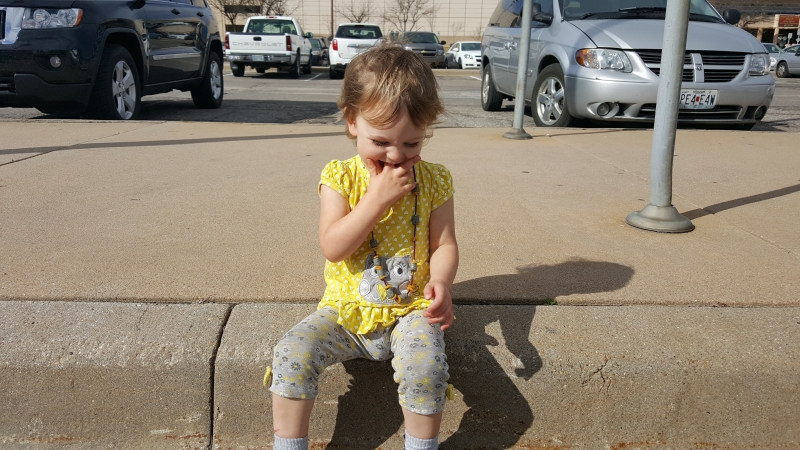
Tirzah Mae on a Curb
Tirzah Mae chose to sit on the curb while mama was putting Louis in his car seat

At the library: “You have a choice. You can look at the books without pulling any new books off the shelf or you can sit in the stroller.”

At home: “You have a choice. You can take your clothes to the hamper or you can go sit in your room for a minute.”

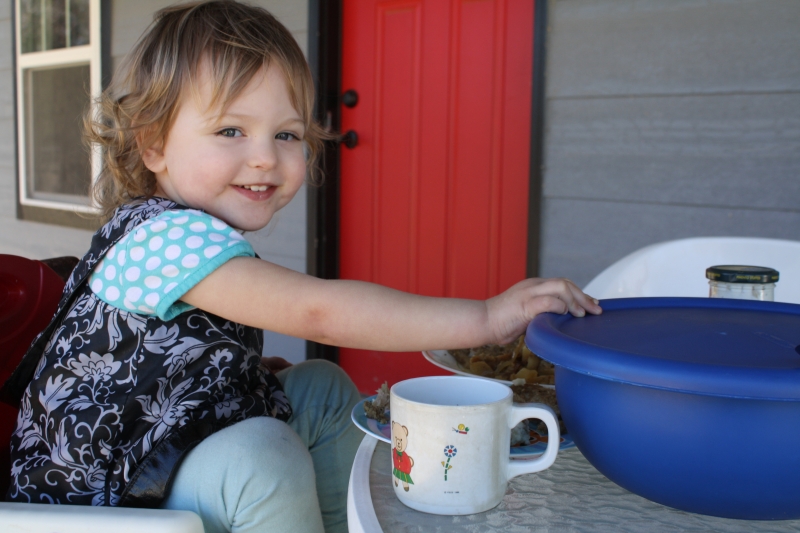
I don’t always use the words “You have a choice”. But I use them often enough that when I reminded Tirzah Mae to clear her bowl from the table after breakfast one morning, I heard her repeat to herself “You have a choice.” And then, a few seconds later, I heard the bowl slide off the table and heard her mutter “Good decision.”

And that is indeed what happens when she selects the option I prefer. “Good choice!” I’ll tell her. Or the aforementioned “Good decision!”

It doesn’t eliminate parenting challenges, doesn’t mean she always obeys. But giving her a choice certainly makes things easier.


Recap (2017.03.04)

It’s been terribly long since I posted one of these, which means I’m going to just fly by the seat of my pants and not try to be comprehensive :-)

In my spirit:

  • Reflecting on the unity of the body in Christ – and struggling with how to be united in Christ when I can’t seem to figure out how to deepen relationships with other believers past the “Hi, how are you?” “Fine, thank you” and “This is what we did this weekend” stage.
  • Rejoicing to be doing “devotions” with my daughter while Louis is napping (reading a Bible story, memorizing Scripture, singing a hymn, and praying together) and to be having family worship with the whole family in the evenings.

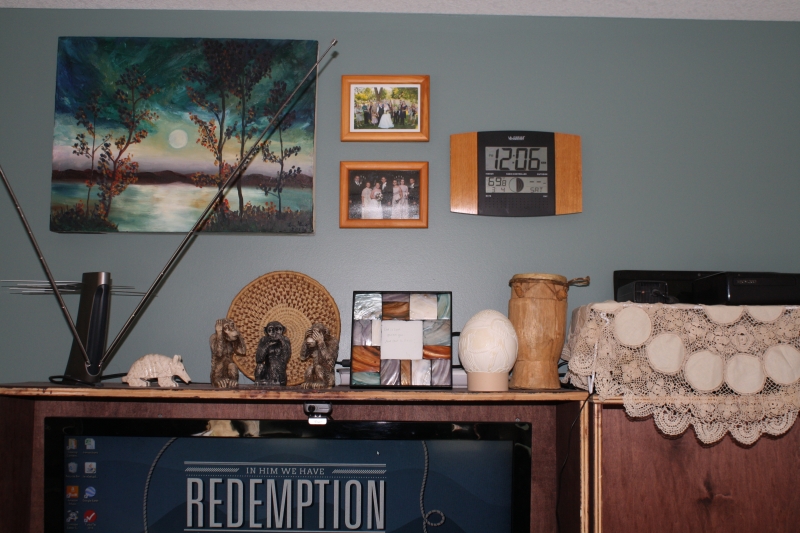
Above my entertainment center

In the living room:

  • After a year in our house, I have finally decorated the top of the entertainment center.
  • I added ten minutes of “zone cleaning” to my routine this past month – which has meant that I’ve started to declutter and move into our house a little more.
  • Daniel and I also made a concentrated effort to get the garage clean enough that he could park his car in there (along with our new-to-us Ford Expedition – we needed a bigger vehicle if we’re going to start fostering soon.)

In the kitchen:

  • We picked up the half beef we bought from my uncle – and now I’m cooking all that wonderful beefy food I don’t eat when I have to pay almost $4 for hamburger – Chili with beef, Beef enchiladas, Beef Pot Roasts, BBQ Beef, Daniel’s families “West Virginia Soup”, Swedish meatballs…
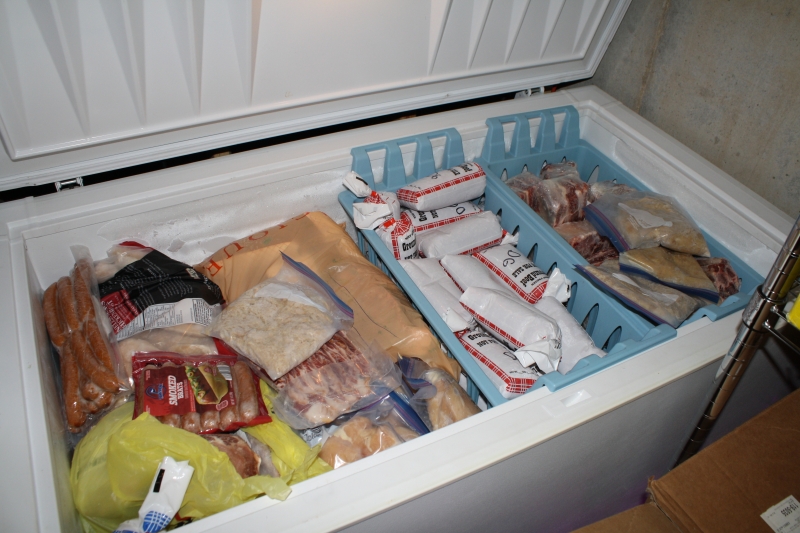
  • The deep freeze – and the fridge freezer – are COMPLETELY full. And I had to throw away a trashbag full of odds and ends to make all the beef fit!

My chest freezer, stuffed full

In the nursery:

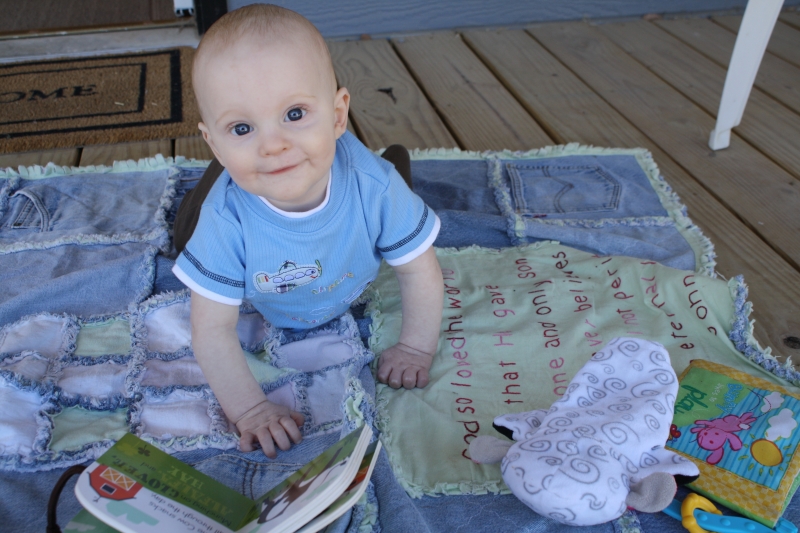
  • Louis has gotten his first two teeth – in two days time – and has also started crawling EVERYWHERE. He vocalizes a lot, blows bubbles and raspberries, and is starting to initiate peekaboo.
  • Tirzah Mae has been busy memorizing Children Desiring God’s “Foundation Verses”, singing songs with actions, helping with clearing the table and putting clothes in the hamper, riding her tricycle and playing in the sandbox – and just generally being a lot of fun. Those extra couple of hours that she’s no longer napping give her lots of opportunity to do more (and give me a lot less time in which to do my own tasks!)
  • We started our foster care class, hoping to adopt out of foster care eventually. Even just a couple weeks in, the class has been enlightening.

In the craft room:

  • I started working on our wedding album (we’re coming up on our 4th anniversary here next week) – but need to find the time to buckle down and finish it. Time is in short supply now that Tirzah Mae isn’t napping.

Seedlings under lights

In the garden:

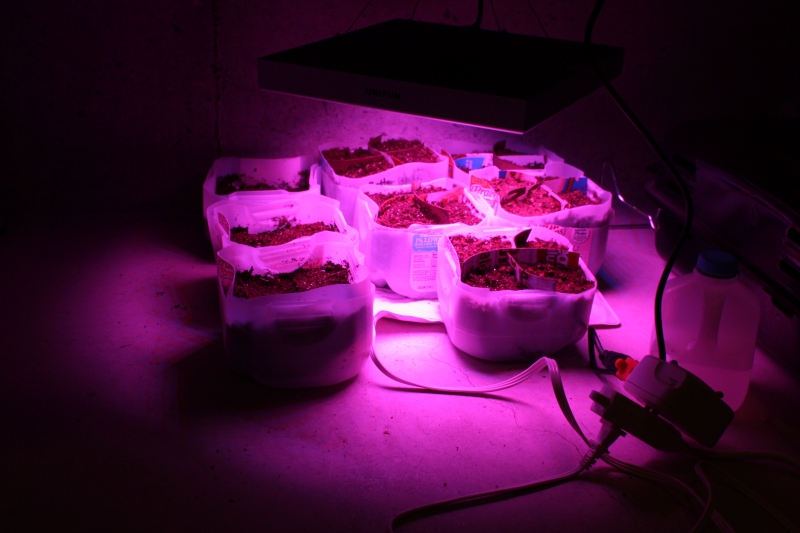
  • I’m loving the grow light I got for Christmas. The broccoli has sprouted, the tomatoes and peppers are planted. I’m itching to get my fingers in the dirt outside.
  • I’ve set up a few beds and want to get herbs in this year – next order of business is getting a truckload of compost delivered. That’s going to be on the agenda this next week (as long as it stays dry enough that a dump truck can get in without destroying the lawn.)

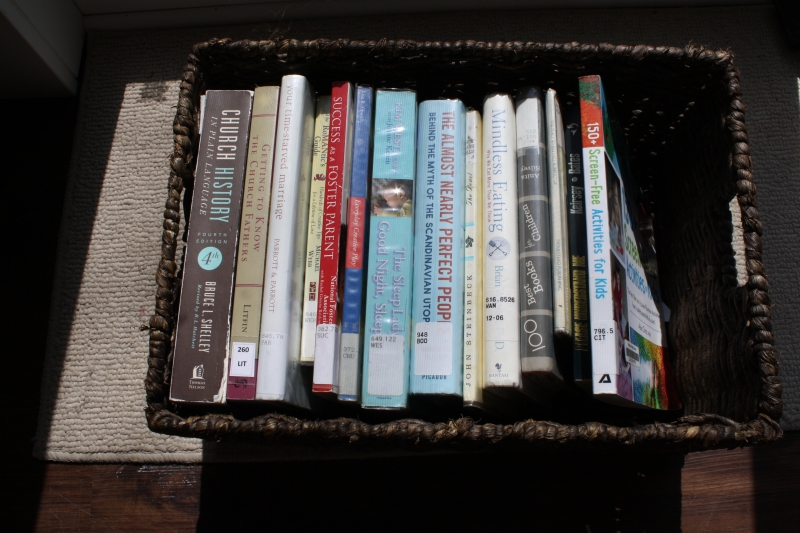
In the library (currently reading):

  • Church History in Plain Language by Bruce L. Shelley
  • Getting to Know the Church Fathers by Bryan M. Litfin
  • Your Time-Starved Marriage by Les and Leslie Parrott
  • Success as a Foster Parent by the National Foster Care Association
  • Everyday Creative Play by Lisa Church
  • The Almost Nearly Perfect People by Michael Booth
  • The Pearl by John Steinbeck
  • The Book of Three by Lloyd Alexander

What I'm reading these days

Added to the TBR List:

Around the web:

  • Should Children Play with Food? – Especially for picky eaters, “playing” with food can be helpful for broadening kids’ horizons and helping them overcome sensory difficulties.
  • The Four-Fold View of Creation – In a day where questions about the age of the earth and about evolution are the questions related to creation, it’s important to be reminded of these points that Christians have historically emphasized about creation (Full disclosure: I’m a day-age creationist and do not believe that humans evolved from other species.)
  • No, Saul the Persecutor Did Not Become Paul the Apostle – This is a pet peeve of mine, so I was thrilled to see it addressed. (HT: Tim Challies

My First Little House Books

HarperCollins’s “My First Little House Books” are picture book adaptations of Laura Ingalls Wilder’s “Little House books.” Renee Graef illustrates the collection, with an aesthetic intentionally mirroring Garth Williams’s illustrations for the chapter book series.

I read all the “My First Little House Books” I could get my hands on this February in celebration of Laura Ingalls Wilder’s 150th birthday and Barbara’s Laura Ingalls Wilder Reading Challenge. I was joined in this challenge by my two-year-old daughter Tirzah Mae, who ate up every word.


Based on Little House in the Big Woods:

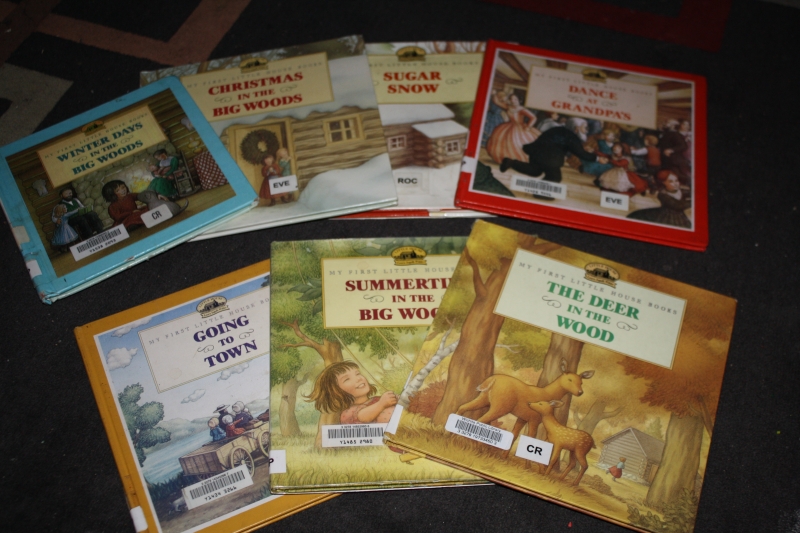
Winter Days in the Big Woods, based on the chapters “Little House” and “Winter Days and Winter Nights”

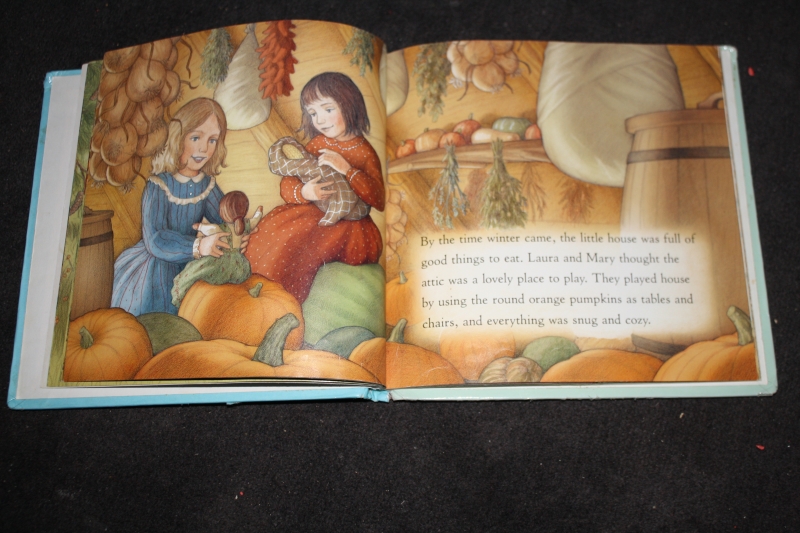
This introduction to Little House in the Big Woods skips right past the messy business of butchering and jumps into the coziness of winter life in the little log house. Mary and Laura playing in the attic. Making “pictures” on the frosty windowpanes. Doing the proper work for each day. Dressing up paper dolls. And pa coming home and playing the fiddle and telling stories. This particular book condenses 44 pages of Laura’s writing into 35 sentences. I couldn’t tell whether I disliked that it skipped so many details or that it said just enough that I could draw up those missing details in my mind. For Tirzah Mae’s part, she adored this particular book, especially the sing-song list of each day’s tasks.
Based on "Little House in the Big Woods"

Christmas in the Big Woods, based on the chapter “Christmas”

I’ve always loved the Christmas stories from each of the Little House books, modeling my own planned “St. Nicholas Day” stockings after Laura and Mary’s (from Little House on the Prairie) with a candy cane, (chocolate) coins, a small toy, and something useful inside. Reading this, I am reminded of even simpler pleasures: pancake men. I plan to include this title in next year’s Christmas basket – and maybe we’ll make some pancake men of our own after reading it.
From "Winter Days in the Big Woods"

Sugar Snow, based on the chapter of the same name

While some of the “My First Little House Books” mention that Pa told stories, few share any of Pa’s stories (maybe because most of them are a little dark?). Sugar Snow is an exception. After Pa brings home some maple sugar for Mary and Laura, he takes them on his knee and tells them how Grandpa made the sugar. This particular story has a nice structure since it (mostly) begins and ends with a day – from Laura’s wakening to her going to sleep.
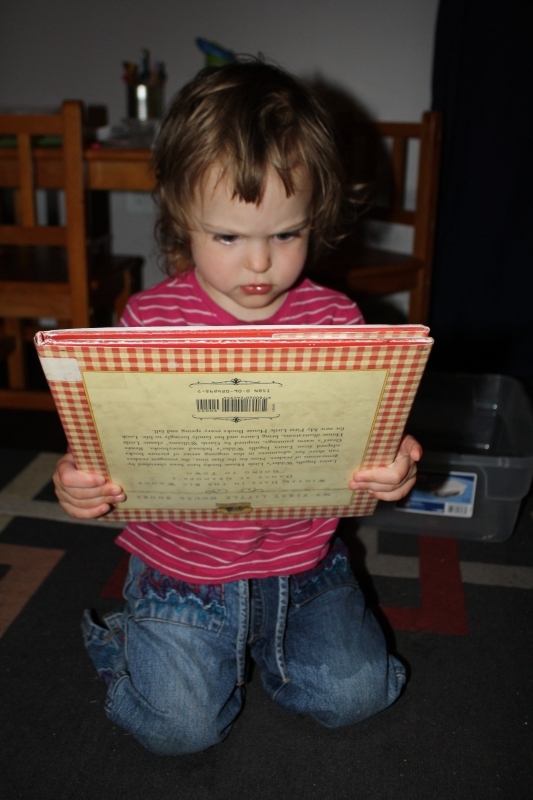
Studying the upside-down cover rather intently

Dance at Grandpa’s, based on the chapter of the same name

Each book adapted from Little House in the Big Woods begins with the same words: “Once upon a time, a little girl named Laura lived in the Big Woods of Wisconsin in a little house made of logs. Laura lived in the little house with her Pa, her Ma, her big sister Mary, her little sister Carrie, and their good old bulldog Jack.” For the adult reader, this repeated introduction might get old (does get old), but toddlers like Tirzah Mae lap it up. This reminds her that this story is about the same family the last story was about. From there, the stories only introduce a limited additional cast of characters. So, in this particular tale, we learn about the dance at Grandpa’s without any mention to the aunts by name, without wild Uncle George, and without the other Laura. Also, since this is NOT the book about sugar snow, there is no mention of the maple sugar. Does this ruin Laura’s delightful narrative? I’ve puzzled it over multiple times and decided that, no, it does not. Instead, it gives a taste to entice a child into Laura’s world – and leaves enough detail unspoken to make exploring the whole thing desirable.
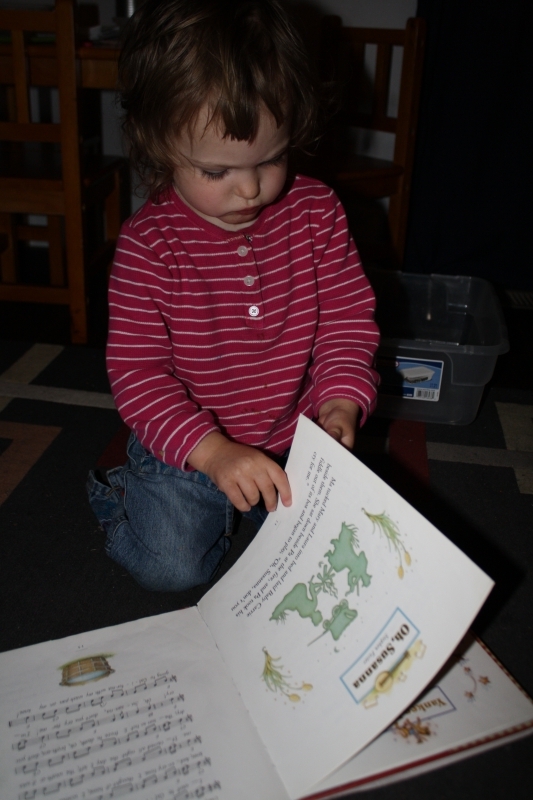
Tirzah Mae turns the pages of the songbook

Going to Town, based on the chapter of the same name
Summertime in the Big Woods, based on the chapter “Summertime”
The Deer in the Wood, based on the chapter of the same name

Tirzah Mae loved all these books based on Little House in the Big Woods, so much so that whenever I read one, she brought me another and another and another. After spending more than a half hour reading through these books, I thought maybe I had been premature in assuming Tirzah Mae couldn’t pay attention to the real thing. I brought up my copy of Little House in the Big Woods from the basement, and began reading it to her the next day. I learned that all those people who say it’s not a great first chapter book read-aloud are right. Even though Tirzah Mae has plenty of attention for prolonged reading of the picture book versions, the “real deal” simply moves too slowly for her toddler mind. Which is just fine. I enjoyed introducing her to the world of Little House using these books and look forward to exploring the “real deal” with her when she’s a little more mature.


We also read a more limited selection of picture books adapted from Little House on the Prairie and Farmer Boy. It seemed to me that Tirzah Mae wasn’t as interested in these, perhaps because she enjoyed the continuity of place so much from the many books based on Little House in the Big Woods. The other books we read were Going West, Prairie Day, A Little Prairie House, Winter on the Farm, A Farmer Boy Birthday, and County Fair.
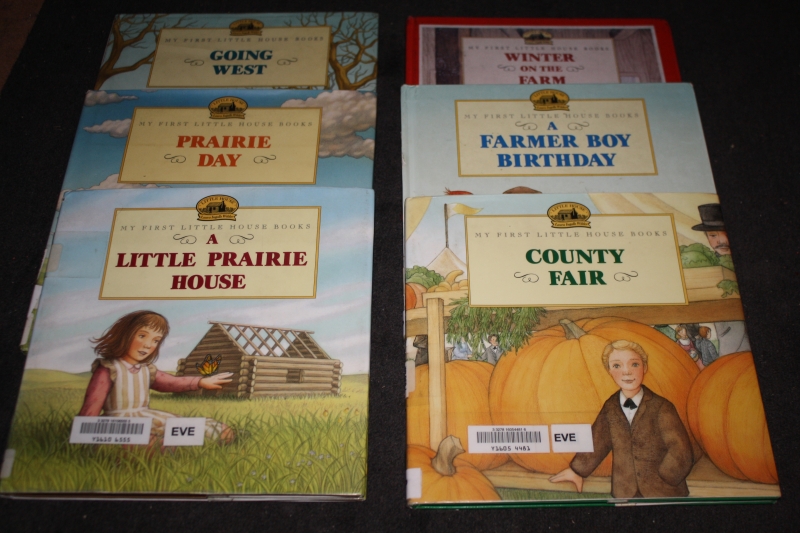
Based on "Little House on the Prairie" and "Farmer Boy"

While the majority of what we read were abridgments of chapters from the first three Little House books, we also read some even simpler topical titles in the “My First Little House Books” series: My Little House ABC, My Little House 123, My Little House Book of Family, and My Little House Book of Animals. These were effectively labeling books, with text like “Brother” in a large typeface with a smaller quote from one of the Little House books underneath (“Nellie and her little brother, Willie, came bouncing in.”) Neither Tirzah Mae and I were big fans of these books, which had no narrative arc and whose characters were often unfamiliar to Tirzah Mae since they hadn’t been included in the narrative storybooks we read.
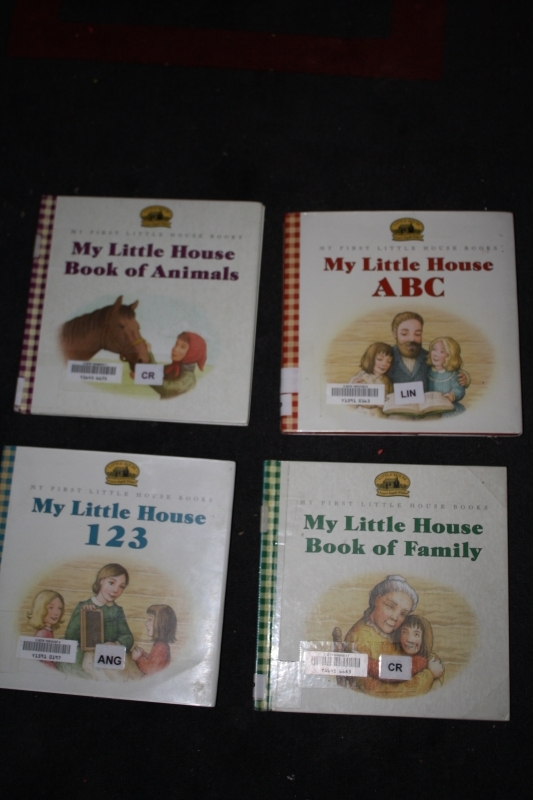
"My First Little" Concept Books

The one exception to our dislike of the topical titles was My Little House Songbook, which included several of the songs Laura mentions in her books. Tirzah Mae insisted that Papa and I read and re-read this book over and over (preferably skipping the text and going straight to the singing part.) :-)
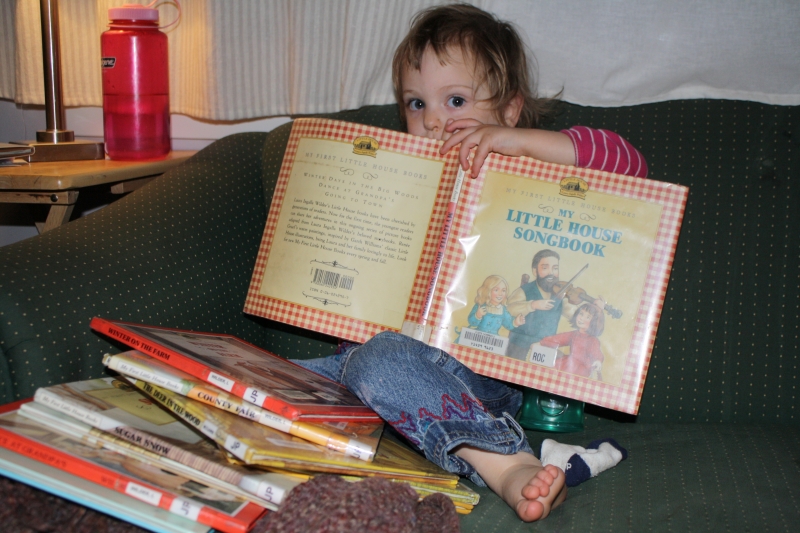
Tirzah Mae and her favorite "My First Little House Book"


I am so glad that Tirzah Mae and I opted to explore the Little House books together this month. While these picture book abridgments can’t possibly measure up to the works they’re based on, they are delightful in their own right and I’m thrilled to be able to use them to introduce my daughter to one of my old friends a little earlier than I otherwise might have been able to. Don’t forget to run over to Barbara’s wrap up post to read about what others have read and done for this year’s Laura Ingalls Wilder Reading Challenge.

Nightstand (February 2017)

Between a quick weekend trip north to pick up some beef (a 513 lb half!), a teething infant, a toddler who is no longer napping, and beginning our foster-care class, I haven’t had a lot of time for reading this month. But I’ve sneaked in a little here and there :-)

Books for Loving:

  • The Epistles of St. Ignatius
    I appreciated reading through these epistles and learning a little more about Ignatius, a second century Christian bishop. While I had some points of disagreement with Ignatius, his arguments against the docetists and for the Incarnation encouraged me to give praise to the Incarnate God. I wrote a little of what I learned about Ignatius in this blog post.

Books for Growing:

  • Mindless Eating by Brian Wansink
    What can be better than a book subtitled “why we eat more than we think”? The subtitle is a delicious wordplay. We eat more food than we think we eat. We eat mindlessly and therefore spend more physical time eating than we spend thinking about what (or why or how) we’re eating. Wansink’s book talks about the psychology of eating, about our unconscious behaviors related to eating and how to tweak those behaviors. Highly recommended.

Books for Knowing:

  • Getting to Know the Church Fathers by Brian Litfin
    I’ve actually only read half of this so far – I’ll finish the other half next month while studying the church under Constantine (and thereabouts). So far, though, it’s been an excellent introduction into some of the noteworthy people of the first few centuries of the church. Litfin gives a mini-biography of each father (and one mother), reflects on their life and teaching from an evangelical perspective, and then shares an excerpt from that father’s writings. As someone who has virtually no knowledge of these individuals, I’ve found this to be very helpful in my study of church history.

Books for Seeing:

  • The Pearl by John Steinbeck
    It’s only five chapters long (I think), and I’ve only read one of those chapters. Sigh. But I’m looking forward to finishing it up next month.

Books for Enjoying:

  • The Emperor of Nihon-Ja by John Flanagan
    Ever since I finished the ninth book in the Ranger’s Apprentice series, I’ve been checking my local library to see if the final book of the series was available. Finally, after months of weekly peeks at the bookshelf, I checked the computer – and discovered that my branch doesn’t own a copy! Silly me. I requested this from another branch and greatly enjoyed it.

While I haven’t read much as far as grown-up reading goes, I’ve been doing lots of reading aloud to the children. And in celebration of Laura Ingalls Wilder’s 150th birthday this month, Tirzah Mae and I read a whole slew of the “My First Little House” picture book adaptations (which I plan to write about Thursday when I wrap up my participation in Barbara’s Laura Ingalls Wilder Reading Challenge.
Don’t forget to drop by 5 Minutes 4 Books to see what others are reading this month!

What's on Your Nightstand?


I’m so glad

Surely every family has their own special phrases, words that can be heard as the warp threads upon which the fabric of our lives are woven.

One of our special phrases is “I’m so glad.”

I’m so glad I’m married to you.

Whispered words as we linger ten more seconds in bed before rising to meet the demands of one or the other of our offspring. Words accompanied by a handsqueeze as we drive together to church. Words spoken in broken voices after a particularly emotional conversation (read: when one of us has hurt the other.)

I’m so glad God made me your mama.

Words said during sweet moments of snuggling. Repeated during bathtime or diaper changes. Reminders to myself as much as to them when my exasperation seems to know no bounds.

I’m so glad

An exclamation when I’m feeling glad. A reminder when I’m not. A reassurance to myself and to them. God has made us a family. And we are glad He has.

What are your family’s special phrases?


Getting to Know Ignatius

Ignatius was an early church father who was bishop of Antioch of Syria. We know of him from a collection of letters he wrote to various churches (and to Polycarp, the bishop of Smyrna) while enroute to Rome, where he expected to be martyred as a witness to Christ.

Ignatius’s letters follow a relatively predictable arc: Ignatius greets the church and writes them some encouragement before settling upon his primary message: the church must be unified in order that she can combat heresy.

For Ignatius, unity means complete submission to the bishop. Ignatius is a strong proponent of the monoepiscopacy, that is, of a single strong bishop as leader of the church in a specific area. Ignatius regards the bishop as analogous to Christ, the presbyters (also called elders) as analogous to the apostles, and the deacons as analogous to angels and the servants of the presbyters. Given this understanding of church governance, Ignatius’ insistence on unity with the bishop makes sense (even if it does grate on these Protestant ears!) However, it is important to note that Ignatius does not urge unity and submission to the bishop for its own sake. Ignatius’ primary goal is that the church remain free from apostasy and heresy – and he sees unity under a selected bishop as a way of attaining that. In his letter to the Ephesian church, Ignatius writes that the one who separates himself from “the bishop and the whole church” is “a wolf in sheep’s clothing, while he presents a mild outward appearance.”

Regarding the relationship of the church to the bishop, Ignatius writes:

“For your justly-renowned presbytery (church), being worthy of God, is fitted as exactly to the bishop as the strings are to the harp. Thus, being joined together in concord and harmonious love, of which Jesus Christ is the Captain and Guardian, do ye, man by man, become but one choir; so that, agreeing together in concord, and obtaining a perfect unity with God, ye may indeed be one in harmonious feeling with God the Father, and His beloved Son Jesus Christ our Lord.”

~Ignatius to the Ephesians

Ignatius was particularly concerned with two dueling heresies: the heresy of the Judaizers and the heresy of the Gnostics. The Judaizers insisted that Christian believers follow the Old Testament laws and become Jews in order to have salvation in Christ. The Gnostics argued that Jesus did not truly come in the flesh but only in the appearance of the flesh (called “docetism”).

Most of Ignatius’ arguments against docetism are propositional: “Now He suffered all these things for us; and He suffered them really, and not in appearance only…” (Ignatius to the Smyrnians) But some of Ignatius’ writings sing with praise for the salvation Jesus wrought through His humanity:

“Being incorporeal, He was in the body; being impassible, He was in a passible body; being immortal, He was in a mortal body; being life, He became subject to corruption, that He might free our souls from death and corruption, and heal them, and might restore them to health, when they were diseased with ungodliness and wicked lusts.”

~Ignatius to the Ephesians

(I had to look up “impassible” – and discovered that it means incapable of suffering pain. While Ignatius does not make this clear, it seems theologically correct that Jesus was physically impassible prior to his incarnation – but he was not incapable of suffering anguish in an emotional or “soulish” sense.)

In another letter, Ignatius speaks of the heretics thus:

“For they speak of Christ, not that they may preach Christ, but that they may reject Christ; and they speak of the law, not that they may establish the law, but that they may proclaim things contrary to it.”

~Ignatius to the Trallians

At other times, Ignatius channels the apostle Paul, proclaiming that if Christ only suffered in appearance, then Ignatius’ sufferings, imprisonment, and impending martyrdom are worthless (see 2 Corinthians 15).

In his letter to the Ephesians, Ignatius gave a test by which to distinguish false teachers. False teachers, Ignatius says, speak of their own accord and for their own glory, while God speaks as the Trinity (the Son does not speak of his own accord but what he hears from the Father, etc.) and for the glory of the Trinity (the Holy Spirit glorifies Christ, etc.)

While most of Ignatius’ letters to the churches focus on combating heresy and encouraging unity under the bishop, his letter to the Romans sharply departs from the norm. The letter to the Roman’s is almost entirely focused on one goal and one goal alone: the Roman church is not to seek to prevent Ignatius’ impending martyrdom, either through prayer or through legal means. Ignatius desires to be martyred as a testimony and wishes no one to stand in his way.

Another departure is Ignatius’ letter to a fellow bishop, Polycarp. This letter consists primarily of instructions to Polycarp and to Polycarp’s flock, with little to no discussion of pure doctrine. The letter to Polycarp is about orthopraxy rather than orthodoxy.

I’ve enjoyed reading Ignatius’ letters as part of my study of church history. As I alluded to above, I do not find myself in agreement with Polycarp’s monoepiscopacy – I believe the Scriptural pattern describes a plurality of elders who share responsibility for the body and to whom the pastor is accountable, rather than a single leader who bears responsibility and to whom the elders are accountable. On the other hand, reading Ignatius’ defenses of Christ’s humanity (in particular) has encouraged me to reflect upon the Incarnation and to better worship the Incarnate God.

Ignatius at a Glance
Date: ~35-108
Location: Antioch
Key theological points:

  • Arguments against Judaizers
  • Arguments against docetism
  • Defense of the monoepiscopacy

Key writings: Letters to a number of churches and to Polycarp

Resources:

  • Litfin, Bryan. Getting to Know the Church Fathers. Chapter 1: Ignatius of Antioch
  • Schaff, Philip. Ante-Nicene Fathers. Volume 1 (available at the Christian Classics Ethereal Library)

Books of Action Rhymes

Maybe some people grew up knowing dozens of little hand plays – they learned them in preschool or at library story time or whatever.

I am not one of those people.

Furthermore, since my preemies aren’t supposed to spend time with other kids until they’re older, I can’t take my toddler to story time (lest my infant be exposed to kids). So I am stuck with books to learn those action rhymes – which is fine with me. Books are my preferred way of learning anyway.

I’ve checked out a few books of action rhymes, mostly as they come up in my reading of the “nursery rhyme” section – juvenile nonfiction Dewey Decimal 398.8, and am attempting to learn a few to share with Tirzah Mae.

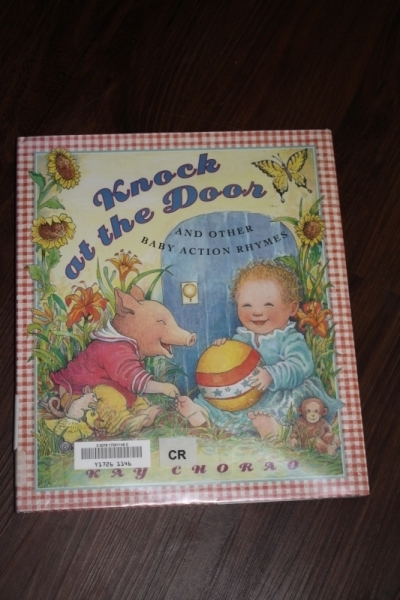
Knock at the Door by Kay Chorao

Knock at the Door

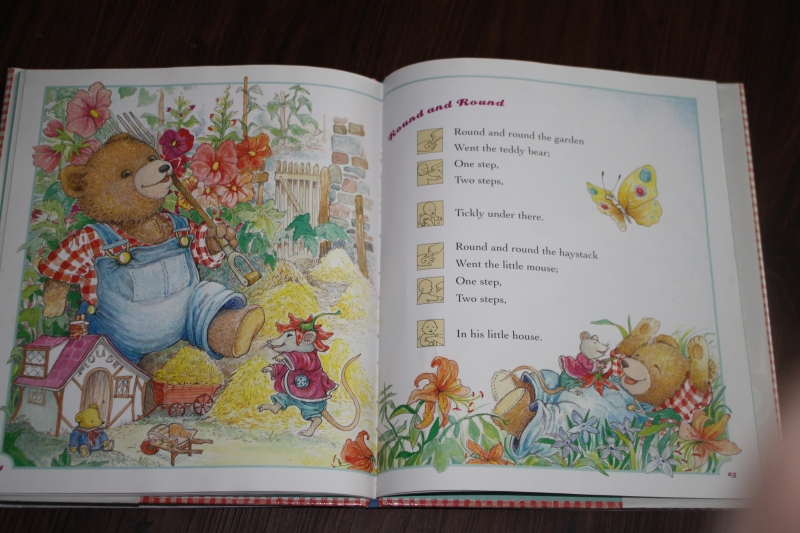
A collection of 20 finger-plays conveniently organized with one or two per double-page spread. Each line of the finger-play is preceded by a small box illustrating the appropriate action. The illustrations are generally clear (or at least I was able to do something with them – whether or not it is correct is another story.) Best of all, the book also includes large illustrations of each rhyme – which means it’ll keep a child’s interest even if mama chooses not to do the finger-play (Guilty as charged – I’m working on it.)

Inside 'Knock at the Door'

Clap Your Hands: Finger Rhymes selected by Sarah Hayes, illustrated by Toni Goffe
A little over 20 finger-rhymes accompanied by illustrations of children performing the finger rhymes. Some of the illustrations make the actions perfectly clear, while others are decidedly less so. There are multiple rhymes to a page, making this less of a favorite for me than Chorao’s Knock at the Door.

Marc Brown’s Playtime Rhymes
Twenty finger plays and other action rhymes accompanied by small-box illustrations of each action and large illustrations depicting the content of the rhyme. While I detest Brown’s Arthur books, his illustrations in these classic rhymes are just fine. Some of these rhymes are more involved than others – but that’s okay. Each rhyme has its own double-page spread, which makes it easy to open up and just do one rhyme (not that I ever want to limit us to just one rhyme. *sarcasm*)

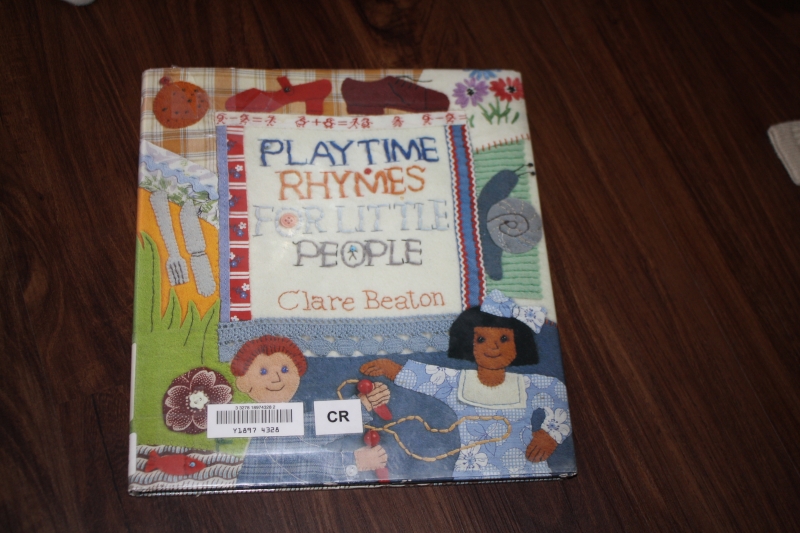
Playtime Rhymes for Little People by Clare Beaton

Playtime Rhymes for Little People

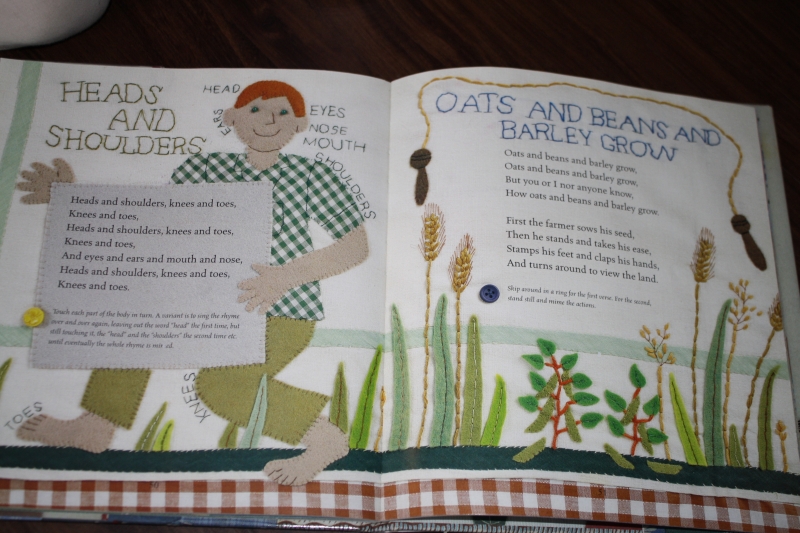
About 40 rhymes including familiar action rhymes (“Incy Wincy Spider” and “Head and Shoulders”) and unfamiliar ones, familiar songs (“The Wheels on the Bus” and “Here we Go round the mulberry bush”) and less familiar ones, and a range of “counting out” songs for selecting who’s “it” during playtime. Unlike several of the other collections I read, this does NOT include figures for how to “act out” the rhyme. Instead, instructions are given in italicized print at the bottom of the page. But, as with other Beaton titles, to focus on the text misses the highest point: Beaton’s lovely applique and embroidery illustrations. Oh how I long to make a collection of pieces in her style for our nursery! (But, time.)

Inside 'Playtime Rhymes for Little People'

Of the four collections reviewed here, I recommend either Knock at the Door or Marc Brown’s Playtime Rhymes for the mom seeking to learn new finger plays – and Playtime Rhymes for Little People for people who are interested in beautiful fabric art :-)


Reading Laura

This is February, which means it’s time to read Laura Ingalls Wilder along with Barbara H’s Laura Ingalls Wilder Reading Challenge.
But this February is no ordinary February.

Tomorrow, February 7th, Laura Ingalls Wilder will turn 150 years old!

And this month, I am introducing my daughter to Laura Ingalls Wilder for the very first time.

Tirzah Mae is two, which means she’s not quite ready to sit down for a full chapter of Laura with only minimal illustrations… but she’s at just the right stage for the “My First Little House books”, abridged from Little House in the Big Woods, Little House on the Prairie, and Farmer Boy and illustrated in the style of Garth Williams.

I intended to read one a day, but we read the first one and Tirzah Mae was hooked. She kept bringing me another and then another and another. Maybe it’s time to try the chapter books after all!

At any rate, the Little House books are the first books I remember binge reading and re-reading – and I’m delighted to be introducing my daughter to my own childhood friends!

Thanks, Barbara, for hosting this challenge – I intend to finish the rest of the “My First Little House Books” that my library offers and to write up my (and Tirzah Mae’s) thoughts at the end of the month.


Nightstand (January 2017)

It’s not every month that 5 Minutes for Books’s “Nightstand” falls on the last day of the month. It’s also not every month where I complete practically every book I’ve been working on by the end of the month, so as to start fresh for the next month. But since I’m trying to be super-disciplined to read at least one book in each of my five categories each month and since I’ve got to keep on top of my church history goal, I have completed everything I planned to read this month.

Louis and True Community

Books for Loving:

  • Paul: In Fresh Perspective by N.T. Wright
    A look at some of the themes of Paul’s writings (Creation and Covenant, Messiah and Apocalyptic, Gospel and Empire) and how Paul reworked traditional categories of Jewish thought (God, God’s people, and the future of God and His people.) I wrote a very few comments on this book in my post summarizing my first month studying church history.
  • True Community by Jerry Bridges
    A look at koinonia in Scripture and its implications for the Christian church of today. Highly readable, with excellent content. A lot to think about, a lot to grow into.

Louis and Growing Books

Books for Growing:

  • Spiritually Parenting Your Preschooler by C. Hope Flinchbaugh
    A quite readable and occasionally helpful little volume for Christian parents. I wish I could recommend it because it reads so nicely for a busy mom. Unfortunately, Flinchbaugh’s Word-of-Faith style charismatic-ism infuses so much that it’s hard to separate the wheat from the chaff. (Full disclosure: I was raised charismatic and am a continuationist; I had experiences with Word-of-Faith type teachings in my early teen years and find several of that movement’s tenets to be unbiblical and unhelpful.)
  • Honey for a Child’s Heart by Gladys Hunt
    Just about every guest of the Read-Aloud Revival podcast recommends this book. But since it wasn’t at my branch of the local library and since I assumed that it was just another book-list book (albeit from a Christian perspective), I wasn’t in any hurry to get it. But when I saw it on the shelf at my church’s library, I decided I’d at least figure out what the buzz was. What I found was so much more than a booklist. This is a full-figured book about nurturing children through books and poetry. I haven’t started going through the bibliography yet (so I can’t really comment on Hunt’s booklist!), but the book itself is an excellent encouragement for Christian parents to share beautiful books with their children.
  • As They Grow: Your Two-Year-Old by Diane O’Connell
    I didn’t have particularly high expectations of this book “by the editors of Parents magazine” – but I was in for a wonderful surprise. This book gives a fairly comprehensive look at what a child experiences in his twos, along with how parents can support and train their children through the twos. While I have a few points of difference with the authors (for example, they are anti-spanking and are concerned that children might learn gender roles if their mother does the housework while their father does the car maintenance), I generally found the advice to be common sense and helpful. I’m planning on skimming through this again and taking some notes so I can implement some of the strategies found within.

Louis and church history

Books for Knowing:

  • Church History in Plain Language by Bruce L. Shelley
    I read the first section (2 chapters long) on the “Age of Jesus and the Apostles” as the spine for my first month’s study of Church History. I’m glad I chose this as a spine. It’s easy to read and has just enough detail to allow me to take tangents for further study, without getting me bogged down as I’m reading.
  • Great People of the Bible and How They Lived by Reader’s Digest
    I read the New Testament section of this volume and found it an excellent resource to understand the stories of the New Testament in their historical context. If you’d like to read more, I wrote some comments on this book and the one above in my post summarizing my first month studying church history.

Louis and my kindle

Books for Seeing:

  • Pygmalion by George Bernard Shaw
    A re-read for my book club. I thoroughly enjoyed this the first time through (enough that I recommended it for book club!) and enjoyed it even more the second time. I especially enjoyed how preparing to lead discussion encouraged me to ask questions of myself as I read.
  • The Strange Case of Dr. Jekyll and Mr. Hyde by Robert Louis Stevenson
    The compelling story of a man who seeks to give his sin nature absolute freedom – and discovers that this is not freedom at all. You can read my full review here.

Louis and Georgette Heyer

Books for Enjoying:

  • Friday’s Child by Georgette Heyer
    A bit of an unusual romance (since the main characters get married in the first couple chapters of the book) and a bit predictable from there on out (spoiler alert: they fall in love). But the inevitability of the two characters falling in love didn’t make this story of a completely innocent girl and her frivolous husband any less fun. A good part of the fun is the strong supporting roles the hero’s best friends serve as they attempt to turn his callow bride into a respectable lady.

Tirzah Mae and what

Up Next:

  • Church History in Plain Language by Bruce L. Shelley
    Section 2: “The Age of Catholic Christianity”
  • Getting to Know the Church Fathers by Brian Litfin
  • The Epistles of St. Ignatius
  • The Early Christians in their own words edited by Eberhard Arnold
  • Early Christian Church by J.G. Davies
  • Against Heretics and Against Marcion by Tertullian
  • The Gospel of Thomas
  • Mindless Eating by Brian Wansink
  • Boys in the Boatby Daniel James Brown
  • Success as a Foster Parent by the National Foster Parent Association with Rachel Greene Baldino
  • The Pearl by John Steinbeck
  • The Emperor of Nihon-Ja by John Flanagan

I’m also planning on reading as many “My First Little House” books as I can find at our library to Tirzah Mae in celebration of Laura Ingalls Wilder’s 150th birthday and Barbara H’s Laura Ingalls Wilder Reading Challenge.
Don’t forget to drop by 5 Minutes 4 Books to see what others are reading this month!

What's on Your Nightstand?