Church History: The Age of Jesus and the Apostles

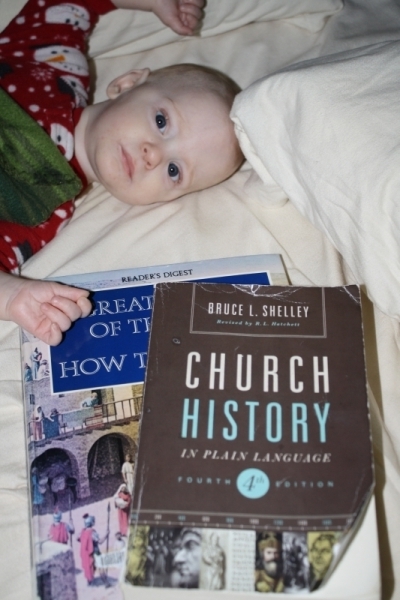
This year’s main spiritual goal is to “grow theologically through a study of church history”. To that end, I’m using Bruce L. Shelley’s Church History in Plain Language as a spine and reading original sources and biographies to supplement my study. This month’s section was “The Age of Jesus and the Apostles, 6 BC – AD 70.” In other words, the New Testament Age. Because I am already relatively familiar with this stage of church history, this was an easy month. I read Matthew, Acts, and Ephesians as my original sources and selected two books on Paul from my local library (only one of which I finished, as seen below.) I also found one of Shelley’s recommended readings at my library and read that.

Core Reading: Church History in Plain Language
The two chapters on “The Age of Jesus and the Apostles” are easy reading. They summarize the narrative portions of the New Testament, giving some historical details drawn heavily from the below-mentioned Great People of the Bible and How They Lived.

Supplemental Reading:

Great People of the Bible and How They Lived by Reader’s Digest
Bruce included this work in his recommended readings for this section – and I’m glad he did. I’ve only read the New Testament section (so far), but I’ve found this to be a highly readable retelling of the narrative of the New Testament with appropriate historical details added in text and with photographs and illustrations. Given that this is a secular work, I would have expected significant skepticism about the words and works of Christ, as well as how the apostles interpreted said words and works – but this is not a skeptical work. In fact, it is quite the opposite. I especially enjoyed the discussion of temple politics and the divisions between the Pharisees and Sadducees and the discussion of the divisions between the Jerusalem Jews and the Hellenists. Another thing I’d never thought of was how the locus of ministry in the New Testament shifts from Galilee (during Jesus’ early ministry) to Jerusalem (during Jesus’ late ministry and the apostles’ early ministry) to Antioch (from which Paul and Barnabas’s missionary journeys were launched.)

Paul: In Fresh Perspective by N.T. Wright

This is a small but dense work edited from some lectures Wright gave at Cambridge University. I found it difficult to find time to read it because it required my full attention (something in short supply!) to get Wright’s points. Nevertheless, I am glad I read this. Some points I found useful:

  • Wright points out Paul’s consistent use of the word “Christ”, which we tend to think of as little more than Jesus’ surname, but which conveyed quite a bit more in Paul’s Jewish context. Specifically, Paul was consistently pointing to Jesus’ messianic role – what Wright calls an “apocalyptic” context. Wright discusses some of the expectations the Jews of Paul’s time would have had surrounding the term “Christ” and what that would have meant to them. To remind myself of this context, I’ve been mentally substituting “The Promised Messiah and Savior” whenever I read “Christ” in the New Testament.
  • Occasionally, I hear the cross in the Roman world compared to an electric chair – “You’d never hang an electric chair around your neck.” But Wright points out that the cross was not simply a means by which Rome carried out executions. It was a symbol of Rome’s might, particularly its power over conquered peoples. The cross represented the power of Rome to kill those who oppose. Yet the subversive nature of the gospel stated that the cross represents the power, not of Rome but of God, not to kill but to save.

Paul: The Mind of the Apostle by A.N. Wilson

I gave this book up after 50 pages, having grown tired of passages like this:

“If readers of the New Testament choose to believe that Paul never set eyes on Jesus and that he had no psychological interest or compulsion to inspire him throughout the thirty years in which he preached Jesus Christ Crucified other than the testimony of the friends of Jesus, whom he had barely met, then that reader is entitled to his or her point of view.”

I understand that not all biographers of Biblical persons consider the Bible to be the authoritative word of God – but I’d prefer not to represented by a straw man. Only a reader of the New Testament who is determined to disbelieve it will assume Paul’s reason for believing was “the testimony of the friends of Jesus whom he had barely met.” Scripture plainly states in Acts 9 and 22 that Paul’s reason for his “obsession” with Jesus was a personal encounter with the risen Christ on the road to Damascus. Call the Damascus road experience a hallucination if you like, but don’t pretend that the Bible gives no explanation for Paul’s zeal.


The Christian and Clinical Depression or Anxiety

In recent years, I’ve seen an increasing number of articles for a Christian audience about clinical depression and anxiety. Most have sought to explain why “just get over it” is unhelpful advice (amazing that needs explanation!) and why having clinical depression or anxiety does not mean that one is unspiritual. More than a few have derided the use of Philippians 4:6 “Be anxious for nothing” or Psalm 42/43 “Why are you downcast, O my soul? Put your hope in God” when talking to someone who is experiencing clinical anxiety or depression. These articles have served a necessary role of educating believers on the psychological conditions many believers suffer with. They have helped believers become more understanding of the multifaceted aspects of anxiety and depression. They have hopefully helped believers understand the benefits of physical and pharmaceutical approaches to managing depression and anxiety.

But I fear these articles have had an unintended (at least I hope it’s unintended) consequence of allowing believers suffering from clinical depression and anxiety to justify disobedience to God.

Now, lest anyone mistake what I am saying, I am not saying that using medication, talk therapy, or a variety of stress management techniques is being disobedient to Christ. I use medication, light therapy, and a variety of lifestyle management techniques to manage seasonal affective disorder and have used medication and lifestyle management techniques to deal with bouts of major depression. I do this with a clear conscience, seeing no Biblical evidence that using these tools to manage my depression is wrong.

But I fear we can easily take the leap from “clinical depression and anxiety are biological with biological cures” to “clinical depression and anxiety are biological therefore I don’t need to be obedient to God’s commands regarding my thoughts and attitudes.

This, friends, is a lie from the pit of hell.

Just as a broken leg doesn’t exempt us from our call to “not neglect to meet together” (Heb 10:25), even though it makes assembling with other believers more difficult, neither does depression or anxiety exempt us from our call to “take every thought captive to obey Christ” (2 Cor 10:5), even though it does mean that there are perhaps more and more persistent thoughts to take captive.

You may need more than just taking thoughts captive to help you manage clinical depression and anxiety, but you certainly don’t need less.

When I am in the throes of depression, my thoughts often take a terrible turn. I contemplate my lack of energy and think “I’m worthless, I never get anything done.” I contemplate my seclusion and think “No one loves me.” I contemplate my thoughts and think “I’ll never be free of this depression.”

But I must not allow these thoughts to take over my mind. As fast as the arrows may volley forth, I must not surrender to them. Instead, I must take them captive to obey Christ.

When my thoughts say “You’re worthless. You never get anything done.”, I reply “My worth is not dependent on my accomplishments but on Christ’s, for ‘God, being rich in mercy, because of the great love with which he loved [me] even when [I was] dead in [my] trespasses, made [me] alive together with Christ (Eph 2:4-5).'”

When my thoughts say “No one love you”, I reply “but God shows his love for [me] in that while [I was] still [a sinner], Christ died for me. (Rom 5:8)”

When my thoughts say “I’ll never be free of this depression”, I reply “Who will deliver me from this body of death? 25 Thanks be to God through Jesus Christ our Lord! (Rom 7:24-25)”

Most of all, when depression turns all my thoughts inward – to myself, to my own shortcomings – I must turn my face resolutely toward God. I must say with the psalmist:

“Why are you cast down, O my soul,
and why are you in turmoil within me?
Hope in God; for I shall again praise him,
my salvation and my God.”
~Psalm 42:11 (ESV)

For those of you who suffer from clinical anxiety, this does not negate your call to “do not be anxious about anything, but in everything by prayer and supplication with thanksgiving let your requests be made known to God. (Phil 4:6)” It probably means you have a lot more anxieties and requests to make known to God than I have, but just because it’s harder for you to be obedient doesn’t mean that you’re excused from that call.

Now, are you starting to feel like I’m bullying you? Placing a burden on you too hard to bear? Are you feeling the need to escape to one of those articles about the biological basis of anxiety and depression?

At various times in the midst of depression, I would be tempted to feel that. But this is not bullying or a burden.

Have you ever heard of cognitive-behavioral therapy? It’s the best proven form of therapy for anxiety and depression. And you know what it is, basically? It’s identifying untrue thoughts and unhelpful actions that contribute to anxiety and depression and replacing them with true thoughts and helpful actions.

You know what that sounds like to me?

“Take every thought captive to obey Christ, being ready to punish every disobedience.” (2 Cor 10:5-6)

So to you, dear sister or brother who suffers from clinical depression, take every physical means necessary to deal with your condition. Take the medicine, go to therapy, get your rest, exercise, do any one of the myriad of things that can help you manage. But do not neglect to take your thoughts captive. Do not neglect to turn your eyes to Christ.



Parenting: Providing Anticipatory Guidance

It didn’t matter how many times I told her not to. She bit the fluoride dropper every time I put it into her mouth.

I’d draw up some fluoride, squeeze the excess out until I had the prescribed 0.5 mL, and insert the dropper into her mouth. She’d clamp the dropper between her teeth and grin at me as I tried to extricate the dropper. “This is not funny, Tirzah Mae,” I’d say, “this is disobedient. You should not bite the dropper.” My frustration level to rose higher and higher as the days went on – and so did Tirzah Mae’s sense that this was a marvelous game.

And then, one day, I suddenly knew exactly what I needed to do.

I needed to give some anticipatory guidance.

Holding hands with Mama

What is anticipatory guidance?

According to yourpediatrician.com:

“‘Anticipatory Guidance’ is a common term in the field of general pediatrics. It refers to providing education to parents about what to expect, or anticipate, over the next few months or years with your child. Recommendations are specific to a child’s age at the time of a visit.”

Our family doctor’s anticipatory guidance involves reminding me to childproof the house at the 6 month visit, since my little one is likely to soon become mobile. Our doctor is letting us know what to expect and what to do.

In the same way, my anticipatory guidance for Tirzah Mae meant telling her what was coming and what I expected of her.

In the above scenario, that meant I’d tell her something like this: “Okay, Tirzah Mae. Mama’s going to give you some fluoride. Now, I don’t want you to bite the dropper.” In this way, she knew exactly how I expected her to behave (or to not behave). If she followed my instructions, I’d praise her: “Thank you for being obedient, Tirzah Mae.” If she disobeyed my instructions, I’d put on my sad face and say “Oh, Tirzah Mae, you’ve been disobedient. Now mama will have to punish you.” And I’d administer whichever punishment was currently the order of the day.

And, as time went by, she learned what I expected and I no longer needed to give anticipatory guidance for the fluoride drops.

Holding her own hands

Now, it’s other things. As I see the pastor or elder making his way to the pulpit for the call to worship on Sunday morning, I explain to Tirzah Mae: “See how Mr. Dave is coming to the pulpit? He’s going to read to us from the Bible and then pray. I want you to be quiet and stand next to mama while he does that.” Or as I get ready to take Tirzah Mae out of her car seat, I’ll explain: “We’re going to go into ALDI, but I want you to hold mama’s hand the whole time we’re in the parking lot, until I put you in the cart.”

It doesn’t mean Tirzah Mae obeys every time, or that we never have struggles, but because I’ve articulated my expectations in advance, I’m able to respond to her actions more calmly rather than reacting in frustration. Because I know that she knows what I expect of her, I need not waffle about punishing her when she disobeys for fear that she’d forgotten my instructions. And the disobedience occurs less and less. In fact, she even begins to anticipate my guidance and say so herself.

She reaches out her hand to grab something from the shelf in the gas station but stops herself just in time. “Fold your hands,” she instructs herself, repeating my guidance. “We’re going to go into the gas station, but I want you to keep your hands folded and not touch anything.”

Anticipatory guidance. It works for us.


Recap (2017.01.21)

In my spirit:

  • Rejoicing in progress
  • Praying for so many friends and family members with health concerns
  • Continuing to delight in hearing my daughter’s voice sing praises to God or recite memorized Scripture

In the living room:

  • Pompoms, pompoms everywhere! I got some pompoms to use for a color-matching activity with Tirzah Mae – and she’s found plenty of other uses for them. The most recent has been to make soups – she stirs them up in a pot, ladles them into bowls, stirs them some more to cool them off, and then serves them to her parents or her brother.
  • I’ve been getting back into exercising and have been encouraged that things are getting easier – it’s time to either pick up my weights or work out to faster music or both!

Louis eating table food

In the kitchen:

  • So far, using a cycle menu is wonderful. I’m finding that there’s more than one day a week where I don’t want to cook – and that my recipes generate enough food that incorporating an extra day of leftovers is probably worthwhile. Thankfully, I have at least one recipe on each week’s cycle that doesn’t include fresh ingredients that’ll go bad if I skip it.
  • Daniel made this Bacon Cheese Ball for a snack day at his work and it was delicious!
  • Daniel brought home some stale hot dog buns that had been sitting around at his work and I tried an overnight Blueberry French toast recipe with frozen blueberries and cream cheese chunks to use them up. Definitely going to add that to the repertoire of breakfast recipes.
  • I used a new technique for making my homemade tortilla chips (brushing just one side of a corn tortilla with canola oil, stacking up a whole stack of the tortillas, and then cutting them into sixths before sprinkling with salt and chili powder and baking at 350 F on full convection for 14 minutes.) In contrast to previous attempts where I oiled the tortillas after cutting, I ended up using only a single tablespoon of oil for 20 tortillas. That translates into 0.7 g of fat (6 calories from fat) per serving versus 7 g of fat (63 calories from fat) per serving store bought tortilla chips. People, that just saved me 57 calories per serving (and how many of you eat just 6-9 chips at a time? We’re talking something more in line with 200 calories in a real-life serving.)

In the nursery:

  • Louis continues to become more and more mobile – he’s rolling and scooting all over the floor :-)
  • I started putting Louis to sleep in the nursery (as opposed to the bassinet in our room) this past week. We’re still too early to tell how it’s going, but I am looking forward to having our room to ourselves again.
  • We’ve started putting on a Seeds Family Worship CD for Tirzah Mae at naptime and bedtime. She loves turning on the CD and it’s a delight to hear her singing God’s word – yesterday it was “Come to me all you who are weary and burdened. And I will give you rest, I will give you rest.” Balm to a mother’s ears (in more ways than one.)
  • I’m working on being consistent with training and discipline, being clear about when I’m giving an instruction versus asking an opinion or offering an option. As someone who tends to use “asking” language when I’m making a request (“Would you like to change Louis’s diaper?” I’ll ask my husband, when I really mean “I’d really like it if you’d change Louis’s diaper”), it’s been something of a transition.

In the craft room:

  • My biggest “craft” this past couple weeks was making Tirzah Mae a color matching activity to go along with Donald Crews’s Freight Train. I cut train cars out of felt and have pom poms for Tirzah Mae to match to the train cars. I expected it to be an activity she’d play with for a couple days before I put it away for a rainy day – but she’s been playing with it multiple times a day for a week now and showing no signs of stopping. Hooray!

Playing with her color train

In the garden:

  • I spoke to a master gardener friend and she encouraged me to check my charts because I might need to start my broccoli seedlings soon. Maybe I should check those now? Looks like February 8 is my date, so I better start figuring out where to source my seeds.

In the library:

  • Great People of the Bible and How They Lived by Reader’s Digest
  • Paul: In Fresh Perspective by N.T. Wright
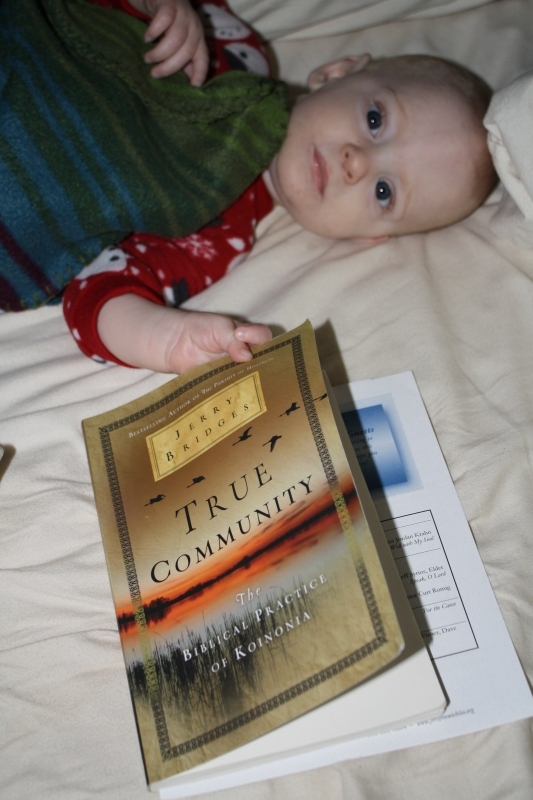
  • True Community by Jerry Bridges
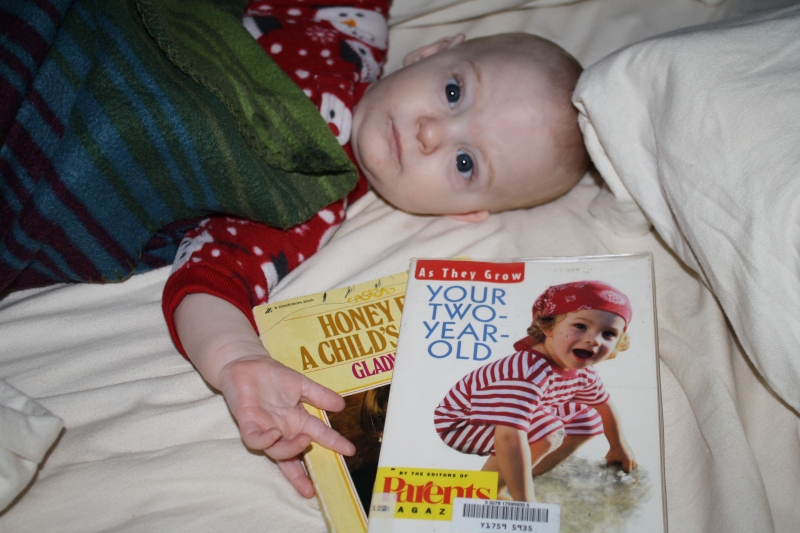
  • As They Grow: Your Two Year Old by Diane O’Connell
  • Spiritually Parenting Your Preschooler by C. Hope Flinchbaugh
  • Honey for a Child’s Heart by Gladys Hunt

Hugging a rolling pin

Added to the TBR List:

Around the web:

Take a picture of me, mama

In blogging history:


Thankful Thursday: Progress

Thankful Thursday banner

Sometimes I get so caught up in the day to day struggles (dishes, laundry, not sleeping consistently for a couple of years) that I forget that we are making progress. Sometimes slowly and steadily, sometimes in leaps and bounds, sometimes in fits and starts. But progress is being made.

This week I’m thankful…

…for increasing helpfulness
Tirzah Mae now consistently helps with cleaning up the house, wiping up spills, setting the table for meals, clearing the table after meals, and dishing up her own food. She takes such joy in being able to close the dishwasher and empty the dustpan. She is growing in ability and in obedience – and it is wonderful to see.

Swinging, a favorite pastime

…for increasing vocabulary
Tirzah Mae is also growing in communication skills. She has spent the last week identifying colors (which means only the red cup will do – but which also means I’m able to communicate instructions or directions more clearly). She is able to tell things she remembers, to identify things she’s thinking about, to communicate what she wants or needs. It makes life so much less frustrating when she can tell me what is bothering her instead of trying to guess vainly.

…for increasing mobility
Louis has started to roll in earnest and to scoot a little – which means he spends a lot of time amusing himself with whatever he can find on the floor. His increased mobility means more work for me making sure the floor only contains acceptable items, but less work because he entertains himself for greater periods of time.

Louis eating table food

…for increasing order
It’s so easy to get discouraged with the state of my home, with how never-ending the task of “picking up” is. But our home is becoming more and more orderly. The house gets “picked up” daily, the dishes don’t pile up, the bed gets made. The toilets don’t have rings, the underwear gets folded (eventually). The house is coming into order.

…for increasing patience
There was a time, not so long ago, that I’d snapped at the kids every day by the end of the day. I’d get frustrated and impatient with them, I’d snap at Tirzah Mae to “just…” whatever. I’ve been praying that God would work the fruit of patience in my life, that he would put a guard over my tongue. And he has. By God’s grace, I am holding my tongue more and more – and even better than holding my tongue, I’m feeling and acting compassionately with my children. This is the work of God – an ongoing work, but one that is showing progress.

I’ve been reading Ephesians in preparation for this semester’s Bible study on Ephesians, and have been struck by Paul’s prayer for the Ephesian church:

“For this reason, because I have heard of your faith in the Lord Jesus and your love toward all the saints, I do not cease to give thanks for you, remembering you in my prayers, that the God of our Lord Jesus Christ, the Father of glory, may give you the Spirit of wisdom and of revelation in the knowledge of him,”
~Ephesians 1:15-17 (ESV)

It’s so easy to only pray when things are going horribly – and to just plain forget to give thanks. But Paul hears of the Ephesians’s faith and love and this causes his heart to swell with thanks to God and with petitions for the Ephesians.

As I think of the progress my children, my home, I myself am making, I too am moved to thanksgiving. God has shown abundant mercy to our family – I pray we would continue to know Him more and more with every passing day.


Book Review: The Strange Case of Dr. Jekyll and Mr. Hyde by Robert Louis Stevenson

Theology tells us that man is depraved (Definition: “morally corrupt, wicked”). Every human is born with original sin. Yet despite man’s depravity from birth, the world is not wholly evil – it does not, has not degenerated into utter chaos and anarchy. Why is this?

Theology has an explanation for that as well. Common Grace is the grace of God that is present for all men, whether they believe the gospel or not. Common grace is responsible for all the good that unregenerate sinners do, and for the restraint of evil through means such as conscience or societal constraints.

But what if man’s innate evil were NOT constrained? What if it had free will to do whatever it chooses without fear of conscience or law?

If this were true of the whole world, surely the world would not last long – everyone would murder everyone and, after a brief period of chaos, all humanity would be obliterated (and that’s just speaking of the natural course of unrestrained sin, without discussing God’s judgment upon sin.)

But what if it was just one man who was evil without constraint? What if, indeed, one were able to split himself into two, with one half unrestrained evil and the other half still the restrained recipient of common grace?

This is the premise of Robert Louis Stevenson’s The Strange Case of Dr. Jekyll and Mr. Hyde (even if Stevenson chooses not to couch it in such explicitly theological terms.)

Does this surprise you?

It certainly surprised me.

The names “Dr. Jekyll” and “Mr. Hyde” are so well-known, so frequently thrown around to mean simply two separate personalities that I believed this book to be about multiple personality disorder. In fact, I’m almost certain I read something once that described J.R.R. Tolkien’s Smeagol/Gollum character a continuation of the literary fascination with multiple personality disorder typified by The Strange Case of Dr. Jekyll and Mr. Hyde. Yet this book is quite emphatically NOT about multiple personality disorder. It’s about unrestrained sin and trying to find a way to avoid the struggle Paul describes in Romans 7:21 “So I find it to be a law that when I want to do right, evil lies close at hand.” Except that Dr. Jekyll wants to find a wholly natural solution to this problem (apart from the supernatural answer God gives to the problem of sin at work in our bodies: “Wretched man that I am! Who will deliver me from this body of death? Thanks be to God through Jesus Christ our Lord!” Romans 7:24-25a ESV)

Discovering that this book was not what I’d expected was an altogether pleasant surprise. Also a pleasant surprise, this is a short book, coming in right around 100 pages, and quite readable. As a result, I highly recommend it to people such as myself – people who are pressed for time but who want to think deeply about the human condition and who desire to be “well-read”.


Rating: 5 stars
Category: Classic fiction
Synopsis: Dr. Jekyll tries to separate his “evil” side from his “good” side, with unexpected results.
Recommendation: Highly recommended


2016 Goals in Review: Prayer

The primary goal in my “relationship with God” category was to “cultivate confident dependence on God by establishing a vibrant prayer life”. I resolved to do this by 1) establishing daily times of prayer, 2) establishing a method for recording prayer requests and answers to prayer, 3) experimenting with prayer “styles”, and 4) reading books on prayer.

I was helped along greatly in this goal by our Tuesday morning women’s Bible study, which happened to be going through D.A. Carson’s Praying with Paul during the spring semester. Having my “public” Bible study and teaching correspond with my current spiritual goals kept me focused and provided both tips and accountability. For example, my Bible study discussion leader mentioned the “PrayerMate” app, which I looked up and found to be helpful for objective 2, which was “to establish a method for recording prayer requests and answers to prayer.” Also, although I wasn’t required to, I read Carson’s book (rather than just the discussion guide) along with our study – allowing me to complete just one book on prayer this year (objective 4).*

So Tuesday Connection helped me with objectives 2 and 4 – but what about objectives 1 and 3?

I never did end up doing anything with objective 3, unless you count using Paul’s prayers as a model for prayer. I didn’t do any prayer walking or praying published prayers or following specific formats (Adoration – Confession – Thanksgiving – Supplication, for example). It just didn’t seem to fit this year. And that’s just fine.

Objective 1, to “establish daily times of prayer”, got off to a good start. I resolved to pray consistently with Tirzah Mae before our meals and snacks and before her bedtime, to pray during my personal time in the word, and to pray while doing dishes. At the beginning of the year, Tirzah Mae and I were eating 3 meals and 2 snacks daily (pregnancy while breastfeeding is a doozy!), affording me plenty of opportunity to pray. Dishes were a convenient “peg” to hang prayer on – they’re something I have to do daily and they’re a rather mindless activity, which allows me plenty of opportunity to pray.

But then Tirzah Mae got older and started “helping” with dishes. What was once a relatively solitary and mindless activity (for me) became a busy activity, requiring all sorts of brain work as I attempt to keep Tirzah Mae from dumping all the dishwater on the floor or from putting dirty dishes in my rinse water or from transferring muck from the dirty dishes onto the clean dishes drip drying in the drying rack. That prayer time, where I had been making most of my petitions and praying over the requests (recorded in PrayerMate), disappeared. It took me most of the second half of the year to find a new rhythm – and this year I’m picking up my intercessory prayer during my after-breakfast and after-lunch cleaning times (Tirzah Mae only helps with segments, allowing a little more time for prayer!)

So what is the state of my goal to “cultivate confident dependence on God by establishing a vibrant prayer life?” I certainly wouldn’t say that my prayer life is vibrant at this point. But I also wouldn’t say that all has been lost. Establishing the habit of prayer (even though part of it, daily petitions and intercession, fell by the wayside for a significant portion of the year) has indeed served to help me cultivate confident dependence of God.

One of the reasons I chose prayer as my spiritual goal for the year was because I was noticing in myself a significant tendency towards self-reliance. I felt that I could do things on my own – and, when I couldn’t, I despaired. That wasn’t what I wanted though. I wanted, and still want, to live a life of dependence on God – a life that recognizes my need for Him and hopes in Him. Last year’s focus on prayer has helped in that. Where once I went to my phone to text my husband in despair or to Facebook to write a frustrated post or where I once gritted my teeth and cleaned the house/parented/pounded out the letter/whatever with a bad attitude, I find myself more and more turning to God, breathing those little Nehemiah prayers “So I prayed to the God of heaven.” (Nehemiah 2:4b ESV).

By the grace of God, this was a good goal – with a good outcome. I pray God would help me continue to grow – both in dependence and in prayer.

*While D.A. Carson’s Praying with Paul was the only book on prayer I completed last year, I did read about half of Spurgeon on Prayer and Spiritual Warfare and was greatly encouraged by Spurgeon’s reflections.


Cookbook Review: Classic Rachael Ray 30-Minute Meals

While I enjoy complicated techniques and fancy ingredients on the occasion, I generally have three priorities in cooking. I like my recipes cheap, quick, and tasty.

Which is why I’ve been selecting cookbooks from the “quick” section at my local library.

Rachael Ray features prominently in this section, and I chose Classic Rachael Ray 30-Minute Meals for my first foray into the world of Ray.

Rachael Ray book cover

The Recipes

With 500 or so recipes, this book doesn’t skimp like some do. The recipes are divided into 4 broad categories: Everyday, Parties, Date Nights, and Kid Chefs. Each recipe contains a side-bar “menu” that includes the entree and suggested sides (recipes for sides may or may not be included depending on their complexity: “Green salad and Crusty Bread” does not have a recipe.) Some recipes include a little blurb with recipe descriptions or personal stories, but not all recipes do.

I tagged quite a few recipes in the “everyday” section as interesting (most of the party recipes were a bit too fancy for me, see above) – and I tried three recipes altogether.

Our family loves curry, so I was eager to try Ray’s “Curry in a Hurry”, which used golden raisins and mango chutney for sweetness (rather than the coconut milk we often use in our curries). I tried it with green curry paste and added extra vegetables (green peppers and sweet potatoes if I remember correctly.) We found that it was INCREDIBLY mild and quite sweet. I suppose we shouldn’t have been terribly surprised – green curry paste is much milder than red curry paste, so we’ve often felt the need to add more green curry to recipes (especially those written for the generic American). Also, both sweet potatoes and bell peppers tend to be sweet vegetables, so… Even so, while the idea was interesting, the reality wasn’t even compelling enough for me to try modifying it for future use.

The second recipe we tried was “Mamma’s Broccolini and Ricotta Pasta”, which was very easy to put together, but lacked something in oomph. Perhaps it was because I used frozen brocccoli instead of broccolini (does broccolini have a stronger flavor?), but we ended up loading this with Parmesan cheese (not in the recipe at all) to give it a bit more flavor – and still found it pretty bland. Sad day.

The third recipe we tried was much more successful. “Chili for ‘Veg-Heads'” is a vegetarian chili recipe with three different types of beans (black, red kidney, and refried beans) as well as peppers and onions. I love me a vegetarian chili, but Daniel likes to have meat in his meals, so I added a pound of ground beef but otherwise made this as written. Daniel conceded that it was good enough to use as a base for developing our own recipe (hooray! I’ve tried a half dozen or so chili recipes over the course of our marriage, none of which merited such high praise – the most common complaint Daniel has had is that my veggie-loaded chilies are too sweet.) As written, the chili is VERY mild (do I sense a theme?) – so most of our modifications have involved adding heat by mixing up the pepper types and/or quantities. I’ve included our favorite rendition below.

Overall thoughts

From the recipes we tried, it appears that Ray really does deliver on the 30 minute promise. Even with cutting up vegetables, I was able to complete the recipes we tried in half an hour. So that’s good. As far as my other two priorities: cheap and tasty? Eh. Many of the recipes call for unusual ingredients, which are generally more expensive (both because they’re harder to find and because you’re more likely to have ingredients left over that you can’t figure out how to use.) As far as taste goes, the three recipes we tried all ended up on the bland side. Then again, we tend to like highly seasoned dishes – so your results may vary.

As far as health goes, I was not tremendously impressed with the suggested menus, which were starch-heavy and vegetable-poor. Skip one of her starches and add an extra vegetable side (or two) if you want a balanced meal. Also, Ray apparently has no idea what constitutes “healthy”, so just ignore anything she says about health (thankfully, she mostly avoids discussing it.)

How is this book for browsing? As mentioned above, some recipes have little blurbs, others don’t – which means you often have to read through a recipe in order to get a sense of what it’s like. You may or may not enjoy that. There are full-page photographs every 5-6 pages (or so, I didn’t actually count), and smaller photos more frequently than that – but a fair number of the photos are of Ray rather than the food, which I find HIGHLY disappointing.

Overall, I am not impressed with Rachael Ray (based solely on this cookbook – I don’t have any other knowledge of her or experience with her.) She fails at two of my primary criteria for recipes (cheap and tasty) – and provided a sub-par recipe reading experience. Again, your results may vary.

Sample Recipe: Chili for Veg-Heads
Liberally adapted by Rebekah Garcia :-)

  • 1 lb ground beef or pork
  • 1 medium onion, chopped
  • 1 medium bell pepper, seeded and chopped
  • 3 jalapeno peppers, seeded and chopped
  • 4 cloves garlic, minced (or 4 tsp pre-potted minced garlic)
  • 1 tsp beef base
  • 1/2 tsp liquid smoke
  • 1 cup water
  • 1 quart diced tomatoes
  • 2 cups black beans (drain and rinse if using canned)
  • 2 cups kidney beans (drain and rinse if using canned)
  • 1.5 Tbsp ground cumin
  • 1.5 Tbsp chili powder
  • 0.5 Tbsp Frank’s Red Hot Sauce
  • 2 cups refried beans
  1. Brown ground beef or pork. Add onions, peppers, and garlic and saute until onions are translucent.
  2. Add rest of ingredients and heat through. Serve with your choice of chili toppings.