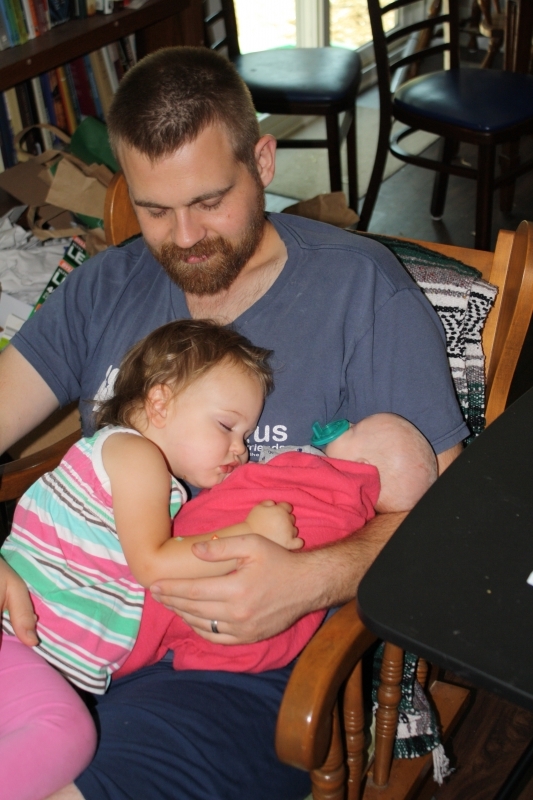
I arrived home from some much needed alone time (read: grocery shopping) to find my little ones fast asleep on their papa.
bekahcubed
Thankful Thursday: Abundance
“Had God brought us out from Egypt
And not visited them with judgment
Dayenu – We should have been content”
So begins the Dayenu, recited or sung at the annual Passover Seder.
At the end of each stanza, we recite dayenu – a word roughly translated “it would have sufficed” or “it would have been enough.” Martha Zimmerman, in her book Celebrate the Feasts (which first introduced me to the Hagaddah) translates dayenu as “We should have been content.”
This week I celebrate abundance. I could have so much less and it would have sufficed. I could have so much less and been content. Yet God has given an abundance. And I am thankful.
This week I’m thankful…
…for meals brought to my home
IF I only had the meals I’d been able to prepare and stash away in my freezer for when the baby came, dayenu. Yet God has blessed me with a dozen more freezer meals from family and friends, and with hot meals arriving at my doorstep three days a week – even now, seven weeks after Louis was born.
…for rain to water the newly planted grass
If the grass had been planted and I’d had to water it, moving sprinklers every half an hour, dayenu. Yet God blessed us with rain after two days of watering – and I’ve only had to water minimally since.
…for a second chance for my tomato plants
Had I only gotten a couple good crops of tomatoes with only a couple dozen pints canned, dayenu. Yet God sent rain that perked up my plants that had almost completely lost their leaves – and they’re flowering again.
…for multiples of pumping supplies and baby sleepers
Had I only one set of pumping supplies and a couple baby sleepers, dayenu. But God has blessed me with two sets of pumping supplies (through no act of my own), so I can relax after pumping without having to get the supplies cleaned. right. now. And God has blessed me (through the generosity of strangers) with a dozen baby sleepers, so I can wait days between loads of laundry (well, baby laundry, anyway :-P)
Such an abundance. More than I ask or think. But all these gifts are nothing compared to the ultimate abundant gift.
I can’t say it better than the Dayenu already has:
“Had God brought us into Israel
And not sent the Promised Messiah
Dayenu — We should have been contentHad God sent the Promised Messiah
But not grafted us into Israel
Dayenu — We should have been contentHad God grafted us into Israel
But not made us full heirs with Christ
Dayenu — We should have been contentBut praise be to God
He has showered blessings on us,
More than we can count:
God brought us out of Egypt
And visited judgment upon the Egyptians,
Cast down their idols
And slew their first born,
Gave us their riches
And parted the seas for us,
Let us walk the dry sea bed
And drowned our pursuers,
Kept us alive forty years in the wilderness
And fed us with manna,
Gave us the Sabbath rest
And led us to the foot of Mount Sinai
And there taught us Torah
And brought us into Israel
And there built the Temple.
He has sent His Promised Messiah
Who has atoned for all our sins.
He has grafted us into Israel and made us full heirs with Christ.”~ Rebekah Menter’s Dayenu
Thanks be to God for his indescribable gift.
The Difference a Robe Makes
The section was scheduled for 3:30 pm. Preparations began.
But first, I needed to get into a hospital gown.
So far, I had refused a hospital gown every time, opting to wear my own robe (for admission and overnights) or my own honest-to-goodness clothes (for days). Wearing my own clothes made me feel human, made me feel autonomous, made me feel myself.
Now, though, I was preparing for what was, for me, the least human, least autonomous, least ME procedure.
I was preparing for a repeat c-section.
And the nurse was waiting for me to change into a hospital gown.
I briefly considered whether it was worth it to fight.
My carefully crafted birth plan, intended for my VBAC attempt, was worthless at this point.
I had worked so hard to be reasonable in my birth plan. I gave my wishes, yes, accepting that there were circumstances under which those wouldn’t be possible or reasonable. Even as I wrote of the interventions I didn’t want, I could think of at least one scenario in which I would accept each one. My biggest request was that I be involved in every step of the process. I wasn’t going to give blanket consent to anything. I wanted to give my own consent every time a line was placed, a medication given, a monitor hooked on.
And now I’d just given consent to the one thing I’d worked so hard to avoid. A repeat c-section. With that, I’d given consent to be hooked to a machine, to be laid flat on my back, to be anesthetized. All those things I’d hoped to avoid this time around? I’d just given consent to go ahead with them.
They were necessary.
The hospital gown was not.
I decided to hold my ground.
I was going to wear my own robe.
My nurse pushed back. “I don’t want to ruin your beautiful robe,” she said. “It’s not going to make it out of the c-section in any condition to wear it again.”
“That’s fine.” I insisted. “I bought this robe for 99 cents at a used store ten years ago. It’s served me well. I don’t care if it’s ruined.”
After a couple more almost identical back and forths, she relented. I would keep my robe on.
They wheeled me into the operating room and the first thing I heard was another nurse calling out, “Somebody get this woman a gown.”
She was peeved, it seemed, that no one had bothered to properly prepare me for surgery.
But my nurse stood firm. “She doesn’t want to wear a gown. She’s quite adamant on that point.”
The anesthetist gave a sigh. “I need to access her back,” she told my nurse. “I need a sterile field to place the spinal.”
I chose to ignore how the anesthetist had been acting as if I weren’t there, weren’t my own person.
I was my own person. That was exactly what the robe represented to me at that point.
I spoke directly to the anesthetist. “Cut it.”
“But, but, your beautiful robe.”
“CUT IT.” I didn’t shout, but I was firm.
I was wearing this robe to surgery, one way or another. The robe was of no import – being able to wear it was of the highest import.
My nurse found some scissors, lifted the back of my robe. “I’m trying to cut as straight and as careful as I can. Maybe you can sew it back up after you’re done.”
I appreciated the effort, but it really wasn’t important. I’d already said that I didn’t care whether the robe was ruined. I really didn’t. The important thing was that somehow, in this birth that was so far from what I wanted, I remain me. The robe let me do that.
I’m sure it’s difficult, on the other side of the operating table, to understand why patients make what seem like such unreasonable demands.
How difficult is it to put on a hospital gown? Not at all. Why can’t she just do as she’s told, follow procedures? Doesn’t she understand how difficult it is to work around a robe that doesn’t have access to the back?
No, I didn’t understand, until you told my nurse, how valuable access to my back is for you.
But please, try to understand my side.
For you, this is just another day at work, albeit one in which you’re dealing with a difficult patient. For me, this is a day when something I’ve been working for for the past 20 months slips from my hands. This is a day when my life is in danger, my baby’s life in danger. When I’m forced to deliver my baby six weeks early via surgery.
For you, the robe is a nuisance. For me, the robe is the last thing that keeps me myself.
I’m so thankful for my nurse. Even though she didn’t understand why it was important, once she understood THAT it was important, she advocated for me.
She may never know (but I do) what a difference a robe makes.
Book Review: Stop Second Guessing Yourself: The Toddler Years by Jen Singer
Doubts seem par for the mothering course.
You see the amazing mother on Facebook who is doing enrichment activities with her children every day of the week (Debbie, I’m looking at you!) and you wonder if your children are missing out because you mostly just stay home and work around the house.
You see other children who are talking in full sentences or singing songs or correctly identifying colors at age 1 and you wonder if maybe you’re the reason your child isn’t doing those same things.
Your toddler melts down when you tell her it’s time to get ready for bed and, instead of going straight to bed (like she’s trying to do), you go to the bathroom to brush her teeth (despite that having been your bedtime routine for months.) And when she melts down, you wonder if maybe you’re doing this mothering thing wrong.
A book called Stop Second Guessing Yourself: The Toddler Years sounds like just the thing. You need something to help you develop confidence in your own mothering so that you can relax and just get on with the mothering instead of constantly, well, second-guessing yourself.
If you pick up Jen Singer’s book hoping to get that, though, you’ll be disappointed. Rather than a confidence-inducing book for mothers, this is a collection of tips for a variety of toddler parenting situations. For the most part, it’s Jen’s own tips – although it does include some blurbs in sidebar form from Singer’s “MommaSaid.net” community. For the most part, the tips were in the relaxed category – hacks to get your kids to do what you want (without necessarily parenting their hearts) or to cope with the inevitable frustrations of toddlerhood.
Okay, I suppose, if that’s what you want. For my part, I prefer my “tip” books to either be
- from an experienced mother whose outcomes are known (Homeschooling mom of a half dozen who has well-mannered teenagers? I’d love to hear her tips of mothering)
- a compilation of research-proven methods (a la Nurture Shock)
- a compilation of tips from hundreds of different moms (because out of hundreds of moms, one of them might have circumstances and/or personalities that mesh with yours and your child’s)
or
So I wasn’t a huge fan of this book. Your results may vary.
Stay tuned, though, if you’re interested in hearing my advice for how to stop second guessing yourself as a mother.
Rating:2 stars
Category: Parenting Advice
Synopsis: One mother’s advice on how to cope with the toddler years. Emphasis on coping (versus parenting).
Recommendation: Not a fan, don’t recommend.
Baby Hacks: Tummy Time and Cloth Diapering
We all know by now that the only thing better than sustained tummy time is frequent tummy time. But who has time and energy for that?
It’s enough work to feed (breastfeeding and pumping and bottle warming, oh my!) and diaper (change, rinse, wash, no-time-to-fold, and repeat) and clothe (spit-up, blow-outs, and big-sister-drool) your baby without having to remember to put baby on the floor on his tummy multiple times a day (supervised – don’t forget that tummy time should ALWAYS be supervised [Sarcasm alert].)
But you can’t do tummy time when baby is hungry (read: half of the day) because then by the time you get around to feeding he’ll be too frustrated to latch well. And you can’t do tummy time right after feeding (read: the other half of the day) because then he’ll spit up everything you just fed him (anyone else need to keep their babies upright practically until the next feeding to avoid the dreaded mouth-nose-gasping-for-air-and-crying-like-he’s-dying-whenever-he-does-get-a-breath-spit-up?)
Getting frequent tummy time in is almost impossible.
Or is it?
Our solution is to turn unavoidable “can’t be on mama” time into tummy time.
I use a washable throw rug in our bathroom (actually, it’s two vintage bath towels sewn together to double thickness). After diapering, when I’m rinsing those cloth diapers, I lay Louis on the rug with a clean burp rag under his head.
Voila.
At least 4 or 5 (if not 8 or 9) little tummy times every day.
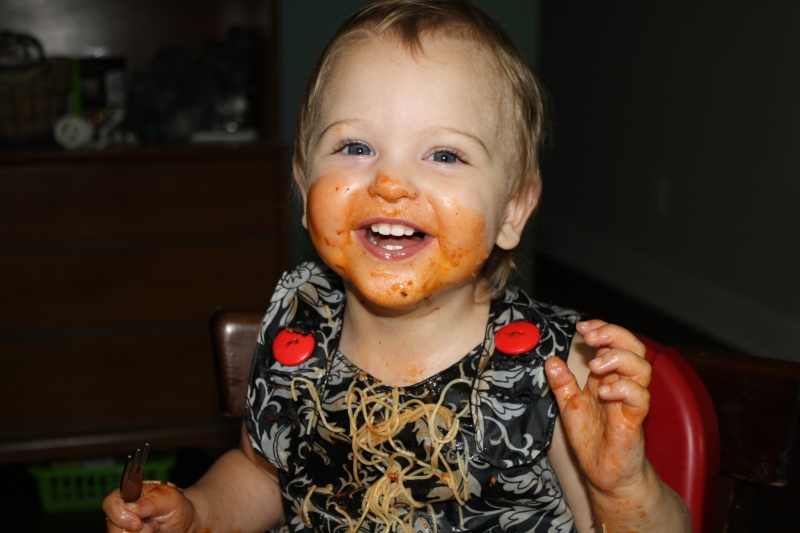
Snapshot: Spaghetti Face
At what point does spaghetti face stop being cute?
Some point after this, that’s for sure.
Skydiving, C-sections, and Control
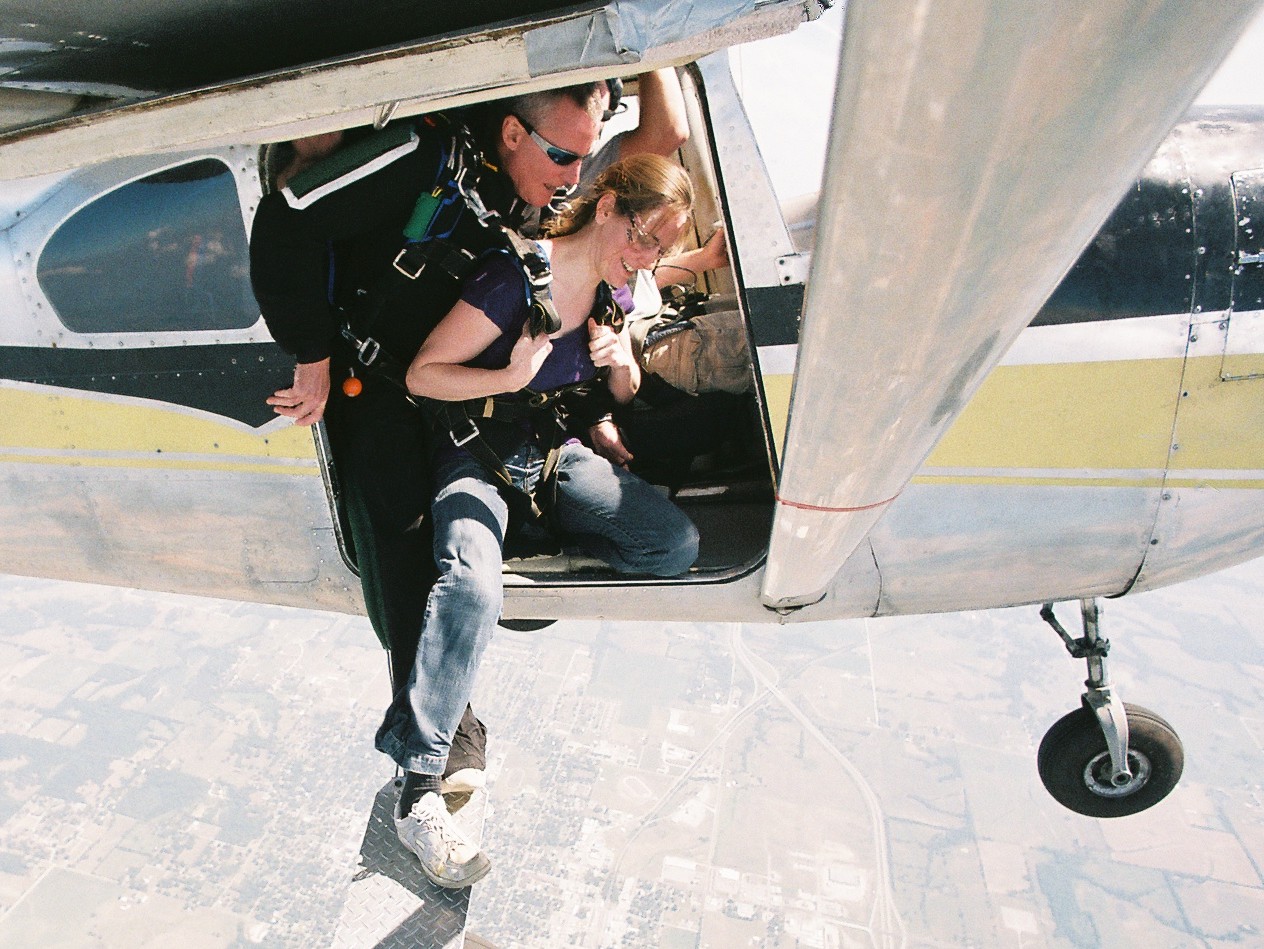
A little over five years ago, I jumped out of an airplane.
It’s never been something I particularly wanted to do – adrenaline is not my thing. But a couple of friends (who didn’t know each other but both knew me) wanted to go – and one of them had scheduled a dive. So I signed up too – and brought my other friend along.

I was nervous leading up to it, but I wasn’t scared. We’d be diving tandem – hooked to an instructor who would do all the hard work. We could just relax and enjoy the ride. Which is exactly what I did.
A little over a month ago, I had a repeat c-section.
It’s never been something I particularly wanted to do – in fact, I did everything in my power to avoid it. I exercised faithfully, I ate like an angel, I took a baby aspirin. When Louis wasn’t in position, I contorted myself into funny positions in an effort to get him head down. When that didn’t work, I had our maternal-fetal specialist do an external version – trying to manually reposition Louis using his hands on the outside of my belly. When that didn’t work, I had no choice.
We scheduled a c-section for 3:30.
I wasn’t particularly nervous, or particularly scared. I’d done this before and made it already.
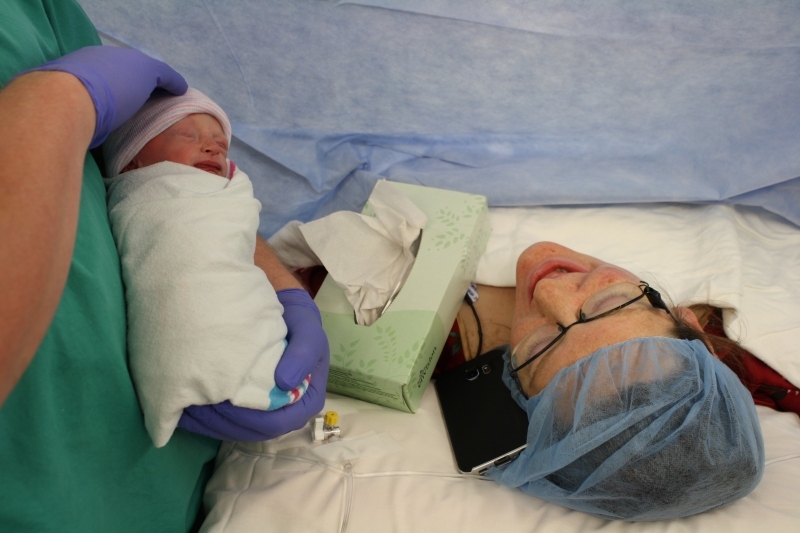
But then the spinal anesthesia took effect and the anesthesiologist asked me to wiggle my toes and lift my legs.
I couldn’t.
It was exactly what was supposed to happen. I wasn’t supposed to be in control of my lower body. If I were, I would be able to feel as they cut into my abdomen and lifted my baby out. I knew that.
But that didn’t keep me from freaking out.
I had lost control.
As I told my skydiving story, I wrote of the one fearful moment – the moment when my instructor loosened the straps between us so I wasn’t in direct contact with his body.
“He told me he would be loosening the connections that held us. I’d drop a bit lower, so inches would separate our bodies.
Now, here, I felt a glimmer of fear. I knew it would be safe, I knew I’d still be attached. But it wouldn’t be the same. Once he’d lowered me, I wouldn’t be able to feel his presence. Would I be able to make it without that sure sensory feedback reminding me that I was safe?
I would choose to trust, I told myself–and so I did.”
I had the same choice to make when my legs no longer followed my commands.
I wasn’t in control, didn’t have the sensory feedback telling me that my body was there, that my baby was there. I had to choose to trust that God was there and that my body still obeyed His commands.
I repeated the affirmation over and over in my head as I willfully relaxed the muscles I could feel:
“I and my baby are fearfully and wonderfully made.
God sees us and knows us.”
I’d chosen my relaxation phrases carefully, wanting to fix my mind on unchanging truth rather than fickle probabilities.
No “I trust my body” or “My body knows how to birth” for me. I knew that my body could fail. I knew that, while most bodies know how to birth, not all do.
I had determined beforehand to fix my trust in God instead of in my body.
But when I couldn’t control my legs?
I had to determine it all again.
My relaxation music, playing from the phone beside my ear, reminded me of the truth:
“Be still my soul, the Lord is at thy side
With patience bear the cross of grief or pain
Leave to thy God to order and provide
Through every change He faithful will remain
Be still my soul, thy best, thy heav’nly Friend
Through thorny ways, leads to a joyful end.”
I chose to trust when I lost control – and God was more than capable to guide and sustain.
I know y’all are just dying to revisit my skydiving story now – so I’ll make it easy for you. Part 1: Geared Up, Part 2: Missed Opportunities, or I’ve always wanted to fly, Part 3: The Jump, and Part 4: Safely Falling.
Thankful Thursday: Milestones
It seems this week has been a milestone week. Life is resuming after the recent crazy pause. So many good changes, so many wonderful firsts.
This week I’m thankful…
…for a switch to demand feedings
Unlike Tirzah Mae, Louis did not come home from the hospital giving clear hunger cues. Instead, he seemed perfectly content to just sleep until we woke him up to eat. As a result, I maintained the hospital schedule of every 3 hour feedings. And let me tell you, scheduled feedings are exhausting. But over the last week, Louis has started giving better and better cues. This weekend, we switched to demand feedings – which gives me a lot more flexibility with my own schedule and Tirzah Mae’s.
…for 6 pounds at 6 weeks
I weighed Louis on a whim, the day before he turned 6 weeks old. Actually, I weighed Louis three times the day before he turned 6 weeks old. I couldn’t believe my eyes, which is why I kept reweighing him. Our little boy is getting big (he’s ready to move out of “preemie” sized diapers to “newborn”!)
…for restrictions lifted
Since Louis is six weeks old now, that means I’m six weeks out from my c-section – and am officially okay to resume normal activities. Which means I can lift Tirzah Mae onto the changing table. Game changer, people.
…for meeting with small group
I haven’t met with our small group from church since we met in my hospital room the day before we had Louis. But this week, our group brought snacks and gifts and met at our house. Each member of our group has been so supportive during my hospitalization and this postpartum period – taking care of Tirzah Mae, bringing meals, asking how I was doing. But it was delightful to be back with everyone all together again.
…for an outing
I took Tirzah Mae and Louis to my 6 week appointment, but otherwise haven’t taken the both of them out of the house without Daniel’s help. Until this Tuesday. It was time for Kansas’s primary elections and I had items due at the library, so we suited up and took off. It wasn’t easy, but I’m glad to know that I can do it!
…for grass
After almost two months of waiting for our grass to be planted, the fellow with the seed drill finally came out on Tuesday and planted our grass – which means I’m watering like crazy to keep the almost 30,000 square feet we just planted wet in this hot Kansas weather. But it’s planted! No more waiting. Now we’re just working, working, working. (I’m better at working than at waiting.)
As I write up my thankfuls this week, I’m reminded of Ecclesiastes (sung to Pete Seeger’s tune and echoing with The Byrds’s voices in my head):
“For everything there is a season, and a time for every matter under heaven:
a time to be born, and a time to die;
a time to plant, and a time to pluck up what is planted;
a time to kill, and a time to heal;
a time to break down, and a time to build up;
a time to weep, and a time to laugh;
a time to mourn, and a time to dance;
a time to cast away stones, and a time to gather stones together;
a time to embrace, and a time to refrain from embracing;
a time to seek, and a time to lose;
a time to keep, and a time to cast away;
a time to tear, and a time to sew;
a time to keep silence, and a time to speak;
a time to love, and a time to hate;
a time for war, and a time for peace.”
~Ecclesiastes 3:1-8 (ESV)
I am thankful for these seasons that God has given. But most of all, I am thankful that, in every season, God is faithful. He holds us in His arms in the stormy seasons and in the calm. He is forever worthy of praise.
It’s a Boy!
Even though I’m not into routine ultrasounds in pregnancy, we’ve ended up with plenty of ultrasounds for both our children (let’s just say that there hasn’t been anything routine about how my pregnancies have progressed!)
With each of the ultrasounds, I’ve been careful to inform the ultrasound tech that we aren’t interested in knowing baby’s sex, so could they please keep it to themselves.
I didn’t think to tell our maternal-fetal specialist when he rolled in the ultrasound to check where baby was lying to determine our course of action the day my condition declined such that delivery was indicated.
Doctor W moved the wand across my belly, confirming that baby was still lying in the transverse position he’d so favored all throughout the pregnancy.
Doctor W explained what I already knew. We couldn’t deliver a transverse baby vaginally. I listened patiently as he explained the different ways a baby might be lying and the relative risks of vaginal delivery with frank breech, footling breech, transverse (the most dangerous is transverse with belly down, since the umbilical cord would almost certainly be delivered first and then be compressed as the rest of baby tried to make his way out.)
And once Doctor W was done explaining, I said my piece. I still wanted that VBAC. I wanted to try everything we could. Yes, I wanted the external version we’d discussed.
Doctor W’s hands moved across my abdomen. He pushed and prodded. He pulled out the wand to see what he’d done. He pushed a little more. He grabbed the wand again.
He’d succeeded at getting baby head down.
He narrated what we were seeing on the ultrasound screen – “There’s the head”. Down in my pelvis.
Just a bit above the head. “And there are his little boy parts. And there are his feet down with his head.”
I looked at Daniel as we acknowledged what we’d just learned.
“Louis,” I said his name in my head, acknowledging our son.
A while later, my nurse was working on her charting and Daniel was off doing something, collecting Tirzah Mae perhaps.
“Do you have any sense of whether the baby’s a boy or a girl?” the nurse asked.
“Well, it doesn’t really matter whether I had a sense or not – Doctor W told us,” I replied.
“Ah shoot,” she said. “I’d hoped you hadn’t noticed.”
I assured her that it was fine, really
And it was.
But now I know, if I really want to wait until delivery to find out, best to let my doctor know in advance too!
Animal Books: Farmyard Sounds
Since moving to Prairie Elms, Tirzah Mae has been enamored with our neighbors’ animals. First it was the dogs (Woof, woof!) belonging to our neighbor to the south. Then it was the chickens (Cluck, cluck!) belonging to our neighbor to the north.
Not one to waste an opportunity to check books out of the library, I rushed off to find as many farm animal books as I could – a great many of which were centered around the sounds farm animals make.

This is a record of what we read, and what we thought of what we read, ordered from favorite to least favorite (give or take.)
Does a Cow Say Boo? by Judy Hindley
Tirzah Mae didn’t really know her animal sounds yet, so I figured the silliness of this book – asking if a variety of farmyard animals say “Boo” – would be over her head. Just goes to show that mama ISN’T always right. While she may not know ALL the animals sounds, she DOES know that neither a cow nor a pigeon nor a goat says “Boo”. The rollicking rhyme scheme and continued questioning is just exactly what it takes to keep Tirzah Mae engaged for the entire book. And when we get to the end, when Tirzah Mae covers her face with her hands and lets out her own “Boo!”? It’s perfect. We highly recommend this book!
This Little Chick by John Lawrence
A little chick goes to visit a variety of different animals – and what do they hear her say? Not “cheep, cheep” as I might have expected. Instead, she speaks to each group of animals in their own language. But when she gets home to her mama at night, she’s full of all sorts of cheeps and oinks and quacks and moos – telling her mama all about her day. I thought this book was just darling.
Barnyard Banter by Denise Fleming
This one isn’t entirely animal sounds, since it includes “Pigs in the wallow. Muck, muck, muck.” – but it’s no less delightful for the occasional non-sound inclusion. The text follows the basic formula seen above (“[Animal] in the [location]. [Sound], [sound], [sound].”) with rhyming pairs of sounds (“muck” rhymed with “cluck”). Fleming’s illustrations are handmade paper poured into molds in the shapes of the animals (I want to try that!) Children will enjoy finding the goose hidden in each double-page spread.
All Kinds of Kisses by Nancy Tafuri
In this board book, a selection of baby animals feel that their mothers’ kisses are the best: “Little Piglet loves Oink kisses. Little Lamb loves Baaa kisses.” Not all the animals are farmyard animals, but most of the farmyard ones are represented. This is also a good book for learning the names of the “baby versions” of animals – ducklings, chicks, kids, etc. In a day and age where cartoonish illustrations are all the rage, the more careful but not quite photo-realistic illustrations are a real plus for me.
Honk, Honk! Baa, Baa! by Petr Horacek
A board book with very simple text beginning with “Hee-Haw, Hee-Haw says the donkey.” Each physical page of the book is shorter than the one before, and the left-hand side of each spread ends up forming the figure of a cow on the very last page. It’s a clever little illustrative technique, and we thoroughly enjoyed it.
Bob by Tracey Campbell Pearson
Bob, the rooster, only clucks until the coop cat (since when does a chicken coop have a cat?) informs him that he needs to learn how to crow so he can wake the girls up in the morning. Bob sets out to find another rooster to teach him to crow, but finds plenty of other animals along the way, each of whom teach him their own sounds. The additional sounds come in handy when a fox tries to get into the henhouse! I’d really like to like this story. The plot is fun, as are the illustrations. But I have a very hard time getting over the initial technical error: Pearson has the cat tell Bob that he isn’t a chicken, he’s a rooster – which is why he should crow instead of cluck. Did you catch that? Roosters are chickens. A male chicken is a rooster, a female chicken a hen. Bob oughtn’t cluck like a hen. I rather hate that this is a deal-breaker for me, but it is.
Pete the Cat: Old MacDonald Had a Farm by James Dean
The lyrics to “Old MacDonald had a Farm”, sung by Pete the Cat himself (apparently he’s a thing?) Complete with really hokey illustrations. I’ll pass.
Everywhere a Moo, Moo, a Scholastic “Rookie Toddler” book
Abbreviated lyrics to “Old MacDonald had a Farm” (sans the “E-I-E-I-O” and the titular preamble) superimposed over photographs of various farm animals. Except that the farm animals are photoshopped onto the same unrealistically green field below the same generic sky with an equally photoshopped barn or farmhouse on the horizon. This could have been a book with really nice photos of animals IN THEIR ENVIRONMENT, but it isn’t.