Lazy Parenting: Help with Housework

“Training your child to help around the house will make the job harder now; but it’ll pay off down the road.”

It’s such common advice, it’s become something of a parenting axiom.

The implication is that lazy parents avoid doing the hard work of parenting – that is, training their children in the way they should go – and end up with more pain and work in the future when their children haven’t been trained to do x or y (or to have z or a character traits).

The axiom tells parents to do the hard work of including their children in housework now so that they can offload some of the housework to their children later. Or, less cynically, parents should do the hard work of including their children in housework now so that their children can be responsible for themselves as they grow into adulthood.

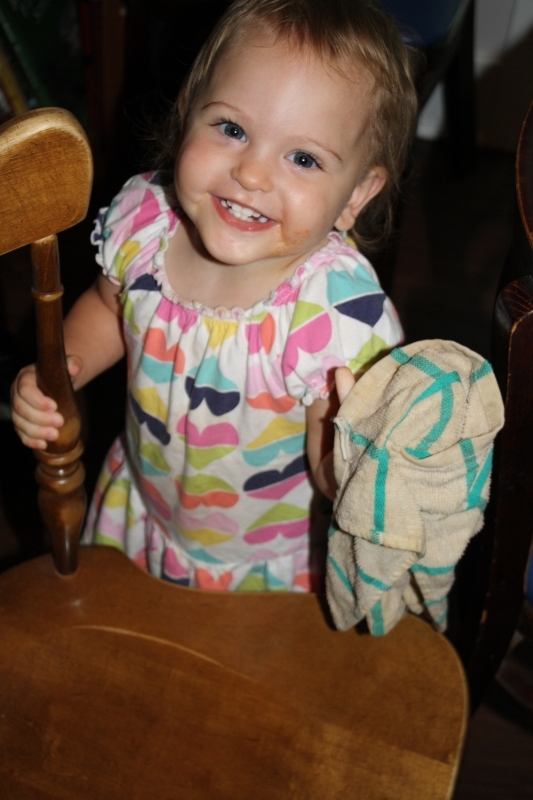
Tirzah Mae helps with wiping chairs

The training task of parenthood is often hard – which is why people find it necessary to remind parents to do the hard work now that will pay off down the road.

But I contend that, at least for toddlers, involving your children in housework does NOT make the job harder now. Involving your toddler in housework can pay off in the here and now – not just down the road.

Now, you are probably thinking “Have you seen how much longer it takes to [insert chore here] when my toddler ‘helps’?”

Yes, I get what you’re saying. My toddler tends to smear food around the chairs when she wipes them, which means I have to re-wipe them. My toddler drops the dustpan before she’s emptied it, which means I have to re-sweep a section of the floor. My toddler puts things in the wrong places when she’s picking up, which means I have to re-sort everything multiple times.

Doing a task with my toddler takes 1.5 to 2 times longer than doing a task myself.

But have YOU seen how much extra work my toddler can create when I let her play independently (not right next to me) while I’m cleaning up?

While I’m saving five minutes by cleaning up after lunch without her help, she’s creating ten minutes worth of work in the living room, bathroom, and bedroom.

The reality is, involving your child in your work right now will have benefits both in the future and in the present.

So, if you want to be a really lazy parent, involve your child in housework now.


Snapshot: Happy Due Date

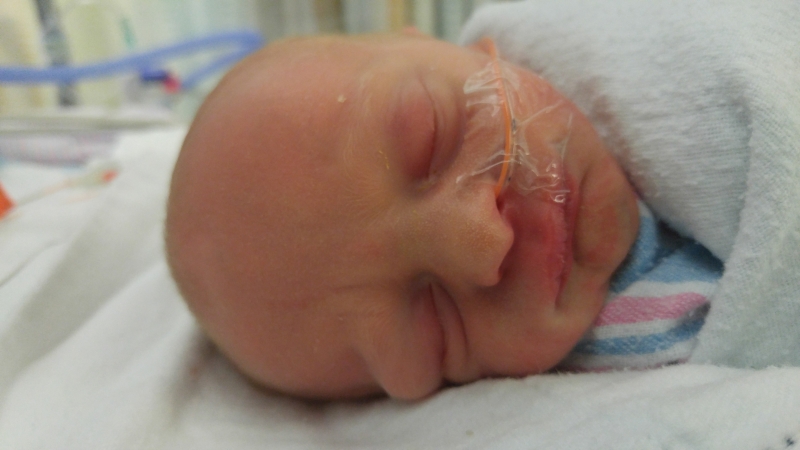
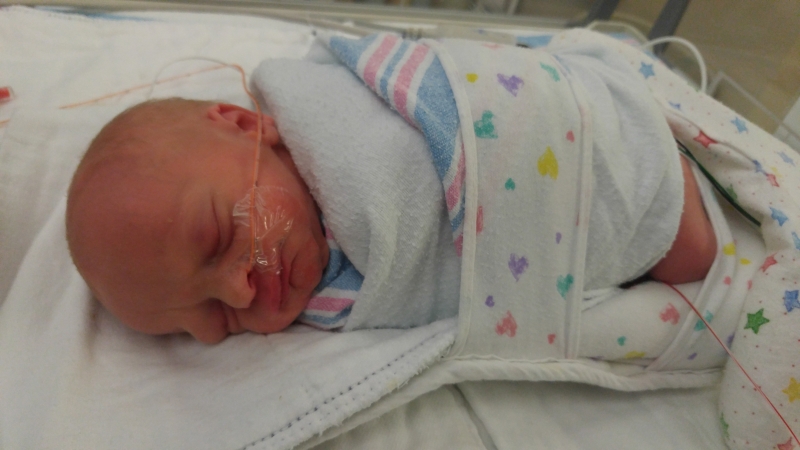
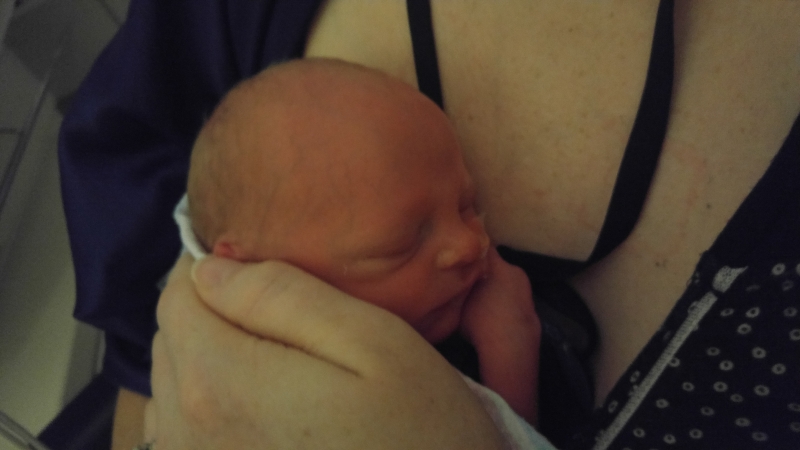
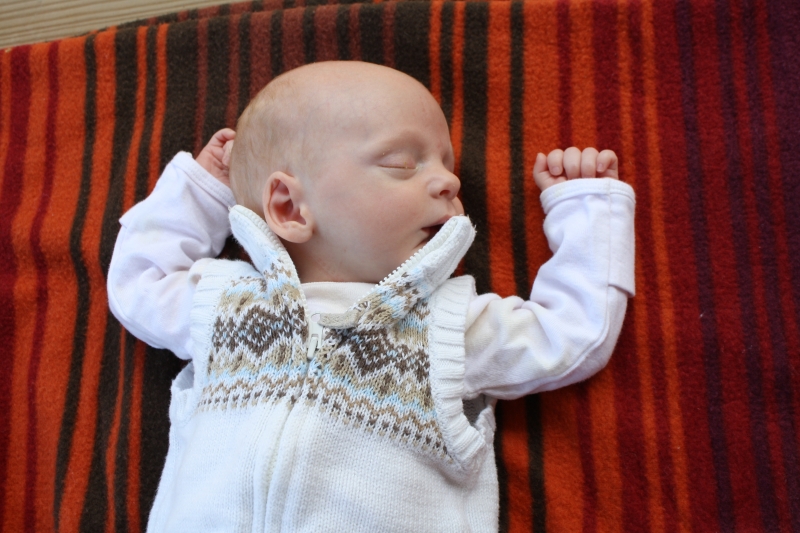
If Louis had arrived on his “expected date of delivery”, he’d have arrived today.

As it is, he’s two days shy of six weeks old.

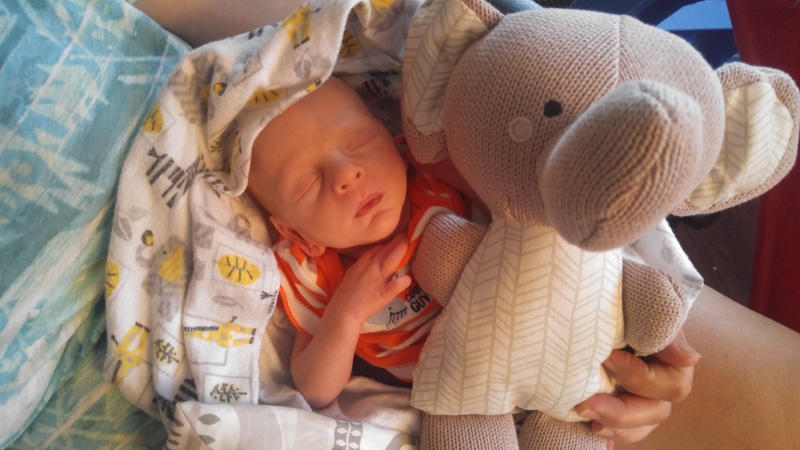
Louis and his elephant

While I was in the hospital, Daniel read an article that suggested that people who are chronically late are optimists. It makes sense. Optimists assume they can make it to their location more quickly than they can. Optimists fail to take into account traffic, children, and losing their keys. And, if they’re optimists in the same sense Daniel and I are, they assume they can get just one more task (and another and another) done before they leave.

Like I said, the article makes sense.

I am an optimist – and I was two weeks late to my own birthday.

But if being late is a sign of optimism, Daniel and I are raising a couple of pessimists.

Either way, we’re glad to have our early birds.

Happy Due Date, dear Louis.


In which we have…

a baby boy.

20160622_161806

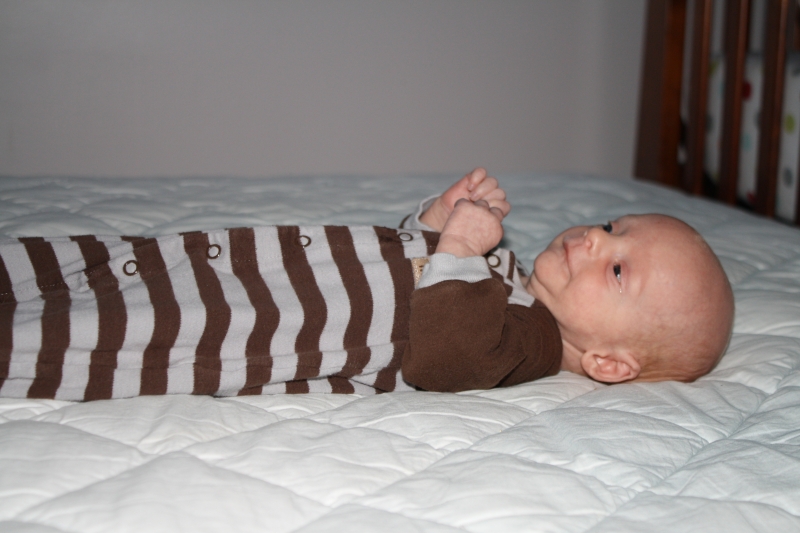
I am pleased to introduce Louis Anthony Fyodor, born a little over a week ago on June 21.

20160622_161604

Louis experienced some growth restriction and was just 6 oz bigger than his sister at birth, despite having an additional 2 weeks in the womb. Nevertheless, he has been growing well. He’s already passed his birthweight (3 lbs, 11 oz) and is getting full feedings of his mother’s breastmilk by tube – with a few good breastfeeding sessions sprinkled in.

20160623_041050

We are so glad to have him.


He will deliver thee

I’ve been slowly reading through C.H. Spurgeon’s Spurgeon on Prayer and Spiritual Warfare after my morning times in the word – and this week, his text has been Psalm 50:15 “Call upon me in the day of trouble: I will deliver thee.”

The morning before we were admitted to the hospital, I read the following words:

“I write this with all reverence: God Himself cannot deliver a person who is not in trouble… The point is, my reader, your adversity may prove your advantage by offering occasion for the display of divine grace… When you are in adversity, then call upon God, and you will experience a deliverance that will be a richer and sweeter experience for your soul than if you had never known trouble.”

I did not know the trouble that would come – but I knew the trouble I had experienced in the past, and I knew that it was indeed an occasion for the display of divine grace. While I would never choose adversity for myself (would any of us?), I know indeed that God’s deliverance does prove a richer and sweeter experience for my soul than had I never known trouble.

I remembered those words as we entered the hospital with a pregnancy in trouble again, rejoicing that my God is present, inviting me to call upon Him, willing to deliver me.

Yesterday morning Spurgeon reminded me of God’s promise: He will deliver me.

“Hear Him say, ‘I will deliver thee,’ and ask no more questions.

I do not suppose that Daniel knew how God would deliver him out of the den of lions. I do not suppose that Joseph knew how he would be delivered out of prison when his master’s wife had slandered his character so shamefully. I do not suppose that these ancient believers even dreamed the way of the Lord’s deliverance. They just left themselves in God’s hands. They rested on God and He delivered them in the best possible manner. He will do the same for you. Simply call upon Him, and then ‘stand still, and see the salvation of the Lord’ (Exod. 14:13)

…God may likewise subject us to many trials. Yet if He says ‘I will deliver thee,’ you can be sure that He will keep His word.”

And that is the promise in which I can trust – not that I know God’s means of deliverance or the timing of his deliverance or any such details. In fact, I am reminded of Hebrews 11:36-38

“They were stoned, they were sawn in two, they were killed with the sword. They went in skins of sheep and goats, destitute, afflicted, mistreated – of whome the world was not worthy – wandering about in deserts and mountains, and in dens and caves of the earth.” (ESV)

In this life, these saints, commended for their faith, did not receive what was promised.

But in the life to come?

Deliverance.

Today, that great cloud of witnesses – the ones who received their deliverance in this life and the ones who received their deliverance in the next – urge me to look to Jesus, the truest testimony that God will deliver me.

For

“He who did not spare his own Son but gave him up for us all, how will he not also with him graciously give us all things?”

Romans 8:32 (ESV)

He will deliver thee.


Preeclampsia, take 2

I was prepared with all sorts of questions for my midwife – questions about preparing my home for our planned home birth. I’ve never gotten this far in pregnancy before.

But the first step at the midwife’s office, before I even talk to the midwife, is to take my blood pressure and weight and temperature in the bathroom – and to pee in a cup. I dipped my urine, counted to sixty, and checked the dipstick.

A bright green strip at the bottom of the stick told me what I hadn’t at all expected to see. I was spilling protein again, majorly.

I had preeclampsia, again.

My questions about home birth went out the window. I knew that was no longer an option.

We had our visit. The midwife confirmed high blood pressure and protein in the urine. She called our OB and we arranged for another hospitalization.

We went home to pack our bags and then on to the hospital.

With Tirzah Mae, we entered the hospital at 30 weeks, 6 days, already with severe preeclampsia (defined by very high blood pressures and/or a range of other abnormal lab values.) We didn’t even fill out paperwork before I was receiving IV magnesium to prevent seizures. I had a shot of steroids to help mature Tirzah Mae’s lungs. The first 24 hours of our hospitalization was intense, with monitors going off all over, with lines into my veins and around my belly and all over everywhere. Tirzah Mae was born eight days later, at 32 weeks, 1 day.

With this baby, we entered the hospital yesterday, at 33 weeks, 4 days. I had preeclampsia – have preeclampsia – but without severe features at this point. I’ve gotten a shot of steroids, but no magnesium. I’ve been on monitors here and there – but have also spent hours on end just lying in bed or sitting typing or reading.

We just finished talking with the maternal-fetal specialist after lunch.

We are on hospitalized bed rest until this baby is born. At the very latest, we will go to 37 weeks (considered full term) – July 10. More likely, I will develop severe features that necessitate immediate delivery. Until then, we wait.

As we wait, we pray. If you will, please pray with us:

  • …that God would be glorified through the events of this pregnancy, as well as through our thoughts, words, and attitudes
  • …that God would grant us patience and trust with the process of bedrest, especially with a toddler around
  • …that God would grant the doctors wisdom to advise us well and us the wisdom to weigh their advice carefully and make clear-headed decisions
  • …that we would have the help we need (and be able to coordinate the help we need) to care for Tirzah Mae throughout my and/or baby’s hospitalization
  • …that we could have conversation that is full of grace and seasoned with salt as we interact with the dozens of medical staff we encounter daily
  • …that this baby could stay in the womb as long as possible
  • …that baby would flip to a head-down position and stay there in time for a vaginal delivery

But most of all, pray that God would be seen as glorious. For He truly is glorious and worthy of praise.


Note to Self: Distracted Parenting

Have you ever noticed, Rebekah, how distracted you can be?

You get up to do one thing and find a half dozen other things to do along the way, such that you sometimes forget what you were aiming to do in the first place.

Sometimes this isn’t a problem.

Many times this isn’t a problem.

Even if you forget your original intent, it’s rarely urgent and will usually get done eventually – and the half dozen little other things need to be done sometime. Now is as good a time as any.

But there are times when this distraction is a problem.

“Come here, Tirzah Mae,” you say. “We’re going to change your diaper.”

And then you notice the toy on the floor that belongs in the nursery and the socks that belong in the hamper in your bedroom. You pick them up and take them to their appropriate spots.

Returning to the living room, you repeat your plea: “Come here, Tirzah Mae. We’re going to change your diaper.”

But on the way into the bathroom to wet her wipes you realize your water bottle is empty so you grab it to refill it.

And so on and so forth.

Tirzah Mae learns that when Mama says “Come here, Tirzah Mae”, Mama really doesn’t mean it. When Mama says “We’re going to change your diaper”, she doesn’t mean right now.

She learns to ignore your directions until you come and get her. She learns that Mama isn’t serious about changing the diaper until Mama picks her up and carries her off to the nursery.

Your distraction is training her to ignore you.

And that is NOT good.

So try this, Rebekah.

Stand by the bathroom door. “Come here, Tirzah Mae,” you should say. “Mama is going to change your diaper.”

Stay there, holding your hand open for her to grab hold of it, repeating yourself if necessary until she obeys. DO NOT BE DISTRACTED.

When Tirzah Mae comes, you can wet the wipes in the bathroom sink and then the two of you will walk, hand in hand to the nursery, where you will change her diaper.

If you notice something that needs to be done while you’re standing by the door waiting for Tirzah Mae to obey, make a mental note but don’t do anything else.

Your primary job is teaching your daughter, not ensuring that the toys and socks are put away and the water bottle filled. You can do those things after you take care of the first thing – training your daughter to be obedient when you give her instructions.

Distraction in housekeeping is one thing. Distraction in parenting is quite another. Keep your eyes on the goal, Rebekah – train your daughter well.


Book Review: Beautiful Babies by Kristen Michaelis

This is basically a defense of the Weston A. Price diet for pregnancy and early childhood. The nutrition advice ranges from odd to downright dangerous. The rationale for the advice is nostalgia and cherry-picked scientific studies. And Michaelis (like a lot of self-taught nutritionists) despises me and my ilk (that is, people with actual training in nutrition.)

A review in which I annoy you by summarizing each chapter of the book using the words “In which…” Don’t say I didn’t warn you.

Chapter 1
In which Michealis reveals that she has no credentials that give her any right to be talking about nutrition – apart from watching food-fright documentaries and reading people like Michael Pollan, Joel Salatin, and Sally Fallon (all of whom are interesting to read, but hardly bastions of science-based nutrition recommendations.)

Chapter 2
In which Michaelis explains that nutrition matters (*gasp*). Except don’t pay any attention to those nasty reductionist dietitians with their advice meant to avoid specific proven risks. No, you should jump on the fetal origins hypothesis (which is a reasonable and scientifically supported hypothesis that a mother’s environment during pregnancy affects her child well into adulthood, but which currently has little evidence of sufficient quality to use to make broad-ranging dietary recommendations) which means you should eat a primitive diet (what? Okay, fetal origins really doesn’t suggest need for a Weston Price style diet – but that doesn’t stop Michaelis from using the one to support the other.)

Chapter 3
In which Michaelis tells you what to avoid: MSG, corn, GMOs, vegetable oils, industrial meats/dairy/eggs, refined sweeteners, and modern gardening/farming practices. Michaelis’ rationale is a mixture of misguided nostalgia and alarmist pseudoscience. Oh, okay. She occasionally includes a bit of real science – and then completely screws up the application. For example, she recommends avoiding corn (and corn-fed animals) because corn oil has a much higher than recommended Omega 6 to Omega 3 fatty acid ratio. It is true that corn oil has a high Omega 6 to Omega 3 fatty acid ratio – and that almost all Americans could stand to eat more Omega 3s relative to Omega 6s. But…the list of corn ingredients Michaelis wants you to avoid? Only 3 of the 21 corn-derived ingredients contains fat. So… unless she’s got another good reason to avoid corn products, she’s just being silly.

Chapter 4
In which Michaelis tells you what TO eat: bone broth, traditional fats and oils, wild and pastured animal foods, natural sweeteners, and “properly prepared” grains. In general, there’s nothing wrong with these items, even if the emphasis is off. Good advice: choose butter or olive oil over partially hydrogenated margarines or shortenings. Advice with some nutritional support, although not enough to warrant broad-based recommendations: wild or pastured animals have a more favorable fatty-acid profile and soaked grains have better nutrient bioavailability (but a diet rich in fruits, vegetables, and whole grains – even the unsoaked kind – is unlikely to be deficient in those micronutrients.) Completely spurious advice? bone broth and natural sweeteners. As far as sweeteners go, your body doesn’t care whether it’s “natural” or not – if it’s sugar (and that includes honey, maple syrup, sucanat, sorghum syrup, coconut palm sugar, and others), the body treats it as sugar. If it isn’t sugar (stevia and “artificial sweeteners”), the body processes it as whatever it is – whether a sugar alcohol, an indigestible starch or whatever. Of course, the real travesty of this chapter is what Michaelis omits. Please note the two food groups she doesn’t bother to mention in any degree: fruits and vegetables. Whatever the controversies nutrition science may have, there is one thing about which every science-based dietitian and nutrition researcher can agree – the general US population should be eating more fruits and vegetables.

Chapter 5
In which Michaelis helps you learn what to eat to poop well. Because your gut is your second brain. Sigh. I don’t even know where to start with this. Let’s just say that some people do have digestive issues that compromise their overall health. Most people don’t. Probiotics are good – but their benefits are frequently overstated. The most important thing you can do to have a healthy digestive system is to get sufficient fiber and water – like, say, from fruits and vegetables (which don’t necessarily need to be lactofermented, thank goodness!)

Chapter 6
In which Michaelis tells you what to eat to be fertile and to have a healthy pregnancy. The “fertility” section is more of Price’s general theories combined with more recent research from the Nurse’s Health Study. Want to hear what the science actually says? Read the highly readable The Fertility Diet by Jorge Chavarro, Patrick J. Skerrett, and Walter Willett – and keep in mind that even a well-executed study like the Nurse’s Healthy Study can’t prove causation.

The “pregnancy” section is where it gets exciting, because Michaelis has somehow figured out the cause of both morning sickness and preeclampsia, two relatively common pregnancy conditions that researchers have been puzzling over for years! (Can you sense the sarcasm?) Of course, the problem is nutrition. And the solution is a variation of the Brewer’s Diet, a favorite diet of natural childbirth advocates everywhere. Problem with the Brewer diet? Well… there are several. While the Brewer diet apparently had great success for Dr. Brewer’s (low-income, minority, teenage) patients in the 60s and 70s, nutrition science has failed to find links between the components of Brewer’s diet and healthy pregnancy. While protein deficiency may have played some role in increasing risk in Brewer’s patients, studies of moderate vs. high protein intake in pregnant women have failed to show any protective effect of increased protein intake. While Brewer’s teenaged patients may have needed the 3000 calories per day that his diet recommends (because they were still developing themselves, in addition to supporting a growing baby in their wombs), research clearly links excess weight gain during pregnancy to development of preeclampsia (and we’re talking weight gain even before those preeclamptic women started putting on all that fluid.) Additionally, while Brewer’s patients may have had nutrient deficiencies that made intake of large quantities of liver helpful and not dangerous, those of us who are adequately nourished in the first place should not be overloading our diet with items high in retinol (preformed Vitamin A), which is highly toxic to a developing baby. We should instead be getting our Vitamin A in the form of carotenoids (from vegetable sources) which our body converts to Vitamin A as needed, without the toxicity to the developing baby.

It’d be nice if we knew the exact cause of preeclampsia and could avoid it at all costs. But the reality is that we don’t know what causes preeclampsia. We know risk factors – first pregnancy with a new partner, high or low maternal age, overweight or obesity prior to pregnancy, excess weight gain during pregnancy. But none of those are a guarantee of preeclampsia – and the absence of those are not a guarantee against preeclampsia. As nice as it would be to just put ourselves on a diet for nine months to keep preeclampsia at bay, the truth is that there is very little evidence that dietary interventions make any difference in the development of preeclampsia. And if there is any promising research along that vein at present? It suggests that maybe increasing dietary fiber might make a difference. What, you mean like eating more fruits and vegetables? Oh. My. Word. That’s pretty much the most preposterous thing I’ve ever heard suggested (Sarcasm, again, in case you didn’t catch it.)

Chapter 7
In which Michaelis reminds you that everything those nasty government-shill dietitians tell you is wrong. (I have a feeling I’m becoming less charitable and more cynical as this book goes on.) But this chapter rehashes that cholesterol and saturated fat aren’t bad for you (dietitian me: it’s complicated). Michaelis also tells you that you don’t need an iron supplement (dietitian me: anyone who is routinely recommending iron supplementation to pregnant women without confirmation of anemia is acting outside the bounds of science-based practice anyway). According to Michaelis, sushi won’t give you listeria but raw cheese might (dietitian me: both sushi and raw cheese are relatively more risky than cooked fish and hard cheeses. In both cases the odds of problems are low but the problem – miscarriage or stillbirth – could be severe if it happens. Mothers should be aware of the risks and make their decisions based on information.) And finally, the occasional glass of red wine won’t harm your baby (dietitian me: probably not, but excess drinking can… and it’s worthwhile for you to find better coping mechanisms than drinking.)

Chapter 8
In which Michaelis leaves the realm of nutrition to promote every other kind of quackery you can think of. After all, Western medicine KILLS PEOPLE (dietitian me: but not as many people as would die prematurely if they opted out of Western medicine for the mumbo-jumbo you’re suggesting.)

Chapter 9
In which Michaelis informs us that breast isn’t always best – in which case you should opt for a homemade baby formula! Dietitian me: Where do I go with this train wreck of a chapter? She’s right that breast isn’t always best. In the developed world, the risk of a woman transmitting HIV through her breastmilk is greater than the risks of formula feeding. For women who are unable to produce breastmilk because of hypoplasia/insufficient glandular tissue, forcing a baby to an empty breast is not best! A drug abuser can pass drugs through her breastmilk to her baby. A severely malnourished woman may have trouble producing high quality milk. BUT… the women reading Michaelis’ book are unlikely to be drug abusers and the degree of maternal malnutrition required to malnourish a breastfed baby is incredibly rare in the United States. As for the appropriate alternative to breastmilk? Iron fortified infant formula. Period. Full stop. Even if you scrupulously follow Michaelis’s recipes for “whole food” infant formula, you’re going to end up with variations in nutrient content because (I’ve got a big surprise for you here) whole foods don’t always have the same nutrient content (even if it’s the same brand). Some organic liver will have more Vitamin A and some will have less. Some homemade broth will have more calcium and some will have less. It’s the nature of natural. But unlike your breastmilk, that liver and homemade broth wasn’t designed by God to be consumed by your baby. Your infant could end up with too much or too little and you’d have no way of knowing until the damage was done. At least with infant formula, you actually do know what the nutrient content is. It’s regulated, controlled. It tries to get as close to breastmilk as possible (which, yes, it doesn’t get close – but it can get closer than anything you can mix up at home.)

Chapter 10
In which Michaelis slams WIC and promotes baby-led weaning. At least she’s honest: “I don’t remember much of what my WIC nutritionist told me.” I’m hoping that what she DID remember was a false memory. Because no WIC dietitian worth her salt is encouraging moms to “just mix a little [infant cereal] in with their [baby’s] milk in a bottle or sippy cup.” Michaelis goes on to explain why this was terrible advice. It’s because babies can’t digest starch like that found in infant cereal. For that reason, babies shouldn’t be given starchy foods until they cut their two year molars. Problem is, Michaelis only knows the beginning of the research (that babies have less pancreatic amylase than adults) and didn’t bother to look at the whole picture (Check out Alice Callahan’s excellent treatment of the topic at Science of Mom if you’re interested in learning more about whether infants can digest infant cereal.) On the other hand, offering cereal in a bottle is truly terrible advice that can promote excess weight gain and possibly increase choking risk. Cereal should be served by spoon.

The ironic thing is that while Michaelis goes full-on WIC-hating in this chapter, I don’t disagree with her basic premise. Once infants are ready to eat solid foods, they can eat “real foods” (that is, the same foods the family is eating.) Most infants and toddlers eat WAY too many starches and sweets – because they’re being plied with cookies and crackers all day long instead of what they should be getting, little bits of everything the family is eating. But then again, I’d be emphasizing fruits and vegetables and whole grains and lean protein sources instead of liver and bone broth and sauerkraut (not that I don’t love me some bone broth and sauerkraut – they’re just not really necessary for good health.)

Conclusions
Fortunately for me, the last 50 pages of this book are recipes rather than more of the same from the first 170 pages. If I’d have had to go on… I might have bashed my head against a wall.

The reality is that nutrition science is in its infancy. There’s a lot we don’t know about how to optimize our diets for health. Some government recommendations (cholesterol restriction) and the ensuing dietary changes (a population going crazy on hydrogenated vegetable oils instead of animal fats) have been for the worse. And for every government recommendation that isn’t fully founded in the research there are two thousand non-governmental, non-reputable recommendations based on a single bit of research (that happens to be contradicted by every other piece of research.) But the answer to an infant science that sometimes lets us down isn’t to ignore science altogether or to cherry-pick studies that fit our predetermined viewpoint, as Michaelis does all throughout her book. The answer is to evaluate the science critically and to go with the stuff that has the most support (rather than jumping on the bandwagon for the newest study). That is not at all what Michaelis does.

With the risk of sounding like a broken record, Michaelis majors on the minors – things that have minimal to no scientific support – while completely ignoring what I (as a nutrition professional) consider to be the most important food advice any American can receive: eat more fruits and vegetables. It’s not sexy advice. It doesn’t have the cachet of ancient wisdom only available to primitive cultures – or the allure of a governmental cover-up. But it’s the soundest advice I can give you. Eat more fruits and vegetables. Aim to include a fruit or vegetable (or two or three) at every meal and snack. You – and your babies – will be better for it.


Rating: 0 stars
Category: Diet Advice
Synopsis: A defense of the Weston Price diet – and a slam on people like me.
Recommendation: I do not recommend this book.

Washing before I wash

Dad teased that my grandma washed her dishes before she washed them – immersing them in soapy water and wiping them down before carefully placing them in the dishwasher for a cycle.

I smiled at Dad’s teasing, wondering at Grandma’s methodical refusal to take advantage of the wonderful convenience she had in her kitchen.

A dishwasher! That washes dishes at the press of a button! Just put the dirty dishes in and, a couple hours later, take the clean dishes out!

We didn’t have a dishwasher, you see. My dad proclaimed he had seven – with no need for another.

I never in a million years imagined that I would become my grandmother.

Yet I have.

After nearly every meal, I walk into the kitchen and fill a dishpan with hot soapy water.

Plastic containers, knives, and lightly soiled mixing bowls and pans get washed first – and rinsed in hot water in another dishpan before I set them in the freestanding drying rack to dry.

Then I place the plates and cups and bowls and utensils from the meal in the dishpan of soapy water. I lift them out one by one, inspecting them for food debris, which I wipe off with a dishcloth before placing the dish in the dishwasher.

Finally, I wash the heavily soiled “big stuff”, soiling my dishwater in the process. But by then it doesn’t matter. I’ll dump the dishwater down the drain or throw it on some plants or use it to soak a pot with persistent cooked-on gunk. No need for clean water for those purposes.

Why did my grandmother wash her dishes before she washed them?

I don’t know.

But I do know why I do.

Because the idea of a dishwasher that turns dirty dishes to clean in the touch of a button is a myth. It might be true for the first few cycles, but eventually, you’ll end up with food particles spread throughout your load of dishes and dried on by the “autodry” function. You’ll have to disassemble the bottom arm and clean out all the detritus that has collected from improper rinsing. It’ll stink.

The alternative most people take is to rinse their dishes prior to placing them in the dishwasher, scraping off the food gunk with a fork or knife and rinsing the rest off under running water.

But, as environmental folks are wont to remind us, the process of rinsing can often use more water than our super-efficient dishwashers do.

So what’s a semi-crunchy-but-still-wants-clean-dishes mama to do?

She washes her dishes before she washes them, using every ounce of water to its greatest advantage.


Thankful Thursday: Borrowed Time

Thankful Thursday banner

Since I’ve reached the point in pregnancy where I was already hospitalized with Tirzah Mae, every moment seems overwhelmed with wonder.

I’m in my own home! I’m not in the hospital! I still have a (decently) clean house! I am still making my own food! I’m walking on my own two feet! I’m not hooked to a blood pressure cuff 24/7! I am drinking and peeing on my own power! I don’t need daily ultrasounds! I don’t have to lie still for two hours so the nurses can get a 20-minute “strip” of baby’s heartbeat and my own uterine contractions!

Even the most mundane things feel surreal – as if I’m living in borrowed time, magic time.

I have a normal pregnancy at this point.

This week I’m thankful…

…for a walk in the park
As this pregnancy continues to progress, exercise becomes more and more difficult. My knees and hips are looser and my balance is off – making it harder to do the squats and lunges that are the staple of my lower body routine. I’ve developed carpal tunnel syndrome in both hands (not uncommon during pregnancy) – making push-ups impossible and my other upper body activities (with free weights) more difficult. But I’ve been on bed rest before and there’s no way I’m letting myself decondition to that degree if I don’t have too – which means I need to find a way to keep active, even if I’m less motivated to do my usual routine. Daniel has been obliging, taking a walk with me along the river on Saturday, and running circles around Tirzah Mae and I as we strolled around another local park on Monday. I’m still aiming to do my usual routines at least once a week (an upper body, a lower body, and a core routine) – but it’s lovely to mix it up with some outdoor walking every other day or so.

…for a strong finish
I’ve greatly enjoyed teaching 3-year-old Sunday School this year. It’s been stretching in the best way – helping me to hone in on the main point of a text, encouraging me to think of activity “centers” that can spark conversations about the “big ideas” of a text. It’s also been stretching in a not-so-fun way. It’s the weekly struggle to get out of the house to be at church half an hour before Sunday School starts, with Tirzah Mae’s bags packed for both nursery (during the Sunday School hour) and the service (where we try to keep her with us.) Now that Sunday School has switched to its summer schedule, I’m glad to have a respite from the mad dash on Sunday mornings – but I know I’ll miss the lesson planning and brainstorming.

…for a landmark day
Tirzah Mae turned 19 months on Tuesday – which also means that it’s now been 19 months since my uterus was cut to allow her to enter the world. It’s best for a uterus to have 18 months to recover from an incision before it has to endure labor again – and mine has now had its 18 months plus one.

…for a good report
Yesterday’s OB visit was unremarkable – which is remarkable in and of itself. My blood pressure there was the same as its always been, my urine showed no protein. No concerns. I should keep doing what I’m already doing. I cried with relief as I drove on to our next task.

…for convenience items
I love to make our own bread, our own yogurt, our own laundry detergent. I can make a higher quality product for less money, and I enjoy “doing it myself”. But as this pregnancy progresses and I need to get off my feet more frequently, I’ve been reminded of the blessing that is prewashed lettuce in a bag, prebaked bread (also in a bag), and the first container of laundry detergent I’ve bought in six or seven years. I don’t have any intention of permanently switching to those products, but it’s nice to have them available when life intervenes.

And when I get done listing the nice-things-I’m-thankful-for, I fear that I may fall into the trap of thanking God only when things are going the way I want them to. I pray that isn’t the case.

Because ultimately, not being hospitalized isn’t the greatest blessing of this week. All the many wonderful conversations and conveniences aren’t the greatest blessing. The greatest blessing is that…

“Christ hath regarded my helpless estate
and hath shed His own blood for my soul.”

What! All this, and Christ too?


Nightstand (May 2016)

It’s time for 5 Minutes for Books’s monthly nightstand – and I am GOING to post this on the day, even if it means skipping pictures!

I don’t particularly feel like I’ve been reading less lately, but I’ve certainly completed fewer books this month than many months. And what I have finished has been racing to keep ahead of books that have to be returned to the library (I really should try checking out fewer – I have about 90, including children’s picture books, checked out right now.)

Books for Loving:

  • I’m in the middle of a rather dense defense of divine sovereignty just now – and thus haven’t finished any “books for loving” this month.

Books for Growing:

  • Beyond the Sling by Mayim Bialik
    An introduction to attachment parenting (AP) – a mix of psychology/neurobiology and the practicalities of how Bialik does AP. There are a number of aspects of attachment parenting that I find appealing and practical (exclusive breastfeeding and babywearing especially), but I am ultimately unconvinced that AP has the scientific support proponents think it has. Most of the studies Bialik cites show how detrimental truly awful parenting can be (that is, abusive and neglectful parenting) – but fail to show how AP-style parenting is preferable to more traditionally Western childrearing practices (standard potty training vs. elimination communication, some variation on crying-it-out and separate sleeping vs. bedsharing, authoritative discipline including some spanking vs. no spanking and a less authoritative discipline style, etc.) I found this interesting as a look at AP, but found little that I consider useful to my own parenting practices.
  • Beautiful Babies by Kristen Michaelis
    Another “growing” book that turned out to be entirely unhelpful. This is basically a defense of the Weston A. Price diet for pregnancy and early childhood. The nutrition advice ranges from odd to downright dangerous. The rationale for the advice is nostalgia and cherry-picked scientific studies. And Michaelis (like a lot of self-taught nutritionists) despises me and my ilk (that is, people with actual training in nutrition.) My husband enjoyed(?) many a rant from his wife thanks to this book.

Books for Knowing:

  • Jewish Family Celebrations by Arlene Rossen Cardozo
    A decent introduction to the Sabbath, the festivals of the Jewish year, and the life-cycle rituals of Judaism. This book has scripts, recipes, and traditional (or less traditional) activities associated with each celebration. One oddity is that the author seems to be a practicing but non-religious Jew. That is, she performs the rituals associated with Judaism but gives no evidence that she believes them to be anything other than ancient myth ritualized by a surviving people – thus, the enduring nature of Judaism is what is celebrated rather than the definitive action of God in calling Israel out from among the other nations.

Books for Seeing:

  • Pygmalion by George Bernard Shaw
    I’ve only seen “My Fair Lady” a couple dozen times, so it’s only fitting that I finally read the play upon which the musical was based. I found myself surprised at how well the musical follows the script, at least inasmuch as the text is preserved. On further reflection, I realize that the brevity of Shaw’s original work assists greatly in its conversion into a (rather long) musical – as opposed to the many books I’ve seen mangled from trying to reduce 300+ pages of text into 90 minutes. I appreciated Shaw’s decidedly unromantic ending and his reflections on the personalities of his characters. Maybe now I need to read Ovid’s Metamorphoses, from whence Shaw’s title came?

Books for Enjoying:

  • Halt’s Peril by John Flanagan
    The penultimate book of the “Ranger’s Apprentice” series. I continue to enjoy the adventures of Will and his friends. This book was particularly interesting since the main “enemy” was not soldiers arrayed in battle lines but… well… something else. :-)
  • Orphan Train by Christina Baker Kline
    This was my book club’s MARCH read – and I finally got around to finishing it here in May. But don’t let that give you the wrong impression. This was an engaging look at family and belonging – told through the eyes of a modern-day foster child and a Depression-era orphan train rider. It was fascinating to learn more about the incredibly-long-running orphan train phenomenon – and I look forward to learning more about the orphan trains and their riders (perhaps by visiting Concordia Kansas’s Orphan Train museum.)

Don’t forget to drop by 5 Minutes 4 Books to see what others are reading this month!

What's on Your Nightstand?