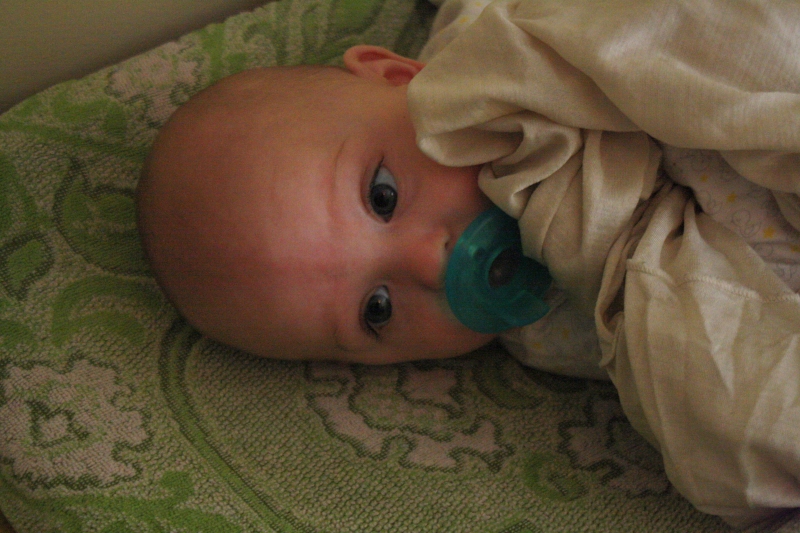
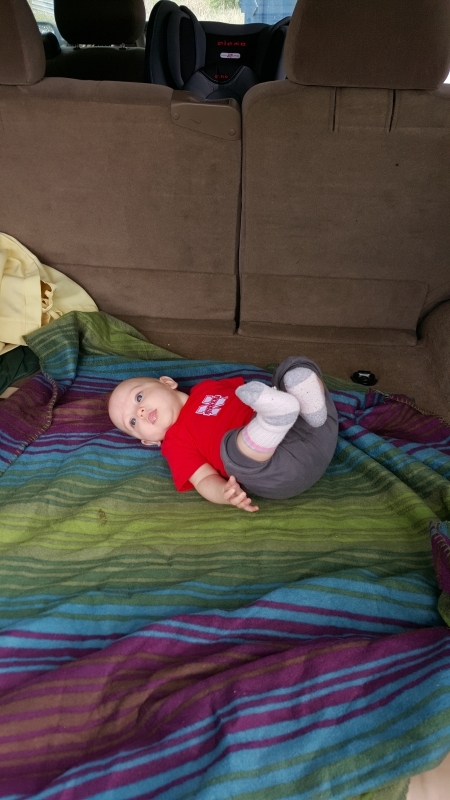
Book Review: Sleep: The Brazelton Way by T. Berry Brazelton and Joshua D. Sparrow

Sleep is one of those things that I think each family has to figure out for themselves. Hundreds of rigid programs exist, but few (none?) are worth following to the letter. Because every baby is different. Every parent is different. Every situation is different.

I used to think I’d never bring a baby into my own bed. I value the intimacy of sharing a bed with my husband (only) too much.

Then we brought home a preemie who would only sleep on Daniel’s chest or mine. We’d trade off nights, Daniel staying awake on the couch with her on his chest, then me taking a turn. Except we got so exhausted with the routine that we were falling asleep with her on our chests. And whatever your views are on the safety of bed-sharing, there can be no mixed opinions about sofa-sleep sharing. It’s dangerous.

We didn’t feel comfortable with her sharing the same surface. I was pumping and fortifying breastmilk to be fed by bottle at that time – and that thing about exclusively breastfeeding mamas being biologically more in tune with their babies and non-exclusive mamas not as much? There’s good scientific evidence for it – and it held out in our experience. I totally could have rolled over on her. We got a guard rail for the bed and a box for her to sleep in next to me (against the rail). Once we were exclusively at the breast (and Tirzah Mae was growing too large for her box), we tried on the bed directly – and there was never a fear that I’d roll over on her. We were physiologically bound, cycling through sleep together. I was aware of her, yet not losing sleep.

But that didn’t mean I was willing to give up and just be a bed-sharer. At the beginning of March, I made getting her to sleep in her bassinet a goal. It was hard work. No longer right next to each other (I placed the bassinet at the foot of the bed), getting up with her became more disruptive to my sleep. It was easier to nurse and then fall asleep together without having to stay awake to put her back in her bassinet after nighttime feedings.

Then I started reading Sleep: The Brazelton Way. There are plenty of things I’m uncertain about regarding Brazelton’s “method” (he seems to think that spacing out feedings during the day helps a child sleep better at night, which I don’t understand philosophically and don’t really agree with nutritionally), but one thing in the “four month” sleep section ended up being an epiphany to me. Brazelton suggested that parents try “patting” their baby back to sleep during nighttime wakenings, not getting them up to eat. What? I thought. Tirzah Mae might not be hungry, might not need to get out of her bassinet at nighttime? I tested it out, patting her when she awoke during the night.

About three-quarters of the time, patting was enough. She settled back into sleep after minimal fussing – and I could go back to sleep too. The other quarter of the time? If she didn’t settle or started to cry, I got her out and fed her. Sometimes I stayed awake to put her back in the bassinet, sometimes I didn’t. But she was on her way to independent sleep.

**Regular readers will note that Tirzah Mae’s sleep took a turn for the worse at the beginning of April. That was majorly disruptive and she was NOT able to be soothed with patting. Now that she is sleeping better and is in her crib in her own room, she awakens much less frequently but generally needs to be fed at those awakenings.**

I have since finished Brazelton’s short volume (114 pages), in which Brazelton addresses a variety of sleep issues (that we aren’t dealing with).

Do I recommend Brazelton’s sleep program? No, I don’t. But I think I will recommend his book. Because I think that coming up with a sleep program that works for your own family involves collecting ideas and occasionally letting your assumptions be challenged and experimenting to find out what works for you. Brazelton’s book is a generally non-extreme resource for coming up with ideas and challenging assumptions.


Rating: 3 stars
Category: Baby Care
Synopsis: Discussion of a baby and young child’s sleep patterns and how parents can deal with common sleep issues.
Recommendation: Useful as a source of ideas, not particularly for a comprehensive “sleep program”.


Book Notes: Christy by Catherine Marshall

Nineteen year old Christy Huddleston wanted to make a difference, wanted to be someone. Someone beyond the daughter of a well-to-do businessman, that is. And when she heard a missionary speak of the needs among the Appalachians just hours away from her city, she was determined to go.

What she finds in Cutter Gap, Tennessee is even more foreign than she’d ever dreamed. She is full of grand plans for helping – but soon discovers that being “someone” and making a difference doesn’t necessarily mean what she thought it had.

This wasn’t my first reading of Catherine Marshall’s Christy. Anna and I owned a copy when we were teens and I know I read it at least once. I think I saw the TV miniseries too – although I might be getting it mixed up with Dr. Quinn Medicine Woman (I know, not at all similar). Needless to say, by now you probably realize that while I read it I really didn’t remember anything from it. I was glad when Stephanie from Simple Things selected Christy as May’s Reading to Know Classics Bookclub reading.

I enjoyed reading the ambitious Christy’s story, thinking back to my own ambitious teenaged and young adult plans for saving the world. I think the desire to make a difference, to be somebody is a common one. I also think that being disappointed with how your well-intentioned efforts turn out is also a common experience. I remember taking an impoverished middle schooler under my wing, determining to share the gospel with her and to train her into a godly girl. I drove her places, taught her how to do various crafts, studied the Bible with her. And I quickly became disillusioned when she and her family began to expect that I’d drive her places on a moment’s notice, wanted me to buy her things, and generally took advantage of my good intentions. I struggled to know what to do when I wanted so badly to help but it didn’t seem to be working the way I thought it would work.

How I wish I’d had someone like Christy’s Miss Alice to mentor me in the ways of giving myself away. I loved reading Marshall’s descriptions of Miss Alice – a woman whose theology I didn’t particularly agree with, but whose gentleness and devotion are absolutely praiseworthy. Miss Alice is described as pretty much a saint, although she avers that she is not, and even the sordid tale she eventually tells does little to sully her reputation. Yes, wouldn’t it be wonderful to have a saint who always knows the right thing to say and to do to mentor one along the way?

Alas, we are much more like Marshall’s other characters – flawed humans with quirks and quibbles and mixed motives.

Christy marvels, in one section, at one woman’s wisdom mixed with superstition. I do too.

Opal went closer to Bird’s-Eye, took his empty plate. “Looky-here, Bird’s-Eye, whilst you was fixin’ that fawn’s leg, you was a real man. You know that? It’s plumb foolish for you not to let more folks in the Cove see a heap more of that Bird’s-Eye. They have the wrong idea ’bout you.”

The man looked at her in genuine astonishment. “That must be woman tease-talk. Are you a-joshin’ me? Fixin’ animals’ legs ain’t no man’s work.”

“Fixin’ onything is man’s work,” came Opal’s firm answer. “Tearin’ down or killin’, that’s easy. Any addlepated fool kin pull the trigger of a rifle-gun or fling a rock. It’s fixin’ that’s hard, takes a heap more doin’.”

Listening to this, I could see again the baby girl’s tiny body lying in the middle of the big bed. How amazing that this homespun mending philosophy and the awful liver-grown superstition could be part of the same woman.

We humans are a mixed lot – with God’s image stamped on world-played clay. Try as she might to smooth the edges and impress them into a new mold, Christy never managed to truly change those she worked with. And neither can we.

The answer, of course, the way to truly make a difference is not in “fixing” or “cleaning up” but in the gospel – as Miss Alice admonished the young pastor David Grantland:

“Clean up a pigsty,” she commented one evening, “and if the creatures in it still have pig-minds and pig-desires, soon it will be the same old pigsty again. Preach the gospel, David, teach it, preach to the hearts of men. That’s your business. Then the fruits, including the reforms in other areas, will follow as fruits. But it’s no good tying apples onto a tree. Soon they’ll be rotting apples….The question at issue, David, is how to get rid of the evil in men. Attacking corruption in the environment won’t do it. That’s like cutting weeds in a field. In a fortnight the weeds will be grown again. And attacking the men themselves won’t work either. Whatever separates men from love can’t be of God.”

Though David was stubborn, at last humbly, he asked the question Miss Alice must have been wanting him to ask, “Well then, how can we deal with evil?”

“By demonstrating to the people a way that’s more powerful than evil. And that’s good news! Let’s get on with living and teaching and preaching that good news with all the verve and enthusiasm we have.”

“Then,” David said, “if that’s the technique, why aren’t people changed more drastically by today’s preaching?”

“Could be because we don’t often have the courage to give the good news to people straight. Most of us are still talking religious theory that we haven’t begun living, and talking in worn-out cliches at that. A watered-down message is as futile as applying rose water to a cancer. When you heart is ablaze with the love of God, when you love other people – especially the ripsnorting sinners – so much that you dare to tell them about Jesus with no apologies, then never fear, there will be results. One of two things will happen. Either there’ll be persecutions, or the fire will leap from your heart to catch and blaze in the depths of other men’s being. I’ve watched the process over and over. And then when the blaze starts, the reforms will follow as surely as the flower follows the bud, or the fruit comes after the blossom on the tree.”

“It’s too slow a way.”

“No David, it isn’t too slow a way. The other is no way at all.”

Amen and amen.

This girl, at nineteen, dreamed of making a difference, of being someone. Life has taught her that her grand dreams don’t necessarily produce grand outcomes. But Miss Alice’s charge echoes in this woman’s heart, reminds her that the gospel is the only way to make a difference, that losing oneself for the gospel is the only way to be someone.

May I have a heart ablaze, a tongue unstopped, a love unfettered – a life that would make a difference.


Check out what other readers are saying about Christy at the May Bookclub wrap-up post


The End of Myself

Desperation.

That’s what I felt as Tirzah Mae’s not sleeping at night approached two months.

Would she ever sleep through the night again? Would my “good” baby, who never cried unless she needed something, ever return?

Despite the doctor’s ultimate diagnosis of colic as the source of her crying and frequent night waking (in other words, “crying for no understandable reason”), I was convinced there was something causing her crying. Yes, we ruled out GERD when two weeks of medication had no effect. But prior to this, Tirzah Mae never cried unless she needed something: she was hungry, she was dirty, she was overtired, she was in pain.

As I got up with her yet again, bleary eyed and exhausted from two months of rarely finishing a sleep cycle and from the effort of cleaning up a filthy mobile home while my own home slipped back into chaos, I was absolutely desperate.

I made a plan to do what I’d been toying with for weeks – I’d go to the pharmacy, pick up every scientifically suspect remedy. Gripe water. Simethicone. Homeopathic remedies.

I was willing to throw away my scientific dogmatism, to do anything, however contrary to my training and philosophy, if only it would help.

That’s when, in desperation, I cried out to God: “God, heal my daughter.”

At long last, she was soothed and fell back asleep. I left her in her crib and returned to my own bed, where I continued to cry out to God until I fell asleep myself.

And I slept. Two hours, three, four.

I roused, thinking surely my overtiredness had kept me from hearing Tirzah Mae’s screams. I heard her rustling in her crib – and nothing more.

I fell back asleep.

Six hours after she had fallen asleep, she awoke and fussed for her mother.

The next night, she slept another five to six hours. And the next. She’s slept wonderfully since Tuesday.

And I turn, at the end of myself, wondering why I waited so long to turn to God.

Why is it that I only turn to Him after I’ve diagnosed her myself, after I’ve turned to the internet, after I’ve turned to the doctor, after the medication fails? Why did I wait until my only other resort was hocus-pocus?

It’s frightening, how slowly I turn to the one who knows all things, who alone has the power to change all circumstances.

It’s humbling, how sinful I am even in turning to Christ.

But it’s so amazing, how God’s mercy doesn’t punish me for waiting to turn to Him. Instead, He graciously grants my daughter (and myself) sleep.

Just one more example of the gospel at work: God, graciously giving good gifts to those who don’t deserve it, forgiving those who turn aside so often to self-reliant idolatry.

Thank you, Lord, for bringing me to the end of myself. Thank you, Lord, for your patience with my delay. Thank you for reminding me again how it is only in you that I live and move and have my being. May I turn aside from self-idolatry and ever more quickly turn to you, the source of all life.


Book Review: Pioneer Girl by Laura Ingalls Wilder

Who is not familiar with little Laura Ingalls, who lived in a series of little houses? Whose childhood memories don’t include either the series of “Little House” books or the spin-off television series “Little House on the Prairie”?

Our books were blue-clad paperbacks illustrated by Garth Williams. My sister and I adored them, moving the books back and forth through the narrow strip of light shining into our room from the hall light as we read illicitly after bedtime. We loved them so much the spines started breaking and the pages got torn. Occasionally, we’d end up having to wait for the other to finish a volume so we could read it. Eventually, we’d check them out of the library to ensure that there’d always be a copy for both of us. Years later, I’d remember the insufficiency of just one set and would stockpile volumes as I found them at used stores, garage sales, and the library book sale. I left a set at my parents and still have two in my own home.

Laura’s story is a part of my story.

As a child, I was never too much interested in how much of the story was true and how much was invented. I didn’t worry about whether Laura was its true author or whether her daughter Rose wrote her mother’s stories for her. The important thing was that the story was authentic, not that it was true.

Honestly, although I’ve read a fair number of biographies of Wilder and have heard some of the theories, I’ve still never been much concerned with where the Little House books deviate from factual occurences. The books are sold as fiction – I don’t expect them to be completely accurate.

But I was curious when Laura’s heretofore unpublished autobiography Pioneer Girl was published last year. I was eager to hear Laura’s story from an adult perspective, a nonfiction take instead of a fictionalized version, in Laura’s own words instead of mediated by Rose. Having heard that the book was a large one, I figured I’d wait until the holds died down at the library (I don’t relish being forced to finish a book in 14 days, as I would if I requested it while it was new.) But then I read Janet’s review and knew I wanted to read it ASAP. I searched on Amazon, figuring I’d just buy it for myself – but the price put me into shock and I placed a request at my library anyway.

I shouldn’t have been worried about the time. When my request came through, I devoured the 370 pages in 3 days.

If I had been worried that Rose had written the novels for her mother, I wouldn’t be anymore. Laura’s voice is the same. If I had been worried that the novels took liberties with the facts, I wouldn’t be anymore. The story is recognizable from one version to the next. Yes, Laura abbreviated episodes, combined people, and rearranged the timeline somewhat in her novels (as well as leaving out a particularly dark year of the family’s life) – but the episodes are unchanged in essence.

Just the autobiography is worthwhile for fans of the “Little House” series. Reading this adult proto-version of Laura’s story adds depth and flavor to the novels we read as children. But the autobiography isn’t all this volume contains. This was published as an “annotated” autobiography, with at least as many words worth of footnotes as words of autobiography. The editor has commented on the different versions of the stories, on corroborating genealogical and census data, on sources of referenced songs or poems or books.

This is a treasure-trove for Little House fans – a glimpse into how the adult Laura viewed and interpreted her childhood, into how Laura’s authorial voice grew throughout the writing of different editions of Pioneer Girl and into the Little House books, into the reality of pioneer life. Fans should definitely read it.


Rating: 4 stars
Category: Autobiography with extensive historical annotations
Synopsis: Laura Ingalls Wilder’s autobiography, written for adults, that she later adapted into the famous “Little House” series for children. This autobiography comes with meticulously researched historical annotations from Pamela Smith Hill of the South Dakota Historical Society.
Recommendation: Fans of Laura Ingalls Wilder should definitely read this. If “Little House” didn’t play a role in your childhood, skip this (but get familiar with the Little House books by all means!)


Nightstand (May 2015)

It’s been another very long month, made up of very short periods of sleep (Although – Tirzah Mae slept a 6 hour stretch last night, at least double as long as she’s slept since Easter. Praise God!) So this is another skeleton post.

Fiction read this month:

  • The Unknown Ajax by Georgette Heyer
    A little hard to get into at first, but I ended up liking this Regency romance quite well.
  • The Phantom of the Opera by Gaston Leroux
    Read (for the third time) with my real-life bookclub.
  • Christy by Catherine Marshall
    Read with the Reading to Know Classics Bookclub.
  • 3 board books by Sandra Boynton

Nonfiction read this month:

Books about health:

  • Lose that Baby Fat! by La Reine Chabut
    A month-by-month selection of exercises for the post-pregnancy year. The exercises are generally good if you already have the equipment (or were already intending to get it). You have to be proactive about setting up your own schedule and making sure you don’t lose gains you’ve made during previous months working on different body parts. See my full review for more information.
  • Drop Dead Healthy by A.J. Jacobs
    The author of The Year of Living Biblically and The Know-It All embarks on another giant project – this time, to be the healthiest man alive. Jacobs makes a ginormous list of possibly healthy practices and works his way through them in an entertaining couple of years. As a project memoir (which is what it is), this is fun – as health journalism, this is pretty poor. Since I enjoy project memoirs, I enjoyed this – but since I generally have a hard time with health journalism that tries, I had an even harder time with Jacobs’ lack of even trying to learn whether the health practices he was partaking in were actually legit.

Other nonfiction:

  • The Urban Homestead by Kelly Coyne and Erik Knutzen
    Interesting to compare and contrast with the 70s-style “back to the land” tomes I read as a teen.
  • And Baby Makes Three by John Gottman and Julie Schwartz Gottman
    Developing the skills to preserve your marriage as your couple becomes a family. The bulk of the book is on managing conflict well – and it has lots of good recommendations (even couple activities to help you practice good communication and effective argument). Even as I agreed with the value of the things the authors mentioned, I didn’t learn a lot – Daniel and I have been blessed with good communication in our marriage and we naturally (or perhaps I should say more accurately, by the grace of God) do many of the things that make for constructive conflict (instead of marriage-breaking conflict.) The addition of Tirzah Mae has certainly affected our marriage and made time and energy more precious – but it hasn’t brought up all sorts of conflict that drives us apart. Even while I didn’t personally find this useful, I do think it has lots of wisdom for those couples who struggle with constructive conflict (and since most every couple I’ve talked to has mentioned how strange it is that Daniel and I still haven’t fought, I’m guessing we’re in the minority here.) ***Also, please be aware: just because Daniel and I don’t fight and have constructive conflict when we do disagree, this does NOT mean that we’re perfect – by no means. Our struggles are just different than many couples’, not necessarily less than others.***
  • 97 Things to Do Before You Finish High School by Stephen Jenkins
    If it weren’t for the few items encouraging kids to dabble in the occult, this would be a decent list for any high schooler. Like many books targeted at high schoolers, though, this suffers from an overwhelming supply of already-dated cultural references (a lot changes in 8 years if you’re talking social media sites, cool music, and fashion trends.)
  • Create an Oasis with Greywater by Art Ludwig
    The definitive book on greywater systems – read my notes here.
  • Cut, Stapled, and Mended by Roanna Rosewood
    A birth memoir about VBAC. An interesting story, a few good points. A lot of raunch and pagan spirituality. I won’t be recommending it.
  • Prairie Girl by Laura Ingalls Wilder
    I absolutely devoured this.
  • A Builder’s Guide to Wells and Septic Systems by R. Dodge Woodson
    Understandably focused on builders, this book gives a basic overview of systems and how to reduce costs while ensuring quality work. Disappointing lack of information about advanced septic systems such as the one we’ll be installing.

Now that the mobile home is empty and Tirzah Mae is (maybe) starting to sleep again, I have high hopes for reviewing many of these in greater depth. For now, I’d encourage you to check out the review I hadn’t posted as of my last nightstand: Stephanie Fast’s She is Mine. It was a tremendously compelling read – and I think you should read it.

Don’t forget to drop by 5 Minutes 4 Books to see what others are reading this month!

What's on Your Nightstand?


Lifecycle of a nightie

Some 20 years ago, my little sister Grace grabbed one of my mom’s nightgowns out of the laundry basket and started carrying it around.

It was a “slicky” nightgown you see, some sort of synthetic with a silky feel, perfect for snuggling against or rubbing between one’s fingers.

As I remember it, Grace carried the nightgown with her whenever she had a chance, slept with it, and generally loved it until Mom made her a “slicky” of her own – something akin to a handkerchief made out of similarly “slicky” fabric.

Years later, mom retired the nightgown and I grabbed it up. I cut off the lower portion, added a casing at top for elastic and wore it as a slip for eight, ten, or more years.

Recently, I pulled the slip from my drawer and added it to a pile of mending sitting atop another dresser in our room. The elastic in the waist is shot. Either I need to replace the elastic or convert the slip to other purposes.

But one day, about a week ago, Tirzah Mae’s lovey (a “slicky” I made for her with ribbon tags) got dirty and was in the wash – and Tirzah Mae was not settling down for a nap without it. I grabbed the old nightie-turned-slip from the dresser and snuggled it against Tirzah Mae’s cheek. Safely nestled in a “slicky”, Tirzah Mae fell asleep.

Tirzah Mae with the old nightie

Today, she wraps her hands in it and waves it around, just as her aunt did some 20 years ago.


Going Green with Greywater (or not)

Greywater. It’s not sewage, but we send gallons of it into our sewers daily. It’s the water we wash our hands with, shower with, bathe in. We can reduce the amount we create but we can’t eliminate it entirely. We’ve got to get clean.

But we don’t have to send it into our sewers. It’s not sewage.

I’ve been doing the most low-tech of greywater recycling for years – dumping my dishwater out the door instead of down the drain – but when we bought ourselves a piece of land and started thinking about building on it, I started thinking about a more elaborate greywater system.

A little bit of research brough me to Art Ludwig’s Create an Oasis with Greywater, the definitive resource on greywater systems. Art describes the value of greywater, helps readers set goals for their greywater system, and helps them design a greywater system that fits their context. It’s a great (if not very pretty) book.

It also made clear that a greywater system is not for us.

Really? You might be asking. How’s it a great book if it convinced you to not go with a greywater system?

That’s the thing. Ludwig (unlike a lot of so-called green gurus) is an environmentalist with his head screwed on straight. He’s not interested in designing or implementing something that seems green but really doesn’t do any good. He spends quite a bit of time helping his readers to scale down their expectations of a greywater system and to evaluate what sort of system makes environmental and economical (he makes the excellent suggestion that economics can be a proxy for environmental soundness, which I wholeheartedly agree with) sense given their individual context.

In our case, our soil demands that we put an advanced septic system on our land. All our wastewater (greywater and the “black” water from our toilets and kitchen sink) will be sent through a dual-chambered system where aerobic fermentation will purify it before it is pumped through a series of tubing to irrigate our lawn from below. So we’ll already be getting one of the primary advantages of a greywater system (without installing separate pipes) – we’ll be irrigating with our water instead of sending it into a sewer. Furthermore, since the “irrigation” step is an important part of the septic process, we cannot add extra irrigation on top of the irrigation field (which will cover most of the area close enough to the house to be feasibly irrigated with greywater). In addition, a septic system requires a certain amount of “dilution” water to work – so it is possible to remove too much water from the septic through a greywater system.

So a greywater system isn’t for us.

Does that mean I won’t be using anything I learned from this book?

Actually, no. Ludwig points out that there are some forms of greywater reuse that can be done without a fancy system. Using your bathwater and a bucket to flush the toilet? Go for it (I fill our low-flow toilet with bathwater to rinse Tirzah Mae’s diapers in – and then flush it with more bathwater.) And throwing my dishwater out the door after I’m done with it? Well, that’s a tricky one. Kitchen sink waste is actually considered blackwater, since it contains organic matter that can feed icky bacteria, causing them to proliferate and make you sick. Even ordinary greywater is not encouraged for vegetable garden use, since it can can contain pathogens. The compromise I make is to discard my dishwater down the drain but to apply the rinse water to my garden. An even better choice would be to use that water on non-edibles, but I currently don’t have any nonedibles that require water.

If you’re at all interested in greywater reuse, I highly recommend Ludwig’s Create an Oasis with Greywater as a resource to help you evaluate a system. Ludwig’s website is also a great resource.


A springtime project

Posts might get scarce around here for the next month or so – because I’ve got quite a spring cleaning project to work on.

The bathroom after two hours of work

A peek inside the trailer’s back door – after two afternoons of work

We’ve got a rolloff out on the land and my task is to empty the trailer into the rolloff.

The roll-off after one hour of work

One hour’s worth of trash

Since Daniel is still needing to work mega-overtime, Tirzah Mae and I are mostly on our own for this project.

My cleaning buddy

My cleaning buddy

Which means we’ll be busy – really, really busy in the next several weeks.


Book Review: Lose that Baby Fat! by La Reine Chabut

Despite ending my pregnancy eight weeks early, I gained significantly more than the recommended amount – at least 50 pounds. Much of it was water weight, which means that, after rigorous diuresing, I returned from the hospital only 8 pounds above my prepregnancy weight. Which perfectly explains why I’m now closer to 18 pounds above my prepregnancy weight.

Well, actuallly, there is an explanation for that. Almost three weeks of bedrest meant a rapid loss of muscle mass, leaving me with a still-voracious appetite (from breastfeeding), but nowhere near as much muscle to use up the calories I’m consuming.

Now, I’m not particularly worried about my weight – I’m still in the healthy range and only a bit above my post-high school norm (I was about 5 pounds lighter than this through college). But I am worried about the loss of muscle mass (and gaining fat mass). Which is why I’ve been making a concerted effort to be active – and to include strength training in my routine. And, of course, this gives me opportunity to read some more books!

Lose that Baby Fat! is supposed to be a month-by-month exercise guide for the first year after having a baby – but I didn’t use it as such. Instead, I worked through the various exercises and routines more quickly (about one month per week) in order to allow me to try and review other books as well. This means that I can’t comment on the effectiveness of the program as written except from a theoretical standpoint – but, actually, there is very little guidance as to how often one is supposed to do the monthly exercises (or whether one is supposed to do anything in addition to them), so I suppose it’d be hard to comment on effectiveness anyway – it will be what you put into it.

As I worked my way through the book, I wrote up comments as seen below.

First Six Weeks: Kegels
Very simple version of Kegels.

Month 2: Walking and Stretching
Do stretches REALLY need to use an exercise ball? I had a hard time balancing well enough to get a good stretch – and nearly all of the stretches could just as easily be done without any equipment at all. (In the author’s defense, it’s easier to balance with tennis shoes on – and I frequently exercise without them.)

Month 3: Abdominals
I like the use of the ball for abdominal exercises like the bicycle and the abdominal crunch – I felt like the ball helped me stay focused (or maybe distracted from the monotony?) and made me less likely to hurt my neck than with the traditional floor exercise. This chapter included a nice range of difficulty, from very easy to quite difficult, perfect for ramping up after a life-experience that rather stretches out those abs :-) (Little complaint here: at the beginning of each chapter the author has a “how you may be feeling” blurb, and this month’s is “Thinking twice about continuing with breastfeeding.” My experience as a WIC dietitian is that women who stick it out to three months very rarely have second thoughts – by then they’ve gotten through the most difficult learning curve and can’t imagine having to wait to mix up a bottle and get it warm before feeding their baby.)

Month 4: Arms and Chest
Pretty standard arm exercises (biceps curls, triceps kickbacks, chest presses) done on the exercise ball with a resistance band. We own an exercise ball, so I did the exercises on it – but I didn’t purchase a resistance band to test these out (I know enough of myself to know that buying a piece of exercise equipment will not motivate me to use it.) Instead, I used the 3 pound weights I already have. All the exercises in this chapter happen to have the resistance working in line with gravity, so no postural changes were required to adapt from one to another. I officially like doing arm exercises on the ball (versus standing or on a bench) – it adds a bit of an ab workout and doesn’t take as much space as a weight bench.

Month 5: Butt
A couple of the exercises involved standing with some part of your body against an exercise ball which is positioned against a wall. Obviously, the author is a fitness-lover rather than a book-lover – she has a room with plenty of wide-open walls. All of my walls are jammed full with either bookshelves or windows. Thankfully, the exercises that she does this with (squats and lunges) can be done just as well without a ball or a wall.

Month 6: Shoulders and Upper Back
This includes four ball and band exercises, half of which require postural modifications to do with free weights (of course, the author doesn’t explain how to do that). Disappointing chapter.

Month 7: Legs
Jumping rope in 30 second intervals. I didn’t do this because I couldn’t be bothered to find my jump rope.

Month 8: Full Body
The first workout that is actually a full workout (as opposed to just a few exercises for a target area). Most of the exercises are duplicates from past chapters – making me wonder if one was really supposed to only be working on the butt in Month 5, for example, instead of incorporating each new monthly set of exercises into a weekly rotation (as I would have assumed).

Month 9: Circuit training
A very short (6 minutes total) but very intense (at least for me) workout with 30 second intervals (Daniel uses a HIIT interval timer on his phone for interval training – and I tried it for this workout, which worked well). This workout uses a coffee table for triceps dips and pushups, but since I don’t have a coffee table, I used a footstool for dips and did girlie pushups straight on the floor. I’m definitely going to have to try this again – it was a good FAST workout.

Month 10: Strength training
These are fairly traditional dumbbell exercises using the exercise ball as a bench.

Month 11: Running
Sorry, even if I did decide to purchase a jogging stroller, you’re not going to get me running. I had enough trouble keeping my bosom controlled before baby and breastfeeding – trying to do it now sounds like a major OUCH!

Conclusion!
If you read through my notes so far, you’ve seen that I had numerous comments regarding equipment use. This book assumes that you have 1) an exercise ball, which is used for almost every exercise, 2) a fitness band, 3) a jump rope, and later on 4) dumbbells and 5) a jogging stroller. I do not feel that any of these are necessary for a good post-pregnancy workout (although having some form of resistance for strength training is worthwhile). I did find that I enjoyed many of the exercises using the ball.

If you have this equipment already, I would recommend this book as a good source for a variety of exercises that can be done using them. If I were to use this book as my complete program, I would plan on doing some sort of aerobic activity (probably walking) at least three times a week and do at least two or three exercises from the current month a couple times a week, adding in a couple exercises from each previous month as well. (It seems crazy to me that the author only puts things together into a full-body workout in month 8 – you’d lose any muscle tone you’d gained in your abs, for example, by then if you hadn’t kept on working with them.)

**Side note: The author knows nothing about nutrition. Disregard anything she says (thankfully, she doesn’t say much.)**


Rating: 3 stars
Category: Post-pregnancy exercise
Synopsis: A month-by-month selection of exercises for the post-pregnancy year.
Recommendation: A good selection of exercises if you already have the equipment (or were already intending to get it). You have to be proactive about setting up your own schedule and making sure you don’t lose gains you’ve made during previous months working on different body parts.


Grandma on childbirth and baby feeding

I was telling my grandma about our Bradley class (I think) when she commented that she’d heard about natural childbirth somewhere toward the end of her childbearing years. She told her doctor she’d like to try. He told her no, she didn’t. She had twelve children, including one set of twins. None were born “naturally”.

I was talking with Daniel’s grandma early on in our marriage (before we were pregnant) and somehow we got on the topic of childbirth and breastfeeding.

She doesn’t remember anything about how her children were born – she was out for their delivery.

She didn’t even see her babies for a fair while after they were born – but she breastfed all four.

Daniel’s other grandma didn’t breastfeed her children. “It wasn’t encouraged in those days,” she told me apologetically. Now she regrets that she didn’t “nurse”. She’s so glad I’m nursing Tirzah Mae. “It’s such a wonderful thing,” she said.

I was mentioning how NOT fun pumping had been when we’d had to do that – but that my supply had been abundant. My grandma told me she’d tried with her first but that it didn’t work out. Grandpa complained about all the money that Similac got from them – twelve children’s worth.

None of Tirzah Mae’s great-grandmother’s had ideal situations. But they managed the best they could. They raised their children with the resources that were available.

And they raised some pretty terrific children.

It’s worth remembering, even as I long for the ideal – and long that the ideal could be available to as many women as possible – that generations of women have experienced the less-then-ideal, have pressed through, have raised their families well.

Natural childbirth. Immediate skin-to-skin. Successful breastfeeding.

I wish that every woman had the physical capability and the support she needed to achieve them.

But when she doesn’t?

She can still mother well.

Take heart, mothers who feel disappointed with your birth or breastfeeding experiences. It’s okay to be disappointed. For those who were coerced, it’s okay to be upset. But your birth or breastfeeding experiences do not define your mothering.

You do.

Our grandmothers pressed through the less-than-ideal and raised our parents well. You can too.