The child will live

Anxious caregiver stays up all night applying compresses to feverish child’s face, chest, limbs.

Child tosses and turns, moaning and breathing laboriously.

Everyone knows that the child is on her deathbed, everyone wishes they could do something – but to no avail. They stand vigil outside the child’s door, waiting for news. The doctor’s worried face declares that the danger is real.

Then, as daylight breaks, the child’s fever subsides. She falls into a “deep, unlabored sleep.”

The doctor declares the worst to be over, orders the anxious caregiver to sleep.

All breathe a sigh of relief. The child will live.


What story am I telling?

I’m not really sure. I feel certain I’ve read this story or a variation on it at least a half dozen times if not more – but I can’t remember where.

Do you know?


All I know is that I felt a little like I was in this story (and yes, I am being melodramatic) last night.

Tirzah Mae went to sleep at nine, woke up screaming at 10:30, midnight, one o’clock, two o’clock, three o’clock, four o’clock, and five o’clock. I had a nightmare that I was (thankfully) able to wake myself up from at 11:15.

It’s been four weeks now that Tirzah Mae’s not been sleeping well, been waking up screaming, been inconsolably fussy during the day. My own sleep has (understandably) suffered.

We took her to the doctor Friday, got some medication. And this weekend has been the worst that it’s been so far.

But this morning, as I was reaching my very wits end, I breastfed Tirzah Mae and she fell into a “deep, unlabored sleep”. She slept for four hours (longer than she’s slept at a stretch since returning from Lincoln on Easter Sunday).

And her mother relaxed into sleep as well. The worst is over. The child will live (and so will her mother.)


Thankful Thursday: Six months ago today

Six months ago today, I was sicker than I’d ever been in my life.

Prepping for the c-section

Six months ago today, I made a decision I’d never thought I’d make.

Six months ago today, my infant daughter was delivered via C-section, eight weeks before her due date.

Weighing in

Six months ago today, my Tirzah Mae was born.


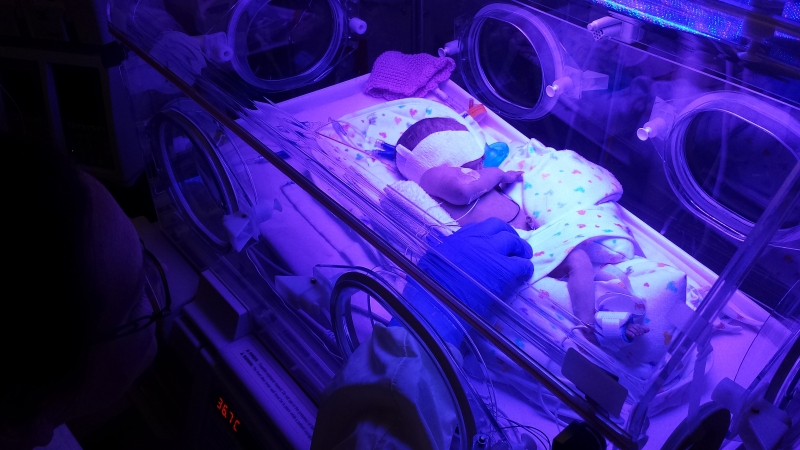
She spent her first 26 days outside the womb in the NICU. She was fed through her veins at first, and then through a tube into her stomach, finally at the breast. She went from an incubator under bili-lights to the incubator without then to an open crib.

Tirzah Mae under the bili lights

She’s spent the last 155 days with us. She is fed at the breast, sleeps near us, is warmed by our warmth when she needs it.

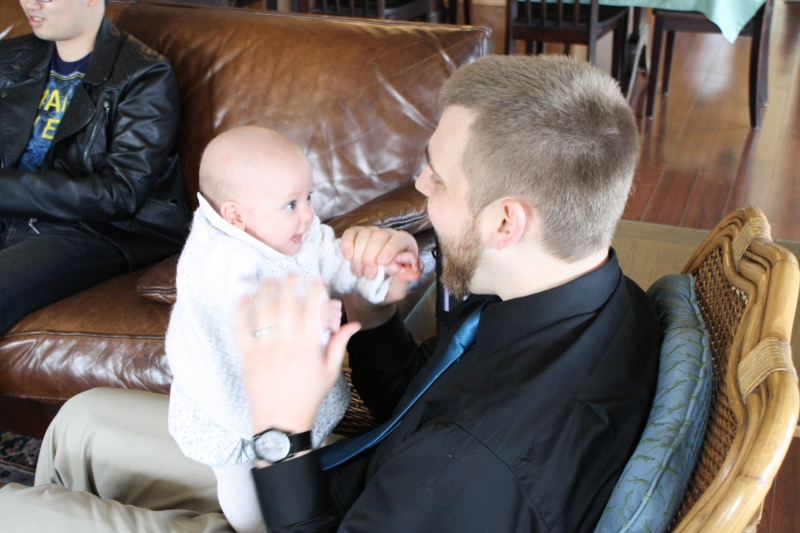
Tirzah Mae and Papa enjoy each other's company

Five months out for just the one month in.


The books say that parents never forget their preemies’ births, their hospitalizations, their difficulties. And maybe the books are right.

But already, the memories start to fade. I forget how tiny she was, how helpless. I forget how desperate we were. I forget that she isn’t just another baby.

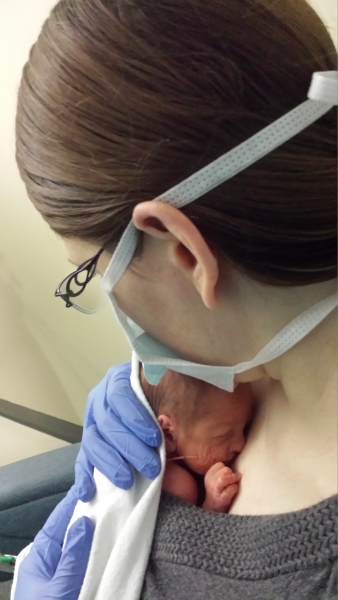
Snuggling inside mama's dress

When people ask her age, I tell them she’s about six months – starting to leave off “but she was born two months early”.

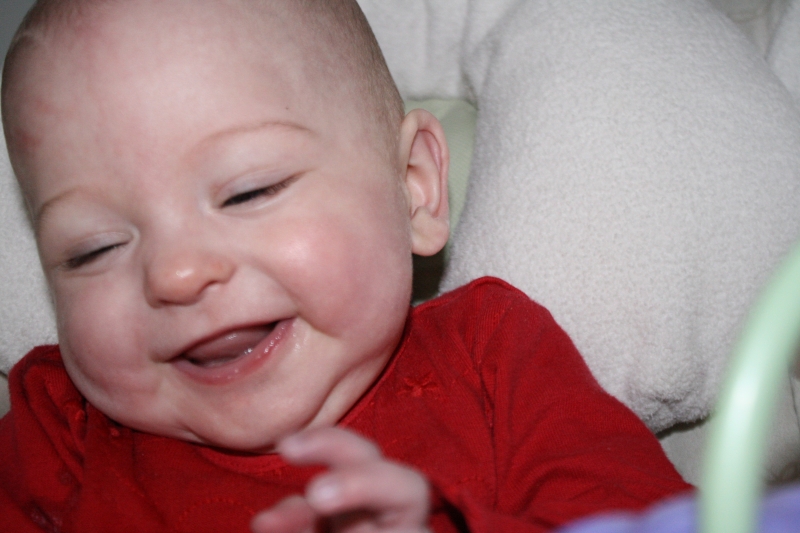
Tirzah Mae smiles as she swings

Six months makes a big difference.


One thing hasn’t changed in those six months though.

I still look at her little fingers, so perfectly formed, now full of flesh where once was only skin and bone. I wonder at them – how perfect, how delicate, how complete they are.

Setting her to scale

Eight weeks early, she was still complete. She was a baby, a human fully formed though immature.


I become sentimental, my thoughts meander.

What can I say that means anything, on this day six month out?

Perhaps the only thing I can say is to sing:

“‘Tis grace hath brought us safe thus far
And grace shall lead us home.”

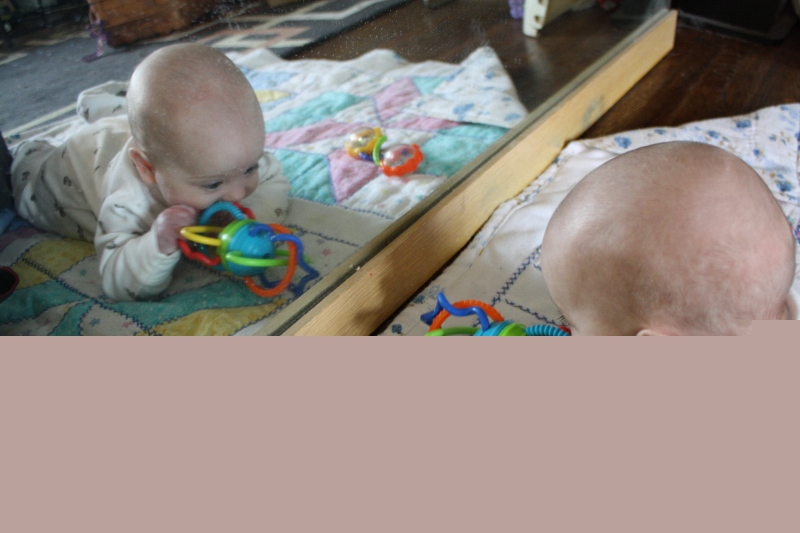
Today, I am thankful for God’s grace. God’s grace in granting me life, in granting Tirzah Mae life. God’s grace in eight extra days in the womb. God’s grace in 26 short days of the NICU. God’s grace in 155 long days at home. God’s grace in sleepless nights, in pumping and shield use. God’s grace in spit up and diapers. God’s grace in baby laughter and Tirzah Mae recognizing herself in the mirror. God’s grace has been omnipresent.

Tirzah Mae plays in the mirror

Thank You, thank You, Gracious God.


Book Review: She is Mine by Stephanie Fast

Written in the third person, Stephanie Fast’s She is Mine reads like a novel. Written in three parts, it unfolds like a play.

It’s the story of the daughter of a Korean woman and an American serviceman. She never knew her father – he didn’t know her mother was pregnant. She was rejected by her mother’s family, said to have brought dishonor on her family. She was abandoned by her mother.

Five year old Yoon Myoung figures that if she travels along the railroad tracks – the railroad tracks that took her away from her mother – she’ll find her way back, back into her mother’s arms. So she walks the tracks, eating roots of grasses then insects and trapped animals. She steals. She is beaten and chased off. She is abused.

I couldn’t put this book down. The story was so compelling, so well-told. As I turned page after page on horror after horror, I almost forgot that this isn’t a story Fast invented. It’s a story she lived.

She is Mine reads like a novel, unfolds like a play – but it’s really an autobiography.

And while it’s the story of an abandoned child, of unspeakable horrors, it’s also the story of hope. It’s the story of a God who sees sparrows and war-orphans, who weeps when the sparrow falls from the sky and who rescues orphans from pits. It’s the story of a God who sees the outcast and declares “She is Mine”.

She is Mine is told in the third person because, the author tells us: “While this is the story of my life, it differs only in cultural details from the stories of the innumerable nameless and faceless orphans around the world today.”

Reading She is Mine pierced my heart. It undid me. I cried practically from the first page to the last.

I cried because life is precious. People are important. Yet there is so much pain, so much injustice, so much horror in the world. She is Mine didn’t shrink back from sharing that pain, that injustice, that horror.

I might have been tempted to close the book. You may be tempted to not pick it up. We don’t like to see pain, injustice, horror. We like happy tears, not anguished ones. We like to read of the human spirit conquering, not being crushed.

But the pain, the injustice, the horror is not reason to close our eyes, to close the book, to tune out the voices of need.

Jesus didn’t. He saw the pain, the injustice, the horror. And he stepped down into it. He bowed under the yoke, was beaten and defiled. Why? So He could lift us, His people, out.

And He calls His people to do the same.

It would be easier to shut our eyes to the plight of the orphan, to busy ourselves with little petty things. But it is not the way God calls His church to live.

If you will let it, Stephanie Fast’s She is Mine could be a tool God uses to open your eyes to the pain of this world, could be a tool God uses to compel you to step into that pain, could be a tool God uses to lift another out.

Will you read this book? Will you let your heart be moved? Will you let your reading compel you to ask God what you can do? Will you listen and obey when He speaks?

I pray that you will.


Rating: 5 stars
Category: Autobiography
Synopsis: The story of a Korean war-orphan, abandoned, abused, and ultimately accepted.
Recommendation: Everyone should read this book.


I received this book from the author thanks to Carrie’s generosity and passion for this story. All opinions are my own – including the opinion that you should head to Amazon (I don’t get anything from them) and order this book right away.


Nightstand (April 2015)

Tirzah Mae’s routine (and mine by extension) is still recovering from our weeklong trip to Lincoln last month, which has meant that I’ve got a fair bit of reading and pretty much nothing else done this month.

Tirzah Mae in a Sunhat

Fiction read this month:

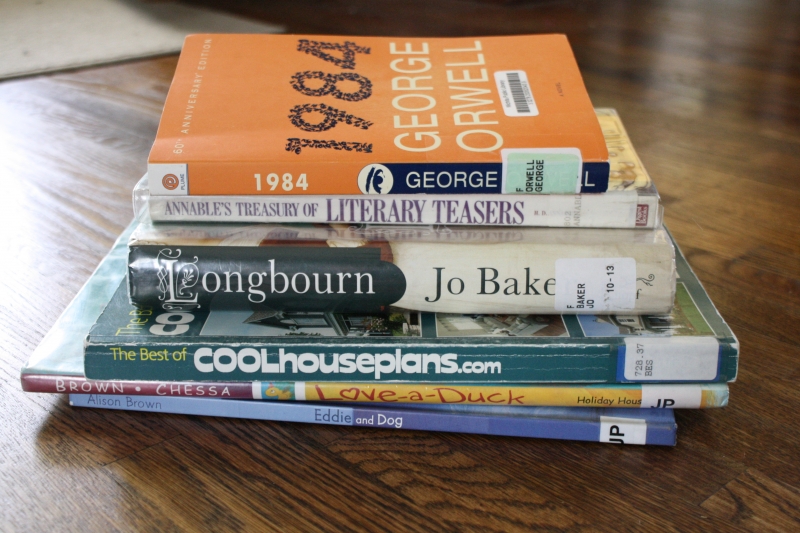
  • Longbourn by Jo Baker
    A tale of the domestic help at Longbourn, home of the Bennets (of Pride and Prejudice fame). I would have loved to have recommended this book, with it’s intriguing premise and generally engaging story (after the first few chapters). Unfortunately, the lewd language, sexual immorality, and otherwise inappropriate content sprinkled throughout makes me unable to recommend it.
  • 1984 by George Orwell
    A fascinating dystopia read with the Reading to Know Classics Bookclub and reviewed here.
  • 6 picture books author last name BROWN
  • 1 board book by Sandra Boynton

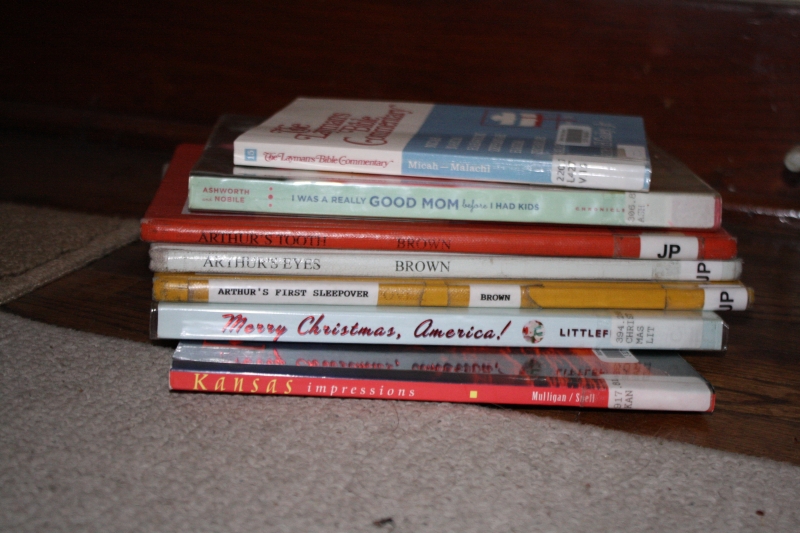
First stack of library returns

Nonfiction read this month:

Books about building a home:

  • The Complete Guide to Building Your Home for Less by Michael Conroy
  • What not to Build by Sandra Edelman, Judy Gaman, and Robby Reid
  • Old-House Dictionary by Steven J. Phillips
  • 3 House Plan Books

Second stack of library returns

Other nonfiction:

  • Annable’s Treasury of Literary Teasers by H.D. Annable
    A volume full of question-and-answer-style literary trivia. I love that the answers to questions were on the very next page (questions on page 1, answers on page 2 so you flipped just one page to get the answers). I hated that I felt like an absolute literary dunce trying to answer the questions.
  • I was a Really Good Mom before I had Kids by Trisha Ashworth and Amy Nobile
    A good book about loving motherhood as much as you love your children. I reviewed it in greater detail earlier this month.
  • She is Mine by Stephanie Fast
    A gripping autobiography of the child of a Korean woman and an American serviceman, abandoned early in life and forced to fend for herself. I definitely recommend it (and will be reviewing it more fully soon.)
  • The Layman’s Bible Commentary: Micah, Nahum, Habakkuk, Zephaniah, Haggai, Zechariah, Malachi by James H. Gailey, Jr.
    Having had one good experience with The Layman’s Bible Commentary, I keep checking out volume after volume to use in conjunction with my personal Bible reading. Unfortunately, this volume goes on the list with others as one in which the author undermines the inspiration of Scripture by presuming all sorts of cobbled together edits of Scripture to produce the finished work, despite the clear reading of the text indicating that, well, these are the words of a specific prophet. Disappointing.
  • Merry Christmas, America! by Bruce Littlefield
    Photos of extravagent Christmas light displays across America – along with stories from the people who create the displays (mostly private homeowners.) A lot of the displays are too gaudy for my taste, but they’re always interesting, as are the stories behind them.
  • Kansas Impressions by Steve Mulligan and Michael Snell
    As a lifelong resident of the Great Plains, I’ve always despised those who dismiss Nebraska or Kansas with a “nothing to see here, move along.” We may not have mountains or oceans, but the plains have their own gentle beauty (perhaps this is one of the reasons why I love Laura Ingalls Wilder’s lovely stories of pioneering in the plains?) Kansas Impressions is a book packed full of beautiful Kansas scenes. If you’ve been inclined to disparage your own state (if you’re a Kansan) or to roll your eyes and not even bother to look for a stop as you drive through Kansas, you should take a look at this book – and see Kansas through new eyes.
  • The Ultimate Breastfeeding Book of Answers by Jack Newman and Teresa Pitman
    Newman is one of the foremost experts in breastfeeding medicine – and I love the way he lets his voice come out in this informative and practical book. It won’t be for everyone, but I did write up some comments on one passage here (regarding whether breastfeeding should be considered the norm or the ideal “best”.)
  • Quick, Cheap Comfort Food by Victoria Shearer
    Over-reliance on convenience items (especially seasoning packets) meant there were only a half dozen or so recipes I found interesting. I tried a couple, which weren’t bad. Skippable.
  • The Pursuit of God by A.W. Tozer
    Read with last month’s Reading to Know Classics Bookclub, it took me forever to get my review up.

Don’t forget to drop by 5 Minutes 4 Books to see what others are reading this month!

What's on Your Nightstand?


Why is she still single?

It’s a question I’m betting all of us have asked at one point or another.

What’s more, I’m betting we’ve all tried our hand at answering it.

Maybe we blame men. They don’t know quality when they see it. They’re trigger-shy about asking women out. They’re too looks-focused. They’re too busy playing video games. They’re too content to be single.

Maybe we blame the woman. She doesn’t take good enough care of herself. She’s not content to be single. She’s not willing to put herself out there and talk to men. Her standards are too high. Her standards are too low. She’s bitter or catty or a flirt.

Maybe we blame circumstances. She belongs to a church with no single men, works in a female-dominated profession. She’s on the mission-field. Her family scares people off. She doesn’t have time to date even if she wanted to. She has an unfortunate hairy mole.

We can come up with thousands of possible reasons for why the girl we admire (or despise) is single. But we really can’t know which are correct.

Except for one explanation.

Because God, in His inscrutable (that means “impossible to understand”) wisdom (that means “excellent judgment”), has kept her single.

It’s not something we like to admit.

Well, actually. We like to say those words: “God, in His inscrutable wisdom” – right before we conjecture as to why God chose as He did or complain that it isn’t a wise choice.

Like Job’s friends, we come up with a dozen answers. God gave Job none – none except “Because I am.”

I remember complaining about being single and childless to a saint in her 90s who’d served over 60 years alongside her husband. “I always wanted to have children,” she told me, with tears in her eyes.

Why was I single? Why did she die childless?

Because God chose.


Thankful Thursday: Treasures in the Mail

Thankful Thursday banner

Tirzah Mae and I usually leave the task of getting the mail to Daniel, but I was eager to try out the ring sling I (finally) finished so we took the quick jaunt across the street. I was glad I had the sling, because I wouldn’t have been able to carry Tirzah Mae plus the mail plus the small brightly colored package and the larger Amazon package if I hadn’t had Tirzah Mae already tied on.

This week I’m thankful…

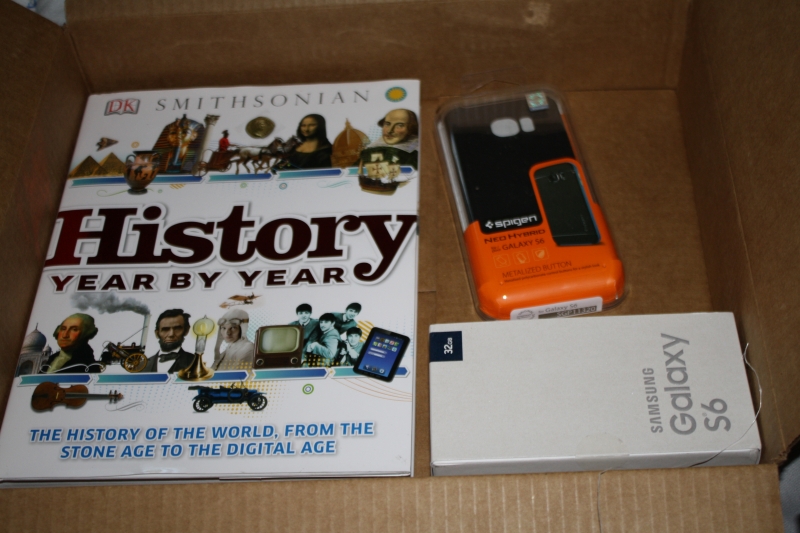
…for a new phone
I dropped my phone within six months of getting it, cracking the screen, but it’s worked okay since then. When the contract expired shortly after Tirzah Mae was born, I told Daniel I thought my phone was fine – we didn’t need to get a new one. Sure, it had some difficulties charging and the battery ran down quickly, but it met my needs. Then when I was in Lincoln for a week and Daniel in Wichita, we discovered that the phone calling function works only about half the time. We vowed we’d get me a new one before either of took another trip. The time got moved up a little more whenit became increasingly difficult to turn the screen off and on about a week ago. So now I have a fancy new phone with all the bells and whistles (including a case to prevent another screen cracking!)

Phone and Book

…for my first homeschool purchase since Tirzah Mae’s birth
We could pay $6 for shipping or $15 on another item to qualify for free shipping so Daniel asked if there was anything I wanted. I checked my list and didn’t really find anything, until, on a whim, I looked up the book I’ve been drooling over since I checked it out from the library: Dorling Kindersley’s Smithsonian History Year by Year. I expected it to be much too expensive (it’s hardcover and not a small book) – but, to my surprise, it was just under $19! I was getting ready to congratulate myself on not purchasing any homeschool materials since we’d been married, until I remembered that we’d stopped by a used store where I’d picked up an art text and a couple history books. I might be a compulsive homeschool shopper (and have been for the past 10+ years!)

Opening the fun colored package

…for adoption books
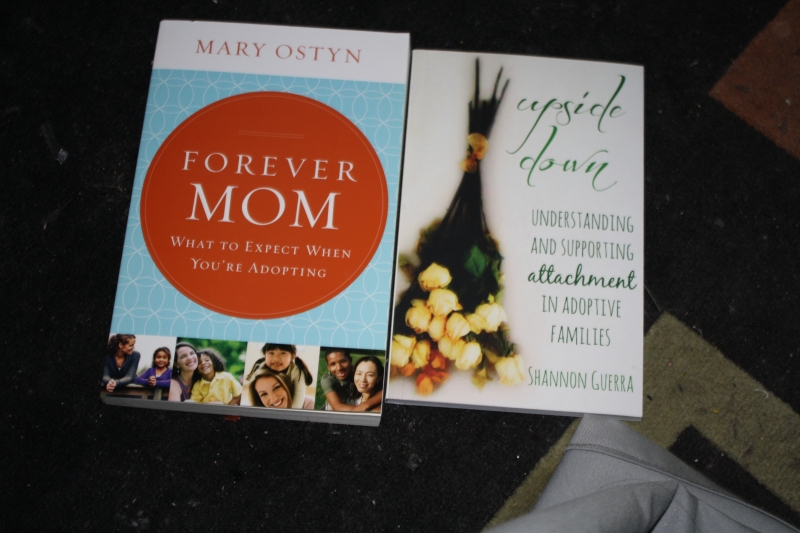
Mary Ostyn of Owlhaven recently hosted a giveaway of her book Forever Mom and Shannon Guerra of Copperlight Wood‘s Upside Down: Understanding and Supporting Attachment in Adoptive Families. Daniel and I have talked about adopting, would like to at some point, but don’t know much about the process at this point. I’m super excited to learn what these moms have to say about the process and how it works within existing families. (Sidenote: Do these books intrigue you? Shannon is hosting a giveaway of the same two – the giveaway is open until the morning of April 28, so go check it out!)

Adoption books
…for a heart-rending read
This one is a treasure that arrived in the mail a few weeks ago, but which I finished yesterday. It’s Stephanie Fast’s She is Mine – sent from Stephanie thanks to Carrie. I’ll be reviewing this soon – but for now, it’s enough to know that this book read like one of the best novels I’ve read in a long time – except that it’s not a novel, it’s an autobiography. It’s absolutely worth reading.

“Every good gift and every perfect gift is from above, coming down from the Father of lights with whom there is no variation or shadow due to change.”
~James 1:17 (ESV)

Thank you, Father, for these good gifts.


Different Definitions of “Custom”

Custom: adj Made to fit the needs or requirements of a particular person. (Definition from Merriam-Webster.)

When I think of the term “custom” (as an adjective), I think of something with a unique pattern created after a person’s needs. For example, if I were to say I created a custom outfit, I would mean that I had drafted a pattern for myself and created an outfit to my own specifications. If I were to adjust a pre-existing pattern to fit my body dimensions (by using one size bodice and another size skirt, for example), I would call it a “customized” dress.

I am beginning to believe that I may be the only one that makes this distinction between “custom” and “customized”.

The reason I think so is because my husband and I have started interviewing builders.

We’ve explored the floor plans builders have online, have walked through dozens of homes in the Parade of Homes (both last October and this month). And we’ve discovered that the current popular house plans are not our forte.

We have pretty specific ideas about flow (no traffic through the work triangle in the kitchen please!), lighting (get those living areas on the south side by all means!), placement of garages (we have an acreage – we don’t want the first thing you see to be a garage.) And pretty much every plan people are building in Wichita defies our specifications.

So we want a custom home.

We walk into the home of yet another builder and ask (usually the realtor, but sometimes we’re lucky and the builder himself is hanging around) a couple of quick questions: Does the builder build custom homes and does he build homes in our price range?

The response to the question of whether a builder builds custom homes is telling. One builder assured us that he did, turning to a plan he’d made (and could show off) that could be customized for a larger lot. Another talked of walking homebuilders through a half-built home and letting them choose where they wanted electrical outlets. One showed us how he’d done pillars instead of a solid wall in one of his stock plans.

Now, I’ve looked at thousands of houseplans (I’m not exagerating, people), and messed with quite a few. And while I’ve used some other plans as a jumping off point for my own plans, I’ve only once ended up with a finished product close enough to the original for me to consider it “customized” rather than “custom”. And I’ve found maybe three plans out of the thousands that comes anywhere close to meeting our specifications. Which means the chances that any builder in town has a spec that can be customized to meet our needs is virtually nil.

We’re looking for a builder who’ll build a custom home – and I’m discovering that one of the difficulties is sorting out which builders understand “custom” as I do.


The incredible, mutant eyebrow hair

“You have pretty eyebrows,” she told me. I carried that compliment around with me for years. She was an older girl, one of the cool girls. I was surprised that she even deigned to talk to me, much less to compliment me on the eyebrows I worked so hard to obtain.

That was when I was much younger, when I read beauty books. When I balanced pencils at just the right angle against my nose so I could arch my eyebrows just so.

Even as I plucked my eyebrows, I kept in mind the injunction that sometimes eyebrows don’t grow back after plucking. I needed to be judicious, to only pluck what I was willing to have never regrow.

I left the perfect arch behind with my teenage years (probably before), but plucking is still a part of my life.

This time, it’s trying to get rid of that ONE WHITE HAIR.

I can feel it when I smooth my eyebrows. It feels different from all the rest – coarse where the others are smooth.

I can see it when I look in the mirror, a blank spot amidst the otherwise dark hair, a disproportionately long hair amongst the normal-length hairs.

When I see it, I pull it, hoping that the books would be right, that continued plucking would cause that hair follicle to give up. But it never does. A new mutant hair springs up overnight, twice as long as the others.

I don’t remember what got us talking about it when my brother and his wife were in Lincoln at the same time as I, but we got to chatting about our eyebrows and my brother confessed that he too has the mutant hair. His hairdresser clips his every time he gets his hair cut – and it regrows to double length with surprising speed.

I seem to recall that my sister and I have commiserated over the hair as well.

One case, two does not a trend make. But three in the same family? Maybe there’s something in the genes. Within our otherwise perfect* genetic code lies a gene for that incredible mutant eyebrow hair.


*Okay, maybe our genetic code isn’t perfect. It seems that to perfect the mind, one must sacrifice somewhere. Our family’s genetic defects include not only a mutant eyebrow hair but persistently crooked (non-squishy) noses. :-)


Chronological Snobbery and my Library

Libraries experience a great pull to stay up-to-date, to provide the newest material and the newest technology. They’ve got to try to keep people interested in them, have to justify staying open. Who would visit them if they couldn’t provide the newest bestsellers, the neatest computers?

Sure, they could cater to the reference crowd, but honestly, with the internet explosion, who wants to dig through a paper copy of a reference work?

So libraries, willingly or unwillingly cater to what C.S. Lewis refers to as our culture’s “chronological snobbery” – assuming that newest means best.

Never is this more evident (or more annoying) than in my local library’s online catalog.

Wichita Public Library’s online catalog sorts search results by DATE, then by title. Which means that if you search for C.S. Lewis’s Mere Christianity, the title is third, below The Great and Holy War: How World War I became a Religious Crusade and C.S. Lewis at War: The Dramatic Story behind Mere Christianity.

In a surprising accident, the book I was searching for ended up on the first page. Searching for Lewis’s The Four Loves gives me 80 titles before I get to the one I want. And I’m lucky that The Four Loves was reprinted in 2004 – and that was given as the publication date. Otherwise I’d be waiting until response 101, a reprint from 1991.

Chronological snobbery.

You should really try it out yourself.

Thankfully, there is another option – I can select “Sort by Relevance” after the search is conducted and end up with the results I was actually searching for. But it takes extra steps that shouldn’t be necessary, wouldn’t be necessary if it weren’t for that darned chronological snobbery.


Book Review: 1984 by George Orwell

Who isn’t familiar with the phrase “Big Brother is always watching”?

It’s a phrase that’s entered into common parlance, quoted by people from all across the political spectrum. Actually, one thing ties together the frequent quoters – they’re generally Chicken Littles.

Okay, okay. That’s maybe a bit extreme. But the doomsday nature of those who quote Orwell’s famous slogan made me apprehensive as I started reading this novel. I continued on with this apprehensiveness for about the first third of the book. I love Orwell’s writing, loved how the story was drawing me in, loved his dystopia. And I thought, “How will I ever be able to discuss this with anyone? This is going to bring every ‘America is going to hell in a handbasket’ out of the woodwork.”

Then the story progressed and I lost myself into it, devouring it in just a few days.

It was an engaging story. I felt for Winston, the main character. I felt betrayed, heartbroken at the twist at the end. I contemplated the dreariness, not just of life under a completely totalitarian regime, but of life without Truth (with a capital T). You see, Winston dreamed of love and of freedom – both wonderful things, bits of eternity set within our heart. But the biggest hole in Winston’s life, the chasm so large he couldn’t even peer into its depths, was his lack of God.

Big Brother wanted to narrow his perspective. They wanted to narrow language so he couldn’t think anything they didn’t want him to think, wanted to narrow his dreams so that he wouldn’t look to anything beyond the now. They wanted to channel all his emotion into one thing and one thing only – love for Big Brother and hate for whoever was the enemy at the time (and had always been the enemy).

In a way, Big Brother succeeded, even while Winston was dreaming of love (and carrying on an affair), even while Winston was dreaming of freedom (and joining a revolutionary society). Winston wasn’t so narrowed that he could not dream of life outside of Big Brother’s control – but he was so narrowed that he never even dreamed of a Life (with a capital L) that could make him free even under Big Brother’s eye.

I’m still apprehensive about discussing 1984, still fear the doomsdayers. Truth is, this nation, just like every other nation has ebbs and flows. Freedom never lasts long, and even while it lasts, it is often more illusory than we make it out to be. And political freedom, as much as I love it and desire it and want to fight for it, is only one small thing.

One can be politically free, can be free from the “thought police”, can be able to live one’s life in peace and still have just as empty a life as Winston Smith. And one can be politically bound, can be under physical and emotional and mental persecution because of one’s beliefs, can be tortured in this life and still be absolutely free.

Because freedom isn’t political, it’s spiritual. And God is bigger than every Big Brother.

That’s what I came out of 1984 with – a conviction that the solution to totalitarianism is not democracy or republicanism (neither in the party sense or the form of government sense), the solution to totalitarianism is Christ.


Rating: 5 stars
Category: Dystopian fiction
Synopsis: Winston Smith dreams of a life outside of Big Brother’s totalitarian regime – and tries find it.
Recommendation: Engaging, thought-provoking, and on every reading list in the country (for good reason).

I read this as a part of Carrie’s Reading to Know Classic Bookclub.