Thankful Thursday: Perspective

Yesterday felt like one of those awful, terrible, no-good days.

I got cavities filled on both sides of my mouth and my teeth ached for the rest of the day.

The realtor for one of the builders we wanted to interview contacted Daniel in the morning to see if we could meet that afternoon (I wanted to – well, I actually told Daniel to say no. I think it’s incredibly rude and unprofessional to expect someone to make plans on that short of notice. I had a dinner on the menu that required me to be in the house for a good part of the afternoon and really didn’t want to be disturbed. But I found some food in the freezer that I could thaw quickly and put in the crockpot, so we went ahead.)

I started messing around with one of the floor plans we’ve been looking at and lost most of the day with what ultimately turned out to be unproductive adjustments.

Our meeting with the builder didn’t give the information I sought and made me further annoyed with the realtor – and resulted in the conclusion that the house plan I like best would be basically unsellable in our community should we ever want to or need to move.

Furthermore, Tirzah Mae had a blow out while we were meeting with the builder and I was definitely not in the mood to deal with it once we got home. Instead, I sat on the couch with a bag of chips, moping and feeling bad about being a bad mother by letting my daughter sit in dirty clothes while I was pouting.

And then Jason showed up.

Jason who considers David Garcia (Daniel doesn’t bother to correct him) his friend.

Then again, he’d probably consider anyone who gives him tennis shoes and rides across town and meals at restaurants a friend.

Because Jason is homeless.

He asked for food and Daniel consulted with me. We invited him in, heated up some homemade pizza rolls, gave him a glass of milk.

He talked at us until 8 o’clock rolled around and Daniel had to tell him he’d need to finish up dinner quickly because we needed to get to bed. Truth is, we usually start preparing for bed long before that.

He left and I sprayed down the house to rid it of the peculiar odor of unwashedness and stale cigarette smoke. My petty complaints seemed so little when I looked at Jason.

I have people who love me, who delight in my presence. I have conversation, real conversation, with people who value my opinion and whose opinion I value. I have food and shelter and clothing that fits. I have a (relatively) clean toilet to relieve myself on and a sink to wash up. I can bathe or shower every day. I can hide from the sun when I want to, can seek out its warmth when it’s pleasing to me. I have food in abundance. I have a home and a clean bed to sleep in every night. I have options for travel – my feet, a bicycle, two cars. I have a mind not blown out by drugs. I have a marriage not destroyed by drugs.

And I have Jesus. Oh, of all the things I have that he lacks, this is the best, the most precious. Even if I were reduced to his level of poverty, I would still have Jesus. As he rambled his mostly incoherent fragments, rarely pausing for us to reply and interrupting us if we ever tried, I was reminded how thankful I am that I have Jesus.


Book Review: The Pursuit of God by A.W. Tozer

One can’t read A.W. Tozer’s The Pursuit of God without grappling with the question of knowledge of God versus experiencing God. It’s the central theme of the book.

Tozer argues that it is insufficient to simply know about God or to pursue knowledge about God – but that one must pursue God Himself and experiences with God.

I agree.

The difficulty comes in when we start to make one exclusive of the other. When we start to think that pursuing God means not pursuing knowledge of God. When we start thinking that knowing about God precludes experiencing God.

And that’s exactly what Tozer seems to do.

It’s hard for me to put my thoughts about this book into words because my thoughts are so mixed. Certain passages in this book had me nodding my head and saying amen, some even brought tears to my eyes, so true and so profound they were.

“…Faith is the gaze of a soul upon a saving God….

Believing, then, is directing the heart’s attention to Jesus. It is lifting the mind to ‘Behold the Lamb of God’ (John 1:29) and never ceasing that beholding for the rest of our lives.”

I love it – and Scripture testifies to it.

But the passage I just quoted is a part of a thought experiment in which Tozer asks what an “intelligent, plain man, untaught in the truths of Christianity” would think upon reading the Scriptures. This thought experiment is a part of Tozer’s regular derision of education in the truths of Christianity and of those who seek doctrinal truth.

I despise his derision.

Much of my mixed opinion of this book probably comes from having belonged to churches that belonged to either of these camps. I spent my teenage years in a church that explicitly or implicitly valued experiences with God over knowledge of God. There I saw (and experienced) great passion for God and willingness to do God’s will – coupled with a tendency to be pushed to and fro with every wind and wave of doctrine and to lose faith when experience wasn’t forthcoming. Now, I belong to a church (and more generally, to a doctrinal camp) that explicitly or implicitly values knowledge of God and right theology over experience. Here, I see a great passion to understand the word and to trust what God has spoken – couple with a tendency
to value right thinking over right living and to draw the lines of orthodoxy so narrowly as to exclude most of the Christian world.

Reading The Pursuit of God reminded made to long for and delight in the experience of my youth – but Tozer’s animosity towards training in theology, really towards any Biblical education besides a man and his Bible in a closet, made me thankful to belong to a church and a doctrinal camp that values education.

Because what Tozer misses is that the more you know, the greater you can appreciate. Knowing about justification doesn’t keep you from experiencing a right relationship with God – in fact, it deepens your ability to experience that relationship, because you understand by faith what you don’t always feel. And often, knowing and understanding by faith leads to experiencing.

So, very mixed thoughts and feelings towards this book – so much so that I can’t really write my usual end-of-the-book-review synopsis and recommendation. Sorry!


I read this as a part of Carrie’s Reading to Know Classic Bookclub. To read more thoughts on the book, check out the March summary post.


Like me, not like me

There are a couple of families of my ilk at the ALDI I frequent.

Frugal women with long hair, wearing skirts and with children in tow.

I silently appraise them, count their children (oh, yes I do!), and note all the daughters also in skirts. I sort through the possible categories in my mind. Gothardite/ATI. Biblical patriarchy. Quiverful. Every category I try to place them in has negative connotations in my mind – but every time I see them, I smile. These are people like me.

I see them silently appraising me. Mentally calculating. Am I one of them? I have the hair, the skirts, the frugality. But only one child at my age? And the skirts that show my knees? Occasionally, a bra strap peeking out? I am a woman not like them.

When I see these women, I assume that they love children and family. I assume that they haven’t bought into our culture’s maxim that children are too expensive. I assume that they love their husbands and submit to them. I assume that they think there are differences between men and women and that femininity is something to be appreciated. I assume that they are like me.

When I see these women, I assume that they don’t use birth control, that they went straight from their fathers’ homes to their husbands’. I assume that they think that femininity means always wearing skirts and modesty means making those skirts long. I assume that they’re not like me.

Every time I see them, I rejoice to find women like me. Every time I see them, I sorrow that even in this I have found women not like me.

I very clearly don’t belong to mainstream mommy culture – my values, beliefs, opinions, and practices are frequently in opposition to theirs. I feel a great kinship with these women I see in the grocery store, these women who are so counterculture.

I wish I could be a part of them. Not because I want to take up the things they believe and do that I do not – but because I want to be a part of their group. I want to have friends, even just A friend who feels like I do or acts like I do.

I’ve probably seen her before, the woman who was in front of me in line with her two little girls. We’ve probably appraised each other before. But this time, after the appraisal, she turned to me and struck up a little conversation – the small talk we have in stores, about leaving our reusable shopping bags at home in a neat pile. It was ordinary and extraordinary.

And it made my heart yearn, like running into these women so like me and not like me often does. It made me yearn for a friend.


Book Review: I was a Really Good Mom before I had Kids by Trisha Ashworth and Amy Nobile

Are you tired of scrolling through the Facebook newsfeed and Pinterest front page, feeling more and more like a failure at motherhood? Have playdates become torture as you learn from other mothers yet another thing good mothers simply MUST be doing? Do you wince as you set the store-bought cupcakes you swore you’d never purchase next to another mom’s fancy homemade cookies on the Bible study snack table?

If so, you might find Ashworth and Nobile’s I was a Really Good Mom before I had Kids a helpful perspective-check.

When I first picked up this book, I figured it must be a memoir, full of stories of a mother failing to live up to her expectations. Alas, a memoir it is not – but despite not being what I expected, I enjoyed and appreciated this book.

Ashworth and Nobile found for themselves that motherhood wasn’t at all what they expected, and got tired of feeling so… defeated … as mothers. They didn’t feel at all the happy, perfect, “good” moms that every other woman seemed to be. They wondered if they were the only ones who felt this way – and they set out to find out the truth about those other mothers.

They interviewed hundreds of mothers and discovered that they weren’t the only women who felt like failures as mothers. They discovered that more mothers than not “love their children, but not being mothers” – and they set out to write a book to help women learn to love motherhood as much as they love their children.
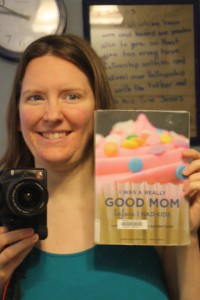
Me with book "I was a Good Mom Before I had Kids"

The book goes through a series of steps to help moms do just that: align their expectations with reality, make peace with their choices, lose the judgment, let go of the guilt, communicate with their husbands, take time for themselves, learn to say no, and live in the moment.

Each step has its own chapter, which begins with a tongue in cheek quiz, such as the one that asks you to “rank these questions in order of bitchiness” and offers “That’s so cute – he has Spider-Man shoes and a Spider-Man lunch box. Does he watch a lot of TV?” as one of the options. After each chapter, the authors offer several action items to help mothers work on the topic broached by that chapter.

While the general concept of this book is not new (there are certainly dozens if not hundreds of books and articles and blog posts on the same subject), I feel like the authors did a good job at creating balance within their book. It seems to me that articles I’ve read in this category tend to fall into two different camps: the you’ve-got-to-take-care-of-yourself camp and the you’ve-got-to-lose-yourself-in-your-child camp.

The you’ve-got-to-take-care-of-yourself camp elaborates a series of self-care rituals that mothers ought to engage in so as not to become bitter over motherhood. Mothers should take time to go to the spa to get a massage or their nails done. They should work out daily. They should eat healthy. These articles tell moms that they need to do these things for themselves – and for their kids. Because a mom who doesn’t take care of herself isn’t good for her kids. The authors of this book discuss the need for mothers to take time for themselves (and for the same reason), but instead of giving another list of things mothers ought to do (and therefore feel like failures for not doing), they encourage mothers to think through and find out what things make them into “a person they enjoy being with”. The authors acknowledge that motherhood may change the things that women find enjoyable – and that’s OKAY. Maybe crafts used to energize you, but now facing the prospect of cleaning up after crafting makes you cringe. Maybe you used to think seeing movies in a theatre was pointless – but now the thought of being able to be in a dark room with no one talking to you is your idea of bliss. That’s OKAY. The important thing is finding out what makes you tick where you’re at now, and finding some way of incorporating that into your life.

In contrast, the you’ve-got-to-lose-yourself-in-your-child camp argues that mothers spend way too much time worrying about the laundry and the dishes and the myriads of things that need to get done – and says that what mothers really need to do is recognize that their children have only one childhood and it should be spent cuddling/playing/talking/reading/exploring with their mothers. So moms should just be okay with the dishes and laundry not being done, meals not being prepared, errands never run, etc. This perspective also tends to make moms feel like failures – because, try as they like, they still can’t feel good about mountains of laundry and unwashed dishes and unmade meals. The authors of I was a good mom address this topic as well – “live in the moment” and “align your expectations” – but they do so in a way that helps moms think through what really is important to them and in a way that acknowledges that mothers will never be able to completely “drop everything.”

In short, I highly recommend this book to mothers who feel overwhelmed by the task of mothering. While I’ve not yet dealt with many of the frustrations discussed in this title, I’ve certainly discovered the need to adjust my expectations since becoming a mother.

As a short caveat, this book is not written from a Christian perspective and there is some inappropriate language found within. Additionally, while the authors do a decent job of encouraging women to understand their husbands’ perspectives in parenting and to communicate well with their husbands, some of the quotes from the women they interviewed convey highly unhealthy attitudes towards husbands.


Rating: 4 stars
Category: Mothering
Synopsis: The authors encourage moms to learn to enjoy motherhood by letting go of unrealistic expectations and developing healthy attitudes and behaviors for mothering.
Recommendation: Recommended to mothers who are struggling with mommy guilt, fighting in the mommy wars (or wishing they could get out of the crossfire), or who are just plain overwhelmed by mothering.

RIP, dear old blog

It’s tragic, watching a dear old blog die.

You’ve followed it for years, seen its posts appear in your feed reader or inbox daily. But then the posts come less frequently. They trickle to a minimum that’s mostly composed of “why I haven’t been blogging” posts. One day, you realize it’s been months since you last saw a post. You check the website just in case it’s been your feed reader that’s messed up – but no, the site is now dead.

Yes, that type of blog death is sad and painful – but equally painful is the blog that keeps on living, but is no longer the friend it used to be.

You used to devour every word the blogger said, excusing the occasional post on a topic you disagreed about or found uninteresting. But then something happened and whether gradually or abruptly, the blogger started posting more and more on the uninteresting or disagreeable things and less and less on the things you like. Your tastes diverged and what you once had in common has been lost.

You start to contemplate unfollowing – but you’re reluctant to do so, given the long relationship you’ve had.

It seems there are several blogs on my blogroll that have been coming to that point lately.

My daily reading has gotten cluttered up by sponsored posts – thinly veiled advertisements for products I couldn’t care less about. I understand the desire to have something monetary to show for the time and energy you put into blogging – every so often, I wish I could get something physical out of it too. But I started following your blog because of the stories you told, the insights you had, the books you reviewed, the recipes you shared, the camaraderie we had. When you occasionally shared about a product, it was because you loved it so much you simply had to share it – not because you were getting paid to do it. What was a friendship is now marketing – and frankly, I don’t care to be marketed to by my friends.

Other blogs, like a group blog I’ve been following, have slowly become less and less interesting to me. Contributors change and these ones have tastes and preferences that aren’t as much in line with mine. I still read them because it challenges me to be exposed to different opinions. But when they also switched to giving just excerpts instead of full posts in their feed? I’ve stopped clicking through.

And then there’s the blog I’m willing to name. When I started following Twenty-Two Words, it was a blog consisting of daily posts written by Abraham Piper. Each post was 22 words long and may have been profound, funny, or thought-provoking. When thinking up 22 word posts became to onerous for Piper, he switched to sharing short clips of interesting things from around the web. I kept following because the posts were short and amusing. But now? Now a dozen (I don’t know the exact numbers) contributors post a half dozen posts daily, each one consisting of lists of twelve or more items with corresponding graphics. The titles have gone from descriptive or evocative to absurd clickbait: “This man took thousands of pictures of flowers. You’ll be amazed at the result.”

I liked short and interesting, twentytwowords. You’re giving me long and laborious. If I wanted Buzzfeed, I’d have subscribed to Buzzfeed. I wanted the blog you were.

It’s sad when dear old blogs die, whether from lack of attention or the wrong kind of attention.

I’ll mourn them each as they go, but the time comes when I’ve got to let dead blogs die – and move onward and upward into better things.

RIP, dear old blog.


Spring Break 2015

Spring Break in high school and college almost always fell over my birthday (before the official start of spring!) – and I enjoyed it, but I didn’t realize how much I took it for granted until I moved off the academic calendar.

Then summer break became a week-long vacation or a 5 day weekend, a day instead of a week for Christmas the norm, and Spring Break nonexistent.

Except that this year, Tirzah Mae and I took a spring break.

My brother and sister-in-law and nieces were taking one of their biannual trips to Lincoln – and we’d promised to work on our parent’s basement as a Christmas gift.

So we spent a packed week in Lincoln – driving up Friday March 27 and coming back just yesterday, April 5.

Between there, we painted two rooms, moved some furniture, played with cousins, went to our favorite only-in-Nebraska restaurants, were completely spoiled by aunts, uncles, grandmas, grandpas, and cousins, and ate way too many jelly beans.

Also, we put on a Seder meal for twenty and visited with Tirzah Mae’s great-grandparents.

(Click on the photo to comment on individual photos.)


Rice Cereal Time?

Tirzah Mae had her “4 month” appointment today (Born five months ago and due 3 months ago) – and her doctor went through the standard four month advice, ending with “You can also start rice cereal now.”

To which Tirzah Mae’s dietitian mother answered, “Thanks but no thanks.”

Despite what your next door neighbor, the label on the baby cereal, and maybe even your family doc says, you do not need to introduce solids at 4 months. Most babies don’t need anything but breastmilk or infant formula until they’re six months old – and both breastfed and formula fed infants are at a disadvantage if they start solids too early.

For breastfed infants, the risk of adding solids before six months is related to what we breastfeeding people call the “virgin gut”. As long as Tirzah Mae is only receiving breastmilk, her gut has a protective layer (a simplified explanation that isn’t precisely correct, sorry!) that practically sheds pathenogenic bacteria and other icky stuff. Once that layer has been broken, baby can get sick more easily (now, don’t get me wrong – this does not mean that breastmilk is no longer beneficial after the gut’s barrier has been broken – keep breastfeeding even if you introduced solids prematurely!) The longer the breastfed baby waits before breaking that barrier, the better off she is – to a point. That point is right about 6 months , when an infant’s iron stores from birth are depleted and she needs some extra iron (this is why iron fortified infant cereal is recommended as baby’s first food).

For the formula fed infant, there’s no gut barrier to break – it’s been broken long ago (after that first two ounces of formula), but that doesn’t mean that we should be gung-ho about starting those solids right at four months. A few babies are developmentally ready at four months – but the vast majority develop the head and neck control needed to safely eat solids later. And introducing solids too soon can risk replacing the relatively nutrient-rich formula baby has been receiving with the (mostly) “empty calories” of (most) “Stage 1” baby foods (as well as increase risk of allergies).

So, when SHOULD you start solids?

If you’re breastfeeding your baby, when your baby shows signs of developmental readiness, no sooner than six months. If you’re formula feeding, when your baby shows signs of developmental readiness, no sooner than four months.

What are these signs of developmental readiness I speak of? I’m so glad you asked.

First, your baby should be sitting up with minimal support. This means with a pillow behind him – not strapped into a seat with a five point harness or sitting in a Bumbo.

Second, your baby should be able to hold his head steady and make controlled head movements in the sitting position. If I had a dime for every parent who has told me their two week old already has great head control… Remember, I said “in the sitting position”.

Finally, your baby should open his mouth wide for a spoon of food and close it once the spoon’s inside. If your baby is still sticking out his tongue when the spoon touches his lips, he’s not ready for solids. His tongue is under reflexive control – it needs to be under his control before he starts eating solids.

As for Tirzah Mae? We’ll be breastfeeding with nothing else added at LEAST for another month (six months from her birthday) but probably closer to three more months (until six months after her due date).


Nightstand (March 2015)

Reading through my list here in preparation for publishing, I see that I read quite a bit more this month than I had realized. Yay!

What's on my Nightstand in March

Fiction read this month:

  • Heart of Darkness by Joseph Conrad
    I read Heather’s pick for last month’s Reading to Know Classics Bookclub and wrote some reflections on what “the heart of darkness” refers to.
  • The Nonesuch by Georgette Heyer
    I continue to enjoy Heyer’s books – they’re one of my favorite escape-novels. In this one, I rather fell in love with the ideal Miss Trent (and wrote about it, of course!)
  • The Battle for Skandia by John Flanagan
    I continue to very much enjoy the Ranger’s Apprentice series. This one goes to new heights of excitement when Will and company are called upon to assist the Skandians (Scandinavians) in fighting off the Temujai (the Mongol horde).
  • The Storied Life of A.J. Fikry by Gabrielle Zevin
    I read this with my in real life book club and look forward to discussing it this Thursday. This is a readers novel, full of references to other works – although I didn’t notice the parallels with George Eliot’s Silas Marneruntil my husband, who is reading it on my recommendation, pointed it out. Read my full review here.
  • Tom Thumb: Grimms’ Tales retold by Eric Carle
    Very nice retellings of four of Grimms’ Tales, accompanied by Carle’s characteristic illustrations. I borrowed this from the library, but I’d like to own a copy.
  • The Barefoot Book of Mother and Son Tales retold by Josephine Evetts-Secker
    An interesting collection of folk tales from around the world. I was a bit disappointed with how the author retells the Grimm Brothers’ “Hans in Luck” (mainly, leaving out the very last few lines about how the boy recounted his great luck to his mother) and I didn’t at all like how the story of Moses was told (as a tall-tale with extrabiblical and anti-biblical details.) But most of the ten stories were entertaining.
  • 5 picture books author last name BROKAMP to BROWN
  • 4 board books by Sandra Boynton
    I like her. I like her a lot.

More on my Nightstand in March

Nonfiction read this month:

Books about Parenting:

  • Dad is Fat by Jim Gaffigan
    Our library (Wichita’s Central library) has an abismal collection of audiobooks, and Jim Gaffigan’s Dad is Fat was one of the three that caught my eye before we left to visit our family in Lincoln. It was the one of the three that Daniel was interested in, so we listened to it on our way up (and down). In general, I enjoy Gaffigan’s humor and enjoyed listening to this book, although I’d heard many of the anecdotes already from watching him on YouTube. Gaffigan is widely considered to be “family-friendly” (something he makes fun of), but this book did include a few expletives.
  • The Wonder Weeks by Hetty van de Rigt and Frans Plooij
    Discusses how infants and toddlers go through predictable patterns of fussiness associated with leaps in mental development – and how parents can assist their children through these leaps. I found this massively helpful – it kept me focused on development instead of frustration when Tirzah Mae went through her first three “wonder weeks” (at 5, 8, and 12 weeks corrected for prematurity – so 13, 16, and 20 for her.)
  • Retro Baby by Anne Zachary
    Written by an occupational therapist, this book is all about gear-free ways to play with your infant – along with literally hundreds of reminders to only put a child to sleep on her back in a crib, to give her plenty of supervised tummy time, and to avoid putting baby in a container (swing, bouncy seat, or carrier) for more than a half an hour a day. I think I would have enjoyed this a lot more if I’d have started reading it now (when I can actually do some of the activities with Tirzah Mae) versus three months ago (when only the aforementioned warnings were really pertinent due to her stage of development.) Very nice activity ideas, pertinent warnings – but probably unrealistic (For example – sometimes I place Tirzah Mae on her tummy unsupervised while I fold laundry. If she falls asleep in her swing, I’m not going to wake her up to move her to the bassinet. And if making dinner takes longer than 30 minutes? She’s going to spend more than 30 minutes in her bouncy seat. Also, yep, we’ve done the cosleeping thing.)

Books about Houses:

  • Tips and Traps When Building Your Home by Robert Irwin
    Helpful look at the process of building your own home – along with tips for getting things done right and warnings to avoid doing things wrong :-)
  • 500 Bungalows by Douglas Keister
    It almost feels wrong to list this among the books I’ve read – because, apart from the introduction, it contains only photographs and locations. The entire book consists of photographs of bungalows from around the country. Quite a few were from my hometown, Lincoln Nebraska – and I found it interesting that I tended to like those houses more than the ones from, say, California (the southern houses generally have flatter roofs, since they don’t need to deal with heavy snow loads – and I’m just not a fan.)

Other nonfiction:

  • Christmas in Canada and
    Christmas in France by World Book

    Who says you can only read about Christmas in December?
  • The VBAC Companion by Diane Korte
    I am reading all I can, hoping to have a successful VBAC the next time around. This was a good resources – and one I’d definitely recommend to others, but it didn’t quite meet my expectations (mostly because I already have a very supportive OB and midwife and don’t really need help finding ones.) Read my full review here.

Books currently in progress

Currently reading:

  • I was a Really Good Mom before I had Kids by Trisha Ashworth and Amy Noble
    A little different than what I expected – but overall a pretty good book along the lines of getting rid of mommy guilt and having reasonable expectations in mothering. I recommended it to my sister-in-law (who’s much more in the throughs of mothering than I, with a three year old, a two year old and one on the way!).
  • Sleep: The Brazelton Way by T. Berry Brazelton and Joshua D. Sparrow
    Because Tirzah Mae is 5 months old (3 once corrected) and it’s time to start being intentional about sleep.
  • Give Them Grace by Elyse Fitzpatrick and Jessic Thompson
    Reading and discussing with my sister-in-law. At the end of the first section, I think some of the examples are on the sermonizing side – but I agree completely with the need to fall upon God’s grace in parenting, not on our wonderful parenting techniques. If there’s one thing I’ve learned so far, it’s that it’s only by God’s grace that our children will ever be “good” (or that we’ll ever be “good parents”.)
  • Vaginal Birth After Cesarean: The Smart Woman’s Guide to VBAC by Elizabeth Kaufmann
    One chapter in, it’s already obvious this author has a chip on her shoulder and is NOT pro-VBAC.
  • The Ultimate Breastfeeding Book of Answers by Jack Newman and Teresa Pitman
    Newman is one of the foremost experts in breastfeeding medicine – and I love the way he lets his voice come out in this informative and practical book. It won’t be for everyone, but I did write up some comments on one passage here (regarding whether breastfeeding should be considered the norm or the ideal “best”.)
  • The Pursuit of God by A.W. Tozer
    Reading for this month’s Reading to Know book club – I agree with Barbara’s liking AND Carrie’s disliking. (Oh my!) Will write more when finished.

Don’t forget to drop by 5 Minutes 4 Books to see what others are reading this month!

What's on Your Nightstand?


Book Review: The VBAC Companion by Diana Korte

I’m sure it will come as a total shock to my readers – but I’m hoping for a vaginal birth the next time around.

I know, I know. You’re having a hard time wrapping your head around it.

Truth is, even if I weren’t all about natural childbirth and minimal interventions and maximizing chances at successfully establishing breastfeeding (all good cases for vaginal birth after c-section, or VBAC), I want to have lots of kids. And you can only have so many repeat cesareans.

So I’m planning on doing everything I can to work toward that end.

Diana Korte’s The VBAC Companion is the first resource I’ve picked up – and it’s a pretty good one. It outlines the case for VBAC, as well as the risks associated with it, and then goes right into how to plan for your VBAC.

The bulk of the book consists of finding a medical professional and a birthing location that are supportive of VBAC.

Turns out, the most important thing you can do to ensure success of your VBAC attempt is to have supportive attendants. Having a doctor or midwife who believes in VBAC, who has practices that support successful laboring (versus “trials of labor” that root against a woman), and who has successfully helped women have VBACs is HUGE.

The final part of the book was about laboring – mostly the general stuff you’d learn in any childbirth preparation class. How to manage pain and keep labor moving by moving around and assuming different positions. Which interventions help a woman to labor well and which slow or stop labor. Helpful things, but not ones unique to VBAC.

This was a good book on preparing for a VBAC. I would imagine that most women who want to attempt a VBAC will find it very useful.

I didn’t.

You see, I was hoping for something more. I was hoping for guidelines for physical fitness, exercises to do. I was hoping for weight gain guidelines. I was hoping for more specific laboring advice. Not that the other stuff isn’t important. I know the stuff this book discussed is the most important stuff for ensuring success. It’s just that I’m blessed to already have two extremely supportive attendants. I know that when I try again, my midwife and my OB are both rooting for me and are going to do everything in their power to help me to be successful.

So, I keep searching for that other stuff (I have a feeling I might not be able to find it in a book – so I’ve got a meeting scheduled with my midwife to talk about what she’s found to be helpful with other women).

Meanwhile, I can wholeheartedly recommend this book as a resource for other women who are hoping for a VBAC, especially for those who don’t know their OB, doctor, or midwife’s track record on VBAC and need help choosing a supportive professional.


Rating: 4 stars
Category: Pregnancy/Childbirth
Synopsis: Rationale for choosing a vaginal birth after cesarean and how to plan for a successful VBAC.
Recommendation: If you are interested in trying for a VBAC, this is a good resource.


Breastfeeding: Normal or Best?

It’s popular, in breastfeeding circles, to talk about how breast isn’t best – it’s normal.

In general, I find the arguments uncompelling (and whenever I do find one compelling, it is unable to withstand discussion with my husband, who is my resident sharpener-of-thought.)

The problem with the debate, I think, is that it adds nothing useful for the woman who is undecided or opposed to breastfeeding. It serves as a rallying cry for the lactivist, but does little for average-Jane-moms.

The other problem with the debate is that there are a couple of different definitions of normal that come into play. There are cultural norms and physiologic norms – two quite different things. Cultural norms refers to what is usual or expected in our cultural. Unfortunately, breastfeeding is not currently normal in our culture. Physiological norms refers to the expected standard for health. So a physiological norm might be a BMI between 18 and 25 (despite many in our culture falling above that range).

Proponents of the “breastfeeding is normal, not best” argument state that using the “best” terminology suggests that breastfeeding is something that women can do to go above and beyond – like telling them that a glass of wine daily can reduce their risk of heart disease. No one would fault a woman for choosing not to go the extra mile to drink a glass of wine daily. They could still be acting appropriately and normally without consuming wine. But breastfeeding is not like a glass of wine daily, adding some benefits but not really something women should be expected to do.

In my opinion, this only adds fuel to the mommy-war flame, without really helping women (who experience great pressure from cultural norms opposing breastfeeding.)

To tell a woman that something is normal and expected physiologically (as it certainly is – just as heterosexual sex is normal and expected versus homosexual sex**) before it is normal and expected culturally is more likely to cause her additional anguish rather than to assist her in making a decision and holding to it.

As an aside, I would love to live in a world where breastfeeding was the cultural norm – where women breastfeeding was common and accepted and where bottles were not the ubiquitous symbol of a baby. I would love to live in a world where all husbands made enough money that their wives could stay home for a minimum of six months after delivering so they could breastfeed their babies (without having to pump and provide expressed breastmilk) – and where there were no husbandless mothers. But that is not the world we live in, so calling breastfeeding “normal” when it is not culturally so confuses the issue.

So I’m not a fan of the “normal” argument. Or at least I wasn’t until I read the following in Jack Newman and Teresa Pitman’s The Ultimate Breastfeeding Book of Answers:

“There is no evidence that what is called ‘breastmilk’ jaundice is bad for the baby. None. On the contrary, bilirubin may be good for the baby, protecting him from potentially damaging chemicals in the body. What we have here is a lack of understanding; that is, too many people do not understand that breastfeeding is the normal physiological method of feeding infants and young children. If most exclusively breastfed, well-gaining babies are jaundiced, then this is normal and not a concern. On the contrary, we should be concerned about babies fed with formula (advertised as being ‘close to breastmilk’) who are not jaundiced. What’s wrong with them that they are not jaundiced? The breastfed baby should be the model of what to expect, not the artificially fed baby.”

This argument, I can agree with wholeheartedly. It would be incredibly useful if medical practitioners got used to the reality that breastfeeding is the physiological norm – and evaluated babies accordingly. If medical practitioners had growth charts that expressed biological norms for breastfed babies instead of formula fed babies, it is likely that fewer women would be encouraged to supplement with formula. If medical practitioners understood biologically normal levels of bilirubin and blood sugars in the breastfed neonate, many more women would be able to successfully establish breastfeeding.

This is a “normal” argument I can get behind.

As another aside (in other words, stop reading if you’ve got hurts related to breastfeeding that are exacerbated by women celebrating breastfeeding), I love Newman and Pitman’s follow-up paragraph:

“For these reasons, there is no call to take the baby off the breast for 24 or 48 hours ‘to be sure that it is breastmilk jaundice,’ and to bring the baby’s bilirubin down to those of the artificially fed baby. In fact, logically, we should not be worrying the breastfeeding mother at all about her jaundiced baby. We should be saying to the formula-feeding mother, ‘Your baby’s bilirubin is too low. This is probably not dangerous, but just to make sure that it is the formula that is keeping his bilirubin too low, I would like you to put the baby to the breast for a few days, so that his bilirubin moves up into the normal range.’ That’s logical.”


**Please don’t misunderstand me, I am in no way suggesting that formula feeding and homosexual sex are at all morally equivalent. That is absolutely untrue. What is true is that they are both different from the physiological or biological norms.