Book Review: The Storied Life of A.J. Fikry by Gabrielle Zevin

“It’s a good book?” Daniel asks me, as the dozenth chuckle emerges from my lips. He’s stopped asking me what’s so funny, as the humor is lost without context.

Yes, it’s a good book. It’s a reader’s book. Full of references to other stories, calls to tropes, twists on standard tales. It’s a reflective book without being self-conscious.

I laughed. By the end, I cried.

The Storied Life of A.J. Fikry is about a bookseller, a widower with defined literary tastes who rather wants to run his bookstore to the ground while killing himself with drink. Now that Nic is dead, what has he to live for?

But a valuable book goes missing while he’s passed out drunk one night – and now his “insurance” is gone. It takes a stolen book, an unlikely friendship, and an abandoned child – but slowly, A.J. Fikry’s life starts to take on meaning again.

Each chapter opens with a book review of sorts: a blurb A.J. wrote about a book or a short story, hinting at what made that story important to him and worth reading to others. While I’d read only a few of the highlighted stories, Fikry’s descriptions were rich – and the connection between the stories he read and the stories he lived most interesting.

“It is so simple.
Maya…I have figured it all out–
The words you can’t find, you borrow.

We read to know we’re not alone.
We read because we are alone.
We read and we are not alone.
We are not alone.

My life is in these books–
Read these and know my heart.

We are not quite novels–
We are not quite short stories–
In the end, we are collected works.

This novel is sure to resonate with other readers as it resonated with me. I recommend it.

My recommendation is not without caveats, however. My readers will want to be aware that this book contains a few expletives and several instances of non-explicit sexual immorality.


Rating: 5 stars
Category: Literary fiction
Synopsis: Widowed bookseller A.J. Fikry is ready to give up on life when a stolen book, an unlikely friendship, and an abandoned child change his course completely.
Recommendation: A book lovers book – if your life has been changed by the stories you’ve read (and vice versa), you’re likely to enjoy this book.


Thankful Thursday: Anniversary and Birthday Week

Thankful Thursday banner

Daniel and I got married five days before my 28th birthday – so I have a week of celebration in March!

This week I’m thankful…

…for gorgeous weather
The weather can’t have been nicer over the past week – and Tirzah Mae and I took full advantage when shopping last Thursday. We skipped the maze of construction (on all four streets at the corner of our shopping center) and walked from Aldi to Walmart for our groceries. The weather must have made others cheery too, because no less than 8 people stopped us during our excursion to comment on my sweet baby or ask about the MOBY wrap :-)

Tirzah Mae finds her fist

…for for birthday burgers
I signed up for Red Robin’s “Royalty”, which means I get a free burger the month of my birthday – and Daniel and I went to redeem it Saturday night. It’s always nice to have a night off cooking, even nicer when it means an evening of simply chatting with my beloved (without our computers or books or television or the laundry to distract).

…for Skyping with my sister-in-law
Debbie and I are reading together again (this time Elyse Fitzpatrick and Jessica Thompson’s Give Them Grace) and Skyping weekly to discuss. This week, we barely got to discussion, but it is always so wonderful just to chat with my former mentee turned friend turned sister-in-law (and since she’s expecting her third, this time she has stuff to teach me about mothering :-))

Enjoying her lovey

…for a lovely evening in
For our anniversary, I cooked one of Daniel’s favorite meals and set us up at the table with a tablecloth and everything. We sat Tirzah Mae in a bouncer beside us and she kept herself occupied the entirety of the meal (a VERY unusual occurrence – usually by dinner she’s pretty clingy and I eat with her on my lap).

…for crafty time
Tirzah Mae is not a good napper – I’m fortunate if she naps 15-30 minutes at a stretch during the day. (Although she is generally pretty good at going right back to sleep after night wakenings, so I’m not complaining about the naps.) Since she gets so fussy in the evening when her papa comes home, I’m trying to help her take a longer nap in the afternoons before he gets home. Yesterday, I laid down with her around 3:00 and she fell asleep for long enough for me to make her a lovey (she’s starting to want to grasp something while she’s eating or falling asleep or even just sitting somewhere, so I thought I’d oblige with what my family calls a “slicky” – a piece of satiny fabric, this one with tags for extra texture.)

What, mom?
…for anticipation of Pi[e] day
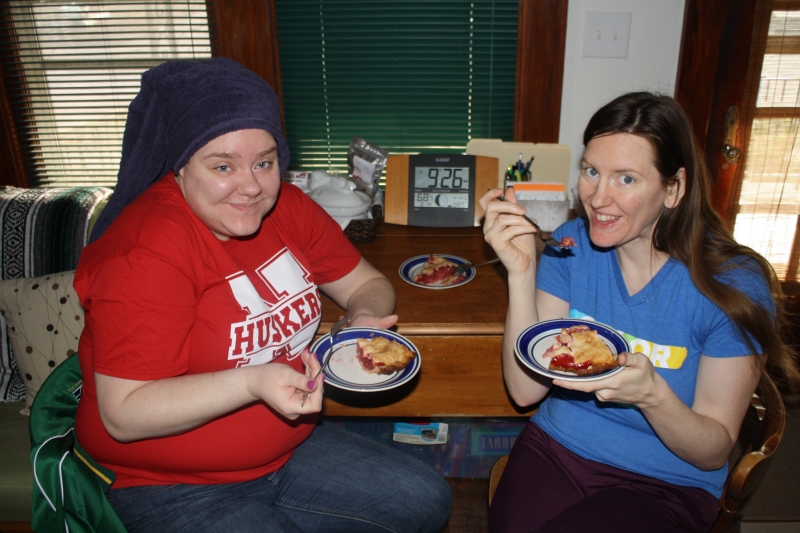
My birthday falls on Pi day every year – but this year is the Pi day to end all pi days, since it can be pi to the tenth significant digit (3/14/15 9:26:53). My sister will be in town and we intend to be eating pie at 9:26!


The Ideal Miss Trent

A frequent charge leveled against romance novels is that they make you discontent with the husband you’ve got by setting up a paragon of a hero.

This may well be true, but I think I’m just as likely (or more so) to fall in love with the heroines.

Take Miss Trent from Georgette Heyer’s The Nonesuch:

“She was always very simply attired; but she wore the inexpensive muslins and cambrics which she fashioned for herself with an air of elegance; and never had he seen her, even on the hottest day, presenting anything but a cool and uncrumpled appearance.”

She was a self-sufficient woman, becoming first a schoolteacher and then a private governess-companion rather than live beholden to her brother. She was, of course, accomplished in the female arts that make one suited for such a post – but above that, she had that certain something that made her universally respected.

The daughter of the house worshipped her as a heroine, yes – but she also won over the low-born mother who had been determined to keep the governess in her place:

“She had been too much delighted to regain possession of her niece to raise any objection to the proviso that Miss Trent must accompany Tiffany; but she had deeply resented it, and had privately resolved to make it plain to Miss Trent that however many Generals might be members of her family any attempt on her part to come the lady of Quality over them at Staples would be severely snubbed. But as Miss Trent, far from doing any such thing, treated her with a civil deference not usually accorded to her by her children Mrs. Underhill’s repressive haughtiness was abandoned within a week; and it was not long before she was telling her acquaintance that they wouldn’t believe what a comfort to her was the despised governess.”

What’s more, Miss Trent was so above-reproach that she even won the respect of the self-absorbed heiress under her care:

“Tiffany took an instant fancy to the new teacher, who was only eight years older than herself, and in whose clear gray eyes she was swift to detect a twinkle. It did not take her long to discover that however straitened her circumstances might be Ancilla came of a good family, and had been used to move in unquestionably genteel circles. She recognized, and was a little awed by, a certain elegance which owed nothing to Ancilla’s simple dresses; and bit by bit she began to lend an ear to such scraps of worldly advice as Ancilla let fall at seasonable moments.”

Miss Trent is just the sort of person I could wish to be: always elegant, always genteel, universally liked, and capable of saying and doing just the right things at the right times.

But, alas, I am myself. And while I can work to stay cool and uncrumpled even on the hottest days, can work towards being genteel without being haughty, can seek to live in such a way as to be above reproach – I am still myself. I sweat and stress, I can be common, I fail.

The important part is not that I be the ideal Miss Trent (which I am not), but that God be seen as Perfect (which He is.)


I don’t want to forget

Two years ago today was a momentous day – one I’ll never forget.

I say that, but the truth is, I’ve already started to forget so much about my wedding day. The sermon, the toasts, the greetings of friends. If I don’t have written record or pictorial proof, chances are I’ve already started to forget – with no way to reclaim those moments.

Which is why, here, on our second anniversary, I want to record the details I most don’t want to forget.

I don’t want to forget…

…the people

[singlepic id=844 w= h= float=none]

My girlfriends helping me dress, bustling on the other side of the hall to prepare a luncheon for the party. The surprising arrival of my brother and his pregnant wife and daughter. Skyping with my other brother, halfway around the world, before the day began. My family, doing what my family does best – making things happen. Extended family arriving in great swaths. People from church in Columbus, from church in Lincoln, from my childhood church. My teammates from the Jacksonville Summer Training Program. Charlotte, who knew us both when, telling me in the receiving line: “You and Daniel – if only I’d have thought of it sooner.”

[singlepic id=865 w= h= float=none]

All of them expressing their support, rejoicing in God’s provision, rooting for our marriage.

…the promises
I lightly adapted the text from The Book of Common Prayer for our order of service. I answered “I will” when our pastor asked me if I would “take Daniel to be your husband, to live with him in holy marriage according to the Word of God? Will you love him, comfort him, honor him, obey him, and keep him in sickness and in health and, forsaking all others, be wife to him as long as you both shall live?”

I promised God that day that I would be wife to Daniel. I promised to live with him in holy marriage, not a secular union. To love him, to comfort him, to honor him, to obey him.

[singlepic id=943 w= h= float=none]

I made a solemn vow before God and the congregation:

“I, Rebekah, take you, Daniel, to be my husband, to have and to hold from this day forward, for better, for worse, for richer, for poorer, in sickness and in health, to love and to cherish, until death do us part. To this, I pledge you my faithfulness.”

I want to remember those promises. I want to keep those promises.

…the Preeminence
It’s normal to have Scripture readings and songs at a wedding. It’s normal for these readings and songs to elevate love, to proclaim love’s worth, to delight in love.

And believe me, Daniel and I enjoy love.

[singlepic id=962 w= h= float=none]

But we wanted our wedding to elevate something else. But that’s not quite right either. We wanted our wedding to elevate someone else.

We chose Colossians 1:15-23 for a reading:

“He is the image of the invisible God, the firstborn of all creation. For by him all things were created, in heaven and on earth, visible and invisible, whether thrones or dominions or rulers or authorities—all things were created through him and for him. And he is before all things, and in him all things hold together. And he is the head of the body, the church. He is the beginning, the firstborn from the dead, that in everything he might be preeminent. For in him all the fullness of God was pleased to dwell, and through him to reconcile to himself all things, whether on earth or in heaven, making peace by the blood of his cross.

And you, who once were alienated and hostile in mind, doing evil deeds, he has now reconciled in his body of flesh by his death, in order to present you holy and blameless and above reproach before him, if indeed you continue in the faith, stable and steadfast, not shifting from the hope of the gospel that you heard, which has been proclaimed in all creation under heaven, and of which I, Paul, became a minister.”

We sang two congregational hymns – one looking backward at the faithfulness of God (“Great is Thy Faithfulness”), one looking forward, petitioning God to be before us (Be Thou My Vision).

[singlepic id=933 w= h= float=none]

Because we didn’t want our wedding prayer to be all about us. We didn’t want our marriage to be all about us. We wanted our marriage to be all about Christ.

I never want to forget that. I always want to live that. I want that day’s passion for Christ’s preeminence to be every day’s passion.


Don’t reassure me, root for me

My eight days of hospitalization prior to having Tirzah Mae were some of the longest days of my life.

So much of what I’d dreamed for in a birth experience was no longer an option. I couldn’t have a home birth. Couldn’t deliver at term. Couldn’t avoid monitors. Couldn’t labor with only my husband and my midwife to observe.

But I could still have a vaginal birth. I could still breastfeed.

I knew that I wanted those things. I made sure my caregivers knew I wanted those things.

Dr. Jensen knew that from the outset – I was one of the moms who seeks him out because he’s the rare type who is willing to care for women who make unconventional birth choices (choices like homebirth). He knew that I wanted normal birth – and only wanted to deviate from normal as absolutely necessary.

But the nurses and residents and even Dr. Wolfe (our excellent maternal-fetal specialist) needed me to tell them what I wanted. And so I did.

I don’t remember most of the reactions, most of the conversations I had with various health professionals regarding our desires – but I do remember two in particular.

One nurse, on hearing that I still wanted a vaginal birth, recounted the story of a young mom with preeclampsia who’d wanted the same thing.

“[The laboring woman’s] mom was really into the Bradley method – and, to be honest, I wasn’t sure at the beginning how into it the girl really was. I doubted she’d make it. But she labored hard and was a real trouper. She had to have the monitors and such but she was squatting and working at it – and she had her baby vaginally. It was one of the most beautiful things I’ve ever seen.”

A second nurse, when I told of my intentions to breastfeed, encouraged me that breastfeeding was wonderful for me and for baby. She told me that it could be hard work but that it was worth it. And she reassured me:

“And if you don’t make enough, it’s okay to supplement too.” She told her own story of struggling and needing to supplement.

As it turned out, I didn’t have a beautiful Bradley pre-eclamptic vaginal delivery. I was given a spinal block and covered in drapes, my abdomen and uterus were cut and my baby lifted out of my womb by gloved hands. It was far from the delivery I’d desired or the beautiful picture my nurse had painted. But I was so glad that nurse had told me her story. It gave me hope for a vaginal delivery, sure – for the vaginal delivery that didn’t happen. But more than that, it told me that she was rooting for me. She wanted me to achieve my desires. She wanted a beautiful delivery for me – and believed it was possible. And for that I am thankful.

Also as it turned out, I never had problems with breastmilk supply. Due in part to genetics and in part to supply-promoting practices, I had what one NICU nurse called “enough milk to feed Wichita”. So the second nurse’s reassurances ended up not being needed. Maybe that’s why I look on her reassurances with such distaste.

I knew then (and know now) what her intent was in providing that reassurance. Many mothers of preemies do have difficulties with supply – and it’s not the end of the world when a baby receives formula. Mothers who have done all they can and still can’t produce enough needn’t feel guilty that their child receives formula. This is true. But I didn’t want reassurances in case yet another something went wrong with my experience – I wanted someone to say that they were on my side, that they wanted for me and my baby what I wanted for me and my baby AND that they believed it was possible.

I didn’t want reassurances. I wanted someone to root for me.


I realize that when I recount stories like this, I might give you the impression that some of the nurses were bad nurses. The nurse who reassured me, the nurse who gave me a nipple shield (and yes, I recognize that cursing her is a sin – and have repented of that sin). Both were excellent nurses in many respects. I recount the difficult parts because those are the parts that I’ve had to struggle through – but these women also did and said many things that kept me from having to struggle through countless other difficulties. I am immensely thankful for these devoted nurses.


Cooking through Farmer Boy

When I first became obsessed with Laura Ingalls Wilder’s “Little House” books, Farmer Boy and The Long Winter were tied for first place in my affections.

The Long Winter appealed to my love for stories telling of survival in the midst of adversity. Farmer Boy appealed to my love for food.

Whose mouth does not water as they read the description of those stacked pancakes, piled high with butter and maple sugar? Who does not long to be beside Almanzo, silently eating the sizzling ham, the stewed pumpkin, the mashed potatoes and gravy? And the pie, oh that pie!

I dreamed of the pies, of the ice cream, of the pound cake and taffy. I delighted in the descriptions of the familiar and wished to try the unfamiliar – Rye’n’Injun bread, apples’n’onions, wintergreen berries. Oh, how I wanted to try those.

Knowing that Farmer Boy was the next book in my re-reading of the series for Barbara’s Laura Ingalls Wilder Reading Challenge, I determined to cook up some of those toothsome meals.

Now, neither Daniel nor I are 19th century farmers and our calorie needs are significantly less than those of the Wilder family. Furthermore, Laura’s descriptions of the meals are often regarded to be hyperbolic, reflecting more food than even a well-off family like the Wilders would have at a typical meal. So I didn’t at all feel bad about paring the meals down to a more manageable size for our purposes.

We had fried ham, stewed squash (in lieu of stewed pumpkin), and mashed parsnips for our first meals – and then I read through chapter 2 again and discovered that it was mashed turnips they had rather than parsnips. Oh well, the parsnips were good – and I was reminded how much I like them.

We made twisted doughnuts (using the recipe in The Little House Cookbook) with lots of powdered sugar on top – and I decided that I liked the twisted technique even if it didn’t flip itself like Mother Wilder’s did. I think I’d like to try the technique again, only with a yeast dough (I prefer raised doughnuts in general.)

With our friend Ruth, we made stacked pancakes (with maple syrup instead of maple sugar), sausage patties in gravy, and apple turnovers.

I used the leftover pastry from the apple turnovers to make a pumpkin-pecan pie, which we ate with more ham and fried potatoes and apples’n’onions. I decided that apples’n’onions are amazing and I should cook them all the time (except that my husband only moderately likes them, so I should just cook them occasionally.)

I made baked beans using Mother Wilder’s technique – take boiled beans (I used Great Northern Beans), add salt pork (I used fatty bits left on the bone I’d boiled the beans with) and onions and green peppers, pour scrolls of molasses over top and bake at a low temperature for a long time. Daniel’s not usually a big fan of baked beans, but he actually liked these fairly well, especially after adding a bit of garlic powder and cayenne pepper. I’ll be using this as a jumping-off point to try to come up with a recipe he’ll really like for everyday use. With the baked beans, I served rye’n’injun bread (made using the recipe in The Little House Cookbook). I really enjoyed the flavor of rye and cornmeal together, but the bread ended up dry and dense (probably because of long cooking time at low temperature and not quite enough steam in my oven.) The next time I make cornbread, I’m going to try using my regular recipe but substituting rye flour for the wheat flour to make a modern-day Rye’n’Injun bread.

Finally, after the month was over, I got around to making roast beef and mashed potatoes with pan gravy, boiled turnips, and boiled carrots. I know I’ve had turnips before, but I was pleasantly surprised at the horseradishy flavor they have, and resolved to find more to do with turnips.

All in all, I ended up making some of the more mundane recipes from the book, holding off on all the pies and cakes and ice cream and taffy. And I discovered just how delicious meat and potatoes can be (and how many vegetables I forget exist.) Mother Wilder didn’t have fresh greens all through the winter, didn’t even have canned green beans or fruits. She had apples, onions, potatoes, turnips, carrots, and squash – but she used them again and again throughout the winter to provide her family with surprisingly fruit and vegetable heavy meals. I’m encouraged that I can do the same, using these root vegetables to round out my usual go-to frozen vegetables or fresh salads.

In addition to cooking from Farmer Boy, I did actually read it – and made some comments on the chapter on Springtime.


Head over to the wrap-up post for Barbara’s challenge to see what others have been reading, and what they’ve said about it.


Heavy heart, wordless petitions

My heart is heavy.

A classmate of Daniel’s (an acquaintance of mine) from high school got married just a little after we did, pregnant just a little after we did.

Their daughter was born early last month, went home with her parents, was readmitted to the hospital not long after, where she fought for her life.

Their daughter lost that fight.

My heart is heavy as I snuggle my infant daughter close. We had a tough start, but I never feared for her life. I can’t even imagine what Daniel’s classmate must be going through.

So with heavy heart, I pray mostly wordless petitions, entreating God for this grieving family.


Where is the Heart of Darkness?

Is it deep in Africa, along the nineteenth century Congo River?

Is it in the bronze people who drum and dance among those shores?

Perhaps it is in the uncivilized world in general – in Britain before the Romans conquered it.

Or maybe it is confined to Mr. Kurtz, that overpowering voice whose dark heart accomplished terrors along the aforementioned Congo.

Joseph Conrad suggests all of the above in his influential story The Heart of Darkness.

Marlowe, our narrator, introduces the idea that darkness might be a place when he opens his story by reflecting on the Thames:

“And this also,” said Marlowe, “has been one of the dark places of the earth.”

Again and again, Marlowe describes the encroaching forests along the bank of the Congo as an impenetrable darkness.

This, then, is darkness – unexplored, uncivilized places. These dark places infect the souls of the men within, turning them savage as the bronze men and their Mr. Kurtz.

It’s an appealing thought, that darkness is external.

Darkness is a place, free of civilization. Spend too much time isolated from civilization and you too will become dark.

But Marlowe’s story belies this interpretation, suggests a whole nother one.

Darkness is inside Mr. Kurtz. It is his passions that are the heart of darkness – the Congo only served to release his evil passions from the society that constrained them.

“They only showed that Mr. Kurtz lacked restraint in the gratification of his various lusts, that there was something wanting in him – some small matter which, when the pressing need arose, could not be found under his magnificent eloquence. Whether he knew of this deficiency himself I can’t say. I think the knowledge came to him at last – only at the very last. But the wilderness had found him out early, and had taken on him a terrible vengeance for the fantastic invasion. I think it had whispered to him things about himself which he did not know, things of which he had no conception till he took counsel with this great solitude – and the whisper had proved irresistibly fascinating. It echoed loudly within him because he was hollow at the core.”

I like this interpretation, like to recoil in horror at the blackness of Kurtz’s soul, at the hollow core which enabled him to perform such evil as he did. I like to think him some kind of psychopath, with unusual lusts and lack of restraint.

But the thought niggles at my mind, burrows deep and will not be satisfied. For is not the heart of darkness in me?

I do not make those around me worship me, do not go to any length to obtain treasure, do not openly obsess over my reputation and fame. But that is only because I do not have Mr. Kurtz’s eloquence, his ability to convince anyone to my greatness. That is only because I am not unrestrained by society and culture as Mr. Kurtz was. My heart is just as lustful, just as hollow, just as absolutely dark.

This is what I must conclude from Joseph Conrad’s Heart of Darkness:

“The heart is deceitful above all things, and desperately sick; who can understand it?”
~Jeremiah 17:9 (ESV)

and

“Cursed is the man who trusts in man
and makes flesh his strength,
whose heart turns away from the Lord.”
~Jeremiah 17:5 (ESV)


Nightstand (February 2015)

We visited our parents over this past weekend – and while traveling is always exhausting, this particular visit seemed even more so (likely because Tirzah Mae seems to have gotten day and night confused again – or, more accurately, has decided to apply her daytime habit of eating every 1-2 hours to nighttime as well.) We spent yesterday breastfeeding (she literally spent no more than a 15 minute segment away from the breast until Daniel arrived home from work) – and thus NOT writing a Nightstand post. Ah, c’est la vie.

Fiction read this month:

  • The Night Circus by Erin Morgenstern
    A terribly gripping fantastical steam-powered novel. It drew me in and kept me through Tirzah Mae’s first round of lots-of-shots. Title is linked to my review.
  • Farmer Boy by Laura Ingalls Wilder
    Growing up, this was probably one of my favorite books in the series – probably because of the ever-present food. I’ve been reading with Barbara’s Laura Ingalls Wilder Reading Challenge and cooking Farmer Boy inspired meals. Yum! I also wrote some reflections from the chapter on springtime
  • 11 picture books author last name BRETT-BROMLEY

Nonfiction read this month:

  • The American Bar Association Guide to Wills and Estates
    When Tirzah Mae arrived early, we suddenly realized all sorts of things we hadn’t gotten in order before she was born – stuff like, what happens to her if we were to have some sort of unfortunate accident? I checked a couple dozen books on estate planning out of the library, but The American Bar Association Guide to Wills and Estates was the one that I ended up reading cover to cover (with the exception of a few clearly nonapplicable chapters.) This book does a great job of guiding the reader through wills, trusts, and other forms of inheritance – including planning for any number of “what ifs”. I definitely recommend this as a resource for those who are beginning the process of writing or updating their will.
  • Urban Farming an “At*Issue” book
    Supposed to be multiple perspectives on this fascinating topic – turned out to be an extended infomercial for urban farming. Title is linked to my review.
  • The Mechanical Baby by Daniel Beekman
    A history of childrearing practices from the middle ages through the 1970s (when the book was written. Fascinating.
  • The Post-Pregnancy Handbook by Sylvia Brown and Mary Dowd Struck
    Theoretically, a great idea for a book. Very poor execution makes me unable to recommend it. Title is linked to my review.
  • Budget Dinners by Good Housekeeping
    This book announces that it “includes delicious meals under $10” – I’m not sure how well it succeeds at keeping costs below $10, since I didn’t really count up the cost and I generally am a relatively frugal cook anyway. But it delivered on deliciousness. I flagged over a dozen of the 100 recipes as ones to try and tried at least a half dozen. Of the recipes we tried, there were a couple we didn’t prefer (as much because I misestimated Daniel’s preferences as anything), but most were very good and worth adding to our repertoire. This is an excellent book with full color photos and easy-to-prepare meals. I recommend it.

On the docket for next month:

Don’t forget to drop by 5 Minutes 4 Books to see what others are reading this month!

What's on Your Nightstand?